Introduction
Data lineage refers to the lifecycle of data as it moves from its point of origin through various transformations and processes to its final destination in a report or application. In plain English, it is the “family tree” of your data. It provides a visual and technical map of how data was captured, who modified it, and where it currently resides. In the enterprise landscape, data lineage has evolved from a “nice-to-have” documentation task into a mission-critical component of the modern data stack, primarily due to the increasing complexity of multi-cloud environments and decentralized data meshes.
Without clear lineage, organizations struggle with “data debt”—a state where the source of a metric is unknown, leading to distrust in analytics and potential compliance failures. In a world where AI models are only as good as the data they are trained on, knowing the exact provenance of information is the only way to ensure model reliability and ethical AI practices.
Real-World Use Cases:
- Regulatory Compliance: Meeting GDPR, CCPA, or BCBS 239 requirements by proving where sensitive data is stored and how it is protected.
- Impact Analysis: Before changing a column in a database, engineers use lineage to see which downstream dashboards or ML models will break.
- Root Cause Analysis: When a CEO sees a wrong number on a dashboard, data teams trace the lineage back to find exactly where the pipeline failed.
- Data Migration: Moving legacy on-premise data to cloud platforms like Snowflake or Databricks by mapping existing dependencies.
- FinOps & Cost Optimization: Identifying “zombie” data pipelines that consume resources but provide no value to end-user reports.
Evaluation Criteria for Buyers:
- Automation Depth: Does the tool automatically parse SQL, ETL code, and BI tools, or is manual entry required?
- Granularity: Can it track data at the table level, column level, or even the cell level?
- Integrations: Does it connect natively to your specific stack (e.g., dbt, Airflow, Snowflake, Tableau)?
- User Experience: Is the visualization intuitive for business users, or is it strictly for data engineers?
- Search & Discovery: How easily can a user find a specific data asset within the lineage map?
- Metadata Extraction: Does it capture technical, operational, and business metadata simultaneously?
- Scalability: Can it handle millions of metadata objects without performance degradation?
- Alerting & Observability: Does it notify users when a lineage break occurs in real-time?
- Security & Privacy: Does it provide RBAC and mask sensitive information within the lineage view?
- Extensibility: Does it offer a robust API or support open standards like OpenLineage?
Best for: Data engineers, Chief Data Officers (CDOs), compliance officers, and analytics managers at mid-to-large scale enterprises managing complex, heterogeneous data environments.
Not ideal for: Small startups with a single database and one dashboard, where manual documentation is still feasible, or teams that do not prioritize data governance.
Key Trends in Data Lineage Software
- AI-Generated Metadata Descriptions: Tools now use Large Language Models (LLMs) to automatically write descriptions for tables and columns based on their lineage and usage patterns.
- Data Contracts Integration: Lineage is increasingly used to enforce “Data Contracts,” where downstream consumers are automatically alerted if an upstream producer plans a schema change.
- Active Metadata Management: Moving from static maps to “active” systems that use lineage to automatically trigger data quality checks or security masking.
- Real-Time Streaming Lineage: As Kafka and Flink become standard, tools are now tracking data movement in sub-second increments rather than daily batch updates.
- The Rise of OpenLineage: A standard API is emerging, allowing different tools to share lineage metadata, preventing vendor lock-in.
- Semantic Layer Alignment: Lineage tools are integrating with semantic layers to show how technical data columns map to business concepts like “Annual Recurring Revenue.”
- Governance at the Edge: Tracking data that never hits a central warehouse, including data moving between microservices and edge devices.
- Automated PII Discovery: Using lineage to trace the flow of personally identifiable information (PII) from ingest to archive, ensuring “Right to be Forgotten” requests are fully honored.
How We Selected These Tools (Methodology)
To select the top 10 data lineage tools for this guide, we followed a strict evaluation methodology based on current industry benchmarks:
- Market Adoption & Mindshare: We prioritized tools that are widely recognized in enterprise RFP processes and have high user community activity.
- Parsing Sophistication: We looked for tools that can natively parse complex SQL dialects and legacy code (COBOL, etc.) without manual assistance.
- Enterprise Security Posture: Only tools with robust access controls and documented security protocols were considered.
- Ecosystem Interoperability: Priority was given to tools that support the “Modern Data Stack” (dbt, Snowflake, Fivetran) as well as legacy systems.
- Observability Signals: We evaluated how well these tools integrate data quality metrics directly into the lineage view.
- Future-Proofing: Tools that have demonstrated 2026-ready features like AI-assisted mapping and OpenLineage support were ranked higher.
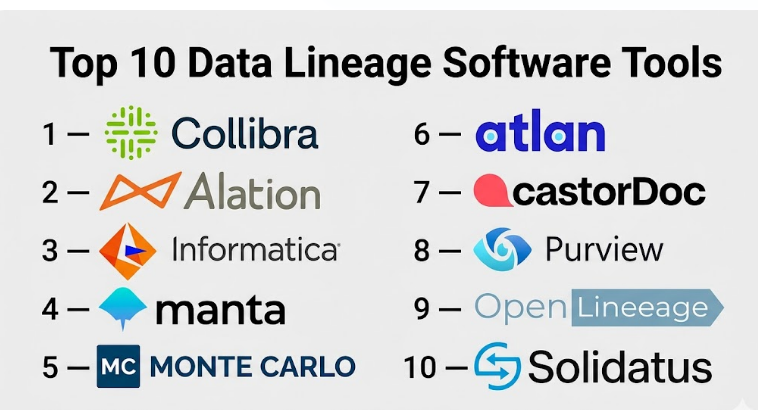
Top 10 Data Lineage Software Tools
#1 — Collibra
Short description: A premier enterprise data governance platform that provides a “Data Intelligence Cloud.” It is designed for large organizations that need to bridge the gap between technical data engineering and business strategy.
Key Features
- Collibra Lineage (formerly OwlDQ): Automatically extracts metadata and creates visual maps from hundreds of sources.
- Technical & Business Lineage: Provides separate views for engineers (SQL level) and business users (process level).
- Automated SQL Parsing: Analyzes complex SQL scripts to map transformations across heterogeneous databases.
- Edge Processing: Allows metadata to be processed locally to comply with strict data residency laws.
- Integrated Data Catalog: Lineage is directly tied to a searchable catalog and business glossary.
- Policy Enforcement: Automatically applies governance policies based on where data resides in the lineage.
Pros
- Most robust governance framework for highly regulated industries like banking and healthcare.
- Excellent cross-functional collaboration features for data stewards and business owners.
Cons
- Implementation can be long and requires significant professional services.
- Expensive pricing makes it inaccessible for smaller organizations.
Platforms / Deployment
- Web / Windows / macOS
- Cloud / Hybrid
Security & Compliance
- SSO/SAML, MFA, RBAC, Encryption at rest and in transit.
- SOC 2 Type II, ISO 27001, GDPR, HIPAA.
Integrations & Ecosystem
Collibra has one of the widest integration networks in the enterprise space.
- Snowflake, Databricks, AWS, Azure, Google Cloud
- Tableau, Power BI, Looker
- Informatica, dbt, Airflow
Support & Community
Extensive documentation, “Collibra University” for certification, and 24/7 enterprise support tiers.
#2 — Alation
Short description: Widely recognized as the pioneer of the modern data catalog, Alation uses “Behavioral Metadata” to provide context and lineage for data assets.
Key Features
- Automated Lineage Generation: Automatically creates lineage maps by parsing query logs and transformation code.
- Data Health Flags: Displays quality warnings (e.g., “stale data”) directly on the lineage nodes.
- Query Log Analysis: Uses actual user behavior to determine which data paths are the most important.
- Open Connector Framework: Allows developers to build custom lineage connectors for proprietary legacy systems.
- Impact Analysis Reports: One-click reports to see who will be affected by a schema change.
- Trust Check: Enables data stewards to endorse or warn against specific data paths within the lineage.
Pros
- High user adoption due to a clean, “Amazon-like” search and discovery experience.
- Strong focus on building a “data culture” rather than just providing technical maps.
Cons
- Lineage for very complex, multi-layered ETL can sometimes require manual fine-tuning.
- Pricing scales quickly based on the number of data sources.
Platforms / Deployment
- Web
- Cloud / Self-hosted / Hybrid
Security & Compliance
- SSO/SAML, MFA, RBAC, Data masking.
- SOC 2, ISO 27001.
Integrations & Ecosystem
Alation integrates deeply with the modern cloud warehouse ecosystem.
- Snowflake, Databricks, BigQuery
- dbt, Fivetran, Matillion
- Salesforce, Slack
Support & Community
Active user community (“Alation Brave”), robust knowledge base, and tiered support options.
#3 — Informatica Enterprise Data Catalog (EDC)
Short description: A powerhouse in the data management space, Informatica EDC provides AI-powered metadata discovery and lineage across massive enterprise data estates.
Key Features
- CLAIRE AI Engine: Uses machine learning to automatically discover data assets and infer lineage.
- End-to-End Lineage: Tracks data from legacy mainframes all the way to modern BI dashboards.
- Data Similarity Discovery: Identifies duplicate or similar data paths to help consolidate redundant pipelines.
- Detailed Transformation Logic: Shows the exact logic (joins, filters, expressions) used at every step.
- System-Level Lineage: Maps relationships between entire systems, not just tables.
- Custom Metadata Loader: A robust tool for importing metadata from niche or custom-built applications.
Pros
- Unrivaled ability to handle “legacy debt” and complex on-premise environments.
- Part of a broader suite (Informatica IDMC) that handles ETL, Quality, and MDM.
Cons
- The interface can feel heavy and “enterprise-traditional” compared to newer SaaS competitors.
- Significant training is required to utilize the full depth of the tool.
Platforms / Deployment
- Web / Windows
- Cloud / Self-hosted / Hybrid
Security & Compliance
- Enterprise-grade RBAC, SSO, LDAP integration, MFA.
- SOC 2, ISO 27001, HIPAA, GDPR.
Integrations & Ecosystem
Deep native integrations within the Informatica ecosystem and all major cloud providers.
- Oracle, SAP, IBM DB2, Microsoft SQL Server
- AWS, Azure, Google Cloud
- Power BI, MicroStrategy
Support & Community
Comprehensive support via Informatica Global Customer Support and a vast network of certified partners.
#4 — Manta
Short description: A specialized data lineage platform that focuses on “deep lineage.” Manta is often used to solve the most difficult technical parsing challenges in the industry.
Key Features
- Scanner-First Approach: High-precision scanners for SQL dialects, ETL tools, and BI platforms.
- Time-Travel Lineage: Allows users to see how the lineage looked at any point in the past.
- Historical Comparison: Side-by-side comparison of lineage maps to track architectural changes.
- Code-Level Analysis: Parses stored procedures and complex scripts to reveal hidden data flows.
- Lineage API: A “headless” lineage capability that allows lineage to be embedded in other apps.
- Impact Analysis: Visualizes the “blast radius” of planned changes with high technical accuracy.
Pros
- Considered the “gold standard” for technical depth; it finds lineage that other tools miss.
- Excellent for migration projects where understanding every code dependency is vital.
Cons
- Focus is primarily technical; may require an additional catalog tool for business-friendly views.
- The visualization can become extremely cluttered for very large systems.
Platforms / Deployment
- Web
- Cloud / Self-hosted
Security & Compliance
- SSO/SAML, RBAC, MFA.
- Not publicly stated.
Integrations & Ecosystem
Manta often functions as a “lineage engine” that feeds data into catalogs like Collibra or Alation.
- IBM InfoSphere, Talend, Informatica
- Snowflake, Teradata, Oracle
- Collibra, Alation (Bi-directional)
Support & Community
Highly specialized technical support and a detailed developer portal.
#5 — Monte Carlo
Short description: The leader in “Data Observability,” Monte Carlo uses lineage as a foundation to detect, resolve, and prevent “data downtime.”
Key Features
- Automated Lineage Extraction: Zero-configuration lineage that builds itself by analyzing query logs.
- Incident Management: Ties data quality alerts directly to the affected downstream lineage nodes.
- Field-Level Lineage: Tracks individual column movements to pinpoint precisely where a data issue began.
- Query Execution Health: Overlays performance metrics (e.g., duration, volume) onto the lineage map.
- Slack/Teams Integration: Sends lineage-aware alerts to engineering teams when a pipeline breaks.
- Data Volume Analysis: Monitors how data size changes as it moves through the lineage.
Pros
- Best-in-class for “DataOps” teams who care about pipeline reliability.
- Extremely fast “time-to-value”—often set up in less than an hour.
Cons
- Focused more on “observability” than “governance”; lacks deep policy management.
- Pricing is based on the number of tables monitored, which can be expensive for high-volume environments.
Platforms / Deployment
- Web
- Cloud (SaaS)
Security & Compliance
- SOC 2 Type II, SSO/SAML, MFA, RBAC.
- GDPR, HIPAA.
Integrations & Ecosystem
Native integrations with the modern data stack.
- Snowflake, Databricks, BigQuery, Redshift
- dbt, Airflow, Prefect, Dagster
- Looker, Tableau, Power BI
Support & Community
Responsive customer success teams and an active community of “Data Reliability” practitioners.
#6 — Atlan
Short description: A modern data collaboration and governance platform designed to feel like “GitHub for data.” It is built for teams that prioritize agility and automation.
Key Features
- Plug-and-Play Lineage: Connects to modern warehouses and BI tools to build lineage in minutes.
- Column-Level Impact Analysis: Shows precisely which dashboard components will break if a column is renamed.
- Visual SQL Parser: Provides a human-readable visualization of complex SQL transformations.
- Metadata Propogation: Automatically pushes descriptions and tags downstream through the lineage.
- Atlan Insights: Allows users to query the metadata itself using a built-in SQL editor.
- OpenLineage Support: Fully compatible with open metadata standards for cross-tool visibility.
Pros
- Highly modern, sleek UI that non-technical users actually enjoy using.
- Great pricing transparency and “SaaS-first” agility.
Cons
- Less focus on legacy on-premise systems (e.g., mainframe or older SAP versions).
- Still maturing some of its advanced “Active Governance” features.
Platforms / Deployment
- Web
- Cloud (SaaS)
Security & Compliance
- SOC 2 Type II, ISO 27001, HIPAA, GDPR.
- SSO/SAML, MFA, Fine-grained RBAC.
Integrations & Ecosystem
Deeply optimized for the “Snowflake/Databricks + dbt” ecosystem.
- Snowflake, Databricks, Google BigQuery
- dbt (Native Cloud & Core support)
- Airflow, GitHub, Slack
Support & Community
Extensive “Atlan University” and a very high-touch customer success model.
#7 — CastorDoc
Short description: An AI-first data catalog and lineage tool that focuses on automating the documentation of the data stack for decentralized teams.
Key Features
- AI-Powered Auto-Documentation: Uses LLMs to generate lineage context and column descriptions.
- Popularity Scores: Ranks data assets within the lineage to show which ones are most reliable.
- One-Click Impact Analysis: Simple, actionable views for engineers before they ship code changes.
- Natural Language Search: Allows users to ask questions like “Where does the revenue metric come from?”
- Contextual Lineage: Overlays ownership and usage data onto the technical map.
- Automated Tagging: Propagates PII tags downstream through the lineage automatically.
Pros
- Extremely lightweight and fast; designed for modern, high-growth tech companies.
- Strong focus on making data understandable for the “Average Joe” in the company.
Cons
- May lack the heavy-duty “Data Quality” solvers found in Monte Carlo or Collibra.
- Limited support for specialized legacy enterprise applications.
Platforms / Deployment
- Web
- Cloud (SaaS)
Security & Compliance
- SOC 2 Type II, GDPR, SSO/SAML.
- Not publicly stated.
Integrations & Ecosystem
Optimized for the modern cloud stack.
- Snowflake, BigQuery, Redshift
- dbt, Fivetran, Airbyte
- Tableau, Looker, Metabase
Support & Community
Rapidly growing community and highly responsive SaaS support.
#8 — Microsoft Purview
Short description: A unified data governance solution that helps manage and govern your on-premises, multi-cloud, and SaaS data, specifically within the Microsoft ecosystem.
Key Features
- Unified Map: Connects Azure data assets, Microsoft 365, and multi-cloud sources.
- Automatic Scanning: Classifies data (e.g., Credit Card Numbers) and maps lineage automatically.
- Azure Data Factory Integration: Deep native lineage for all ADF-based ETL pipelines.
- Sensitivity Labels: Maps how sensitivity labels (e.g., “Highly Confidential”) flow through the organization.
- Glossary-to-Lineage Mapping: Links business terms directly to the technical data assets.
- Data Sharing Lineage: Tracks data as it is shared across different organizations or business units.
Pros
- The natural choice for organizations already committed to the Azure and Microsoft 365 stack.
- Extremely competitive pricing for Azure customers.
Cons
- Lineage capabilities for non-Microsoft sources (e.g., AWS, GCP) are less mature.
- The UI can be fragmented across different Azure management portals.
Platforms / Deployment
- Web / Azure Portal
- Cloud (Azure)
Security & Compliance
- Microsoft Entra ID (formerly Azure AD), SSO, MFA.
- Full suite of Microsoft’s global certifications (ISO, SOC, FedRAMP).
Integrations & Ecosystem
Native to Microsoft, but expanding into multi-cloud.
- Azure SQL, Synapse, Power BI
- Teradata, SAP, Oracle
- AWS S3 (Basic support)
Support & Community
Standard Microsoft Azure support tiers and an immense global network of consultants.
#9 — OpenLineage
Short description: An open-source standard for data lineage collection and analysis. It is not a standalone “product” but a framework used to build lineage-aware data ecosystems.
Key Features
- Universal Standard: Provides a consistent JSON schema for lineage events.
- Airflow Integration: Automatically captures lineage from Airflow tasks as they execute.
- Spark Support: Collects lineage from Spark jobs without requiring manual code changes.
- Marquez Reference Implementation: An open-source metadata repository for storing OpenLineage events.
- Extensible API: Allows any tool to become “OpenLineage-compliant.”
- Real-Time Collection: Captures lineage events as they happen, not after the fact.
Pros
- Prevents vendor lock-in; your lineage data remains portable and standardized.
- Completely free and community-driven.
Cons
- Requires significant engineering effort to set up, manage, and visualize.
- Lacks the “out-of-the-box” BI and legacy connectors of paid platforms.
Platforms / Deployment
- Linux / Docker / Kubernetes
- Self-hosted / Cloud-agnostic
Security & Compliance
- Dependent on the implementation (e.g., Marquez or the backend database used).
Integrations & Ecosystem
Supported by a growing number of commercial and open-source tools.
- Apache Airflow, Spark, Flink
- dbt, Great Expectations
- Atlan, Manta (Consumption support)
Support & Community
Thriving open-source community on GitHub and Slack.
#10 — Solidatus
Short description: A metadata management and data lineage platform that focuses on “graph-based” visual modeling for complex organizational change.
Key Features
- Graph-Native Visualization: High-performance visualization that handles massive complexity without slowing down.
- Regulatory Reporting: Specifically designed to build lineage for financial regulations like BCBS 239.
- Temporal Lineage: Tracks how data architecture has evolved over years, not just days.
- Business Process Mapping: Connects technical lineage to the actual business processes they support.
- What-If Analysis: Allows users to model the impact of future changes in a sandbox environment.
- API-First Design: Everything in the tool is accessible and manageable via a robust API.
Pros
- Exceptional for high-stakes modeling in banking, insurance, and defense.
- Extremely flexible; can model almost any relationship, not just database tables.
Cons
- More manual “modeling” focus compared to the “auto-scanning” focus of tools like Atlan.
- Can be intimidating for users who aren’t familiar with graph theory or complex modeling.
Platforms / Deployment
- Web
- Cloud / Self-hosted
Security & Compliance
- Enterprise-grade RBAC, SSO/SAML, MFA.
- Not publicly stated.
Integrations & Ecosystem
Built to integrate with enterprise IT management and governance stacks.
- Collibra, Alation
- ServiceNow, Jira
- Informatica, Manta
Support & Community
Direct professional support and a growing network of specialized consulting partners.
Comparison Table (Top 10)
| Tool Name | Best For | Platform(s) Supported | Deployment | Standout Feature | Public Rating |
| Collibra | Large Enterprise Governance | Web, Windows, macOS | Hybrid | Policy Enforcement | 4.4 / 5 |
| Alation | Collaborative Data Culture | Web | Hybrid | Behavioral Metadata | 4.5 / 5 |
| Informatica EDC | Complex Legacy Environments | Web, Windows | Hybrid | CLAIRE AI Engine | 4.2 / 5 |
| Manta | Deep Technical Parsing | Web | Self-hosted | Time-Travel Lineage | N/A |
| Monte Carlo | Data Observability & Reliability | Web | Cloud (SaaS) | Data Downtime Alerts | 4.8 / 5 |
| Atlan | Modern Data Teams | Web | Cloud (SaaS) | Metadata Propagation | 4.7 / 5 |
| CastorDoc | AI-First Documentation | Web | Cloud (SaaS) | AI Auto-Documentation | N/A |
| Microsoft Purview | Azure-Centric Organizations | Azure Portal | Cloud (Azure) | Sensitivity Labeling | 4.1 / 5 |
| OpenLineage | Open Standard / Custom Build | Linux, Kubernetes | Self-hosted | Vendor-Agnostic | N/A |
| Solidatus | Visual Modeling / Finance | Web | Hybrid | Graph-Native Visuals | N/A |
Evaluation & Scoring of Data Lineage Tools
The following table provides a weighted score based on key 2026 criteria. These scores are comparative across the top 10 list.
| Tool Name | Core (25%) | Ease (15%) | Integrations (15%) | Security (10%) | Performance (10%) | Support (10%) | Value (15%) | Weighted Total |
| Collibra | 10 | 4 | 9 | 10 | 8 | 9 | 5 | 8.15 |
| Alation | 9 | 7 | 9 | 9 | 8 | 8 | 6 | 8.05 |
| Informatica | 10 | 3 | 10 | 10 | 7 | 9 | 4 | 7.70 |
| Manta | 10 | 4 | 8 | 7 | 9 | 8 | 6 | 7.75 |
| Monte Carlo | 8 | 9 | 10 | 9 | 9 | 9 | 7 | 8.55 |
| Atlan | 8 | 10 | 9 | 9 | 9 | 9 | 8 | 8.70 |
| CastorDoc | 7 | 10 | 8 | 8 | 9 | 8 | 9 | 8.20 |
| Purview | 7 | 6 | 7 | 10 | 8 | 9 | 10 | 7.60 |
| OpenLineage | 6 | 2 | 8 | 5 | 10 | 4 | 10 | 6.15 |
| Solidatus | 9 | 5 | 8 | 8 | 10 | 8 | 6 | 7.80 |
How to Interpret These Scores:
- Atlan and CastorDoc lead in “Ease of Use,” making them ideal for rapid team adoption.
- Collibra and Informatica represent the “Core Feature” heavyweights, suitable for high-compliance needs.
- OpenLineage has the lowest ease/support scores because it is a technical framework, but it offers the highest “Value” for custom-build projects.
- Weighted Total: This score reflects a balance for a typical 2026 modern enterprise.
Which Data Lineage Software Tool Is Right for You?
Solo / SMB
Small teams often lack the bandwidth for heavy governance. CastorDoc or Atlan are recommended here because they offer the fastest “Time-to-Discovery” with minimal configuration. If you are on a tight budget, implementing OpenLineage with a basic UI (like Marquez) can provide value without licensing costs.
Mid-Market
For companies scaling their data operations, Monte Carlo is an excellent choice to ensure data reliability while building out lineage. If the focus is on collaboration and search, Alation provides the best balance of features and user experience.
Enterprise
Large organizations with significant legacy footprints should look at Informatica EDC or Manta. If the organization is heavily regulated (Banking, Healthcare), Collibra is the industry standard for ensuring policy compliance along the data chain.
Cloud-Specific
- Azure: Stick with Microsoft Purview for the best integration with Azure Data Factory and Synapse.
- AWS/GCP/Multi-Cloud: Atlan or Collibra provide a better multi-cloud abstraction layer.
Budget vs Premium
- Budget: OpenLineage (Free), Microsoft Purview (Consumption-based).
- Premium: Collibra, Informatica, Solidatus.
Feature Depth vs Ease of Use
- Technical Depth: Manta, Informatica, Houdini (N/A), Solidatus.
- Ease of Use: Atlan, CastorDoc, Alation.
Integrations & Scalability
- Best Integrations: Collibra, Informatica.
- Best Scalability: Monte Carlo, Atlan.
Security & Compliance Needs
Organizations needing SOC 2, HIPAA, and GDPR auditing at every step of the lineage should prioritize Collibra, Atlan, or Microsoft Purview.
Frequently Asked Questions (FAQs)
1. What is the difference between data lineage and data cataloging?
A data catalog is a repository that organizes data assets (like a library catalog). Data lineage is a subset of cataloging that specifically tracks the relationships and movement of that data between assets (like a family tree).
2. How much time does it take to implement a data lineage tool?
Modern SaaS tools like Atlan or Monte Carlo can show basic lineage in 1–2 hours. Enterprise on-premise solutions like Informatica EDC can take 3–6 months for a full, multi-system rollout.
3. Can I build data lineage manually?
Yes, using Excel or diagrams, but it is not recommended for environments with more than 10 tables. Manual lineage becomes obsolete the moment a developer changes a single line of SQL code.
4. What are the common security risks with lineage tools?
The tool itself needs access to your query logs and metadata. Ensuring the tool has SOC 2 compliance and supports your internal SSO/RBAC is critical to prevent metadata leaks.
5. Does data lineage track actual data or just metadata?
Most professional tools only track “metadata” (the names of tables, columns, and transformation logic). They do not move or store your actual customer data, which reduces security risks.
6. Why is column-level lineage more important than table-level?
Table-level lineage tells you “System A talks to System B.” Column-level lineage tells you “The ‘Revenue’ column in the dashboard comes from the ‘Gross_Sales’ column in the database minus ‘Discounts’.” It is necessary for true impact analysis.
7. How does OpenLineage help my organization?
OpenLineage provides a standard way for your tools (like Airflow and Spark) to “speak” to your governance tools. This means you can switch lineage providers in the future without losing your historical data flow.
8. What is “impact analysis” in the context of lineage?
Impact analysis is the ability to see the “blast radius” of a change. If you delete a column in your data warehouse, lineage shows you exactly which 5 reports and 2 ML models will stop working.
9. Can lineage tools handle non-SQL data sources?
Yes, but the quality varies. Advanced tools like Manta or Informatica can parse COBOL, Java, or custom scripts, while lighter SaaS tools might only support standard SQL dialects.
10. Is data lineage required for GDPR compliance?
While GDPR doesn’t explicitly use the words “data lineage,” it requires you to prove you know where customer data is, how it is used, and to delete it upon request. Lineage is the only practical way to fulfill these requirements at scale.
Conclusion
Data lineage is the “map” that makes the “territory” of your data usable and trustworthy. In as data ecosystems become increasingly decentralized, the ability to trace information back to its source is the primary differentiator between data-driven and data-confused organizations.When choosing a tool, avoid the trap of looking for the “most features.” Instead, look for the tool that fits your team’s workflow—whether that is the automated observability of Monte Carlo, the governance rigor of Collibra, or the agile collaboration of Atlan. Start with a single high-value use case, such as “Dashboard Trust” or “Compliance Reporting,” and build your lineage maturity from there.

Find Trusted Cardiac Hospitals
Compare heart hospitals by city and services — all in one place.
Explore Hospitals
Data lineage tools are most valuable when they help organizations track how data moves, changes, and is used across systems throughout its lifecycle. By providing end-to-end lineage mapping, source-to-target tracing, data flow visualization, impact analysis, transformation tracking, metadata management, dependency discovery, governance support, compliance reporting, and integration with data warehouses, ETL pipelines, BI platforms, and data catalogs, these tools enable organizations to improve data transparency, understand downstream impacts, troubleshoot data issues faster, strengthen governance, and build greater trust in enterprise data.