Introduction
Data Masking & Tokenization Tools are software solutions designed to protect sensitive data by substituting real values with fictitious but realistic equivalents (masking) or replacing them with surrogate tokens (tokenization). In simple terms, masking hides sensitive characters ( credit card digits), while tokenization replaces the original data with a unique token that cannot be reverse‑engineered without a secure mapping. These tools are foundational for modern data security programs, privacy regulations, and secure analytics. data privacy expectations and compliance mandates have intensified globally. Organizations are storing and processing ever‑larger volumes of personal, financial, and regulated data often across hybrid environments. At the same time, AI and analytics platforms demand large training datasets that may include sensitive fields. Rather than restrict access, data masking and tokenization tools allow safe data utilization without exposing real data to risks or breaches.
Real‑world use cases include:
- Protecting customer personally identifiable information (PII) in development and test environments.
- Tokenizing payment card information in e‑commerce systems to reduce scope of audit.
- Masking sensitive fields in analytics platforms so BI teams can work with data safely.
- Protecting health data before feeding it into machine learning models to preserve patient privacy.
- Supporting compliance with GDPR, CCPA, PCI DSS, HIPAA, and other privacy frameworks.
What buyers should evaluate:
- Types of masking supported (static, dynamic, on‑the‑fly).
- Tokenization schemes and how they map to original data.
- Integration with databases, ETL/ELT pipelines, and applications.
- Scalability and performance for large datasets.
- Security controls (encryption, RBAC, audit logs).
- Policy definition and automation capabilities.
- Support for structured and unstructured data.
- Compliance reporting and audit readiness.
- Deployment models (cloud, on‑prem, hybrid).
- Support and documentation quality.
Best for: Data security teams, privacy officers, compliance and risk management leaders, IT architects, and developers in mid‑market to enterprise organizations with regulated data.
Not ideal for: Very small teams or applications with minimal sensitive data, where simpler database‑built‑in protections or manual controls may be sufficient.
Key Trends in Data Masking & Tokenization Tools
- AI‑Driven Detection & Masking: Tools are starting to use machine learning to identify sensitive content automatically rather than relying solely on static rules.
- Real‑Time, On‑the‑Fly Masking: Rather than masking copies of data, modern systems deliver masked results dynamically based on user context or role.
- Cloud Native Masking Pipelines: As data warehouses and lakes migrate to the cloud, masking/tokenization tools are embedding natively into cloud ETL/ELT workflows.
- Hybrid Deployment Models: Support for both cloud and on‑premises requirements to satisfy data residency and regulatory constraints.
- Integration with MLOps Pipelines: Ensuring that masked data flows seamlessly into analytics and AI training without exposing original values.
- Policy‑Driven Automation: Central policy definition engines that enforce masking/tokenization uniformly across systems.
- Multi‑Format Support: Expanding beyond structured SQL databases to include semi‑structured (JSON, XML) and unstructured text.
- Dynamic Tokenization: Tokens that change based on context or session to strengthen security.
- Standardized Compliance Reporting: Built‑in templates aligned with global privacy laws to help audits.
- Low‑Code/No‑Code Interfaces: Enabling data stewards and privacy professionals to define masking policies without code.
How We Selected These Tools (Methodology)
- Market Adoption & Recognition: Tools used by significant enterprises or recommended by industry analysts.
- Feature Completeness: Masking types (static, dynamic), tokenization schemes, multi‑format support.
- Scalability & Performance: Capable of processing large datasets with acceptable latency.
- Security Posture: Encryption, role‑based access control (RBAC), audit trails, and governance features.
- Integrations & Ecosystem: Connectivity with databases, cloud platforms, data warehouses, and applications.
- Compliance Support: Built‑in capabilities for GDPR, PCI DSS, HIPAA, and similar regimes.
- Deployment Flexibility: Cloud, on‑prem, hybrid support.
- Customer Fit Across Segments: Tools suitable for SMB, mid‑market, and enterprise usage.
- Ease of Use & Documentation: Usability and quality of documentation.
- Support & Community: Availability of vendor support, professional services, or active user communities.
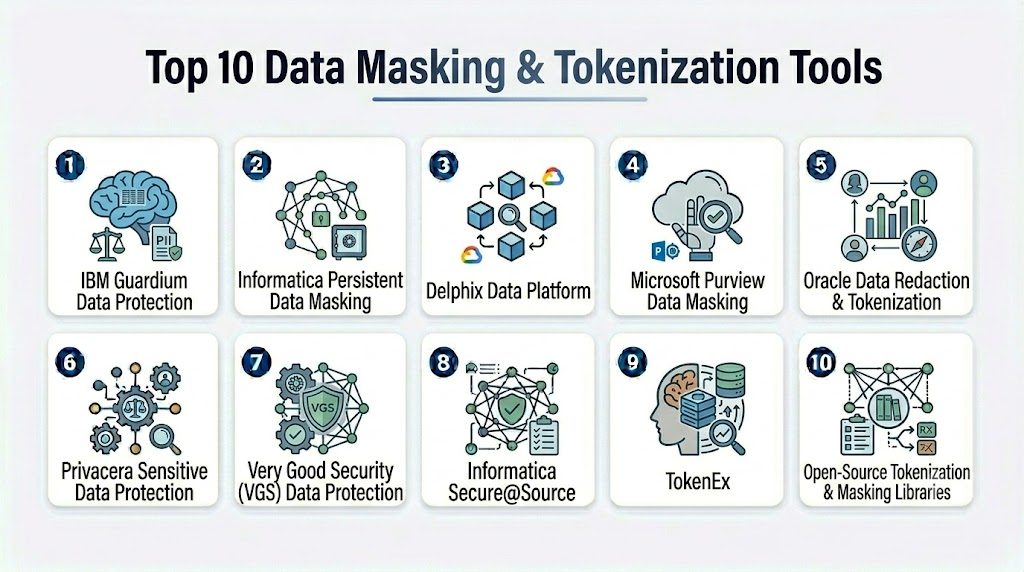
Top 10 Data Masking & Tokenization Tools
1- IBM Guardium Data Protection
Short description: An enterprise‑grade data protection platform that includes comprehensive masking, tokenization, and monitoring capabilities.
Key Features
- Static and dynamic data masking
- Enterprise tokenization support
- Real‑time activity monitoring
- Policy engine for masking rules
- Integration with major databases and applications
- Audit logging and compliance reporting
Pros
- Robust enterprise governance features
- Strong integration with IBM ecosystem and major databases
Cons
- High complexity may require specialized skills
- Premium pricing for large deployments
Platforms / Deployment
- Web / Linux / Windows
- Cloud / On‑Prem / Hybrid
Security & Compliance
- RBAC, audit logs
- Not publicly stated: Specific certifications
Integrations & Ecosystem
IBM Guardium integrates deeply with:
- Relational databases
- Data warehouses
- Enterprise applications
- SIEM systems
Support & Community
- Enterprise support tiers
- Extensive documentation and knowledge base
2- Informatica Persistent Data Masking
Short description: A well‑established masking and tokenization solution, often part of Informatica’s broader data management suite.
Key Features
- Static and dynamic data masking
- Multiple tokenization techniques
- Fine‑grained role‑based policy controls
- Integration with ETL pipelines
- Masking templates for common use cases
- Audit and compliance reports
Pros
- Strong data integration capabilities
- Mature support from a recognized vendor
Cons
- Can be complex to configure in heterogeneous environments
- Pricing may suit larger enterprises better
Platforms / Deployment
- Web / Linux / Windows
- Cloud / On‑Prem / Hybrid
Security & Compliance
- Not publicly stated
Integrations & Ecosystem
- Big data platforms
- Cloud data warehouses
- Data integration pipelines
Support & Community
- Comprehensive documentation
- Support tiers and professional services
3- Delphix Data Platform
Short description: Delphix provides data virtualization and masking/tokenization services that support secure test data management and analytics workflows.
Key Features
- Virtualized data masking
- Test data management
- Tokenization support
- Policy automation
- Snapshot and version control
- Integration with CI/CD pipelines
Pros
- Streamlines secure data delivery for dev/test environments
- Supports automated workflows
Cons
- May require architectural investment
- Advanced features can be complex
Platforms / Deployment
- Web / Linux / Windows
- Cloud / On‑Prem / Hybrid
Security & Compliance
- Not publicly stated
Integrations & Ecosystem
- CI/CD tools
- Databases and warehouses
- Virtual data services
Support & Community
- Vendor support
- Documentation
4- Microsoft Purview Data Masking
Short description: A part of Microsoft’s governance suite, offering data masking and tokenization capabilities integrated with Azure and Microsoft data services.
Key Features
- Policy‑driven data masking
- Integration with Azure SQL and data services
- Dynamic masking rules
- RBAC integration with identity providers
- Audit logging for masked data access
- Compliance tracking
Pros
- Seamless for Microsoft environments
- Strong compliance feature set
Cons
- Best suited for Azure‑centric organizations
- May be less flexible outside Microsoft ecosystems
Platforms / Deployment
- Web / Cloud
Security & Compliance
- Inherits Microsoft security standards
- Not publicly stated: Specific certifications
Integrations & Ecosystem
- Azure SQL and analytics services
- Microsoft identity frameworks
- Logging and analytics systems
Support & Community
- Microsoft enterprise support
- Extensive documentation
5- Oracle Data Redaction & Tokenization
Short description: Oracle’s built‑in data protection suite, integrated with Oracle databases, offering masking, redaction, and tokenization capabilities.
Key Features
- Static and dynamic redaction
- Tokenization for sensitive fields
- Database‑level controls
- Policy enforcement at runtime
- Audit trails and logs
- Integration with database security features
Pros
- Strong for Oracle database environments
- Database‑native performance
Cons
- Limited outside Oracle platforms
- Complex configuration
Platforms / Deployment
- Web / Linux / Windows
- On‑Prem / Hybrid
Security & Compliance
- Not publicly stated
Integrations & Ecosystem
- Oracle databases
- Enterprise security platforms
Support & Community
- Oracle support plans
- Documentation
6- Privacera Sensitive Data Protection
Short description: A platform focused on fine‑grained access control and data masking/tokenization across hybrid data stores and cloud warehouses.
Key Features
- Dynamic and static masking
- Tokenization support
- Policy engine for sensitive data
- Data classification and tagging
- Unified governance dashboard
- Audit trails with access logs
Pros
- Central governance across cloud and on‑prem
- Good for hybrid data strategies
Cons
- Relatively newer than established legacy suites
- Feature maturity varies by connector
Platforms / Deployment
- Web / Cloud / Hybrid
Security & Compliance
- Not publicly stated
Integrations & Ecosystem
- Cloud data warehouses
- BI platforms
- Data lakes and marts
Support & Community
- Vendor support
- Documentation
7- Very Good Security (VGS) Data Protection
Short description: A proxy‑based data protection platform that tokenizes sensitive data at the gateway, removing exposure from backend systems.
Key Features
- Proxy‑level tokenization
- PCI‑friendly data handling
- Vaultless token storage
- Real‑time token mapping
- Developer SDKs
- Monitoring and alerting
Pros
- Minimal impact on backend systems
- Strong for payment and transaction data
Cons
- Requires application integration changes
- Not a full standalone masking suite
Platforms / Deployment
- Cloud
Security & Compliance
- Not publicly stated
Integrations & Ecosystem
- SDKs for API integration
- Logging systems
Support & Community
- Developer resources
- Support tiers
8- Informatica Secure@Source
Short description: A data security and governance offering that includes sensitive data discovery, classification, and masking/tokenization capabilities.
Key Features
- Sensitive data discovery
- Masking and tokenization
- Policy automation
- Risk scoring and dashboards
- Compliance reporting
- Integration with governance workflows
Pros
- Combines discovery with protection
- Analytics‑driven risk insights
Cons
- Enterprise focused and larger footprint
- Complexity for smaller teams
Platforms / Deployment
- Web / Cloud / On‑Prem
Security & Compliance
- Not publicly stated
Integrations & Ecosystem
- Governance ecosystems
- Data catalogs
- Analytics tools
Support & Community
- Professional support
- Documentation
9- TokenEx
Short description: A cloud‑native tokenization service that securely tokenizes sensitive data with flexible tokens and mapping controls.
Key Features
- Tokenization for structured data
- Supports multiple token types
- Secure key management
- Configurable token formats
- Integration APIs
- Token lifecycle auditing
Pros
- Easy API‑based integration
- Flexible token formats
Cons
- Focused on tokenization (less deep masking features)
- Requires developer integration
Platforms / Deployment
- Cloud
Security & Compliance
- Not publicly stated
Integrations & Ecosystem
- API connectors
- Logging systems
Support & Community
- Support plans
- Documentation
10- Open‑Source Tokenization & Masking Libraries
Short description: Community‑driven libraries and frameworks used to build custom masking/tokenization solutions within applications.
Key Features
- Developer‑centric libraries
- Customizable patterns and rules
- Integration into pipelines
- Support for common languages
- No vendor lock‑in
- Community contributions
Pros
- Cost‑effective
- Highly customizable
Cons
- Engineering effort required
- Support varies by project
Platforms / Deployment
- Linux / Windows / Cloud / Self‑Hosted
Security & Compliance
- Varies / Not publicly stated
Integrations & Ecosystem
- Integrates with CI/CD
- Works with dev frameworks
Support & Community
- Community‑driven
- Documentation varies
Comparison Table (Top 10)
| Tool Name | Best For | Platform(s) Supported | Deployment | Standout Feature | Public Rating |
|---|---|---|---|---|---|
| IBM Guardium Data Protection | Enterprise governance | Web / Linux / Windows | Cloud / On‑Prem / Hybrid | Enterprise masking + tokenization | N/A |
| Informatica Persistent Data Masking | Broad integration | Web / Linux / Windows | Cloud / On‑Prem / Hybrid | Data integration maturity | N/A |
| Delphix Data Platform | Data virtualization | Web / Linux / Windows | Cloud / On‑Prem / Hybrid | Virtualized masked data | N/A |
| Microsoft Purview Data Masking | Microsoft environments | Web / Cloud | Cloud | Azure integration & dynamic masking | N/A |
| Oracle Data Redaction & Tokenization | Oracle DB users | Web / Linux / Windows | On‑Prem / Hybrid | Database native redaction | N/A |
| Privacera Sensitive Data Protection | Hybrid governance | Web / Cloud / Hybrid | Cloud / Hybrid | Unified hybrid governance | N/A |
| Very Good Security (VGS) Data Protection | API & payment use | Cloud | Cloud | Proxy tokenization | N/A |
| Informatica Secure@Source | Governance + protection | Web / Cloud / On‑Prem | Cloud / On‑Prem / Hybrid | Sensitive data discovery + masking | N/A |
| TokenEx | Cloud tokenization | Cloud | Cloud | Flexible token formats | N/A |
| Open‑Source Libraries | Custom solutions | Linux / Windows / Cloud | Self‑Hosted / Cloud | Highly customizable | N/A |
Evaluation & Scoring of Data Masking & Tokenization Tools
| Tool | Core Features | Ease | Integrations | Security | Performance | Support | Value | Weighted Total |
|---|---|---|---|---|---|---|---|---|
| IBM Guardium Data Protection | 9 | 7 | 8 | 8 | 8 | 7 | 7 | 8.1 |
| Informatica Persistent Data Masking | 8 | 7 | 8 | 7 | 8 | 7 | 6 | 7.6 |
| Delphix Data Platform | 8 | 7 | 7 | 7 | 7 | 6 | 7 | 7.3 |
| Microsoft Purview Data Masking | 8 | 7 | 7 | 8 | 8 | 7 | 6 | 7.6 |
| Oracle Data Redaction & Tokenization | 7 | 6 | 6 | 7 | 7 | 6 | 6 | 6.6 |
| Privacera Sensitive Data Protection | 8 | 6 | 7 | 7 | 7 | 7 | 6 | 7.1 |
| Very Good Security (VGS) Data Protection | 7 | 7 | 6 | 8 | 8 | 6 | 7 | 7.2 |
| Informatica Secure@Source | 8 | 6 | 7 | 7 | 7 | 7 | 6 | 7.1 |
| TokenEx | 7 | 8 | 6 | 7 | 7 | 6 | 8 | 7.1 |
| Open‑Source Libraries | 6 | 5 | 6 | 6 | 7 | 5 | 9 | 6.8 |
Which Data Masking & Tokenization Tool Is Right for You?
Solo / Freelancer
Open‑Source Libraries or TokenEx provide flexible, low‑cost options for custom projects or small workloads.
SMB
Tools like Very Good Security (VGS) Data Protection and Privacera Sensitive Data Protection balance capability with manageability for growing teams.
Mid‑Market
Microsoft Purview Data Masking and Informatica Persistent Data Masking offer solid enterprise‑grade features without the overhead of the biggest suites.
Enterprise
IBM Guardium Data Protection, Informatica Secure@Source, and Delphix Data Platform deliver comprehensive masking/tokenization and governance at scale.
Budget vs Premium
Open‑source and cloud‑native platforms can reduce cost; full suites with deep integration and policy automation are premium investments.
Feature Depth vs Ease of Use
Enterprise tools excel in depth but require expertise; cloud‑native and API‑first tools provide faster adoption curves.
Integrations & Scalability
Evaluate whether connectors to your data warehouse, ETL tools, and applications exist natively to reduce integration time.
Security & Compliance Needs
If strict compliance reporting is required, prefer tools with audit trails, role‑based controls, and compliance dashboards.
Frequently Asked Questions (FAQs)
1- What pricing models are offered for these tools?
Pricing varies widely: subscription tiers, usage‑based billing, enterprise licensing, or open‑source free models with optional support.
2- How long does implementation take?
Simple cloud masking may take days; full enterprise governance with policy automation can take weeks.
3- Can these tools mask unstructured text?
Some modern tools support both structured and unstructured data; verify before evaluation.
4- What’s the difference between masking and tokenization?
Masking hides parts of data; tokenization replaces data with secure tokens that require a mapping service.
5- Are these tools compliant with regulations?
Most align with frameworks (PCI DSS, GDPR, HIPAA), but organizational practices and audit validity still matter.
6- Do these tools integrate with DevOps and CI/CD?
Many support API access and pipeline integration for automated testing and provisioning.
7- Is dynamic masking slower than static?
Dynamic masking can introduce processing overhead, but modern tools optimize for performance.
8- Can data be unmasked?
Tokenization systems with secure vaults permit controlled unmasking; masking generally cannot be reversed.
9- What deployment options exist?
Cloud, on‑prem, and hybrid deployments are common depending on vendor and compliance requirements.
10- Should I mask data before analytics?
Yes ,masked data allows BI and analysis without exposing sensitive attributes.
Conclusion
Data Masking & Tokenization Tools are essential for modern data security strategies, safeguarding sensitive information while enabling data utilization. Organizations should evaluate tools based on integration breadth, compliance needs, deployment flexibility, and operational maturity. From cloud‑native tokenization services to enterprise governance suites, the right choice depends on your regulatory context, data landscape, and organizational maturity.

Find Trusted Cardiac Hospitals
Compare heart hospitals by city and services — all in one place.
Explore Hospitals
A key consideration often overlooked is how data masking and tokenization strategies affect downstream analytics and application compatibility. Organizations should also plan for governance, key management, and ongoing compliance requirements to avoid hidden operational challenges.