Introduction
Personally Identifiable Information (PII) Detection & Redaction Tools are specialized solutions that identify, classify, and mask or remove sensitive personal data from documents, databases, logs, and other sources. In plain English, these tools help organizations spot things like names, addresses, social security numbers, credit card information, and other identifiable data and then automatically hide or remove it to protect privacy and comply with regulations. as data volumes grow exponentially and regulatory scrutiny increases across regions (GDPR, CCPA, India’s DPDP Act, HIPAA, etc.), automated PII detection and redaction have moved from nice to have to mission‑critical. Manual review of data at scale is impractical, error‑prone, and risky. Modern tools leverage advanced pattern matching and increasingly AI/ML‑driven contextual detection to catch nuanced PII that simple regex tools miss. They integrate with data pipelines, content workflows, chat systems, and document repositories to ensure sensitive data is never inadvertently exposed.
Real‑world use cases include:
- Automatically redacting PII in legal documents, contracts, and court filings.
- Scrubbing customer service chat logs before storing or sharing for analysis.
- Removing sensitive data from large datasets used for ML/AI training.
- Detecting and masking PII in database records prior to partner data exchange.
- Ensuring regulatory compliance in healthcare, finance, HR, and government records.
What buyers should evaluate:
- Accuracy of detection (false positives/negatives).
- Contextual understanding (beyond simple pattern matching).
- Redaction flexibility (masking, encryption, tokenization).
- Integration with enterprise systems and workflows.
- Deployment options (cloud, on‑prem, hybrid).
- Scalability for high‑volume data.
- Audit trails and compliance reporting.
- Performance and latency for real‑time use cases.
- Security features (RBAC, encryption, logging).
- Support and documentation quality.
Best for: Security and compliance teams, data governance officers, IT managers, developers building privacy‑aware applications, and organizations handling regulated or sensitive data at scale.
Not ideal for: Small teams with minimal data privacy needs or occasional redaction requirements where manual review or lightweight scripting may suffice.
Key Trends in PII Detection & Redaction Tools
- AI/ML‑Driven Detection: Moving beyond regex to context‑aware models that understand semantics and catch subtle PII patterns.
- Multi‑Modal PII Detection: Increasing support for text, images, audio, and video content to identify PII across formats.
- Integration with Data Lakes & Data Meshes: Tools increasingly plug into modern data architectures to enforce privacy at scale.
- Real‑Time Detection: Inline scanning, streaming data redaction, and API‑based hooking for live systems like chatbots and messaging apps.
- Regulatory Alignment: Built‑in templates and workflows for GDPR, CCPA, HIPAA, and emerging global privacy regimes.
- Explainability: Transparency in detection logic and audit trails to satisfy compliance auditors.
- Low‑Code/No‑Code Interfaces: Easier policy definition and rule customization for non‑technical business users.
- Edge and On‑Device Redaction: PII detection at the edge for mobile or client‑side applications to reduce data leakage risk.
- Hybrid Deployment Models: More choices for cloud, on‑prem, and air‑gapped deployment based on risk and compliance needs.
- PII Lifecycle Management: Tools increasingly integrate with classification, retention, and data governance platforms.
How We Selected These Tools (Methodology)
Our selection reflects a balanced view of tools that are credible, widely adopted, feature‑rich, and applicable across segments:
- Market Adoption / Mindshare: Recognized usage or presence in enterprise environments and privacy projects.
- Feature Completeness: Depth of PII detection, redaction options, contextual analysis, and extensibility.
- Reliability & Performance: Tools that scale reliably and handle high‑volume text and unstructured data.
- Security Posture: Presence of RBAC, encryption, audit trails, and enterprise governance features.
- Integrations & Ecosystem: Compatibility with popular data repositories, workflows, and applications.
- Customer Fit Across Segments: Suitability for SMBs through large enterprises.
- Innovation & Future Readiness: Use of modern AI/ML techniques and support for emerging use cases.
- Support & Documentation: Strong resources to enable adoption and troubleshooting.
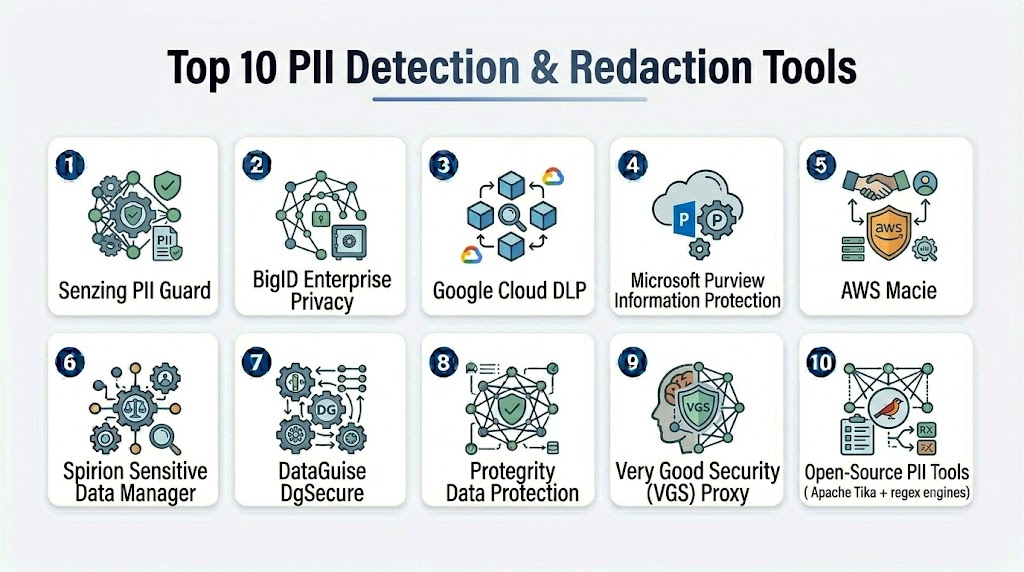
Top 10 PII Detection & Redaction Tools
1- Senzing PII Guard
Short description: A PII detection and redaction platform that uses pattern recognition and configurable rules to identify sensitive data across structured and unstructured sources.
Key Features
- Multi‑source PII scanning (text, documents, databases)
- Configurable detection rules and patterns
- Automated redaction and masking options
- Audit trail and compliance logging
- Integration connectors for common data platforms
- Batch and real‑time scanning modes
Pros
- Flexible rule system for industry needs
- Supports both structured and unstructured content
Cons
- May require tuning for domain‑specific detection
- Advanced deployment can be complex
Platforms / Deployment
- Web / Linux / Windows
- Cloud / On‑Prem / Hybrid
Security & Compliance
- Audit logs and role‑based access
- Not publicly stated: specific certifications
Integrations & Ecosystem
Senzing PII Guard connects to data warehouses and content repositories.
- API integration
- Database connectors
- Document store integration
Support & Community
- Professional support options
- Documentation and setup guides
2- BigID Enterprise Privacy
Short description: Enterprise privacy and data intelligence platform with strong PII discovery and redaction capabilities designed for large deployments.
Key Features
- Deep discovery across data stores
- Contextual PII classification
- Automated redaction pipelines
- Data lineage and mapping
- Policy enforcement workflows
- Audit and compliance reporting
Pros
- Strong enterprise governance and visibility
- Context‑aware classification reduces false positives
Cons
- Enterprise cost structure
- Onboarding can be intensive
Platforms / Deployment
- Web
- Cloud / On‑Prem
Security & Compliance
- Not publicly stated
Integrations & Ecosystem
Rich connectors to enterprise data platforms.
- Data lake and warehouse connectors
- BI tool integration
- Policy management integrations
Support & Community
- Dedicated enterprise support
- Training resources
3- Google Cloud DLP
Short description: Google Cloud Data Loss Prevention (DLP) provides scalable PII detection and redaction for datasets and streaming data on Google Cloud.
Key Features
- Pattern and entity‑based PII detection
- Contextual analysis
- Data masking and tokenization
- Streaming and batch support
- Pre‑defined detectors for global PII types
- Audit and usage logs
Pros
- Highly scalable on cloud infrastructure
- Broad PII detector coverage
Cons
- Best suited to organizations on Google Cloud
- May be overkill for small use cases
Platforms / Deployment
- Cloud
Security & Compliance
- Inherits Google Cloud security standards
- Not publicly stated: specific certifications
Integrations & Ecosystem
Seamless with cloud native services.
- Cloud storage
- Pub/Sub and data processing tools
- Logging and monitoring dashboards
Support & Community
- Google Cloud support
- Thematic documentation
4- Microsoft Purview Information Protection
Short description: Microsoft’s unified data governance tool that includes PII detection and automated redaction as part of broader information protection.
Key Features
- Sensitive data identification
- Policy‑driven data classification
- Auto redaction and encryption
- Integration with Office 365 and data stores
- Role‑based access controls
- Compliance and audit dashboards
Pros
- Tight integration with Microsoft ecosystem
- Good for organizations already standardized on Microsoft tools
Cons
- Complexity for non‑Microsoft environments
- Learning curve can be steep
Platforms / Deployment
- Web / Cloud
Security & Compliance
- Enterprise‑grade access controls
- Not publicly stated: specific certifications
Integrations & Ecosystem
Deep Microsoft integrations.
- Office apps
- SharePoint, Teams
- Azure data platforms
Support & Community
- Microsoft enterprise support
- Extensive docs
5- AWS Macie
Short description: Amazon Macie detects PII and sensitive data across S3 and other AWS data stores, with built‑in redaction and alerting capabilities.
Key Features
- Automated PII discovery
- Machine learning‑driven classification
- Sensitive data dashboards
- Alert workflows
- Data access pattern analysis
- Integration with AWS Security services
Pros
- Strong for AWS‑centric workloads
- Alerts tied to cloud security posture
Cons
- Reliant on AWS ecosystem
- Cost scales with data volume
Platforms / Deployment
- Cloud
Security & Compliance
- Inherits AWS IAM and encryption
- Not publicly stated: specific certifications
Integrations & Ecosystem
Works with AWS services.
- S3, Glue, Athena
- Security alerts
- Logging tools
Support & Community
- AWS support tiers
- Documentation
6- Spirion Sensitive Data Manager
Short description: Provides discovery and protection of sensitive and PII data across endpoints, servers, and cloud repositories.
Key Features
- PII and sensitive data discovery
- Pattern‑based and rule‑based detection
- Redaction and masking workflows
- Endpoint and server scanning
- Policy definition and enforcement
- Reporting and dashboards
Pros
- Broad coverage across sources
- Rich policy management
Cons
- Deployment complexity for enterprise scale
- GUI may be dated
Platforms / Deployment
- Windows / Linux / Cloud / On‑Prem
Security & Compliance
- Not publicly stated
Integrations & Ecosystem
Supports connectors to varied repositories.
- File servers
- Cloud storage
- Database scanning
Support & Community
- Documentation
- Support plans
7- DataGuise DgSecure
Short description: Enterprise solution for PII detection, classification, and redaction designed for large data estates.
Key Features
- Deep dataset scanning
- Data classification and tagging
- Safe data publishing controls
- Redaction and tokenization
- Policy orchestration
- Compliance dashboards
Pros
- Powerful for structured data environments
- Centralized governance
Cons
- Enterprise focus means higher cost
- Setup can be involved
Platforms / Deployment
- Web / Cloud / On‑Prem
Security & Compliance
- Not publicly stated
Integrations & Ecosystem
- Connectors for DBs and BI tools
- Data governance ecosystem
- Policy integrations
Support & Community
- Professional support
- Training
8- Protegrity Data Protection
Short description: Comprehensive data protection platform emphasizing PII discovery, classification, and risk‑aware redaction.
Key Features
- PII and sensitive data detection
- Business context classification
- Adaptive tokenization and masking
- Usage analytics
- Policy and compliance workflows
- Reporting and dashboards
Pros
- Strong analytics and context awareness
- Fits complex enterprise requirements
Cons
- Higher investment threshold
- Implementation time
Platforms / Deployment
- Cloud / On‑Prem / Hybrid
Security & Compliance
- Not publicly stated
Integrations & Ecosystem
- Enterprise connectors
- Policy management tools
- Workflow systems
Support & Community
- Support tiers
- Documentation
9- Very Good Security (VGS) Proxy
Short description: VGS acts as a security proxy that intercepts and redacts PII in transit, protecting applications without storing sensitive data.
Key Features
- Intercept and redact PII in API traffic
- Tokenization
- Vaultless sensitive data handling
- Compliance‑friendly architecture
- Developer‑friendly SDKs
- Real‑time monitoring
Pros
- Real‑time protection without storing data
- Excellent for modern apps and APIs
Cons
- Developer integration work required
- Not a full data governance suite
Platforms / Deployment
- Cloud
Security & Compliance
- Not publicly stated
Integrations & Ecosystem
- SDKs for major languages
- API gateways
- Logging and monitoring
Support & Community
- Developer resources
- Support plans
10- Open‑Source PII Tools (Apache Tika + Regex Engines)
Short description: Combinations of open‑source engines and libraries used to build customizable PII detection and redaction pipelines.
Key Features
- Highly customizable
- Can be integrated into pipelines
- Uses pluggable detectors
- Supports basic redaction scripting
- Open definitions
- Community contributions
Pros
- Cost‑effective
- No vendor lock‑in
Cons
- Requires engineering effort
- Varies in accuracy
Platforms / Deployment
- Linux / Windows / Cloud / Self‑hosted
Security & Compliance
- Varies / N/A
Integrations & Ecosystem
- Works with data pipelines
- Custom connectors
- Community extensions
Support & Community
- Community‑driven
- Documentation varies
Comparison Table (Top 10)
| Tool Name | Best For | Platforms | Deployment | Standout Feature | Public Rating |
|---|---|---|---|---|---|
| Senzing PII Guard | Broad enterprise | Web / Linux / Windows | Cloud / On‑Prem / Hybrid | Flexible detection rules | N/A |
| BigID Enterprise Privacy | Large deployments | Web | Cloud / On‑Prem | Deep PII discovery + governance | N/A |
| Google Cloud DLP | Cloud‑native | Cloud | Cloud | Scalable cloud detection | N/A |
| Microsoft Purview | Microsoft ecosystem | Web | Cloud | Unified data governance | N/A |
| AWS Macie | AWS workloads | Cloud | Cloud | AWS integrated alerts | N/A |
| Spirion Sensitive Data Manager | Endpoints + repositories | Windows / Linux | Cloud / On‑Prem | Multi‑source scanning | N/A |
| DataGuise DgSecure | Structured data | Web | Cloud / On‑Prem | Enterprise dataset control | N/A |
| Protegrity Data Protection | Complex enterprises | Cloud / On‑Prem | Hybrid | Adaptive masking/tokenization | N/A |
| VGS Proxy | API traffic | Cloud | Cloud | Vaultless PII interception | N/A |
| Open‑Source PII Tools | Custom workflows | Varies | Self‑hosted / Cloud | Fully customizable | N/A |
Evaluation & Scoring of PII Detection & Redaction Tools
| Tool | Core (25%) | Ease (15%) | Integrations (15%) | Security (10%) | Performance (10%) | Support (10%) | Value (15%) | Weighted Total |
|---|---|---|---|---|---|---|---|---|
| Senzing PII Guard | 8 | 7 | 7 | 7 | 7 | 6 | 8 | 7.5 |
| BigID Enterprise Privacy | 9 | 6 | 8 | 7 | 8 | 7 | 6 | 7.7 |
| Google Cloud DLP | 8 | 7 | 8 | 7 | 9 | 7 | 7 | 8.0 |
| Microsoft Purview | 8 | 6 | 7 | 7 | 8 | 7 | 6 | 7.5 |
| AWS Macie | 8 | 7 | 7 | 7 | 8 | 7 | 7 | 7.7 |
| Spirion Sensitive Data Manager | 7 | 6 | 6 | 6 | 7 | 6 | 7 | 6.7 |
| DataGuise DgSecure | 8 | 6 | 7 | 7 | 8 | 7 | 6 | 7.3 |
| Protegrity Data Protection | 9 | 6 | 8 | 7 | 8 | 7 | 6 | 7.7 |
| VGS Proxy | 7 | 7 | 6 | 7 | 8 | 6 | 8 | 7.3 |
| Open‑Source PII Tools | 6 | 5 | 6 | 6 | 6 | 5 | 9 | 6.6 |
Which PII Detection & Redaction Tool Is Right for You?
Solo / Freelancer
Consider open‑source combos or cloud‑native tools (e.g., Google Cloud DLP) for affordable, scalable detection with minimal setup.
SMB
Tools like Senzing PII Guard and AWS Macie offer balance between capability and cost for mid‑range usage patterns.
Mid‑Market
Solutions such as Microsoft Purview and DataGuise DgSecure offer governance and integration with enterprise data sources without the largest enterprise price tags.
Enterprise
BigID Enterprise Privacy, Protegrity Data Protection, and hybrid deployments bring the governance, analytics, and policy orchestration required at scale.
Budget vs Premium
Open‑source or native cloud options can reduce costs; full suites with analytics and policy orchestration are premium.
Feature Depth vs Ease of Use
Cloud‑native services excel in ease; enterprise suites shine in depth and governance visibility.
Integrations & Scalability
Choose tools with strong connectors to your data ecosystem, especially if working with big data, analytics, or multi‑cloud environments.
Security & Compliance Needs
Tools with robust audit logging, role‑based controls, and compliance reporting are essential for regulated industries.
Frequently Asked Questions (FAQs)
1- What pricing models are common for PII tools?
Pricing can include subscription tiers, usage‑based billing, seat‑based licensing, or enterprise contracts. Many tools offer enterprise pricing on request.
2- How long does implementation take?
Simple cloud tools can be onboarded in days; enterprise deployments with connectors and governance workflows may take weeks or months.
3- Can these tools detect PII in images or audio?
Some modern tools support multi‑modal detection (images, audio), but capabilities vary — always evaluate based on your formats.
4- Do regex‑based tools suffice?
Regex can catch simple patterns but often misses contextual or obfuscated PII. AI/ML‑driven tools improve accuracy and reduce false positives.
5- Can PII detection slow down workflows?
Inline detection adds processing, but modern tools optimize for performance. Real‑time use cases may require tuning.
6- Are these tools compliant with regulations?
Tools often support compliance reporting but don’t guarantee compliance — organizational practices and policies still matter.
7- How often should detection models be updated?
Regularly update rules and models to reflect new data types, formats, and evolving PII patterns.
8- Can these tools be integrated into CI/CD or data pipelines?
Yes — many provide APIs or connectors for automated scanning in pipelines and workflows.
9- Do tools support cloud and on‑prem environments?
Many offer hybrid deployment options to meet enterprise flexibility and compliance needs.
10- What’s the difference between detection and redaction?
Detection finds sensitive data; redaction removes, masks, or tokenizes it according to policy.
Conclusion
PII Detection & Redaction Tools are critical components of modern data governance and security strategies. Whether you’re protecting customer data, ensuring regulatory compliance, or preparing data for analytics and AI workloads, these tools help automate what would otherwise be expensive, error‑prone manual processes. From cloud‑native services to enterprise governance platforms and customizable open‑source options, there’s a range of solutions for every context. To move forward: shortlist 2–3 tools based on your priorities (cloud compatibility, enterprise governance, real‑time capabilities), run pilot tests on representative datasets, validate performance and accuracy, and ensure integration into your broader privacy and security framework.

Find Trusted Cardiac Hospitals
Compare heart hospitals by city and services — all in one place.
Explore Hospitals
One challenge that deserves more attention is balancing redaction accuracy with false positives, especially in large-scale environments. Organizations should also consider audit trails, model updates, and integration with existing data governance processes for long-term reliability.