Introduction
eBPF Observability & Runtime Security Tools help organizations monitor, troubleshoot, and secure modern cloud-native infrastructure directly at the Linux kernel level. eBPF, short for Extended Berkeley Packet Filter, allows developers and security teams to safely run programs inside the operating system kernel without modifying kernel source code. These tools provide deep visibility into Kubernetes clusters, containers, networking, APIs, workloads, and runtime behavior with minimal performance overhead. As enterprises continue adopting Kubernetes, microservices, edge computing, and distributed cloud-native architectures, traditional monitoring and runtime security approaches are struggling to keep pace. eBPF-based platforms have become increasingly important because they deliver real-time observability, low-level telemetry, threat detection, and runtime enforcement without relying heavily on intrusive agents.
Real-World Use Cases
- Kubernetes Runtime Monitoring: Platform engineering teams use eBPF tools to monitor containers, pods, namespaces, and Kubernetes networking activity in real time. This helps improve troubleshooting, workload visibility, and operational reliability across dynamic cloud-native environments.
- Cloud-Native Threat Detection: Security teams deploy eBPF runtime security platforms to identify suspicious process behavior, unauthorized privilege escalation, malicious network connections, and container escape attempts before they impact production systems.
- Application Performance Observability: DevOps teams use eBPF observability tools to trace application latency, API bottlenecks, and service dependencies without requiring extensive code instrumentation. This improves troubleshooting efficiency in microservices architectures.
- Network Traffic Analysis: Enterprises use eBPF-powered networking tools to monitor east-west traffic, DNS requests, service communication patterns, and API interactions inside Kubernetes clusters and hybrid-cloud environments.
- Compliance and Runtime Governance: Organizations operating in regulated industries use runtime security monitoring and audit visibility to improve compliance reporting and strengthen workload governance across production environments.
- Zero-Trust Cloud Infrastructure Security: Security teams combine eBPF runtime telemetry with policy enforcement engines to establish granular workload visibility and continuous runtime verification across distributed cloud-native infrastructure.
Evaluation Criteria for Buyers
- Runtime security capabilities
- Kubernetes and container visibility
- Performance overhead
- Threat detection quality
- Networking observability support
- Cloud-native integration flexibility
- Scalability and telemetry handling
- Security policy enforcement
- Developer and API ecosystem
- Enterprise governance features
Best for
Cloud-native enterprises, Kubernetes operators, DevOps teams, SREs, platform engineering teams, security operations teams, managed service providers, and organizations operating large-scale containerized infrastructure.
Not ideal for
Organizations running mostly legacy monolithic infrastructure without containerization or businesses that do not require deep runtime telemetry or cloud-native observability.
Key Trends in eBPF Observability & Runtime Security Tools
- eBPF is becoming a foundational layer for Kubernetes observability.
- AI-assisted anomaly detection is improving runtime threat identification.
- Agentless runtime visibility adoption is accelerating.
- CNAPP and runtime security platforms are integrating eBPF telemetry.
- Cloud providers are expanding managed eBPF observability services.
- Zero-trust workload security strategies are growing rapidly.
- Service mesh observability is increasingly leveraging eBPF networking visibility.
- Runtime threat hunting is becoming more automated.
- Performance optimization for large Kubernetes clusters is improving.
- Open-source eBPF ecosystems continue expanding rapidly.
How We Selected These Tools (Methodology)
- Evaluated Kubernetes and runtime observability depth
- Compared runtime threat detection capabilities
- Assessed performance efficiency and telemetry quality
- Reviewed enterprise deployment maturity
- Analyzed cloud-native ecosystem integrations
- Considered scalability across distributed environments
- Evaluated open-source community adoption
- Compared policy enforcement and governance capabilities
- Reviewed developer experience and API support
- Included both enterprise and developer-focused platforms
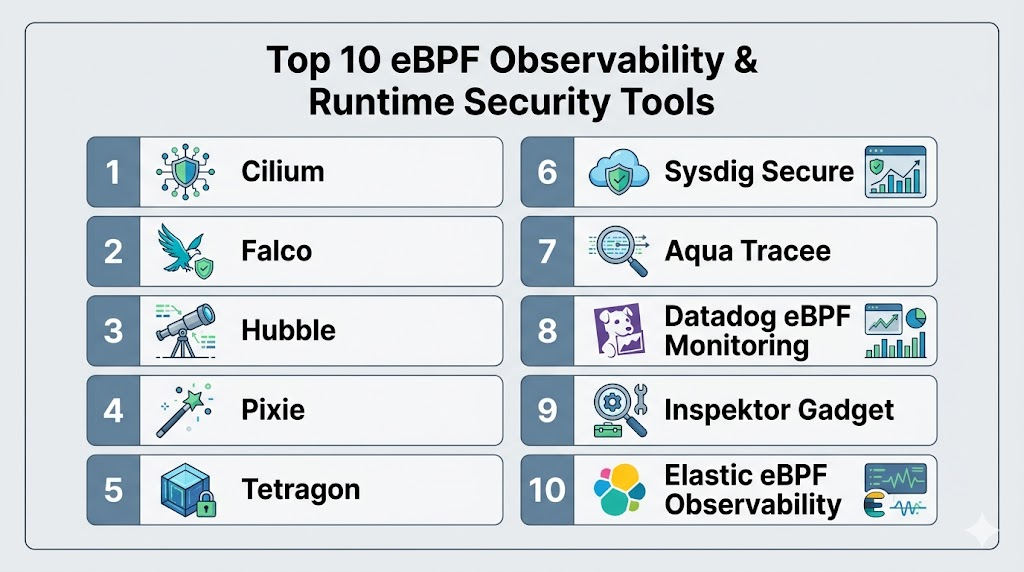
Top 10 eBPF Observability & Runtime Security Tools
1- Cilium
Short description: Cilium is one of the most influential eBPF-powered networking, observability, and security platforms in the Kubernetes ecosystem. It provides deep visibility into container networking, workload communication, and runtime activity while enabling advanced network security policies. Organizations use Cilium extensively for cloud-native networking modernization and Kubernetes runtime observability.
Key Features
- eBPF-powered networking
- Kubernetes network policies
- Runtime observability
- Service mesh integration
- DNS and API visibility
- Load balancing
- Threat detection support
Pros
- Excellent Kubernetes-native architecture
- Strong performance and scalability
- Deep visibility into network traffic and workloads
Cons
- Advanced deployments can become complex
- Requires Kubernetes expertise
- Initial learning curve for networking policies
Platforms / Deployment
Cloud / Self-hosted / Hybrid
Security & Compliance
Supports workload isolation, runtime visibility, network policy enforcement, and Kubernetes security controls. Additional compliance certifications vary depending on deployment architecture.
Integrations & Ecosystem
Cilium integrates deeply with cloud-native ecosystems and is commonly used alongside Kubernetes networking and observability stacks.
- Kubernetes
- Prometheus
- Grafana
- Envoy
- Hubble
- Service Mesh platforms
Support & Community
Strong CNCF ecosystem adoption and one of the largest open-source eBPF communities available today.
2- Falco
Short description: Falco is an open-source runtime security platform focused on detecting abnormal behavior in containers, Kubernetes clusters, and Linux systems. It uses kernel telemetry and eBPF integrations to identify suspicious runtime events and policy violations. Security teams frequently use Falco for cloud-native threat detection and runtime monitoring.
Key Features
- Runtime threat detection
- Kubernetes security monitoring
- Policy-based alerting
- Container behavior analysis
- eBPF event collection
- Syscall monitoring
- Real-time security alerts
Pros
- Strong runtime detection capabilities
- Widely adopted in Kubernetes security environments
- Flexible policy engine
Cons
- Alert tuning may require effort
- High telemetry environments can increase complexity
- Advanced rule customization needs expertise
Platforms / Deployment
Cloud / Self-hosted
Security & Compliance
Supports runtime monitoring, policy enforcement, and threat detection for Kubernetes and Linux environments. Auditability and telemetry visibility are major strengths.
Integrations & Ecosystem
Falco integrates with SIEM, observability, and incident response platforms.
- Kubernetes
- Slack
- Splunk
- Prometheus
- Grafana
- Security orchestration tools
Support & Community
Large open-source security community with active CNCF ecosystem participation.
3- Hubble
Short description: Hubble is the observability layer built on top of Cilium that provides deep network visibility and runtime communication monitoring for Kubernetes environments. It helps teams visualize service interactions, troubleshoot traffic issues, and analyze workload behavior in real time. Organizations frequently use it alongside modern service mesh architectures.
Key Features
- Network flow visibility
- Service communication mapping
- DNS observability
- API traffic tracing
- Kubernetes-aware telemetry
- Runtime flow analytics
- eBPF-powered packet visibility
Pros
- Excellent Kubernetes network observability
- Strong integration with Cilium
- Useful troubleshooting capabilities
Cons
- Best suited for Kubernetes ecosystems
- Requires Cilium deployment
- Enterprise governance features limited
Platforms / Deployment
Cloud / Self-hosted
Security & Compliance
Supports runtime visibility and traffic analysis workflows. Additional compliance information varies by environment.
Integrations & Ecosystem
Works closely with Kubernetes networking and observability platforms.
- Cilium
- Grafana
- Prometheus
- Kubernetes dashboards
Support & Community
Strong open-source adoption and growing observability ecosystem support.
4- Pixie
Short description: Pixie is an eBPF-powered observability platform designed for Kubernetes environments and developer-focused troubleshooting workflows. It provides automatic telemetry collection, distributed tracing, and application-level visibility without requiring manual instrumentation. DevOps and SRE teams use Pixie for real-time debugging and operational monitoring.
Key Features
- Auto-telemetry collection
- Distributed tracing
- Application profiling
- Kubernetes observability
- Real-time debugging
- Network telemetry
- Low-overhead monitoring
Pros
- Developer-friendly observability workflows
- Minimal instrumentation requirements
- Strong Kubernetes troubleshooting support
Cons
- Primarily Kubernetes-focused
- Enterprise security controls vary
- Some advanced use cases may require customization
Platforms / Deployment
Cloud / Self-hosted
Security & Compliance
Supports runtime telemetry and observability workflows. Additional compliance certifications are not publicly stated.
Integrations & Ecosystem
Pixie integrates with observability and Kubernetes ecosystems.
- Kubernetes
- OpenTelemetry
- Grafana
- Prometheus
- Cloud-native observability stacks
Support & Community
Strong developer adoption and active cloud-native community participation.
5- Tetragon
Short description: Tetragon is an eBPF-based runtime security and observability platform designed for Kubernetes and Linux environments. It provides process-level visibility, runtime enforcement, and security telemetry directly from the kernel layer. Security teams use it for advanced threat detection and workload monitoring.
Key Features
- Process-level runtime visibility
- Kubernetes security monitoring
- Runtime enforcement
- Threat detection
- Policy-based monitoring
- Kernel-level telemetry
- eBPF event analysis
Pros
- Deep runtime visibility
- Strong Kubernetes security alignment
- Low-overhead telemetry collection
Cons
- Requires Linux and Kubernetes expertise
- Advanced policies can become complex
- Enterprise management capabilities evolving
Platforms / Deployment
Cloud / Self-hosted
Security & Compliance
Supports runtime security monitoring, workload telemetry, and policy enforcement for cloud-native environments.
Integrations & Ecosystem
Frequently used with Kubernetes and security observability platforms.
- Kubernetes
- Cilium
- Grafana
- SIEM systems
Support & Community
Growing open-source adoption and strong cloud-native ecosystem alignment.
6- Sysdig Secure
Short description: Sysdig Secure combines eBPF-powered observability, runtime security, compliance monitoring, and cloud-native threat detection into a unified platform. Organizations use it to secure Kubernetes workloads, monitor runtime activity, and improve cloud-native governance. It is widely adopted in enterprise container security environments.
Key Features
- Runtime threat detection
- Kubernetes posture management
- Compliance monitoring
- Cloud-native visibility
- Vulnerability management
- Runtime policy enforcement
- Incident investigation workflows
Pros
- Comprehensive enterprise security platform
- Strong Kubernetes visibility
- Mature runtime detection capabilities
Cons
- Premium enterprise pricing
- Platform scope may be broad for smaller teams
- Advanced deployments may require tuning
Platforms / Deployment
Cloud / Hybrid
Security & Compliance
Supports runtime security monitoring, compliance visibility, policy enforcement, and workload governance capabilities.
Integrations & Ecosystem
Integrates broadly across cloud-native and enterprise security environments.
- AWS
- Azure
- Google Cloud
- Kubernetes
- SIEM platforms
- DevSecOps workflows
Support & Community
Strong enterprise support and mature operational ecosystem.
7- Aqua Tracee
Short description: Tracee is Aqua Security’s open-source eBPF runtime security and observability platform focused on threat detection and behavioral monitoring. It enables security teams to analyze runtime events and identify suspicious activity in Linux and Kubernetes environments. Organizations frequently use it for cloud-native threat hunting.
Key Features
- Runtime event tracing
- Threat detection
- Behavioral monitoring
- Kubernetes visibility
- Linux syscall analysis
- Security event telemetry
- eBPF-powered monitoring
Pros
- Strong open-source runtime security capabilities
- Useful for threat hunting workflows
- Good cloud-native security alignment
Cons
- Advanced usage may require expertise
- Enterprise governance limited in open-source version
- Alert tuning can be necessary
Platforms / Deployment
Cloud / Self-hosted
Security & Compliance
Supports runtime telemetry, behavioral analysis, and workload threat detection.
Integrations & Ecosystem
Integrates with cloud-native security and monitoring platforms.
- Kubernetes
- SIEM platforms
- Security analytics systems
- Observability stacks
Support & Community
Strong cloud-native security community and active open-source development.
8- Datadog eBPF Monitoring
Short description: Datadog uses eBPF technologies to enhance cloud infrastructure observability, application performance monitoring, and runtime telemetry collection. Organizations use it to gain low-overhead visibility into workloads, networking, and Kubernetes environments. It combines eBPF observability with broader monitoring and analytics capabilities.
Key Features
- Infrastructure monitoring
- eBPF telemetry collection
- Application performance monitoring
- Kubernetes observability
- Runtime visibility
- Network analytics
- Distributed tracing
Pros
- Strong enterprise observability ecosystem
- Unified monitoring workflows
- Good cloud-native scalability
Cons
- Usage costs can increase at scale
- Broad platform complexity
- Some advanced runtime security capabilities limited
Platforms / Deployment
Cloud
Security & Compliance
Supports enterprise observability governance and telemetry collection workflows. Additional compliance details vary across products.
Integrations & Ecosystem
Large ecosystem of integrations across cloud and DevOps environments.
- AWS
- Azure
- Google Cloud
- Kubernetes
- CI/CD systems
- Observability stacks
Support & Community
Strong enterprise support and large observability ecosystem.
9- Inspektor Gadget
Short description: Inspektor Gadget is an open-source eBPF toolkit designed for Kubernetes debugging, troubleshooting, and runtime analysis. It helps operators collect low-level telemetry and investigate workload behavior inside clusters. Developers and SRE teams commonly use it for operational diagnostics.
Key Features
- Kubernetes debugging tools
- Runtime analysis
- eBPF tracing
- Container telemetry
- Networking diagnostics
- Security investigation
- Cluster troubleshooting
Pros
- Lightweight troubleshooting workflows
- Strong Kubernetes alignment
- Useful operational diagnostics
Cons
- Focused primarily on diagnostics
- Limited enterprise governance
- Advanced users benefit most
Platforms / Deployment
Self-hosted
Security & Compliance
Focused mainly on troubleshooting and operational visibility rather than compliance management.
Integrations & Ecosystem
Works within Kubernetes troubleshooting ecosystems.
- Kubernetes
- Container runtimes
- Debugging workflows
- Open-source observability stacks
Support & Community
Growing open-source community adoption.
10- Elastic eBPF Observability
Short description: Elastic integrates eBPF-powered telemetry into its observability and security ecosystem to improve runtime visibility and cloud-native monitoring. Organizations use it for infrastructure analytics, Kubernetes observability, and workload telemetry analysis. It combines runtime insights with search and analytics capabilities.
Key Features
- eBPF telemetry collection
- Kubernetes monitoring
- Security analytics
- Infrastructure visibility
- Runtime telemetry
- Log correlation
- Observability dashboards
Pros
- Strong analytics and search capabilities
- Unified observability platform
- Flexible deployment options
Cons
- Enterprise deployments can become complex
- Large telemetry environments require tuning
- Advanced runtime enforcement limited
Platforms / Deployment
Cloud / Self-hosted / Hybrid
Security & Compliance
Supports observability analytics, runtime telemetry collection, and enterprise monitoring workflows.
Integrations & Ecosystem
Integrates broadly across DevOps and observability ecosystems.
- Kubernetes
- Elastic Stack
- Cloud providers
- SIEM systems
- Monitoring pipelines
Support & Community
Large observability ecosystem and strong enterprise adoption.
Comparison Table (Top 10)
| Tool Name | Best For | Platform Supported | Deployment | Standout Feature | Public Rating |
|---|---|---|---|---|---|
| Cilium | Kubernetes networking | Linux/Kubernetes | Hybrid | eBPF networking visibility | N/A |
| Falco | Runtime threat detection | Linux/Kubernetes | Self-hosted | Behavioral runtime security | N/A |
| Hubble | Kubernetes traffic visibility | Kubernetes | Self-hosted | Service communication mapping | N/A |
| Pixie | Developer observability | Kubernetes | Hybrid | Auto-telemetry collection | N/A |
| Tetragon | Runtime enforcement | Linux/Kubernetes | Self-hosted | Process-level visibility | N/A |
| Sysdig Secure | Enterprise runtime security | Multi-platform | Cloud/Hybrid | Unified runtime security | N/A |
| Aqua Tracee | Threat hunting | Linux/Kubernetes | Self-hosted | Behavioral monitoring | N/A |
| Datadog eBPF Monitoring | Cloud observability | Multi-platform | Cloud | Unified telemetry analytics | N/A |
| Inspektor Gadget | Kubernetes troubleshooting | Kubernetes | Self-hosted | Runtime diagnostics | N/A |
| Elastic eBPF Observability | Infrastructure analytics | Multi-platform | Hybrid | Search-driven telemetry | N/A |
Evaluation & Scoring Table
| Tool Name | Core 25% | Ease 15% | Integrations 15% | Security 10% | Performance 10% | Support 10% | Value 15% | Weighted Total |
|---|---|---|---|---|---|---|---|---|
| Cilium | 10 | 8 | 10 | 9 | 10 | 9 | 9 | 9.35 |
| Falco | 9 | 8 | 9 | 10 | 9 | 9 | 9 | 9.00 |
| Hubble | 8 | 8 | 8 | 8 | 9 | 8 | 9 | 8.30 |
| Pixie | 9 | 9 | 8 | 7 | 9 | 8 | 9 | 8.55 |
| Tetragon | 9 | 7 | 8 | 9 | 9 | 8 | 8 | 8.40 |
| Sysdig Secure | 10 | 8 | 9 | 10 | 9 | 9 | 7 | 8.95 |
| Aqua Tracee | 8 | 7 | 8 | 9 | 8 | 8 | 9 | 8.10 |
| Datadog eBPF Monitoring | 9 | 9 | 10 | 8 | 9 | 9 | 7 | 8.85 |
| Inspektor Gadget | 7 | 7 | 7 | 7 | 8 | 7 | 10 | 7.65 |
| Elastic eBPF Observability | 9 | 8 | 9 | 8 | 9 | 9 | 8 | 8.60 |
Frequently Asked Questions
1. What is eBPF?
eBPF stands for Extended Berkeley Packet Filter and allows programs to run safely inside the Linux kernel without modifying kernel code. It enables deep visibility into networking, processes, and runtime behavior. Modern observability and runtime security platforms heavily rely on eBPF. It has become a foundational technology for cloud-native monitoring.
2. Why are eBPF tools important for Kubernetes?
Kubernetes environments generate highly dynamic workloads and network traffic that traditional monitoring tools often struggle to track efficiently. eBPF provides low-overhead telemetry directly from the kernel layer. This improves observability, troubleshooting, and runtime threat detection. It is especially valuable for large-scale cloud-native environments.
3. Are eBPF tools only for security teams?
No. DevOps teams, SREs, platform engineers, and developers also use eBPF tools for observability, debugging, performance optimization, and networking analysis. Many platforms combine runtime security and operational telemetry together. This creates shared visibility across infrastructure and security teams. Adoption spans multiple operational roles.
4. What is runtime security?
Runtime security focuses on monitoring workloads and systems while they are actively running in production environments. These tools identify suspicious behavior, unauthorized access, and abnormal process activity in real time. Runtime visibility helps organizations respond faster to threats. eBPF greatly improves the quality of runtime telemetry.
5. Do eBPF tools require agents?
Many eBPF platforms reduce dependency on traditional intrusive agents because telemetry is collected directly from the Linux kernel. Some solutions still deploy lightweight collectors or integrations depending on deployment architecture. Agentless visibility is becoming increasingly common. Reduced overhead is one of eBPF’s biggest advantages.
6. Can eBPF impact performance?
eBPF is generally designed for low-overhead telemetry collection compared to traditional monitoring approaches. However, poorly configured policies or excessive tracing can still impact system resources. Most modern platforms optimize telemetry collection carefully. Performance tuning is important for large-scale production clusters.
7. What industries use eBPF observability tools?
Technology companies, financial institutions, SaaS providers, telecom operators, cloud-native enterprises, and managed service providers are major adopters. Organizations operating Kubernetes and distributed infrastructure benefit most. Runtime security adoption is especially strong in regulated industries. Usage continues expanding across cloud-native ecosystems.
8. Are eBPF tools difficult to deploy?
Deployment complexity depends on the platform and infrastructure size. Open-source tools may require deeper Linux and Kubernetes expertise, while enterprise platforms simplify deployment through managed workflows. Initial setup and policy tuning are often the most complex steps. Operational maturity improves over time.
9. How do eBPF tools help with troubleshooting?
These platforms provide deep visibility into system calls, networking flows, process activity, and application performance. Teams can identify bottlenecks, latency issues, failed connections, and abnormal workload behavior more quickly. This reduces troubleshooting time significantly. Real-time telemetry improves operational visibility across distributed systems.
10. What should organizations evaluate before choosing an eBPF platform?
Organizations should evaluate runtime visibility depth, Kubernetes compatibility, telemetry scalability, threat detection quality, integration flexibility, and operational complexity. Security governance and compliance requirements should also be considered. Open-source and enterprise platforms offer different advantages. Running a pilot deployment is strongly recommended.
Conclusion
eBPF Observability & Runtime Security Tools are rapidly becoming foundational technologies for cloud-native infrastructure visibility and Kubernetes security. As organizations continue scaling microservices, distributed applications, and hybrid-cloud deployments, traditional monitoring approaches often fail to deliver the runtime depth and performance efficiency required by modern environments. Platforms such as Cilium, Falco, Pixie, Tetragon, Sysdig Secure, and Datadog are helping enterprises improve observability, runtime threat detection, workload governance, and operational troubleshooting using low-overhead kernel-level telemetry. The best platform depends on whether your organization prioritizes Kubernetes networking, runtime threat detection, developer observability, or enterprise governance capabilities. Organizations should shortlist two or three platforms, run pilot deployments inside production-like Kubernetes environments, validate telemetry quality and scalability, and ensure alignment with long-term cloud-native security and observability strategies before making a final decision.

Find Trusted Cardiac Hospitals
Compare heart hospitals by city and services — all in one place.
Explore Hospitals