Introduction
Hospital Information Systems are integrated software platforms that help hospitals manage clinical, administrative, financial, and operational workflows from one connected digital environment. They support activities such as patient registration, doctor scheduling, EMR or EHR access, billing, pharmacy, laboratory, radiology, inventory, bed management, and reporting. Hospital Information Systems matter because hospitals need faster care delivery, stronger data security, better patient experience, connected departments, and smarter operational decision-making. A modern HIS is no longer only a back-office system; it is becoming the digital backbone of hospital operations.
Real-world use cases include:
- Patient Registration: Managing patient demographics, hospital numbers, visit history, admission records, and discharge workflows.
- OPD and IPD Management: Supporting outpatient visits, inpatient admissions, ward allocation, nursing workflows, and discharge planning.
- Lab and Radiology Integration: Connecting test orders, diagnostic reports, imaging workflows, and clinical review.
- Billing and Revenue Cycle: Managing insurance, coding, invoices, claims, payment tracking, and financial reporting.
- Pharmacy and Inventory: Tracking prescriptions, medicine stock, purchase orders, expiry dates, and supply chain workflows.
What buyers should evaluate:
- Ease of use for doctors, nurses, administrators, and billing teams
- Clinical workflow fit for OPD, IPD, emergency, ICU, pharmacy, lab, and radiology
- Integration capability with EMR, PACS, LIS, RIS, billing, pharmacy, and patient portals
- Security and compliance for patient data protection and access control
- Scalability for beds, departments, users, branches, and patient volume
- Implementation and training support
- Reporting and analytics depth
- Cloud, self-hosted, or hybrid deployment flexibility
- Total cost of ownership
- Vendor reliability and long-term roadmap
Best for: hospitals, multi-specialty clinics, diagnostic networks, healthcare groups, medical colleges, public hospitals, and hospital administrators that need connected clinical operations, patient management, billing workflows, and department-level coordination.
Not ideal for: very small clinics that only need appointment scheduling, solo practitioners that need a lightweight EMR, or non-clinical wellness businesses that do not require full hospital operations management.
Key Trends in Hospital Information Systems
- AI-assisted hospital operations are becoming more relevant for patient flow prediction, documentation support, bed utilization, billing checks, care gap alerts, and operational dashboards.
- Interoperability is now a core requirement, with hospitals expecting HIS platforms to connect with EMR, EHR, LIS, RIS, PACS, pharmacy systems, insurance platforms, payment tools, and national health data networks.
- Cloud and hybrid deployment models are growing, especially for hospitals that want scalability, remote access, centralized updates, and lower infrastructure burden while still controlling sensitive data.
- Cybersecurity expectations are increasing, with stronger demand for MFA, SSO, RBAC, audit logs, encryption, data backup, disaster recovery, and access monitoring.
- Patient digital experience is becoming part of HIS strategy, including online appointment booking, digital registration, patient portals, mobile access, self-service billing, and automated reminders.
- Department-level automation is expanding, especially for pharmacy, laboratory, radiology, nursing, operation theater, emergency, housekeeping, billing, and inventory workflows.
- Analytics and command-center dashboards are becoming important, helping hospital leaders monitor occupancy, revenue, waiting time, discharge delays, doctor productivity, and department performance.
- Integration with medical devices and diagnostic tools is becoming more valuable, especially in ICU, radiology, laboratory, and emergency care environments.
- Modular pricing and implementation models are increasing, allowing hospitals to start with core modules and expand into advanced clinical, financial, or patient engagement workflows later.
- Compliance and audit readiness are stronger priorities, especially for hospitals handling sensitive patient data, insurance claims, controlled medicines, and multi-location operations.
How We Selected These Tools
- We selected Hospital Information Systems and hospital-grade healthcare platforms with strong market recognition and proven relevance in hospital environments.
- We included a balanced mix of enterprise hospital systems, regional healthcare platforms, clinical information systems, and hospital operations platforms.
- We evaluated feature completeness, including patient administration, clinical workflows, billing, pharmacy, lab, radiology, reporting, and interoperability.
- We considered hospital fit, not just clinic-level EMR functionality, because HIS platforms must support multiple departments and operational roles.
- We looked at integration ecosystem strength, including support for EMR, LIS, RIS, PACS, pharmacy, insurance, claims, analytics, APIs, and interoperability standards.
- We considered security posture signals, including access control, audit logs, role-based permissions, encryption expectations, and healthcare compliance readiness.
- We prioritized platforms with relevance for multi-location hospitals, public healthcare systems, specialty hospitals, community hospitals, and large health networks.
- We avoided guessed ratings, certifications, prices, and claims where public details are not confidently known.
- We considered implementation complexity, because HIS success depends on migration, training, department mapping, workflow configuration, and change management.
- We treated scoring as comparative and practical, not as a universal ranking for every hospital.
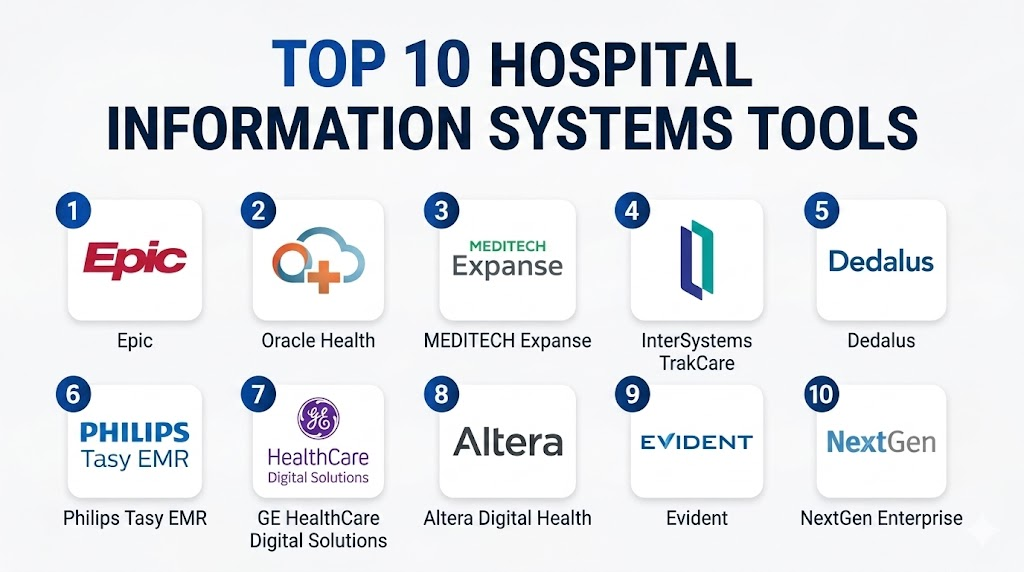
Top 10 Hospital Information Systems Tools
1- Epic
Short description: Epic is a major enterprise healthcare information platform used by large hospitals, academic medical centers, and integrated health systems. It supports patient records, clinical workflows, hospital operations, patient engagement, analytics, and interoperability.
Key Features
- Enterprise-grade patient record and hospital workflow management
- Strong inpatient, outpatient, emergency, specialty, and revenue cycle support
- Patient portal ecosystem for communication, appointments, results, and self-service
- Interoperability support for health information exchange and connected care
- Clinical documentation, orders, medications, results, and care coordination
- Analytics and reporting for clinical, operational, and population health needs
- Large ecosystem of implementation partners and healthcare IT specialists
Pros
- Strong fit for large hospitals and complex health systems.
- Broad clinical and operational functionality across many departments.
- Mature ecosystem for interoperability, patient engagement, and analytics.
Cons
- Implementation can be expensive and time-intensive.
- May be too complex for small hospitals or basic facility management needs.
- Requires strong internal IT, training, and governance teams.
Platforms / Deployment
Web / mobile access varies by module
Cloud / hosted / hybrid options vary by implementation
Security & Compliance
Epic is widely used in regulated healthcare environments. Common enterprise expectations include RBAC, audit logs, access controls, encryption, and secure authentication workflows. Specific certifications and contractual security details should be verified directly.
Integrations & Ecosystem
Epic has a strong healthcare ecosystem for connecting hospital departments, patient portals, labs, imaging systems, billing workflows, health information exchanges, and analytics platforms.
- EMR and clinical workflow integrations
- Lab and diagnostic connectivity
- Radiology and imaging integrations
- Revenue cycle workflows
- Patient portal ecosystem
- API and interoperability options
Support & Community
Epic provides structured implementation support, training resources, documentation, and enterprise customer programs. It has a strong hospital customer community, but adoption requires careful planning, workflow governance, and long-term optimization.
2- Oracle Health
Short description: Oracle Health is an enterprise healthcare platform used by hospitals, health systems, and large provider organizations. It supports clinical workflows, patient administration, interoperability, revenue operations, and healthcare data management.
Key Features
- Hospital-grade clinical documentation and patient management
- Inpatient, outpatient, emergency, and specialty workflow support
- Medication, orders, results review, and care coordination tools
- Interoperability capabilities for connected healthcare data exchange
- Revenue cycle, scheduling, and administrative workflow support
- Alignment with broader Oracle cloud, data, and analytics ecosystem
- Scalable architecture for enterprise healthcare organizations
Pros
- Strong fit for hospitals and large provider networks.
- Broad clinical and administrative workflow coverage.
- Enterprise technology ecosystem can support data and analytics strategy.
Cons
- Implementation and modernization can be complex.
- Smaller hospitals may need careful cost and resource planning.
- Buyers should validate roadmap, migration, and support model carefully.
Platforms / Deployment
Web / enterprise access varies by implementation
Cloud / hosted / hybrid options vary by customer environment
Security & Compliance
Oracle Health is used in healthcare environments that require strong data protection. Expected controls may include role-based access, audit trails, authentication controls, and secure patient data workflows. Specific compliance details should be verified directly.
Integrations & Ecosystem
Oracle Health can connect hospital workflows with enterprise data infrastructure, analytics, payer workflows, and operational systems. It is especially relevant for hospitals with complex IT architecture.
- Lab and pharmacy connectivity
- Clinical data exchange
- Revenue cycle workflows
- Enterprise analytics
- Cloud and database ecosystem alignment
- API and interoperability capabilities
Support & Community
Support depends on contract scope, implementation model, customer size, and partner involvement. Large hospitals usually need structured rollout plans, staff training, internal champions, and ongoing optimization support.
3- MEDITECH Expanse
Short description: MEDITECH Expanse is a hospital information and EHR platform used by community hospitals, regional health systems, and integrated care organizations. It supports clinical, administrative, revenue, patient engagement, and interoperability workflows.
Key Features
- Acute, ambulatory, emergency, and specialty workflow support
- Clinical documentation, orders, medication, and results management
- Web-based experience for modern hospital teams
- Patient engagement and portal capabilities
- Revenue cycle and administrative workflow support
- Interoperability and healthcare data exchange
- Reporting and operational analytics capabilities
Pros
- Good fit for community hospitals and mid-sized health systems.
- Supports hospital and ambulatory workflows in a connected environment.
- Can be practical for organizations seeking broad functionality without extreme enterprise complexity.
Cons
- Advanced specialty needs should be validated carefully.
- Implementation still requires workflow redesign and staff training.
- Integration depth can vary by hospital environment.
Platforms / Deployment
Web / mobile access varies by module
Cloud / hosted / hybrid options vary by implementation
Security & Compliance
MEDITECH is used by regulated healthcare organizations and supports expected hospital security needs such as user permissions, audit trails, access controls, and secure patient data handling. Specific certifications should be verified with the vendor.
Integrations & Ecosystem
MEDITECH Expanse supports integrations across clinical care, hospital administration, patient engagement, revenue workflows, and external data exchange.
- Lab and imaging integrations
- Patient portal connectivity
- Revenue cycle workflows
- Care coordination tools
- Reporting and analytics
- Interoperability support
Support & Community
MEDITECH provides implementation support, documentation, training resources, and customer service programs. Its support ecosystem is especially useful for hospitals that need structured onboarding and ongoing optimization.
4- InterSystems TrakCare
Short description: InterSystems TrakCare is a unified healthcare information system designed for hospitals and health systems that need connected clinical, administrative, and patient management workflows. It is used in many regions for enterprise healthcare data and care delivery operations.
Key Features
- Unified electronic patient record and hospital workflow support
- Patient administration, scheduling, clinical documentation, and care coordination
- Laboratory, pharmacy, radiology, and departmental workflow connectivity
- Interoperability and healthcare data exchange capabilities
- Support for multi-site healthcare organizations
- Analytics and reporting capabilities
- Strong healthcare data platform foundation through InterSystems technology
Pros
- Strong fit for hospitals needing connected clinical and administrative data.
- Useful for regional and multi-site healthcare environments.
- Strong interoperability and data management orientation.
Cons
- Implementation can require significant planning and technical expertise.
- Buyers should validate local support and partner availability.
- May be more complex than needed for small clinics.
Platforms / Deployment
Web / platform access varies by implementation
Cloud / self-hosted / hybrid options vary by customer environment
Security & Compliance
InterSystems solutions are used in healthcare environments requiring protected patient data workflows. Expected controls may include access control, auditability, secure data exchange, and role-based permissions. Specific certifications and compliance details should be verified directly.
Integrations & Ecosystem
InterSystems TrakCare is designed for connected healthcare environments and can support interoperability across hospitals, departments, labs, and external systems.
- Clinical system integrations
- Lab and pharmacy workflows
- Radiology and diagnostic connectivity
- Health information exchange
- Analytics and reporting
- API and interoperability tools
Support & Community
Support varies by region, implementation partner, and contract. Hospitals should clarify onboarding support, configuration assistance, local partner availability, training resources, and long-term upgrade planning.
5- Dedalus
Short description: Dedalus provides healthcare information systems and digital health solutions for hospitals, diagnostic networks, laboratories, and regional healthcare organizations. It is especially relevant for organizations needing clinical, administrative, diagnostic, and interoperability workflows.
Key Features
- Hospital information and clinical workflow management
- Patient administration, care coordination, and departmental workflows
- Diagnostic, laboratory, and imaging ecosystem support
- Interoperability and healthcare network connectivity
- Analytics and operational reporting capabilities
- Support for regional healthcare systems and public health environments
- Modular solutions for different healthcare use cases
Pros
- Strong fit for hospitals and regional healthcare networks.
- Broad healthcare IT portfolio across clinical and diagnostic workflows.
- Useful for organizations needing interoperability across multiple care settings.
Cons
- Product fit may vary by region and solution package.
- Buyers should validate local implementation support.
- Some deployments may require significant configuration.
Platforms / Deployment
Web / platform access varies by solution
Cloud / self-hosted / hybrid options vary by implementation
Security & Compliance
Dedalus serves regulated healthcare organizations. Expected capabilities may include role-based access, audit logs, secure data handling, and compliance-oriented workflows. Specific certifications and data protection commitments should be verified directly.
Integrations & Ecosystem
Dedalus supports hospital and healthcare network integrations across clinical, diagnostic, administrative, and regional data exchange needs.
- Hospital workflow integrations
- Laboratory systems
- Imaging and diagnostic workflows
- Healthcare data exchange
- Analytics and reporting
- Regional care coordination
Support & Community
Support depends on region, product line, and implementation model. Buyers should confirm local partner availability, training approach, documentation, migration assistance, and long-term maintenance support.
6- Philips Tasy EMR
Short description: Philips Tasy EMR is a healthcare information system used by hospitals and healthcare organizations to manage clinical, administrative, and operational workflows. It is relevant for hospitals that want integrated patient management, care coordination, and departmental operations.
Key Features
- Patient administration and clinical workflow support
- Hospital operations, scheduling, and department coordination
- EMR functionality for patient record management
- Billing and administrative workflow capabilities
- Reporting and analytics for hospital performance
- Integration with healthcare devices and clinical environments
- Support for multi-department hospital operations
Pros
- Strong healthcare brand with experience in clinical technology.
- Good fit for hospitals seeking clinical and operational integration.
- Useful for organizations that also use diagnostic and care technology ecosystems.
Cons
- Regional availability and implementation approach may vary.
- Buyers should validate module depth for local hospital workflows.
- Integration and migration planning may require careful project management.
Platforms / Deployment
Web / platform access varies by implementation
Cloud / self-hosted / hybrid options vary by customer environment
Security & Compliance
Philips serves regulated healthcare environments. Expected security capabilities may include access control, auditability, secure patient data workflows, and role-based permissions. Specific certifications should be confirmed directly.
Integrations & Ecosystem
Philips Tasy can support hospital workflows across patient management, clinical care, diagnostics, reporting, and operational systems. It can be especially relevant where hospitals also use broader Philips healthcare technology.
- Clinical workflow integrations
- Diagnostic and device ecosystem alignment
- Patient administration
- Billing and reporting workflows
- Department-level coordination
- Interoperability options
Support & Community
Support varies by country, contract, and deployment model. Buyers should confirm implementation services, training, documentation, local support resources, and upgrade planning before selection.
7- GE HealthCare Command Center and Digital Health Solutions
Short description: GE HealthCare provides hospital digital solutions that support operational intelligence, command center workflows, care coordination, and clinical efficiency. While not always a full traditional HIS replacement, it is relevant for hospitals seeking advanced operational visibility and workflow optimization.
Key Features
- Hospital command center and operational intelligence capabilities
- Patient flow, bed management, and capacity optimization
- Integration with clinical and operational data sources
- Real-time dashboards for hospital leadership
- Care coordination and operational decision support
- Analytics for bottlenecks, utilization, and performance
- Alignment with broader GE HealthCare clinical technology ecosystem
Pros
- Strong fit for hospitals focused on operational optimization.
- Useful for improving patient flow, bed capacity, and department coordination.
- Strong healthcare technology ecosystem presence.
Cons
- May not replace a full HIS or EMR by itself.
- Best value depends on integration with existing hospital systems.
- Buyers should validate scope, modules, and workflow ownership clearly.
Platforms / Deployment
Web / platform access varies by solution
Cloud / hybrid options vary by implementation
Security & Compliance
GE HealthCare operates in regulated healthcare technology environments. Security and compliance capabilities vary by solution and deployment. Specific controls, certifications, and data handling responsibilities should be verified directly.
Integrations & Ecosystem
GE HealthCare digital solutions often connect with hospital operational systems, clinical data sources, devices, imaging workflows, and analytics environments.
- Hospital operations dashboards
- Bed and capacity management
- Clinical data integrations
- Imaging ecosystem alignment
- Operational analytics
- Command center workflows
Support & Community
Support depends on the selected solution, implementation scope, and enterprise agreement. Hospitals should clarify deployment assistance, integration support, training, monitoring, and long-term optimization services.
8- Altera Digital Health
Short description: Altera Digital Health provides healthcare information and clinical systems for hospitals, health systems, and provider organizations. Its solutions are relevant for organizations needing patient management, clinical documentation, revenue workflows, and connected care operations.
Key Features
- Hospital and ambulatory clinical workflow support
- Patient administration and care coordination tools
- Clinical documentation and provider workflow capabilities
- Revenue cycle and administrative workflow support
- Interoperability and healthcare data exchange options
- Reporting and operational visibility
- Support for provider organizations and health networks
Pros
- Established healthcare IT background with hospital and provider workflow experience.
- Useful for organizations needing clinical and administrative system support.
- Can support connected care across multiple provider environments.
Cons
- Product fit depends on the exact solution selected.
- Buyers should validate roadmap, support, and integration depth.
- Implementation may require careful configuration and staff training.
Platforms / Deployment
Web / platform access varies by solution
Cloud / hosted / hybrid options vary by product and implementation
Security & Compliance
Altera Digital Health serves healthcare organizations with privacy and compliance requirements. Expected controls may include user roles, auditability, secure data workflows, and access control. Specific certifications should be verified directly.
Integrations & Ecosystem
Altera Digital Health supports healthcare integrations across clinical, administrative, revenue, and interoperability workflows.
- Patient administration
- Clinical documentation
- Revenue cycle workflows
- Interoperability tools
- Reporting and analytics
- Third-party healthcare integrations
Support & Community
Support varies by product line, region, contract, and implementation model. Buyers should confirm onboarding scope, training, migration support, technical assistance, and long-term customer success resources.
9- Evident
Short description: Evident, part of the TruBridge ecosystem, provides hospital information and EHR solutions focused largely on community hospitals, rural hospitals, and smaller healthcare organizations. It supports clinical, financial, administrative, and patient management workflows.
Key Features
- Hospital EHR and patient management workflows
- Clinical documentation, medication, orders, and results support
- Administrative and financial workflow tools
- Revenue cycle and billing support through related ecosystem offerings
- Reporting and operational visibility
- Community hospital-focused functionality
- Support for smaller and regional hospital environments
Pros
- Good fit for community hospitals and rural healthcare organizations.
- Practical focus on hospital operations, clinical workflows, and financial management.
- Can be more approachable for smaller hospitals than large enterprise systems.
Cons
- May not match the depth required by very large academic medical centers.
- Buyers should validate advanced integrations and specialty workflows.
- Support scope and implementation resources should be reviewed carefully.
Platforms / Deployment
Web / platform access varies by solution
Cloud / hosted / hybrid options vary by implementation
Security & Compliance
Evident serves hospitals and regulated healthcare environments. Expected security capabilities may include role-based permissions, auditability, secure access, and protected health data workflows. Specific certifications should be confirmed directly.
Integrations & Ecosystem
Evident supports hospital workflows across patient care, administration, finance, billing, and reporting. It is often relevant for hospitals that need core HIS and EHR functionality without unnecessary enterprise complexity.
- Clinical workflow integrations
- Billing and revenue cycle support
- Patient administration
- Reporting tools
- Pharmacy and lab workflow options
- Community hospital operations
Support & Community
Support is generally oriented toward hospitals and healthcare organizations using the platform. Buyers should clarify implementation planning, training resources, migration support, support tiers, and upgrade processes.
10- NextGen Enterprise
Short description: NextGen Enterprise is widely used in ambulatory and specialty care environments and can support healthcare organizations that need clinical documentation, practice management, interoperability, analytics, and patient engagement. For hospitals with strong outpatient networks, it can be part of a broader hospital information strategy.
Key Features
- Clinical documentation and patient record workflows
- Ambulatory and specialty practice support
- Practice management and revenue cycle workflows
- Patient portal and communication tools
- Population health and reporting capabilities
- Interoperability and healthcare data exchange
- Support for multi-location provider networks
Pros
- Strong option for outpatient departments and specialty provider networks.
- Useful for hospitals with large ambulatory care operations.
- Combines clinical, administrative, and reporting features.
Cons
- May not be a full replacement for complex inpatient HIS needs.
- Hospital buyers should validate inpatient workflow coverage carefully.
- Configuration and training are important for adoption.
Platforms / Deployment
Web / mobile access varies by module
Cloud / hosted options vary by implementation
Security & Compliance
NextGen is used by regulated healthcare organizations and supports expected privacy and access control workflows. Capabilities may include role-based access, auditability, and secure patient data handling. Specific certifications should be verified with the vendor.
Integrations & Ecosystem
NextGen supports clinical operations, patient engagement, payer workflows, reporting, and interoperability. It is most relevant for hospitals that need strong outpatient and specialty care connectivity.
- Lab and imaging connectivity
- E-prescribing
- Patient portal and communication tools
- Billing and claims workflows
- Analytics and population health tools
- API and interoperability support
Support & Community
NextGen provides onboarding, training, documentation, implementation services, and customer support. Support experience may vary by product package, implementation complexity, and organizational size.
Comparison Table
| Tool Name | Best For | Platform(s) Supported | Deployment | Standout Feature | Public Rating |
|---|---|---|---|---|---|
| Epic | Large hospitals and integrated health systems | Web, mobile access varies | Cloud / Hosted / Hybrid varies | Enterprise clinical depth and patient portal ecosystem | N/A |
| Oracle Health | Enterprise hospitals and provider networks | Web, enterprise access varies | Cloud / Hosted / Hybrid varies | Enterprise healthcare data and clinical workflow alignment | N/A |
| MEDITECH Expanse | Community hospitals and regional health systems | Web, mobile access varies | Cloud / Hosted / Hybrid varies | Hospital and ambulatory workflow coverage | N/A |
| InterSystems TrakCare | Multi-site hospitals and regional health systems | Web, platform access varies | Cloud / Self-hosted / Hybrid varies | Unified patient record and interoperability focus | N/A |
| Dedalus | Hospitals and regional healthcare networks | Web, platform access varies | Cloud / Self-hosted / Hybrid varies | Broad clinical, diagnostic, and healthcare network portfolio | N/A |
| Philips Tasy EMR | Hospitals needing clinical and operational integration | Web, platform access varies | Cloud / Self-hosted / Hybrid varies | Hospital workflow support with clinical technology ecosystem | N/A |
| GE HealthCare Digital Solutions | Hospitals focused on operational command centers | Web, platform access varies | Cloud / Hybrid varies | Patient flow and operational intelligence | N/A |
| Altera Digital Health | Hospitals and provider organizations | Web, platform access varies | Cloud / Hosted / Hybrid varies | Clinical and administrative healthcare workflows | N/A |
| Evident | Community and rural hospitals | Web, platform access varies | Cloud / Hosted / Hybrid varies | Community hospital-focused HIS and EHR functionality | N/A |
| NextGen Enterprise | Outpatient networks and specialty care operations | Web, mobile access varies | Cloud / Hosted varies | Specialty and ambulatory workflow strength | N/A |
Evaluation & Scoring of Hospital Information Systems
| Tool Name | Core 25% | Ease 15% | Integrations 15% | Security 10% | Performance 10% | Support 10% | Value 15% | Weighted Total |
|---|---|---|---|---|---|---|---|---|
| Epic | 10 | 7 | 10 | 9 | 9 | 9 | 7 | 8.75 |
| Oracle Health | 9 | 7 | 9 | 9 | 8 | 8 | 7 | 8.15 |
| MEDITECH Expanse | 8 | 8 | 8 | 8 | 8 | 8 | 8 | 8.00 |
| InterSystems TrakCare | 8 | 7 | 9 | 8 | 8 | 8 | 7 | 7.85 |
| Dedalus | 8 | 7 | 8 | 8 | 8 | 7 | 7 | 7.60 |
| Philips Tasy EMR | 8 | 7 | 8 | 8 | 8 | 7 | 7 | 7.60 |
| GE HealthCare Digital Solutions | 7 | 8 | 8 | 8 | 8 | 8 | 7 | 7.60 |
| Altera Digital Health | 7 | 7 | 8 | 8 | 7 | 7 | 7 | 7.25 |
| Evident | 7 | 8 | 7 | 8 | 7 | 8 | 8 | 7.50 |
| NextGen Enterprise | 7 | 8 | 8 | 8 | 7 | 7 | 8 | 7.60 |
Which Hospital Information Systems Tool Is Right for You?
Solo / Freelancer
Hospital Information Systems are generally not designed for solo freelancers or independent consultants. A single doctor, therapist, or small healthcare consultant usually needs a lightweight EMR, practice management tool, or appointment scheduling platform instead of a full HIS.
A full HIS includes complex hospital modules such as IPD, OPD, pharmacy, billing, lab, radiology, bed management, nursing, inventory, and finance. These modules are unnecessary for solo users unless they are part of a larger hospital group.
SMB
Small and medium-sized hospitals should focus on practical deployment, ease of use, billing support, patient registration, lab integration, pharmacy workflows, and reporting. MEDITECH Expanse, Evident, selected Dedalus solutions, Philips Tasy EMR, or regional HIS platforms may be suitable depending on geography and hospital complexity.
SMB hospitals should avoid overbuying. The best HIS should support daily hospital operations without creating unnecessary implementation burden. Key priorities include staff training, migration support, department-level workflows, and reliable vendor support.
Mid-Market
Mid-market hospitals and multi-specialty hospital groups need stronger configurability, interoperability, multi-location support, financial reporting, and department integration. MEDITECH Expanse, InterSystems TrakCare, Dedalus, Philips Tasy EMR, Altera Digital Health, and Oracle Health may be relevant options depending on clinical scope and regional availability.
Mid-market buyers should involve hospital administrators, doctors, nurses, finance teams, pharmacy teams, lab leaders, radiology teams, and IT teams during evaluation. HIS success depends on cross-department adoption, not only software features.
Enterprise
Large hospitals, academic medical centers, government health systems, and integrated delivery networks usually need enterprise-grade platforms such as Epic, Oracle Health, MEDITECH Expanse, InterSystems TrakCare, or Dedalus. These systems are built for complex clinical, administrative, financial, and interoperability requirements.
Enterprise buyers should evaluate long-term architecture, data governance, cybersecurity, patient engagement, interoperability, analytics, and implementation capacity. A strong HIS should help standardize operations across departments and locations while supporting future digital health initiatives.
Budget vs Premium
Budget-focused hospitals should calculate total cost, including licensing, implementation, data migration, hardware, hosting, training, integrations, support, customization, and maintenance. A low-cost system can become expensive if it creates workflow delays, billing errors, or poor adoption.
Premium systems usually provide stronger enterprise functionality, deeper integrations, better scalability, and larger support ecosystems. However, they may be unnecessary for smaller hospitals with simpler operations. The best choice is the one that delivers value without overwhelming the organization.
Feature Depth vs Ease of Use
A feature-rich HIS can support complex hospital workflows, but it may also require more training and configuration. Smaller hospitals should prioritize usability and fast adoption, while large hospitals may need advanced workflow depth and governance.
During demos, buyers should test real workflows such as registration, admission, bed allocation, doctor notes, lab orders, pharmacy dispensing, billing, discharge, inventory, and reporting. A good HIS should work well in daily hospital operations, not only in presentation slides.
Integrations & Scalability
Hospitals should evaluate integrations with EMR, EHR, LIS, RIS, PACS, pharmacy, billing, insurance, payment gateways, patient portals, biometric systems, medical devices, and analytics platforms. Integration quality can make or break HIS adoption.
Scalability should include more beds, departments, users, branches, data volume, and digital services. Hospitals planning expansion should choose a system that can support multi-location operations and future modules without major disruption.
Security & Compliance Needs
Hospital Information Systems handle sensitive patient, financial, clinical, and operational data. Buyers should evaluate MFA, SSO, RBAC, audit logs, encryption, backup, disaster recovery, data retention, and access monitoring.
Compliance requirements vary by country, hospital type, and data governance policy. Hospitals should involve compliance, legal, IT security, and clinical leadership before signing any HIS contract.
Frequently Asked Questions
1. What is a Hospital Information System?
A Hospital Information System is software that helps hospitals manage clinical, administrative, financial, and operational workflows. It connects departments such as registration, OPD, IPD, lab, radiology, pharmacy, billing, inventory, and reporting.
2. How is HIS different from EMR?
An EMR mainly stores and manages patient medical records. A HIS is broader because it manages the whole hospital ecosystem, including patient records, billing, departments, pharmacy, lab, radiology, inventory, admissions, and discharge.
3. How much does a Hospital Information System cost?
Pricing varies based on hospital size, number of beds, modules, users, deployment model, implementation support, integrations, customization, and maintenance. Buyers should evaluate total cost of ownership, not only licensing fees.
4. How long does HIS implementation take?
Implementation can take a few months for smaller hospitals and much longer for large hospital networks. Timeline depends on data migration, workflow mapping, hardware readiness, integrations, staff training, and testing.
5. What are common HIS buying mistakes?
Common mistakes include choosing only by price, ignoring department workflows, underestimating training, skipping integration planning, and failing to involve doctors, nurses, billing teams, pharmacy, lab, and IT staff during evaluation.
6. Is cloud-based HIS safe for hospitals?
Cloud-based HIS can be safe when supported by strong security controls, encryption, access management, audit logs, backups, and vendor governance. Hospitals should verify data protection, compliance, hosting, and disaster recovery details before purchase.
7. Can HIS integrate with lab and radiology systems?
Yes, many Hospital Information Systems integrate with LIS, RIS, PACS, diagnostic tools, and imaging systems. Buyers should confirm integration methods, setup cost, data flow, reporting format, and support responsibilities.
8. Can small hospitals use enterprise HIS platforms?
Small hospitals can use enterprise platforms, but they may be too expensive or complex. Many small hospitals benefit from modular, cloud-based, or community-hospital-focused systems that match their workflows and budget.
9. What should hospitals check before switching HIS platforms?
Hospitals should review data migration, downtime risk, staff training, billing continuity, patient record accuracy, integration replacement, reporting continuity, support quality, and contract terms before switching systems.
10. What departments are usually included in a HIS?
A HIS can include registration, OPD, IPD, emergency, nursing, pharmacy, laboratory, radiology, billing, insurance, inventory, finance, HR, housekeeping, operation theater, and reporting modules depending on the vendor.
11. Does a HIS support patient portals?
Many modern HIS platforms support patient portals or integrate with patient engagement tools. These portals may include appointment booking, test results, digital forms, bill payment, reminders, and secure communication.
12. Which Hospital Information System is best overall?
There is no single best HIS for every hospital. Epic may fit large health systems, MEDITECH may fit community hospitals, InterSystems or Dedalus may fit regional networks, and Evident may fit smaller hospital environments.
Conclusion
Hospital Information Systems are now essential for modern hospitals that need connected patient management, clinical workflows, financial operations, department coordination, and secure data governance. The best HIS depends on hospital size, specialty mix, deployment preference, budget, integration needs, security expectations, and implementation readiness. Epic, Oracle Health, MEDITECH Expanse, InterSystems TrakCare, and Dedalus are strong options for complex hospital environments, while Philips Tasy EMR, Altera Digital Health, Evident, NextGen Enterprise, and GE HealthCare digital solutions may fit specific hospital workflows, regional needs, or operational priorities. Buyers should avoid selecting a platform only by brand name or feature list. Real success depends on workflow fit, staff adoption, migration quality, integration readiness, support reliability, and long-term scalability. The best next step is to shortlist two or three systems, run department-wise demos, validate security and integrations, compare total cost, and start with a structured pilot before full rollout.

Find Trusted Cardiac Hospitals
Compare heart hospitals by city and services — all in one place.
Explore Hospitals
Hospital Information Systems (HIS) are most effective when they unify clinical, administrative, and financial operations within a single platform. By integrating patient records, appointment scheduling, billing, laboratory services, pharmacy management, and reporting, these systems improve operational efficiency, enhance care coordination, and support better decision-making across healthcare organizations.