Introduction
Insurance Underwriting Platforms help insurers evaluate risk, automate underwriting decisions, manage policy approvals, streamline quote generation, and improve operational efficiency through centralized digital workflows. These systems are becoming increasingly important as insurers modernize legacy operations, accelerate policy issuance, improve customer experience, and strengthen risk management processes. Modern underwriting platforms now include AI-driven risk scoring, workflow automation, analytics dashboards, API integrations, cloud-native deployment, and real-time decision support capabilities. Property and casualty insurers, life insurance providers, health insurers, MGA organizations, and specialty insurance carriers rely on these platforms to improve underwriting accuracy and operational scalability. Buyers should evaluate automation capabilities, analytics, integrations, scalability, workflow flexibility, security controls, compliance support, reporting visibility, cloud readiness, and ease of customization before selecting a platform.
Real World Use Cases
- Property and casualty insurers automate underwriting approvals and policy issuance workflows.
- Health insurers improve risk assessment and operational compliance management.
- Life insurance providers streamline underwriting and beneficiary eligibility processes.
- MGA organizations centralize underwriting operations and quote generation workflows.
- Specialty insurers use analytics tools for complex risk evaluation and pricing decisions.
- Brokers improve operational efficiency and underwriting collaboration across teams.
Evaluation Criteria for Buyers
- Underwriting workflow automation
- Risk assessment and analytics capabilities
- Integration with policy and claims systems
- Reporting and operational dashboards
- Scalability across insurance products
- Security and governance controls
- Cloud deployment flexibility
- Customer and broker communication tools
- Ease of customization
- Operational usability and onboarding
Best for
Insurance carriers, MGA providers, health insurers, life insurance companies, specialty insurers, brokers, and financial organizations requiring centralized underwriting automation and risk evaluation workflows.
Not ideal for
Very small insurance agencies with minimal underwriting complexity or organizations managing underwriting through basic CRM and spreadsheet workflows.
Key Trends in Insurance Underwriting Platforms
- AI-driven underwriting automation is improving decision speed and operational efficiency.
- Cloud-native underwriting systems are replacing legacy insurance infrastructure.
- API-first ecosystems are improving integration flexibility across insurance operations.
- Predictive analytics are improving underwriting accuracy and fraud prevention.
- Low-code workflow customization is accelerating insurance product launches.
- Real-time underwriting decisions are improving customer experience.
- Embedded analytics dashboards are improving operational visibility.
- Omnichannel servicing capabilities are becoming standard across underwriting workflows.
- Security and governance requirements are increasing in regulated insurance environments.
- Workflow automation is reducing manual underwriting workloads across operations.
How We Selected These Tools
The tools below were selected using a practical evaluation framework focused on underwriting automation, operational scalability, analytics capabilities, and enterprise usability.
- Insurance industry adoption and market reputation
- Breadth of underwriting functionality
- Workflow automation depth
- Risk analytics capabilities
- Scalability across insurance operations
- Security and governance support
- Integration ecosystem maturity
- Reporting and operational visibility
- Customization flexibility
- Customer onboarding and support quality
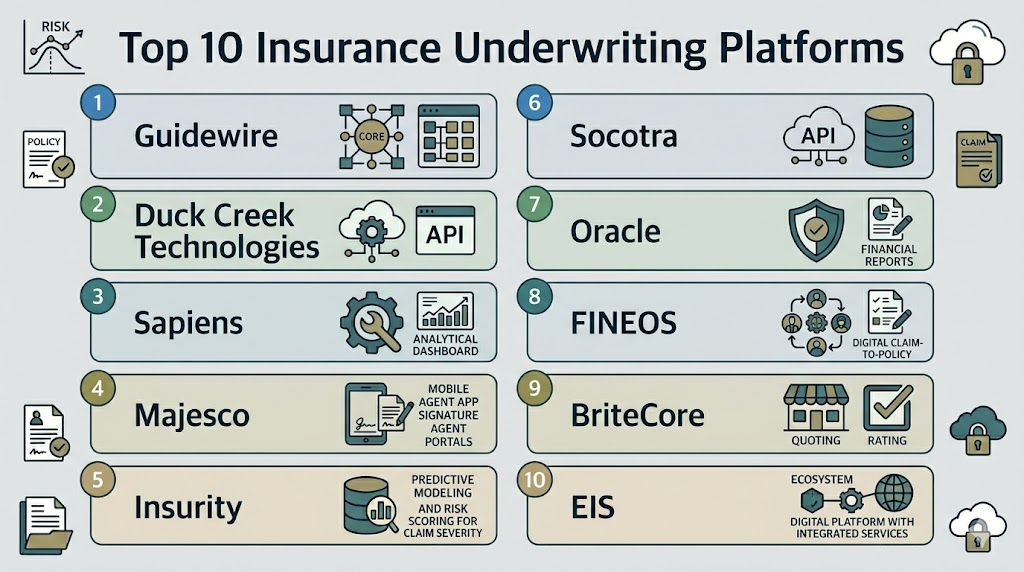
Top 10 Insurance Underwriting Platforms
1- Guidewire
Short description: Guidewire provides enterprise-grade underwriting and policy administration capabilities for property and casualty insurers requiring centralized operational workflows and automation.
Key Features
- Underwriting workflow automation
- Risk evaluation tools
- Product configuration
- Billing integration
- Operational dashboards
- Claims coordination
- Cloud deployment support
Pros
- Strong enterprise scalability
- Mature insurance ecosystem
- Advanced operational automation
Cons
- Complex enterprise implementation
- Premium pricing structure
- Requires experienced administration
Platforms / Deployment
- Web
- Cloud / Hybrid
Security & Compliance
- Encryption
- RBAC
- Audit logs
- SSO/SAML reportedly supported
Integrations & Ecosystem
Guidewire integrates with claims, billing, CRM, and analytics systems for centralized underwriting operations.
- APIs
- CRM systems
- Billing platforms
- Analytics tools
- Insurance operational systems
Support & Community
Strong insurance implementation ecosystem with enterprise onboarding and consulting services.
2- Duck Creek Technologies
Short description: Duck Creek Technologies provides cloud-based underwriting and policy management software for insurers modernizing operational workflows and customer servicing.
Key Features
- Underwriting automation
- Product configuration
- Workflow orchestration
- Billing coordination
- Operational reporting
- Cloud-native deployment
- Risk analytics
Pros
- Flexible cloud architecture
- Strong product configuration support
- Good operational scalability
Cons
- Enterprise onboarding complexity
- Advanced customization requires expertise
- Premium pricing model
Platforms / Deployment
- Web
- Cloud
Security & Compliance
- Encryption
- Audit logs
- RBAC reportedly supported
- SSO reportedly available
Integrations & Ecosystem
Duck Creek integrates with operational insurance systems for centralized underwriting coordination.
- APIs
- CRM systems
- Billing tools
- Analytics platforms
Support & Community
Strong onboarding and insurance-focused implementation support.
3- Sapiens
Short description: Sapiens provides underwriting and policy administration software for life, health, and property and casualty insurance providers seeking operational modernization.
Key Features
- Underwriting workflows
- Risk analytics
- Product configuration
- Billing integration
- Customer communication
- Operational reporting
- Workflow automation
Pros
- Broad insurance sector coverage
- Good operational visibility
- Flexible workflow support
Cons
- Enterprise deployment complexity
- UI modernization varies
- Advanced configuration may require support
Platforms / Deployment
- Web
- Cloud / Hybrid
Security & Compliance
- Encryption
- Audit logs
- RBAC reportedly supported
- SSO reportedly available
Integrations & Ecosystem
Sapiens integrates with insurance operations, analytics, and CRM systems for centralized underwriting management.
- APIs
- CRM systems
- Billing platforms
- Analytics tools
Support & Community
Insurance-focused onboarding and operational consulting support.
4- Majesco
Short description: Majesco delivers underwriting and insurance servicing software focused on operational modernization and digital customer engagement.
Key Features
- Underwriting management
- Workflow automation
- Customer servicing
- Risk evaluation
- Billing integration
- Analytics dashboards
- Product configuration
Pros
- Strong digital engagement capabilities
- Broad operational functionality
- Flexible workflow management
Cons
- Enterprise implementation complexity
- Premium operational pricing
- Advanced onboarding requirements
Platforms / Deployment
- Web
- Cloud
Security & Compliance
- Encryption
- Audit logs
- RBAC reportedly supported
- SSO reportedly available
Integrations & Ecosystem
Majesco integrates with CRM, analytics, and operational insurance systems for centralized underwriting coordination.
- APIs
- CRM platforms
- Billing systems
- Analytics tools
Support & Community
Enterprise onboarding and operational consulting support for digital insurance modernization.
5- Insurity
Short description: Insurity provides underwriting and policy administration software focused on property and casualty insurance operations and risk evaluation workflows.
Key Features
- Underwriting workflows
- Risk analytics
- Workflow automation
- Billing coordination
- Operational dashboards
- Compliance tracking
- Reporting analytics
Pros
- Strong property and casualty specialization
- Good operational visibility
- Flexible workflow support
Cons
- Enterprise customization complexity
- Some modules require configuration
- Premium support pricing
Platforms / Deployment
- Web
- Cloud
Security & Compliance
- Encryption
- Audit logs
- RBAC reportedly available
Integrations & Ecosystem
Insurity integrates with insurance analytics and operational management systems for centralized underwriting operations.
- APIs
- CRM tools
- Billing systems
- Analytics platforms
Support & Community
Operational onboarding and insurance-focused implementation guidance.
6- Socotra
Short description: Socotra delivers API-first underwriting and insurance core platform capabilities focused on operational agility and workflow automation.
Key Features
- Underwriting automation
- API-first architecture
- Product configuration
- Workflow orchestration
- Billing integration
- Reporting dashboards
- Operational scalability
Pros
- Strong API flexibility
- Modern cloud-native architecture
- Rapid operational deployment support
Cons
- Requires technical expertise
- Smaller ecosystem compared to legacy vendors
- Enterprise customization complexity
Platforms / Deployment
- Web
- Cloud
Security & Compliance
- Encryption
- Audit logs
- RBAC reportedly available
Integrations & Ecosystem
Socotra integrates with insurance operations and analytics systems through APIs.
- APIs
- CRM platforms
- Billing systems
- Analytics tools
Support & Community
Developer-focused onboarding and operational implementation support.
7- Oracle Insurance
Short description: Oracle Insurance provides enterprise underwriting and policy management capabilities for large-scale insurers requiring operational scalability and governance support.
Key Features
- Underwriting workflows
- Risk evaluation
- Workflow automation
- Operational dashboards
- Billing integration
- Compliance tracking
- Enterprise analytics
Pros
- Strong enterprise scalability
- Mature database ecosystem
- Broad integration capabilities
Cons
- Complex enterprise deployment
- High implementation costs
- Requires experienced administration
Platforms / Deployment
- Web
- Cloud / Hybrid
Security & Compliance
- Encryption
- RBAC
- Audit logs
- SSO/SAML reportedly supported
Integrations & Ecosystem
Oracle integrates with enterprise financial, operational, and insurance systems for centralized underwriting operations.
- ERP systems
- Analytics platforms
- APIs
- CRM systems
Support & Community
Large enterprise ecosystem with strong onboarding and consulting support.
8- FINEOS
Short description: FINEOS specializes in underwriting and insurance administration software for life insurance, disability insurance, and employee benefits operations.
Key Features
- Underwriting workflows
- Risk management
- Billing coordination
- Customer servicing
- Operational reporting
- Product configuration
- Workflow automation
Pros
- Strong life insurance specialization
- Good employee benefits support
- Flexible operational workflows
Cons
- Industry specialization may limit fit
- Advanced onboarding requirements
- Enterprise implementation complexity
Platforms / Deployment
- Web
- Cloud
Security & Compliance
- Encryption
- Audit logs
- RBAC reportedly available
Integrations & Ecosystem
FINEOS integrates with insurance servicing and operational management systems.
- APIs
- CRM platforms
- Billing systems
- Analytics tools
Support & Community
Insurance-focused onboarding and implementation expertise.
9- BriteCore
Short description: BriteCore provides cloud-native underwriting and policy servicing software for insurers modernizing operational workflows and deployment infrastructure.
Key Features
- Underwriting automation
- Billing coordination
- Workflow management
- Reporting dashboards
- Operational analytics
- Product configuration
- Cloud deployment support
Pros
- Modern cloud architecture
- Faster deployment compared to legacy systems
- Good usability
Cons
- Enterprise customization may vary
- Smaller ecosystem than major competitors
- Advanced analytics depth varies
Platforms / Deployment
- Web
- Cloud
Security & Compliance
- Encryption
- Audit logs
- SSO reportedly supported
Integrations & Ecosystem
BriteCore integrates with insurance operational and analytics systems through APIs.
- APIs
- CRM systems
- Billing tools
- Analytics platforms
Support & Community
Responsive onboarding and operational support suitable for growing insurers.
10- EIS
Short description: EIS provides cloud-native underwriting and insurance management software for insurers seeking digital operational modernization and customer-centric servicing.
Key Features
- Underwriting administration
- Workflow automation
- Billing coordination
- Customer engagement tools
- Analytics dashboards
- Omnichannel servicing
- Product configuration
Pros
- Strong digital customer experience
- Modern cloud deployment
- Good operational flexibility
Cons
- Enterprise onboarding complexity
- Advanced workflows require configuration
- Premium enterprise pricing
Platforms / Deployment
- Web
- Cloud
Security & Compliance
- Encryption
- RBAC reportedly supported
- Audit logs
- SSO reportedly available
Integrations & Ecosystem
EIS integrates with insurance operational systems, CRM platforms, and analytics tools.
- APIs
- CRM systems
- Billing platforms
- Analytics tools
Support & Community
Enterprise onboarding and operational consulting support for digital insurance modernization.
Comparison Table
| Tool Name | Best For | Platforms Supported | Deployment | Standout Feature | Public Rating |
|---|---|---|---|---|---|
| Guidewire | Enterprise property and casualty insurers | Web | Cloud, Hybrid | Mature underwriting ecosystem | N/A |
| Duck Creek Technologies | Cloud insurance modernization | Web | Cloud | Flexible cloud architecture | N/A |
| Sapiens | Multi-line insurance providers | Web | Cloud, Hybrid | Broad insurance coverage | N/A |
| Majesco | Digital insurance operations | Web | Cloud | Customer engagement workflows | N/A |
| Insurity | Property and casualty underwriting | Web | Cloud | Risk evaluation support | N/A |
| Socotra | API-first insurance operations | Web | Cloud | API-driven flexibility | N/A |
| Oracle Insurance | Enterprise insurance operations | Web | Cloud, Hybrid | Enterprise scalability | N/A |
| FINEOS | Life and benefits insurance | Web | Cloud | Employee benefits specialization | N/A |
| BriteCore | Cloud-native insurance deployment | Web | Cloud | Modern operational usability | N/A |
| EIS | Customer-centric insurance servicing | Web | Cloud | Omnichannel underwriting experience | N/A |
Evaluation & Scoring of Insurance Underwriting Platforms
| Tool Name | Core Features 25% | Ease of Use 15% | Integrations 15% | Security 10% | Performance 10% | Support 10% | Value 15% | Weighted Total |
|---|---|---|---|---|---|---|---|---|
| Guidewire | 10 | 7 | 9 | 9 | 9 | 9 | 7 | 8.65 |
| Duck Creek Technologies | 9 | 8 | 8 | 8 | 9 | 8 | 7 | 8.10 |
| Sapiens | 8 | 7 | 8 | 8 | 8 | 8 | 7 | 7.75 |
| Majesco | 8 | 7 | 8 | 8 | 8 | 8 | 7 | 7.75 |
| Insurity | 8 | 7 | 7 | 8 | 8 | 8 | 7 | 7.60 |
| Socotra | 8 | 7 | 9 | 8 | 8 | 7 | 7 | 7.80 |
| Oracle Insurance | 9 | 6 | 10 | 9 | 9 | 9 | 6 | 8.25 |
| FINEOS | 8 | 7 | 7 | 8 | 8 | 8 | 7 | 7.60 |
| BriteCore | 7 | 8 | 7 | 7 | 8 | 7 | 8 | 7.50 |
| EIS | 8 | 7 | 8 | 8 | 8 | 8 | 7 | 7.75 |
Which Insurance Underwriting Platform Is Right for You?
Solo / Freelancer
Smaller insurance agencies and independent operators generally benefit from lightweight underwriting systems that prioritize usability, cloud deployment, and operational simplicity. Easy-to-use platforms with basic risk evaluation, quote generation, and reporting workflows are often sufficient for smaller operational environments. These organizations usually prioritize affordability and fast onboarding over advanced enterprise customization. Cloud-native systems also reduce infrastructure management complexity.
SMB
Small and medium-sized insurance businesses should focus on platforms that balance workflow automation, operational flexibility, usability, and pricing efficiency. SMB insurers often need scalable underwriting systems that improve servicing efficiency without introducing unnecessary operational complexity. Customer communication, reporting visibility, and automation are especially valuable for growing insurance providers. Simpler onboarding and centralized dashboards also improve operational adoption.
Mid-Market
Mid-market insurers benefit from stronger integrations, analytics, centralized reporting, and multi-product underwriting capabilities. These organizations often require more advanced workflow automation and operational visibility as product lines and customer operations expand. Platforms with mature APIs and flexible underwriting workflows are usually the best fit. Scalability and operational coordination become increasingly important as underwriting volumes grow.
Enterprise
Large insurance carriers should prioritize governance, scalability, workflow automation, advanced analytics, risk evaluation capabilities, and enterprise-grade integration support. Organizations operating across multiple insurance lines often require highly configurable underwriting systems with centralized reporting and operational governance controls. Enterprise deployments also demand mature integrations with billing, CRM, underwriting, and policy administration systems. Security, compliance, and operational resilience become critical selection factors.
Budget vs Premium
Budget-focused underwriting systems usually prioritize operational simplicity, usability, and core underwriting workflows for smaller organizations. Premium enterprise platforms provide advanced analytics, risk modeling, operational governance, automation, and large-scale insurance management capabilities. Organizations should evaluate long-term operational value rather than focusing only on licensing costs. Premium platforms are generally better suited for highly regulated and operationally complex insurance environments.
Feature Depth vs Ease of Use
Some underwriting platforms provide extensive workflow customization, advanced analytics, and operational governance controls but require more onboarding and technical expertise. Other solutions focus on operational simplicity and rapid deployment for insurers seeking practical modernization capabilities. Businesses should balance feature depth with usability and operational adoption. Highly complex systems may reduce efficiency if workflows become difficult for teams to manage.
Integrations & Scalability
Insurance providers using CRM, billing, ERP, analytics, and policy administration systems should prioritize platforms with mature APIs and broad integration ecosystems. Strong integrations improve operational visibility and reduce manual administrative work across departments. Scalable systems also help insurers expand underwriting workflows without requiring major infrastructure changes later. Long-term scalability is especially important for insurers managing multiple insurance products and distributed operations.
Security & Compliance Needs
Insurance organizations operating in regulated environments should prioritize encryption, RBAC, audit logging, SSO, and governance controls when evaluating underwriting systems. Security becomes increasingly important when handling sensitive customer, billing, and underwriting data. Enterprises often require centralized access management and compliance reporting capabilities for audit readiness. Strong governance features also improve operational accountability and regulatory compliance management.
Frequently Asked Questions
1. What are Insurance Underwriting Platforms?
Insurance Underwriting Platforms help insurers evaluate risk, automate underwriting decisions, generate quotes, and manage policy approvals through centralized digital workflows. These systems improve operational efficiency and underwriting visibility across insurance operations. Many platforms also provide automation, analytics, and reporting capabilities. Modern systems combine underwriting, policy servicing, and operational management into a unified environment.
2. Which insurance sectors use underwriting platforms the most?
Property and casualty insurers, life insurance providers, health insurers, MGA organizations, and specialty insurance companies are among the largest users of underwriting platforms. These organizations require centralized systems to manage risk evaluation, pricing, approvals, and operational workflows. Underwriting systems help improve efficiency, scalability, and operational consistency. They are also increasingly used for digital insurance modernization initiatives.
3. Are cloud-based underwriting platforms secure?
Most modern underwriting platforms provide encryption, access controls, audit logging, and secure cloud infrastructure to support enterprise security requirements. Many vendors also offer role-based permissions and centralized governance capabilities. Insurance providers handling sensitive customer and financial data should carefully evaluate vendor security controls. Security requirements vary depending on operational complexity and regulatory obligations.
4. How much do Insurance Underwriting Platforms cost?
Pricing varies based on organization size, deployment complexity, integrations, underwriting automation requirements, and insurance product lines. Some vendors use subscription-based pricing while enterprise systems often require customized licensing agreements. Advanced analytics, workflow customization, and operational governance can increase total ownership costs. Organizations should evaluate both implementation expenses and long-term operational value before selecting a platform.
5. Do these systems support workflow automation?
Yes, most modern underwriting platforms provide workflow automation capabilities for risk assessment, quote generation, approvals, customer communication, and operational reporting. Automation helps insurers reduce manual workloads and improve operational efficiency. Many platforms also support configurable workflows and analytics dashboards. Workflow automation is increasingly important for insurers managing high underwriting volumes.
6. Can underwriting platforms integrate with policy administration systems?
Many enterprise underwriting systems integrate with policy administration, CRM, billing, ERP, analytics, and claims systems through APIs and connectors. Integrations help insurers centralize operational workflows and improve visibility across departments. Insurance providers using modern digital ecosystems often prioritize mature integration capabilities. Strong integrations also improve scalability and long-term operational flexibility.
7. What are common implementation challenges?
Organizations often underestimate workflow configuration, onboarding, data migration, integration planning, and operational training requirements during implementation. Large insurance deployments may also require dedicated administrators and governance planning. Some enterprise systems involve lengthy customization and deployment timelines. Careful implementation planning and phased rollouts usually improve long-term operational success.
8. Are AI features becoming important in underwriting platforms?
AI-powered risk scoring, predictive analytics, automated underwriting decisions, workflow intelligence, and fraud detection are becoming increasingly valuable in modern insurance environments. These capabilities help insurers improve operational efficiency and accelerate underwriting processes. Automation also reduces manual administrative workloads across departments. AI-driven insights support more proactive operational and risk management strategies.
9. What should buyers prioritize when selecting a platform?
Insurance organizations should prioritize scalability, workflow automation, integrations, reporting visibility, analytics capabilities, operational flexibility, and compliance support before comparing advanced features. Security capabilities such as encryption, RBAC, audit logging, and SSO are especially important for regulated environments. Buyers should evaluate how well the platform supports real underwriting workflows and operational requirements. Pilot testing is strongly recommended before full deployment.
10. Are Insurance Underwriting Platforms suitable for SMB insurers?
Yes, many vendors now provide SMB-friendly underwriting solutions with cloud deployment, simplified workflows, and faster onboarding capabilities. Smaller insurers often benefit from centralized underwriting, reporting, and operational visibility without needing enterprise-scale infrastructure. SMB-focused platforms also tend to prioritize usability and operational flexibility. Choosing a scalable platform helps support long-term operational growth and insurance product expansion.
Conclusion
Insurance Underwriting Platforms play a critical role in helping insurers improve underwriting accuracy, workflow automation, operational scalability, customer servicing, and risk evaluation across insurance operations. Modern platforms provide centralized underwriting coordination, analytics dashboards, cloud deployment flexibility, omnichannel communication, and enterprise integrations that strengthen operational performance and improve scalability. The right platform depends heavily on operational complexity, underwriting volume, integration requirements, compliance expectations, and long-term modernization goals. SMBs often prioritize usability and deployment simplicity, while large insurance carriers require advanced governance, analytics, risk modeling, workflow automation, and enterprise-grade integration capabilities. Insurance organizations should focus on operational fit, scalability, security controls, integration maturity, and workflow flexibility rather than selecting a platform based only on feature count. A practical approach is to shortlist a few platforms, test underwriting workflows, validate integrations and compliance requirements, and then choose the solution that best supports long-term operational efficiency and insurance modernization objectives.

Find Trusted Cardiac Hospitals
Compare heart hospitals by city and services — all in one place.
Explore Hospitals
Insurance underwriting platforms are most valuable when they automate and optimize the underwriting process by evaluating risk, determining policy eligibility, and supporting accurate pricing decisions. By providing AI-driven risk assessment, rules-based underwriting, automated data collection, predictive analytics, document management, regulatory compliance, workflow automation, and integration with policy administration and third-party data sources, these platforms help insurers accelerate policy approvals, improve underwriting accuracy, reduce operational costs, and deliver faster, more consistent customer experiences.