Introduction
IoT Device Management Platforms are software solutions that allow organizations to securely manage, monitor, and update a wide array of connected devices across diverse networks. These platforms provide centralized visibility, remote configuration, firmware updates, security management, and analytics for IoT ecosystems. As enterprises adopt IoT at scale efficient device management has become critical to ensure reliability, security, and operational efficiency.
Why it matters now: Modern IoT deployments involve thousands to millions of devices, spanning industrial equipment, healthcare sensors, smart cities infrastructure, and consumer devices. Without a robust platform, organizations face challenges in maintaining device health, applying security patches, monitoring performance, and analyzing data streams effectively.
Real-world use cases:
- Smart manufacturing: Managing factory sensors, robotics, and predictive maintenance devices.
- Healthcare monitoring: Remote management of wearable devices and hospital equipment.
- Energy management: Tracking and controlling smart meters, grid sensors, and renewable assets.
- Logistics and fleet management: Managing GPS trackers, RFID readers, and vehicle sensors.
- Smart buildings: Coordinating HVAC, lighting, and security systems across multiple locations.
Evaluation criteria for buyers:
- Device onboarding and provisioning capabilities
- Remote monitoring and firmware management
- Scalability and multi-tenant support
- Security and compliance (encryption, audit logs, GDPR, SOC 2)
- Integration with existing IT/OT systems
- Data analytics and visualization
- Alerting and event management
- Ease of deployment and maintenance
- Cost and licensing flexibility
- Vendor support and community ecosystem
Best for: Enterprises, SMBs, and IoT service providers that operate large-scale connected device networks, need remote monitoring, and require strong security and regulatory compliance. Industries include manufacturing, healthcare, energy, transportation, and smart city initiatives.
Not ideal for: Small projects with only a few devices or hobbyist deployments, where manual management or simpler cloud IoT services may suffice.
Key Trends in IoT Device Management Platforms
- AI-driven predictive maintenance: Platforms now include AI/ML to predict device failures before they occur.
- Edge computing integration: Processing data closer to devices reduces latency and bandwidth usage.
- Zero-trust security models: Devices and networks are continuously verified to prevent breaches.
- Firmware over-the-air (FOTA) updates: Remote updates are becoming faster and more reliable.
- Interoperability and standards adoption: Increased use of MQTT, OPC-UA, and LwM2M protocols.
- Hybrid and multi-cloud deployment: Support for on-premises, cloud, or hybrid environments.
- Digital twins support: Device twins enable simulation, diagnostics, and performance monitoring.
- Regulatory compliance automation: Built-in tools for GDPR, HIPAA, ISO 27001 compliance.
- Integration with enterprise platforms: Direct connections to ERP, CRM, and analytics platforms.
- Subscription and pay-as-you-go models: Flexible pricing based on device count and usage.
How We Selected These Tools (Methodology)
- Evaluated market adoption and vendor mindshare among enterprises and IoT integrators.
- Assessed feature completeness for device onboarding, monitoring, updates, and analytics.
- Reviewed reliability and performance signals such as uptime, latency, and scalability.
- Examined security posture including authentication, encryption, and audit capabilities.
- Considered integration ecosystem, APIs, and interoperability with other software and cloud services.
- Accounted for customer fit across segments including SMB, mid-market, and large enterprise.
- Weighted platform flexibility for cloud, on-premises, and hybrid deployments.
- Analyzed support quality and community engagement for onboarding and troubleshooting.
- Factored in pricing models relative to device counts and enterprise budgets.
- Focused on 2026 relevance, including AI features, edge computing, and IoT analytics.
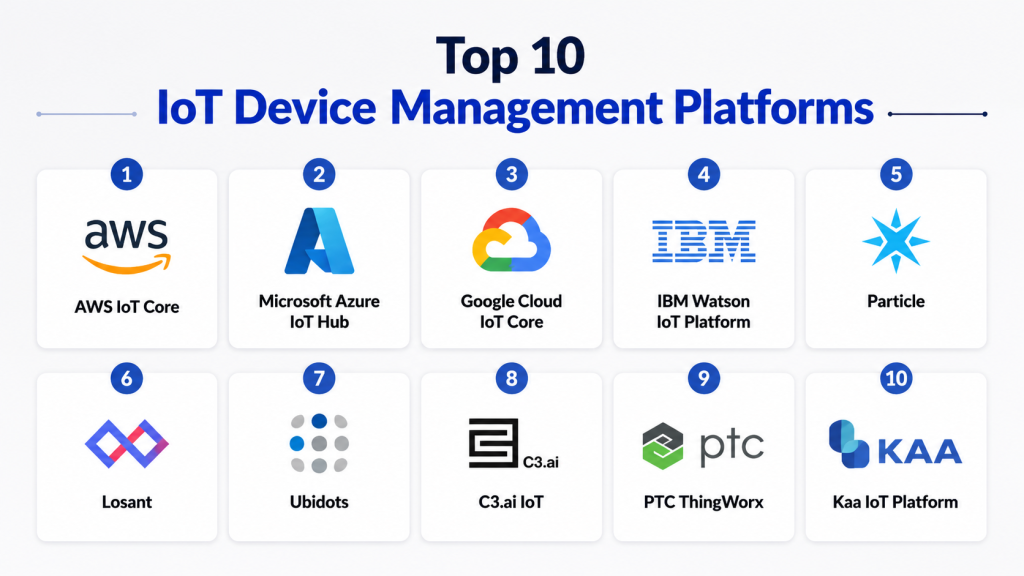
Top 10 IoT Device Management Platforms
1- AWS IoT Core
Short description: AWS IoT Core provides a scalable cloud platform to connect, manage, and secure IoT devices, ideal for enterprises leveraging AWS infrastructure.
Key Features
- Device registration and provisioning at scale
- Secure communication via TLS and MQTT protocols
- FOTA updates and shadow device states
- Real-time telemetry ingestion and rules engine
- Integration with AWS analytics, Lambda, and AI services
- Role-based access control and policy management
Pros
- Seamless integration with the AWS ecosystem
- Highly scalable for large device fleets
- Extensive analytics and AI/ML capabilities
Cons
- Complexity can be high for smaller teams
- Pricing can be unpredictable with large-scale data ingestion
- Requires AWS-specific expertise
Platforms / Deployment
- Web / Cloud
- Cloud
Security & Compliance
- TLS encryption, RBAC, audit logs
- SOC 2, ISO 27001
Integrations & Ecosystem
AWS IoT Core integrates tightly with AWS analytics, AI/ML, and storage services:
- AWS Lambda
- Amazon S3 / Kinesis / DynamoDB
- AWS IoT Analytics / SageMaker
- Third-party APIs via REST/MQTT
Support & Community
Comprehensive documentation, support tiers, and active community forums.
2- Microsoft Azure IoT Hub
Short description: Azure IoT Hub enables secure device-to-cloud and cloud-to-device communication with enterprise-grade device management features.
Key Features
- Bi-directional messaging with cloud integration
- Device twins for state synchronization
- Automatic device provisioning
- FOTA support and device monitoring dashboards
- Scalable messaging via IoT protocols
- Integration with Azure analytics and AI services
Pros
- Enterprise-ready with strong Microsoft ecosystem integration
- Supports millions of devices
- Advanced security features
Cons
- Complexity for small deployments
- Pricing scales with device count and messages
- Some features require Azure subscription
Platforms / Deployment
- Web / Windows / Linux / iOS / Android
- Cloud
Security & Compliance
- SSO/SAML, MFA, encryption
- ISO 27001, SOC 2, GDPR
Integrations & Ecosystem
Integrates with Microsoft Azure stack and third-party systems:
- Azure Stream Analytics
- Power BI
- Azure Machine Learning
- REST/MQTT APIs
Support & Community
Extensive docs, enterprise support plans, active developer community.
3- Google Cloud IoT Core
Short description: Google Cloud IoT Core offers device connectivity, management, and analytics leveraging GCP infrastructure and edge computing.
Key Features
- Device provisioning and authentication
- Secure communication with TLS
- Cloud Pub/Sub integration for messaging
- Real-time telemetry ingestion
- Device shadowing for state management
- Analytics and AI integration
Pros
- Seamless integration with Google Cloud services
- Scalable for large IoT networks
- Strong analytics and ML capabilities
Cons
- Limited support outside Google Cloud
- Some advanced features require deep technical knowledge
- Migration can be complex
Platforms / Deployment
- Web / Cloud
- Cloud
Security & Compliance
- TLS encryption, RBAC, audit logs
- SOC 2, ISO 27001
Integrations & Ecosystem
- Google BigQuery
- Cloud Functions
- Cloud AI and ML services
- REST APIs
Support & Community
Varies / Not publicly stated; strong documentation and active forums.
4- IBM Watson IoT Platform
Short description: IBM Watson IoT Platform allows enterprises to connect devices, analyze data, and automate IoT workflows with AI-powered insights.
Key Features
- Device connectivity and management
- Real-time analytics and visualization
- AI-driven predictive maintenance
- Secure FOTA updates
- Integration with IBM Cloud services
- Role-based access and audit logs
Pros
- Strong AI/ML integration
- Enterprise-grade security
- Scalable for industrial IoT
Cons
- Cost can be high for SMBs
- Learning curve for full AI features
- Some integration complexity
Platforms / Deployment
- Web / Windows / Linux / iOS / Android
- Cloud / Hybrid
Security & Compliance
- TLS, MFA, audit logs
- ISO 27001, SOC 2
Integrations & Ecosystem
- IBM Cloud services
- Node-RED and Watson AI
- REST/MQTT APIs
- Third-party analytics
Support & Community
Comprehensive enterprise support; moderate community forums.
5- Particle
Short description: Particle provides a device-first IoT platform for developers and SMBs to build, connect, and manage IoT hardware efficiently.
Key Features
- Device OS and firmware management
- Secure device provisioning
- Cloud APIs for integration
- Real-time monitoring and alerts
- FOTA support
- Web and mobile dashboards
Pros
- Developer-friendly and fast onboarding
- Strong hardware ecosystem
- Simple cloud management
Cons
- Limited analytics compared to enterprise platforms
- Best suited for smaller deployments
- Some limitations in hybrid or on-prem deployment
Platforms / Deployment
- Web / Windows / Linux / iOS / Android
- Cloud
Security & Compliance
- TLS, secure authentication
- Not publicly stated
Integrations & Ecosystem
- REST APIs
- MQTT integration
- Particle cloud services
Support & Community
Active developer community, tutorials, and support tiers.
6- Losant
Short description: Losant is a low-code IoT platform enabling rapid application development, device management, and data visualization for enterprises.
Key Features
- Low-code workflow engine
- Device provisioning and management
- Real-time dashboards
- Alerts and notifications
- Integration with cloud and enterprise systems
- API access and extensibility
Pros
- Rapid prototyping and deployment
- Flexible workflow automation
- Good multi-cloud support
Cons
- Requires subscription for full features
- May need additional integration work for complex environments
- Limited offline edge capabilities
Platforms / Deployment
- Web / Cloud
- Cloud / Hybrid
Security & Compliance
- TLS encryption, RBAC
- Not publicly stated
Integrations & Ecosystem
- REST APIs
- Webhooks
- Cloud integrations: AWS, Azure, GCP
Support & Community
Strong documentation and support; active online community.
7- Ubidots
Short description: Ubidots is a cloud-first IoT platform for SMBs and educational projects, enabling device management, data visualization, and analytics.
Key Features
- Device onboarding and provisioning
- FOTA updates and monitoring
- Visual dashboards
- Alerts and triggers
- REST and MQTT API support
Pros
- Easy to use for SMBs and makers
- Rapid deployment
- Affordable pricing
Cons
- Not ideal for large enterprise-scale IoT
- Limited advanced analytics
- Hybrid deployment not supported
Platforms / Deployment
- Web / iOS / Android
- Cloud
Security & Compliance
- TLS encryption, authentication
- Not publicly stated
Integrations & Ecosystem
- REST API
- Webhooks
- Zapier integration
Support & Community
Documentation and community forums available; responsive support tiers.
8- C3.ai IoT
Short description: C3.ai IoT provides an AI-powered platform for industrial enterprises, focusing on predictive maintenance, energy management, and operational optimization.
Key Features
- AI/ML-driven device analytics
- Large-scale device management
- Predictive maintenance
- Cloud-based dashboards
- Integration with ERP and SCADA systems
Pros
- Strong industrial IoT focus
- Advanced AI analytics
- Scales to millions of devices
Cons
- Complexity and cost can be high
- Requires specialized implementation
- Less suitable for SMBs
Platforms / Deployment
- Web / Cloud
- Cloud / Hybrid
Security & Compliance
- Encryption, audit logs, RBAC
- Not publicly stated
Integrations & Ecosystem
- ERP, SCADA, IoT protocols
- REST APIs
- AI analytics services
Support & Community
Enterprise support; community less active than developer-focused platforms.
9- PTC ThingWorx
Short description: ThingWorx is an industrial IoT platform providing rapid application development, device management, and operational insights for manufacturing and logistics.
Key Features
- Device management and provisioning
- FOTA and remote updates
- Low-code application builder
- Analytics and visualization dashboards
- Workflow and alerting engine
Pros
- Enterprise-grade industrial IoT
- Low-code applications accelerate deployment
- Strong integration options
Cons
- High learning curve
- Cost can be prohibitive for SMBs
- Some cloud dependencies
Platforms / Deployment
- Web / Windows / Linux
- Cloud / Hybrid
Security & Compliance
- TLS, MFA, RBAC
- Not publicly stated
Integrations & Ecosystem
- ERP, MES, SCADA integration
- REST/MQTT APIs
- Edge devices and sensors
Support & Community
Strong enterprise support and documentation; moderate community.
10- Kaa IoT Platform
Short description: Kaa is an open-source IoT platform offering device management, integration, and analytics for developers and enterprises.
Key Features
- Device provisioning and control
- FOTA updates
- Multi-tenant support
- Analytics and dashboards
- API and SDK support for multiple languages
Pros
- Open-source flexibility
- Multi-platform support
- Cost-effective for custom solutions
Cons
- Requires technical expertise to deploy
- Less polished UX compared to commercial platforms
- Enterprise support varies
Platforms / Deployment
- Web / Windows / Linux / macOS
- Cloud / Self-hosted / Hybrid
Security & Compliance
- TLS, RBAC
- Not publicly stated
Integrations & Ecosystem
- REST APIs and SDKs
- MQTT integration
- Supports third-party analytics
Support & Community
Open-source community, documentation available; commercial support optional.
Comparison Table (Top 10)
| Tool Name | Best For | Platform(s) Supported | Deployment | Standout Feature | Public Rating |
|---|---|---|---|---|---|
| AWS IoT Core | Enterprise IoT | Web | Cloud | Scalability + AWS ecosystem | N/A |
| Azure IoT Hub | Enterprise | Web / Windows / Linux | Cloud | Device twins & Microsoft integration | N/A |
| Google Cloud IoT Core | Enterprise | Web | Cloud | Edge + analytics integration | N/A |
| IBM Watson IoT Platform | Industrial IoT | Web / Windows / Linux / iOS / Android | Cloud / Hybrid | AI-driven insights | N/A |
| Particle | Developer / SMB | Web / Windows / Linux / iOS / Android | Cloud | Hardware + developer tools | N/A |
| Losant | SMB / Enterprise | Web | Cloud / Hybrid | Low-code workflows | N/A |
| Ubidots | SMB / Educational | Web / iOS / Android | Cloud | Dashboards & alerts | N/A |
| C3.ai IoT | Industrial | Web | Cloud / Hybrid | Predictive maintenance | N/A |
| PTC ThingWorx | Manufacturing | Web / Windows / Linux | Cloud / Hybrid | Low-code industrial apps | N/A |
| Kaa IoT Platform | Developer / Custom | Web / Windows / Linux / macOS | Cloud / Self-hosted / Hybrid | Open-source flexibility | N/A |
Evaluation & Scoring of IoT Device Management Platforms
| Tool Name | Core (25%) | Ease (15%) | Integrations (15%) | Security (10%) | Performance (10%) | Support (10%) | Value (15%) | Weighted Total (0–10) |
|---|---|---|---|---|---|---|---|---|
| AWS IoT Core | 9 | 7 | 9 | 9 | 9 | 8 | 7 | 8.7 |
| Azure IoT Hub | 9 | 7 | 9 | 9 | 9 | 8 | 7 | 8.7 |
| Google Cloud IoT Core | 8 | 7 | 8 | 8 | 8 | 7 | 7 | 8.0 |
| IBM Watson IoT | 9 | 6 | 8 | 9 | 8 | 7 | 6 | 7.9 |
| Particle | 7 | 8 | 7 | 7 | 7 | 7 | 8 | 7.5 |
| Losant | 8 | 8 | 8 | 7 | 8 | 7 | 7 | 7.9 |
| Ubidots | 6 | 8 | 6 | 6 | 6 | 6 | 8 | 6.7 |
| C3.ai IoT | 9 | 6 | 7 | 9 | 8 | 6 | 6 | 7.7 |
| PTC ThingWorx | 9 | 6 | 8 | 8 | 8 | 6 | 6 | 7.8 |
| Kaa IoT Platform | 7 | 6 | 7 | 7 | 7 | 6 | 9 | 7.3 |
Which IoT Device Management Platform Is Right for You?
Solo / Freelancer
Focus on lightweight, developer-friendly platforms such as Particle or Ubidots for quick prototyping and minimal overhead.
SMB
Losant or Particle provide a balance of ease-of-use, dashboards, and moderate scalability.
Mid-Market
Azure IoT Hub or AWS IoT Core offers scalability, integration with enterprise systems, and secure device management.
Enterprise
IBM Watson IoT, C3.ai, or PTC ThingWorx provide AI-powered insights, advanced security, and industrial-grade performance.
Budget vs Premium
Open-source platforms like Kaa offer cost-effective customization, while cloud-native enterprise platforms provide richer integrations at higher cost.
Feature Depth vs Ease of Use
Developer-focused platforms prioritize simplicity; enterprise platforms offer deeper analytics and device control at the cost of complexity.
Integrations & Scalability
Enterprise deployments benefit from AWS, Azure, and Google Cloud ecosystems; SMBs can leverage API-first platforms with flexible integrations.
Security & Compliance Needs
Regulated industries (healthcare, energy) require platforms with strong encryption, RBAC, and compliance certifications.
Frequently Asked Questions (FAQs)
1- What pricing models do IoT device management platforms offer?
Most platforms use subscription pricing based on device count, messages, or data volume. Some offer pay-as-you-go or tiered plans to scale with growth.
2- How difficult is onboarding devices?
It varies. Enterprise platforms support bulk provisioning and automated onboarding, while developer-focused platforms require manual setup or SDK integration.
3- Can I manage devices remotely?
Yes. Remote device management, monitoring, and firmware updates are core features of these platforms.
4- How do these platforms handle security?
They implement TLS, RBAC, MFA, and audit logs. Some provide compliance with SOC 2, ISO 27001, and GDPR.
5- Are AI/ML analytics included?
Many platforms integrate with AI/ML tools for predictive maintenance, anomaly detection, and operational insights.
6- Can platforms scale to millions of devices?
Cloud-native platforms like AWS IoT Core and Azure IoT Hub are designed for massive scalability. Smaller platforms may be limited.
7- How do integrations work?
Platforms offer REST/MQTT APIs, webhooks, and native connectors to ERP, analytics, and cloud services.
8- What common mistakes should be avoided?
Not planning for security, ignoring protocol standards, underestimating device counts, and neglecting compliance can cause failures.
9- How easy is switching platforms?
Switching can require re-onboarding devices, adapting APIs, and migrating data. Vendor support helps minimize disruption.
10- Are hybrid deployments possible?
Some platforms support hybrid deployment with on-premises edge nodes combined with cloud management, offering flexibility for regulatory or latency requirements.
Conclusion
IoT Device Management Platforms are essential for modern enterprises, enabling secure, scalable, and efficient control of connected devices. Choosing the right platform depends on organizational size, deployment scale, integration needs, and compliance requirements. Small teams benefit from developer-focused solutions like Particle or Ubidots, while enterprises require robust platforms like AWS IoT Core, Azure IoT Hub, or IBM Watson IoT for AI-driven insights and industrial-grade management. Start by shortlisting 2–3 platforms, run a pilot deployment, validate integration and security needs, and then scale across your IoT ecosystem.

Find Trusted Cardiac Hospitals
Compare heart hospitals by city and services — all in one place.
Explore Hospitals
The true value of an IoT device management platform often emerges after deployment, when thousands of devices need to be managed reliably over time. Features that simplify provisioning, policy enforcement, and large-scale troubleshooting can make day-to-day operations far more efficient than focusing solely on connectivity capabilities.