Introduction
IVR (Interactive Voice Response) and Voice Bot Platforms are technologies that allow businesses to automate voice interactions with customers. These platforms enable users to navigate menus, request information, and complete tasks using voice commands or keypad inputs. In the current landscape, where customer expectations for immediate and efficient support are high, IVR and voice bots are crucial for reducing wait times, improving service quality, and lowering operational costs.
Organizations leverage IVR and voice bots in numerous scenarios, such as call routing in contact centers, automated appointment scheduling, customer support, lead qualification, and survey collection. These platforms can handle high call volumes, offer self-service options, and integrate seamlessly with CRM and ticketing systems, providing agents more time to handle complex queries. When evaluating IVR and voice bot platforms, buyers should consider factors including AI and NLP capabilities, ease of use, integration support, deployment options, multilingual support, analytics and reporting, scalability, security compliance, and total cost of ownership.
Best for: Contact centers, customer support teams, large enterprises, SMBs aiming to reduce call center load, industries like banking, healthcare, telecom, and e-commerce.
Not ideal for: Small organizations with minimal call volume or businesses that rely solely on human-driven interactions where advanced automation is unnecessary.
Key Trends in IVR & Voice Bot Platforms
- Adoption of AI-powered natural language processing (NLP) to understand complex customer queries.
- Integration with CRM and omnichannel platforms to create unified customer experiences.
- Self-service automation to reduce call center costs and enhance response speed.
- Cloud-based deployment as organizations shift from on-premises IVR systems.
- Support for multilingual interactions and regional accents.
- Predictive analytics and conversation insights to optimize scripts and workflows.
- Voice biometrics and authentication for secure transactions.
- Omnichannel voice bots integrating voice with chat, SMS, and email.
- Flexible subscription and usage-based pricing models for scalability.
- Compliance with GDPR, HIPAA, and other industry-specific regulations for secure data handling.
How We Selected These Tools (Methodology)
- Evaluated market adoption and mindshare across enterprises and SMBs.
- Assessed feature completeness, including NLP, automation, analytics, and omnichannel support.
- Reviewed performance and reliability through uptime records and user feedback.
- Analyzed security and compliance, focusing on encryption, authentication, and regulatory adherence.
- Considered integration capabilities with CRMs, ticketing systems, and communication platforms.
- Measured customer fit across different industries and company sizes.
- Evaluated ease of deployment and cloud vs on-premises options.
- Considered vendor support quality and community resources.
- Analyzed pricing models and total cost of ownership.
- Prioritized tools that offer scalability and adaptability for future voice automation needs.
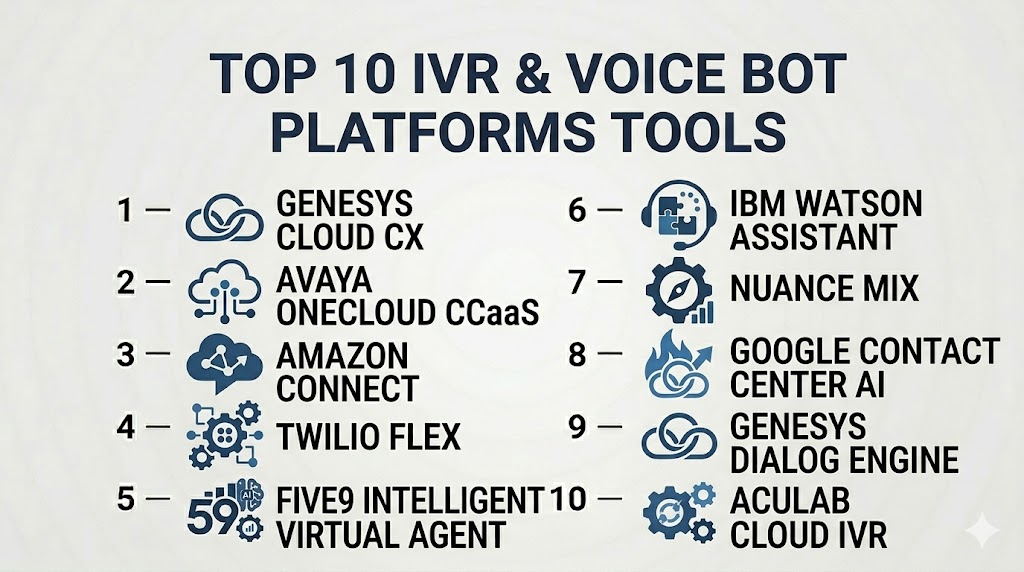
Top 10 IVR & Voice Bot Platforms Tools
#1 — Genesys Cloud CX
Short description : Genesys Cloud CX offers a comprehensive IVR and voice bot platform for enterprises. It leverages AI and natural language understanding to provide automated, intelligent customer interactions.
Key Features
- AI-driven voice bots and NLP
- Predictive call routing and intelligent IVR
- Omnichannel integration (voice, chat, email)
- Real-time analytics and dashboards
- Multilingual support
- CRM integrations
Pros
- Enterprise-grade scalability and reliability
- Advanced AI and analytics features
Cons
- Can be complex for smaller teams
- Premium pricing
Platforms / Deployment
- Web / Cloud
Security & Compliance
- SOC 2, GDPR, HIPAA
Integrations & Ecosystem
- Salesforce, ServiceNow, Microsoft Dynamics
- Open APIs for custom workflows
- Third-party analytics and reporting integrations
Support & Community
- 24/7 support, detailed documentation, user community
#2 — Avaya OneCloud CCaaS
Short description : Avaya OneCloud CCaaS provides advanced IVR and voice bot solutions with strong integration capabilities for mid-market and large enterprises.
Key Features
- AI-powered voice bots and IVR menus
- Omnichannel routing and self-service options
- Speech analytics and reporting
- CRM and ticketing system integration
- Multilingual support
Pros
- Flexible and reliable for enterprise contact centers
- Comprehensive analytics
Cons
- Implementation complexity
- Cost can be high for SMBs
Platforms / Deployment
- Web / Cloud / Hybrid
Security & Compliance
- SOC 2, ISO 27001, GDPR
Integrations & Ecosystem
- Salesforce, Microsoft Dynamics, Oracle CRM
- API for custom integration
- Workflow automation tools
Support & Community
- Enterprise support tiers, documentation, community portal
#3 — Amazon Connect
Short description : Amazon Connect is a cloud-based contact center platform with integrated IVR and voice bot capabilities, leveraging AWS AI services for advanced automation.
Key Features
- AI-powered voice bots via Amazon Lex
- Predictive and dynamic IVR flows
- Real-time analytics and reporting
- Omnichannel support
- Pay-as-you-go pricing
Pros
- Scalable and flexible
- Integration with AWS ecosystem
Cons
- Requires technical expertise
- Complexity in designing advanced flows
Platforms / Deployment
- Web / Cloud
Security & Compliance
- SOC 2, GDPR, HIPAA, encryption
Integrations & Ecosystem
- AWS Lambda, CRM integrations
- Open APIs for customization
- Third-party analytics tools
Support & Community
- AWS support plans, documentation, active community
#4 — Twilio Flex
Short description : Twilio Flex is a programmable contact center platform offering IVR and voice bots, ideal for developers and mid-to-large organizations seeking customizable voice automation.
Key Features
- Customizable IVR and voice bot workflows
- AI and NLP integration
- Multichannel support (voice, chat, SMS)
- Real-time analytics and dashboards
- Cloud-native and scalable
Pros
- Highly customizable and developer-friendly
- Flexible integration with existing systems
Cons
- Requires developer resources
- Steeper learning curve for non-technical teams
Platforms / Deployment
- Web / Cloud
Security & Compliance
- SOC 2, GDPR, MFA
Integrations & Ecosystem
- CRM, ticketing systems, APIs
- Open-source libraries for extensions
- Workflow automation
Support & Community
- Documentation, developer forums, paid support plans
#5 — Five9 Intelligent Virtual Agent
Short description : Five9 offers a voice bot and IVR solution that automates customer interactions, providing AI-assisted conversation handling for enterprises.
Key Features
- AI-driven voice bots
- Predictive and skills-based routing
- Real-time analytics and dashboards
- Omnichannel engagement
- Integration with CRM platforms
Pros
- High scalability for enterprise contact centers
- AI-enhanced customer experience
Cons
- Requires Five9 subscription
- Implementation may be complex
Platforms / Deployment
- Web / Cloud
Security & Compliance
- SOC 2, GDPR
Integrations & Ecosystem
- Salesforce, HubSpot, Microsoft Dynamics
- APIs for workflow integration
- Third-party reporting tools
Support & Community
- 24/7 enterprise support, knowledge base
#6 — IBM Watson Assistant
Short description : IBM Watson Assistant enables AI-powered voice bots and IVR solutions, providing advanced natural language understanding for automated customer interactions.
Key Features
- AI and NLP-powered voice bots
- Omnichannel communication
- Real-time analytics and insights
- Multilingual capabilities
- Integration with CRM and ticketing systems
Pros
- Advanced AI capabilities for complex conversations
- Highly scalable and secure
Cons
- Costly for small teams
- Requires AI expertise for advanced setups
Platforms / Deployment
- Web / Cloud
Security & Compliance
- SOC 2, ISO 27001, GDPR, HIPAA
Integrations & Ecosystem
- Salesforce, ServiceNow, Slack
- API access for custom solutions
- Watson ecosystem tools
Support & Community
- Enterprise support, documentation, user community
#7 — Nuance Mix
Short description : Nuance Mix offers IVR and voice bot solutions for enterprises, focusing on AI-driven automation and natural language understanding.
Key Features
- NLP and AI-powered voice bots
- Omnichannel support
- Predictive IVR flows
- Real-time analytics and reporting
- Integration with CRM systems
Pros
- Strong AI capabilities
- Enterprise-grade reliability
Cons
- Licensing cost may be high
- Implementation requires technical knowledge
Platforms / Deployment
- Web / Cloud
Security & Compliance
- SOC 2, GDPR, HIPAA
Integrations & Ecosystem
- Salesforce, Microsoft Dynamics
- APIs for custom workflows
- Analytics and reporting tools
Support & Community
- Documentation, enterprise support
#8 — Google Contact Center AI
Short description : Google Contact Center AI provides IVR and voice bot solutions leveraging Dialogflow, allowing businesses to automate customer interactions using Google’s AI capabilities.
Key Features
- AI and NLP-powered conversational bots
- Multichannel integration
- Real-time analytics and dashboards
- Customizable IVR flows
- Integration with Google Cloud and CRM systems
Pros
- Advanced AI and NLP capabilities
- Cloud scalability and flexibility
Cons
- Requires technical expertise
- Integration complexity for non-Google systems
Platforms / Deployment
- Web / Cloud
Security & Compliance
- SOC 2, GDPR
Integrations & Ecosystem
- CRM platforms, Google Cloud services
- APIs and SDKs for custom workflows
- Third-party analytics
Support & Community
- Google Cloud support, forums, documentation
#9 — Genesys Dialog Engine
Short description : A component of Genesys CX that provides voice bots and IVR, emphasizing AI conversation management and automated call routing.
Key Features
- AI-powered IVR and voice bots
- Predictive routing and conversation analytics
- Omnichannel support
- Real-time dashboards
- CRM integration
Pros
- Strong enterprise AI features
- Scalable for high call volumes
Cons
- Complexity for small teams
- Requires Genesys CX subscription
Platforms / Deployment
- Web / Cloud
Security & Compliance
- SOC 2, GDPR
Integrations & Ecosystem
- Salesforce, Microsoft Dynamics
- API for extensions
- Analytics and reporting integration
Support & Community
- Documentation, enterprise support
#10 — Aculab Cloud IVR
Short description : Aculab Cloud IVR offers cloud-based voice bot and IVR solutions, suitable for mid-market businesses and service providers.
Key Features
- Customizable IVR flows
- Voice bot integration
- Call recording and reporting
- API-based integration
- Multichannel support
Pros
- Flexible and developer-friendly
- Quick deployment
Cons
- Less AI sophistication than enterprise tools
- Smaller community
Platforms / Deployment
- Web / Cloud
Security & Compliance
- Not publicly stated
Integrations & Ecosystem
- CRM systems, custom APIs
- Workflow automation
Support & Community
- Email support, documentation
Comparison Table (Top 10)
| Tool Name | Best For | Platform(s) Supported | Deployment | Standout Feature | Public Rating |
|---|---|---|---|---|---|
| Genesys Cloud CX | Enterprise | Web | Cloud | AI-powered IVR & voice bots | N/A |
| Avaya OneCloud CCaaS | Mid-market / Enterprise | Web | Cloud / Hybrid | Omnichannel automation | N/A |
| Amazon Connect | Mid-market / Enterprise | Web | Cloud | AWS AI integration | N/A |
| Twilio Flex | Developers / Mid-market | Web | Cloud | Customizable workflows | N/A |
| Five9 Intelligent Virtual Agent | Enterprise | Web | Cloud | AI-assisted conversation | N/A |
| IBM Watson Assistant | Enterprise | Web | Cloud | Advanced NLP & AI | N/A |
| Nuance Mix | Enterprise | Web | Cloud | AI-driven automation | N/A |
| Google Contact Center AI | Enterprise | Web | Cloud | Dialogflow NLP | N/A |
| Genesys Dialog Engine | Enterprise | Web | Cloud | AI conversation management | N/A |
| Aculab Cloud IVR | Mid-market / SMB | Web | Cloud | Flexible IVR flows | N/A |
Evaluation & Scoring of IVR & Voice Bot Platforms
| Tool Name | Core (25%) | Ease (15%) | Integrations (15%) | Security (10%) | Performance (10%) | Support (10%) | Value (15%) | Weighted Total (0–10) |
|---|---|---|---|---|---|---|---|---|
| Genesys Cloud CX | 9 | 8 | 8 | 9 | 9 | 8 | 7 | 8.4 |
| Avaya OneCloud CCaaS | 8 | 7 | 7 | 8 | 8 | 7 | 7 | 7.6 |
| Amazon Connect | 8 | 7 | 8 | 8 | 8 | 7 | 8 | 7.9 |
| Twilio Flex | 8 | 7 | 8 | 8 | 8 | 7 | 7 | 7.7 |
| Five9 Intelligent Virtual Agent | 9 | 7 | 7 | 8 | 8 | 7 | 6 | 7.7 |
| IBM Watson Assistant | 9 | 6 | 8 | 9 | 8 | 7 | 6 | 7.7 |
| Nuance Mix | 8 | 6 | 7 | 8 | 8 | 7 | 6 | 7.3 |
| Google Contact Center AI | 9 | 6 | 7 | 8 | 8 | 7 | 6 | 7.4 |
| Genesys Dialog Engine | 9 | 6 | 7 | 8 | 8 | 7 | 6 | 7.4 |
| Aculab Cloud IVR | 7 | 7 | 6 | 6 | 7 | 6 | 7 | 6.7 |
Scores are comparative; higher weighted totals indicate stronger overall performance, features, and usability across business contexts.
Which IVR & Voice Bot Platforms Tool Is Right for You?
Solo / Freelancer
- Tools like Aculab Cloud IVR or Twilio Flex provide flexible, pay-as-you-go deployment for small projects or prototypes.
SMB
- Amazon Connect and Twilio Flex balance cost, AI capability, and integration flexibility for growing teams.
Mid-Market
- Avaya OneCloud CCaaS and Genesys Dialog Engine support scaling IVR workflows, AI features, and reporting analytics.
Enterprise
- Genesys Cloud CX, IBM Watson Assistant, and Nuance Mix provide enterprise-grade reliability, compliance, and AI-powered automation for large-scale operations.
Budget vs Premium
- SMBs and startups can prioritize cloud-based, pay-as-you-go solutions. Premium enterprise tools offer advanced NLP, AI analytics, and omnichannel support but at higher costs.
Feature Depth vs Ease of Use
- Smaller teams should prioritize usability and simplified flows; large enterprises benefit from depth, AI features, and detailed analytics.
Integrations & Scalability
- Select tools that connect seamlessly with CRM, ticketing, and analytics platforms and can scale with growing call volumes and agent counts.
Security & Compliance Needs
- Enterprises handling sensitive customer data require SOC 2, HIPAA, GDPR, and MFA-enabled platforms. SMBs can prioritize encryption and secure access.
Frequently Asked Questions (FAQs)
1. How much do IVR & voice bot platforms cost?
Pricing varies by deployment, number of agents, and features. Cloud-based pay-as-you-go models are popular for SMBs, while enterprise solutions may require subscriptions and advanced licensing.
2. Can IVR and voice bots integrate with CRM systems?
Yes, leading platforms integrate with Salesforce, Microsoft Dynamics, HubSpot, and other CRMs, enabling seamless automation and data synchronization.
3. How long does implementation take?
Cloud platforms often require days for setup and configuration. Enterprise deployments with custom workflows may take several weeks.
4. Are these platforms compliant with data regulations?
Top platforms comply with GDPR, HIPAA, SOC 2, and regional laws. Always verify compliance for your industry and region.
5. What are common use cases?
Use cases include call routing, self-service support, appointment scheduling, lead qualification, surveys, and customer feedback collection.
6. Do IVR and voice bots support multiple languages?
Many modern platforms offer multilingual support and regional accent recognition to serve diverse customer bases.
7. What security features should I expect?
Look for encryption, MFA, SSO/SAML, RBAC, audit logs, and compliance certifications for secure operations.
8. Can small businesses benefit from voice bots?
Yes, tools like Twilio Flex and Aculab Cloud IVR provide affordable, scalable options for SMBs to automate simple interactions.
9. How does AI enhance IVR?
AI and NLP improve recognition of complex queries, allow natural conversation flow, and optimize routing and call handling for efficiency.
10. Are there alternatives for low-volume needs?
Small teams can use click-to-call, basic automated voicemail, or integrated telephony features in CRMs for simple automation without advanced voice bots.
Conclusion
IVR and Voice Bot Platforms have evolved into essential tools for businesses seeking to automate customer interactions efficiently. The choice of platform depends on organizational size, call volume, desired AI sophistication, and compliance requirements. SMBs and startups may benefit from flexible cloud-based options like Twilio Flex or Aculab Cloud IVR, while enterprises requiring advanced AI, omnichannel support, and detailed analytics can leverage Genesys Cloud CX, IBM Watson Assistant, or Nuance Mix. Prioritizing integration capabilities, security, and scalability ensures that the chosen platform delivers measurable efficiency gains. Organizations should shortlist multiple solutions, run pilot programs, and validate features, AI capabilities, and compliance before full-scale deployment, ensuring optimal customer engagement and operational performance.

Find Trusted Cardiac Hospitals
Compare heart hospitals by city and services — all in one place.
Explore Hospitals
IVR and voice bot platforms comparison clearly explains how automation and AI-based call handling improve customer support efficiency and make communication faster and more structured.