Introduction
Secrets scanning tools are security solutions designed to detect sensitive information such as API keys, passwords, tokens, encryption keys, and private credentials accidentally exposed in code repositories, CI/CD pipelines, containers, or cloud configurations. In modern software development, where distributed teams and rapid deployments are the norm, secret leaks have become one of the most common and dangerous security risks. As organizations accelerate DevOps, adopt Git-based workflows, and integrate hundreds of third-party services, the likelihood of committing secrets into repositories has increased significantly. Secrets scanning tools help prevent credential leaks, reduce breach risks, and enforce secure development practices automatically.
Real-world use cases include:
- Detecting API keys accidentally pushed to Git repositories
- Scanning CI/CD pipelines for exposed credentials
- Monitoring cloud infrastructure templates for sensitive data leaks
- Securing container images before deployment
- Enforcing compliance policies for secret handling in regulated industries
What buyers should evaluate:
- Detection accuracy (false positives vs false negatives)
- Real-time scanning capabilities
- CI/CD and Git integration depth
- Support for multiple languages and frameworks
- Cloud and container coverage
- Remediation automation options
- Compliance reporting features
- Scalability for large repositories
- Ease of setup and developer experience
- Enterprise security controls
Best for: DevSecOps teams, security engineers, cloud platform teams, software engineering organizations, and enterprises managing large-scale codebases across multiple repositories.
Not ideal for: Small teams with minimal automation needs, non-software organizations, or projects without frequent code deployments or external integrations.
Key Trends in Secrets Scanning Tools
- AI-assisted secret detection with context-aware analysis
- Shift-left security integrated directly into developer IDEs
- Real-time scanning during pull requests and commits
- Automated secret rotation and remediation workflows
- Expansion into cloud configuration and IaC scanning convergence
- Increased use of machine learning to reduce false positives
- Integration with DevSecOps pipelines as default practice
- Secrets lifecycle management beyond detection (prevention + rotation)
- SaaS-based centralized security dashboards for multi-repo environments
- Stronger regulatory compliance mapping for sensitive data protection
How We Selected These Tools (Methodology)
- Market adoption across DevSecOps and security engineering teams
- Depth of secret detection capabilities and accuracy
- Integration with Git platforms and CI/CD systems
- Support for multi-language and multi-cloud environments
- Security posture and enterprise readiness
- Developer experience and ease of onboarding
- Community maturity and ecosystem growth
- Scalability for large enterprise repositories
- Automation and remediation capabilities
- Support for modern cloud-native workflows
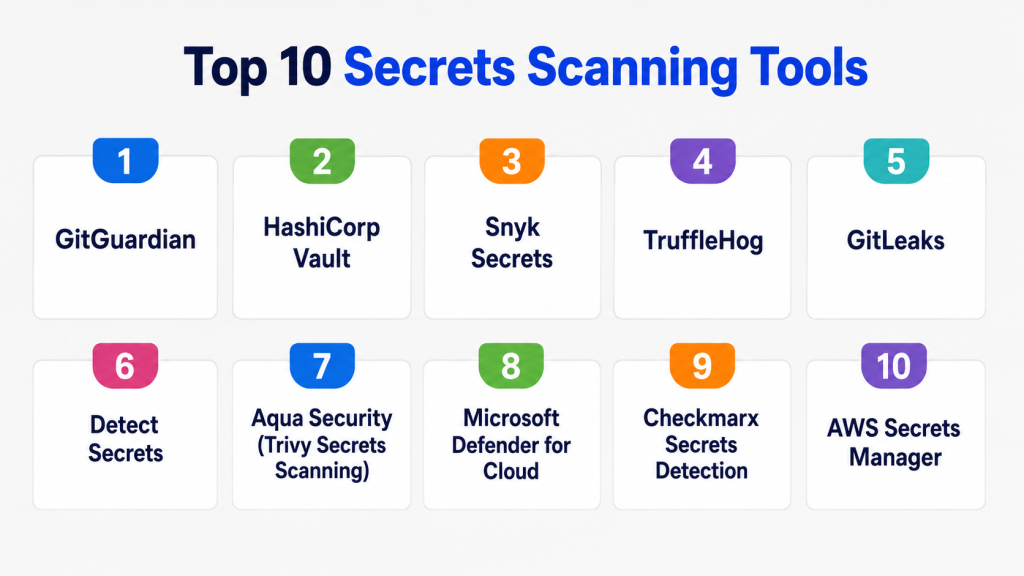
Top 10 Secrets Scanning Tools
1- GitGuardian
Short description:
GitGuardian is a leading secrets detection platform that continuously scans code repositories, CI pipelines, and developer environments to identify exposed credentials. It is widely used by DevSecOps teams in enterprises.
Key Features
- Real-time Git repository scanning
- CI/CD pipeline integration
- Public and private repo monitoring
- Secret detection rules engine
- Incident alerting system
- Developer-first remediation guidance
- Compliance reporting dashboards
Pros
- High detection accuracy
- Strong enterprise adoption
- Excellent Git integration
Cons
- Premium pricing for advanced features
- Can generate alerts at scale in large repos
- Requires tuning for optimal accuracy
Platforms / Deployment
Cloud / Self-hosted (enterprise options vary)
Security & Compliance
- SSO/SAML support
- MFA authentication
- RBAC controls
- Audit logging
- Compliance frameworks support: Not publicly stated
Integrations & Ecosystem
GitGuardian integrates deeply into DevSecOps pipelines and security workflows.
- GitHub
- GitLab
- Bitbucket
- Slack
- Jira
- CI/CD tools
Support & Community
Strong enterprise documentation, dedicated support tiers, and active DevSecOps community presence.
2- HashiCorp Vault (Secrets Scanning Capabilities)
Short description:
HashiCorp Vault is primarily a secrets management platform, but it also supports detection and governance patterns for sensitive data exposure in infrastructure workflows.
Key Features
- Centralized secrets storage
- Dynamic secrets generation
- Access control policies
- Audit logging
- Token-based authentication
- Encryption as a service
- Integration with cloud providers
Pros
- Strong enterprise-grade security
- Excellent secrets lifecycle management
- Highly scalable architecture
Cons
- Not a dedicated secrets scanning tool
- Requires operational expertise
- Complex initial setup
Platforms / Deployment
Cloud / Self-hosted / Hybrid
Security & Compliance
- SSO integration
- RBAC
- Encryption at rest and in transit
- Audit logs enabled by default
- Compliance certifications: Not publicly stated
Integrations & Ecosystem
- Kubernetes
- AWS
- Azure
- Google Cloud
- Terraform
- CI/CD pipelines
Support & Community
Strong enterprise support and large open-source community.
3- TruffleHog
Short description:
TruffleHog is an open-source secrets scanning tool that searches repositories and data sources for high-entropy strings and exposed credentials.
Key Features
- Deep repository scanning
- Regex and entropy-based detection
- Git history scanning
- API key detection
- CI/CD integration
- Multi-source scanning support
- Open-source extensibility
Pros
- Free and open-source
- Strong detection capabilities
- Highly customizable
Cons
- Requires tuning for accuracy
- No centralized enterprise dashboard by default
- Limited built-in governance features
Platforms / Deployment
Cloud / Self-hosted
Security & Compliance
- Local execution support
- No external data dependency by default
- RBAC: Not publicly stated
Integrations & Ecosystem
- GitHub
- GitLab
- Jenkins
- Docker
- CI/CD pipelines
Support & Community
Strong open-source community with active contributions.
4- Snyk Secrets
Short description:
Snyk Secrets is part of the Snyk security platform and focuses on detecting sensitive credentials across codebases and CI/CD workflows.
Key Features
- Real-time secret scanning
- Developer IDE integration
- Git repository scanning
- CI/CD pipeline integration
- Vulnerability correlation
- Auto-remediation suggestions
- Security dashboards
Pros
- Strong developer experience
- Easy integration into pipelines
- Unified security platform
Cons
- Requires Snyk ecosystem adoption for full value
- Advanced features may require paid tiers
- Limited customization for detection rules
Platforms / Deployment
Cloud / Hybrid
Security & Compliance
- SSO support
- MFA authentication
- Audit logs
- Compliance mapping: Not publicly stated
Integrations & Ecosystem
- GitHub
- GitLab
- Bitbucket
- Jenkins
- VS Code
- Docker
Support & Community
Strong documentation and enterprise support.
5- AWS Secrets Manager (Detection & Governance Use Cases)
Short description:
AWS Secrets Manager is primarily a secrets storage service but plays a key role in secrets governance and indirect detection across AWS environments.
Key Features
- Secure secrets storage
- Automatic rotation
- IAM-based access control
- Cloud-native integration
- Encryption with KMS
- API-driven access
- Audit logging
Pros
- Deep AWS integration
- Highly secure architecture
- Scalable for enterprise workloads
Cons
- AWS-only ecosystem dependency
- Not a dedicated scanning tool
- Limited cross-platform visibility
Platforms / Deployment
Cloud (AWS only)
Security & Compliance
- IAM policies
- Encryption at rest and transit
- CloudTrail logging
- Compliance certifications: Not publicly stated
Integrations & Ecosystem
- AWS Lambda
- EC2
- EKS
- RDS
- CI/CD tools
Support & Community
Enterprise AWS support and strong documentation.
6- GitLeaks
Short description:
GitLeaks is an open-source secrets detection tool designed for scanning Git repositories for hardcoded secrets.
Key Features
- Git repository scanning
- Pre-commit hooks
- CI/CD integration
- Regex-based detection
- Custom rule support
- Git history analysis
- Lightweight architecture
Pros
- Free and open-source
- Easy to integrate
- Fast scanning performance
Cons
- Limited enterprise features
- Requires manual tuning
- No centralized dashboard
Platforms / Deployment
Cloud / Self-hosted
Security & Compliance
- Local scanning support
- No data transmission requirement
- RBAC: Not publicly stated
Integrations & Ecosystem
- GitHub
- GitLab
- Jenkins
- Pre-commit frameworks
Support & Community
Active GitHub community with frequent updates.
7- Microsoft Defender for Cloud (Secrets Detection Features)
Short description:
Microsoft Defender for Cloud includes secrets detection capabilities within its broader cloud security posture management suite.
Key Features
- Cloud workload protection
- Secret detection in cloud resources
- Security recommendations
- Continuous monitoring
- Threat detection
- Compliance dashboards
- Multi-cloud support
Pros
- Strong enterprise cloud security
- Deep Azure integration
- Unified security management
Cons
- Best suited for Microsoft ecosystem
- Complex configuration
- Broad platform may reduce focus on secrets-only use cases
Platforms / Deployment
Cloud (Azure + multi-cloud support)
Security & Compliance
- RBAC
- MFA
- Audit logging
- Compliance frameworks: Not publicly stated
Integrations & Ecosystem
- Azure services
- AWS
- Google Cloud
- Microsoft Sentinel
- DevOps pipelines
Support & Community
Enterprise-grade Microsoft support.
8- Detect Secrets (Yelp Open Source Tool)
Short description:
Detect Secrets is an open-source tool that helps identify secrets before they are committed to version control systems.
Key Features
- Pre-commit scanning
- Baseline management
- Plugin-based architecture
- Git integration
- Custom rule definitions
- CI/CD pipeline support
- Lightweight scanning engine
Pros
- Simple and lightweight
- Easy integration
- Strong developer adoption
Cons
- Limited enterprise features
- Requires manual rule tuning
- No centralized reporting system
Platforms / Deployment
Cloud / Self-hosted
Security & Compliance
- Local scanning support
- Plugin-based security controls
- RBAC: Not publicly stated
Integrations & Ecosystem
- Git hooks
- GitHub
- GitLab
- Jenkins
Support & Community
Strong open-source community support.
9- Aqua Security (Trivy Secrets Scanning)
Short description:
Aqua Security’s Trivy includes secrets scanning capabilities for containers, repositories, and infrastructure environments.
Key Features
- Container image scanning
- Secrets detection engine
- IaC scanning
- Kubernetes integration
- Vulnerability scanning
- CI/CD pipeline integration
- Policy enforcement
Pros
- Strong container security
- Multi-scope scanning
- DevSecOps-friendly
Cons
- Broader tool, not secrets-only
- Requires configuration tuning
- Enterprise features may be complex
Platforms / Deployment
Cloud / Self-hosted
Security & Compliance
- RBAC support
- Audit logging
- Policy enforcement
- Compliance frameworks: Not publicly stated
Integrations & Ecosystem
- Kubernetes
- Docker
- GitHub
- GitLab
- Jenkins
Support & Community
Strong enterprise and open-source community support.
10- Checkmarx Secrets Detection
Short description:
Checkmarx provides application security testing with integrated secrets detection for code and CI/CD pipelines.
Key Features
- Static application security testing
- Secrets detection engine
- CI/CD integration
- Developer IDE plugins
- Compliance reporting
- Risk prioritization
- Enterprise dashboards
Pros
- Strong enterprise security focus
- Comprehensive application security suite
- Good CI/CD integration
Cons
- Enterprise pricing
- Complex deployment
- Best value in large organizations
Platforms / Deployment
Cloud / Self-hosted / Hybrid
Security & Compliance
- SSO/SAML
- MFA
- Audit logging
- Compliance certifications: Not publicly stated
Integrations & Ecosystem
- GitHub
- GitLab
- Azure DevOps
- Jenkins
- CI/CD pipelines
Support & Community
Enterprise-grade support with structured onboarding.
Comparison Table (Top 10)
| Tool Name | Best For | Platforms Supported | Deployment | Standout Feature | Public Rating |
|---|---|---|---|---|---|
| GitGuardian | Enterprise DevSecOps | Multi-platform | Cloud/Self-hosted | Real-time repo scanning | N/A |
| HashiCorp Vault | Secrets governance | Multi-platform | Hybrid | Secret lifecycle management | N/A |
| TruffleHog | Open-source scanning | Multi-platform | Self-hosted | Deep repo scanning | N/A |
| Snyk Secrets | Developer security | Multi-platform | Cloud/Hybrid | Developer-first integration | N/A |
| AWS Secrets Manager | AWS environments | AWS | Cloud | Native AWS integration | N/A |
| GitLeaks | Lightweight scanning | Multi-platform | Self-hosted | Fast Git scanning | N/A |
| Microsoft Defender | Cloud security | Multi-cloud | Cloud | Unified cloud security | N/A |
| Detect Secrets | Pre-commit scanning | Multi-platform | Self-hosted | Pre-commit hooks | N/A |
| Aqua Trivy | Container security | Multi-platform | Hybrid | Multi-scope scanning | N/A |
| Checkmarx | Enterprise AppSec | Multi-platform | Hybrid | Full security suite | N/A |
Evaluation & Scoring of Secrets Scanning Tools
| Tool | Core | Ease | Integrations | Security | Performance | Support | Value | Weighted Total |
|---|---|---|---|---|---|---|---|---|
| GitGuardian | 10 | 9 | 10 | 9 | 9 | 9 | 8 | 9.25 |
| HashiCorp Vault | 9 | 7 | 9 | 10 | 9 | 9 | 8 | 8.80 |
| TruffleHog | 8 | 9 | 8 | 8 | 9 | 8 | 10 | 8.55 |
| Snyk Secrets | 9 | 9 | 9 | 9 | 9 | 9 | 8 | 8.95 |
| AWS Secrets Manager | 8 | 9 | 9 | 10 | 9 | 9 | 8 | 8.90 |
| GitLeaks | 8 | 9 | 8 | 8 | 9 | 8 | 10 | 8.55 |
| Microsoft Defender | 9 | 8 | 9 | 10 | 9 | 9 | 8 | 8.95 |
| Detect Secrets | 8 | 9 | 8 | 8 | 9 | 8 | 10 | 8.55 |
| Aqua Trivy | 9 | 8 | 9 | 9 | 9 | 8 | 9 | 8.85 |
| Checkmarx | 9 | 7 | 9 | 10 | 9 | 9 | 7 | 8.55 |
Which Secrets Scanning Tool Is Right for You?
Solo / Freelancer
- GitLeaks for simple scanning
- TruffleHog for open-source flexibility
- Detect Secrets for pre-commit checks
SMB
- Snyk Secrets
- GitGuardian
- Aqua Trivy
Mid-Market
- GitGuardian
- Snyk Secrets
- Microsoft Defender for Cloud
Enterprise
- GitGuardian
- Checkmarx
- HashiCorp Vault
- Microsoft Defender for Cloud
Budget vs Premium
- Budget-friendly: TruffleHog, GitLeaks, Detect Secrets
- Premium enterprise: GitGuardian, Checkmarx, Microsoft Defender
Feature Depth vs Ease of Use
- Deep enterprise governance: GitGuardian, Checkmarx
- Easy adoption: Snyk Secrets, GitLeaks
Integrations & Scalability
- Best integration ecosystems: GitGuardian, Snyk, Microsoft Defender
- Best scalability: HashiCorp Vault, Checkmarx
Security & Compliance Needs
- Strong compliance focus: Checkmarx, Microsoft Defender, GitGuardian
- Strong encryption and governance: HashiCorp Vault
Frequently Asked Questions
1- What are secrets scanning tools?
They are security tools that detect exposed credentials like API keys, passwords, and tokens in code and infrastructure.
2- Why are secrets dangerous in code repositories?
Exposed secrets can lead to unauthorized access, data breaches, and cloud account compromise.
3- Do secrets scanning tools prevent leaks?
Yes, they detect and often block secrets before they are committed or deployed.
4- Are open-source secrets scanners reliable?
Yes, but they require configuration and tuning for enterprise-grade accuracy.
5- Can secrets scanning tools integrate with CI/CD?
Yes, most modern tools integrate directly into CI/CD pipelines.
6- What is the difference between secrets scanning and secrets management?
Scanning detects exposed secrets, while management securely stores and rotates them.
7- Do these tools support cloud environments?
Yes, many support AWS, Azure, and Google Cloud integrations.
8- Are secrets scanning tools suitable for small teams?
Yes, especially lightweight tools like GitLeaks or Detect Secrets.
9- What is the biggest challenge in secrets scanning?
False positives and alert fatigue are common challenges.
10- Can AI improve secrets detection?
Yes, modern tools increasingly use AI to reduce false positives and improve context awareness.
Conclusion
Secrets scanning tools are now a core part of modern DevSecOps strategies. As software delivery speeds increase and cloud-native architectures expand, preventing credential leaks is no longer optional it is essential for security and compliance. While tools like GitGuardian, Snyk Secrets, and Microsoft Defender for Cloud offer enterprise-grade protection, open-source tools like TruffleHog and GitLeaks remain strong options for smaller teams. The right choice depends on your infrastructure complexity, compliance requirements, and DevOps maturity. The best approach is to shortlist 2–3 tools, test them in your CI/CD pipeline, evaluate detection accuracy, and validate integration with your development workflow before full-scale adoption.

Find Trusted Cardiac Hospitals
Compare heart hospitals by city and services — all in one place.
Explore Hospitals
Secrets scanning becomes significantly more valuable when it is paired with automated rotation and response workflows. Detecting exposed credentials is important, but reducing the time between discovery and remediation is what truly limits potential damage.