Introduction
WebAssembly WASM Runtimes & Toolchains are software platforms that allow developers to build, compile, run, and deploy WebAssembly applications across browsers, servers, edge environments, cloud platforms, and embedded systems. A runtime executes WASM modules, while a toolchain helps developers compile languages such as Rust, C, C++, Go, and others into WebAssembly binaries. As organizations increasingly pursue portable, secure, and high-performance workloads, WebAssembly has evolved from a browser technology into a broader application platform. In 2026 and beyond, WASM is being adopted for edge computing, serverless applications, AI inference, plugin architectures, cloud-native workloads, and secure application sandboxing.
Real World Use Cases
- Running applications consistently across browsers and servers
- Building secure sandboxed plugins and extensions
- Deploying edge computing workloads closer to users
- Packaging microservices with reduced resource consumption
- Running AI inference workloads in portable environments
- Creating cloud-native applications with stronger isolation
- Building cross-platform applications from a single codebase
Evaluation Criteria for Buyers
When evaluating WASM runtimes and toolchains, consider:
- Runtime performance
- Standards compliance
- Security isolation capabilities
- Language support
- Kubernetes compatibility
- Edge deployment readiness
- Developer tooling quality
- Observability and monitoring support
- Ecosystem maturity
- Enterprise support availability
Best for: Platform engineers, cloud architects, DevOps teams, edge computing providers, software vendors, developers building portable applications, and enterprises exploring next-generation application deployment models.
Not ideal for: Organizations running simple monolithic applications that already perform adequately using traditional virtual machines or containers and have no portability or sandboxing requirements.
Key Trends in WebAssembly WASM Runtimes & Toolchains for 2026 and Beyond
- WASM is becoming a major platform for edge computing deployments.
- AI inference workloads are increasingly leveraging WebAssembly portability.
- Kubernetes integration through WASM operators continues expanding.
- Serverless platforms are adopting WASM to reduce cold-start latency.
- Secure plugin architectures increasingly use sandboxed WASM execution.
- Hybrid container and WASM deployments are becoming common.
- Supply-chain security initiatives are improving WASM artifact validation.
- Multi-language development support continues growing.
- WASI standards are maturing rapidly.
- Enterprise observability and governance capabilities are becoming key differentiators.
How We Selected These Tools
Our selection criteria included:
- Industry adoption and developer mindshare
- Active development and roadmap momentum
- Runtime performance benchmarks
- WASI and standards support
- Security and sandboxing capabilities
- Cloud-native compatibility
- Enterprise deployment readiness
- Documentation quality
- Community strength
- Integration ecosystem maturity
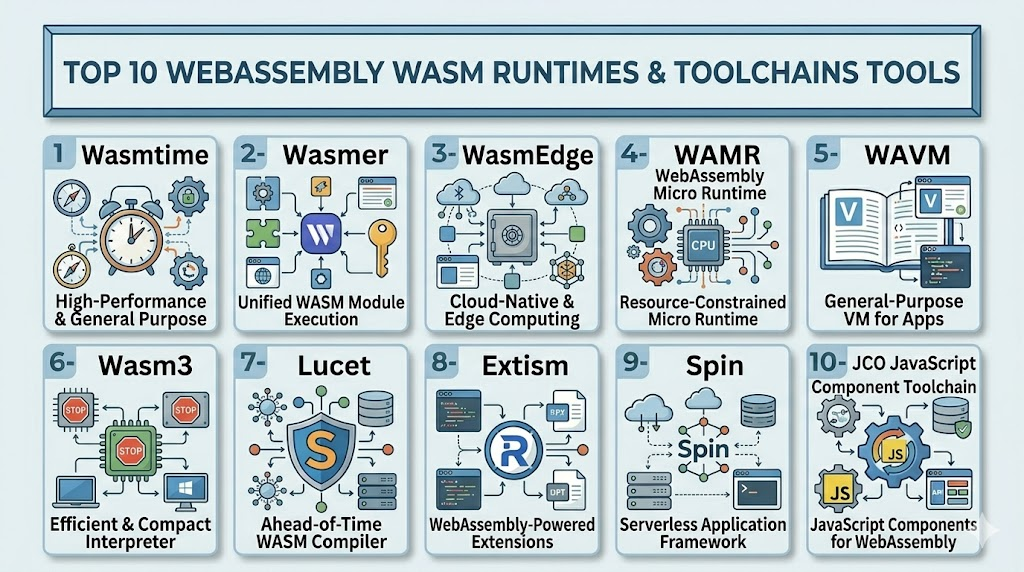
Top 10 WebAssembly WASM Runtimes & Toolchains Tools
1- Wasmtime
Short description:
Wasmtime is one of the most widely adopted WebAssembly runtimes. Developed by the Bytecode Alliance, it focuses on security, standards compliance, and high-performance execution across cloud and edge environments.
Key Features
- WASI support
- Secure sandbox execution
- Cranelift compiler integration
- Multi-language support
- Cross-platform deployment
- Component model support
- Embeddable runtime architecture
Pros
- Strong standards compliance
- Active open-source ecosystem
- Enterprise-ready performance
Cons
- Advanced configuration may require expertise
- Primarily developer-focused
- Learning curve for newcomers
Platforms / Deployment
- Windows
- macOS
- Linux
- Cloud
- Self-hosted
Security & Compliance
- Sandboxed execution
- Memory isolation
- Secure runtime architecture
Integrations & Ecosystem
Wasmtime integrates extensively with cloud-native and developer ecosystems.
- Rust ecosystem
- Kubernetes projects
- Bytecode Alliance initiatives
- WASI tooling
- CI/CD platforms
Support & Community
Excellent documentation and strong community support backed by the Bytecode Alliance.
2- Wasmer
Short description:
Wasmer provides a full WebAssembly runtime and deployment platform for developers seeking portability across desktop, cloud, and edge environments.
Key Features
- Universal runtime
- WASI compatibility
- Package management
- Edge deployment support
- Multiple compiler backends
- Cross-platform execution
- Developer-friendly tooling
Pros
- Easy onboarding experience
- Broad deployment flexibility
- Strong packaging ecosystem
Cons
- Enterprise governance features vary
- Ecosystem still evolving
- Some advanced capabilities require expertise
Platforms / Deployment
- Windows
- macOS
- Linux
- Cloud
- Self-hosted
Security & Compliance
- Sandboxed runtime
- Memory isolation
Integrations & Ecosystem
Strong integration support for modern development workflows.
- GitHub
- CI/CD platforms
- Container workflows
- Edge deployments
Support & Community
Large open-source community with active documentation.
3- WasmEdge
Short description:
WasmEdge focuses on cloud-native, edge computing, and AI workloads. It is optimized for lightweight deployment and high-performance execution.
Key Features
- Edge optimization
- AI inference support
- Kubernetes integration
- Container compatibility
- Low resource footprint
- Fast startup times
- Cloud-native architecture
Pros
- Excellent edge performance
- AI-focused capabilities
- Lightweight runtime
Cons
- Smaller ecosystem than Wasmtime
- Specialized focus
- Enterprise adoption still growing
Platforms / Deployment
- Linux
- macOS
- Windows
- Cloud
- Edge
Security & Compliance
- Runtime isolation
- Sandboxed execution
Integrations & Ecosystem
Popular within cloud-native and edge ecosystems.
- Kubernetes
- CNCF projects
- AI frameworks
- Edge platforms
Support & Community
Growing community and strong open-source momentum.
4- WAMR WebAssembly Micro Runtime
Short description:
WAMR is designed for embedded systems, IoT devices, and resource-constrained environments requiring lightweight execution.
Key Features
- Embedded device support
- Small footprint
- Fast startup
- Multiple execution modes
- IoT optimization
- Native integration APIs
- Edge deployment capabilities
Pros
- Extremely lightweight
- Strong IoT support
- Efficient resource usage
Cons
- Limited enterprise tooling
- Smaller ecosystem
- Specialized use cases
Platforms / Deployment
- Linux
- Embedded Systems
- IoT Devices
Security & Compliance
- Sandboxed execution
- Memory protection
Integrations & Ecosystem
Focused on embedded and IoT development.
- Embedded SDKs
- Device platforms
- Edge infrastructure
Support & Community
Active open-source support within embedded computing communities.
5- WAVM
Short description:
WAVM provides a high-performance virtual machine designed for WebAssembly execution with compatibility and standards alignment.
Key Features
- JIT compilation
- Standards compliance
- LLVM integration
- Cross-platform support
- Fast execution
- Embeddable runtime
- Advanced debugging
Pros
- High-performance execution
- Good developer flexibility
- Strong standards support
Cons
- Smaller community
- Less enterprise visibility
- Limited commercial backing
Platforms / Deployment
- Windows
- Linux
- macOS
Security & Compliance
- Runtime isolation
- Sandboxed execution
Integrations & Ecosystem
- LLVM ecosystem
- Developer toolchains
- Open-source integrations
Support & Community
Community-driven project with technical documentation.
6- Wasm3
Short description:
Wasm3 is an ultra-fast interpreter designed for embedded environments and low-resource devices.
Key Features
- Lightweight architecture
- Embedded deployment
- Interpreter execution
- Small memory footprint
- Fast startup
- IoT support
- Portable runtime
Pros
- Very low resource requirements
- Excellent for IoT
- Fast deployment
Cons
- Not optimized for large workloads
- Limited enterprise tooling
- Smaller ecosystem
Platforms / Deployment
- Embedded Systems
- Linux
- IoT Devices
Security & Compliance
- Sandboxed runtime
- Isolation controls
Integrations & Ecosystem
- Embedded frameworks
- IoT platforms
- Device ecosystems
Support & Community
Good community engagement within embedded development.
7- Lucet
Short description:
Lucet is a WebAssembly compiler and runtime focused on secure execution and fast startup performance.
Key Features
- Ahead-of-time compilation
- Fast startup
- Secure execution
- Sandboxing
- Cloud deployment
- Native integration
- Runtime optimization
Pros
- Strong security focus
- Fast execution
- Good cloud suitability
Cons
- Smaller ecosystem
- Reduced momentum compared to leaders
- Limited enterprise adoption
Platforms / Deployment
- Linux
- Cloud
- Self-hosted
Security & Compliance
- Sandboxing
- Memory isolation
Integrations & Ecosystem
- Cloud-native projects
- Server-side applications
- Runtime integrations
Support & Community
Smaller but technically strong community.
8- Extism
Short description:
Extism provides a plugin framework built around WebAssembly, enabling organizations to create secure extensibility models.
Key Features
- Plugin platform
- Multi-language support
- Sandboxed execution
- Runtime portability
- Host SDKs
- Secure extension architecture
- Cloud compatibility
Pros
- Excellent plugin framework
- Developer-friendly APIs
- Strong portability
Cons
- Niche focus
- Plugin-centric architecture
- Smaller ecosystem
Platforms / Deployment
- Windows
- macOS
- Linux
- Cloud
Security & Compliance
- Runtime isolation
- Sandboxed plugins
Integrations & Ecosystem
- Rust
- Go
- Python
- JavaScript
- SDK ecosystem
Support & Community
Growing community focused on extensibility use cases.
9- Spin
Short description:
Spin is a developer framework that simplifies building serverless applications using WebAssembly technologies.
Key Features
- Serverless development
- Cloud-native deployment
- WASM application packaging
- Event-driven architecture
- Local development tooling
- Kubernetes support
- API integration
Pros
- Simplifies WASM adoption
- Strong developer experience
- Cloud-native orientation
Cons
- Framework rather than pure runtime
- Learning curve
- Ecosystem still evolving
Platforms / Deployment
- Windows
- macOS
- Linux
- Cloud
Security & Compliance
- Runtime isolation
- Secure execution environments
Integrations & Ecosystem
- Kubernetes
- Cloud platforms
- APIs
- CI/CD tools
Support & Community
Strong documentation and active community participation.
10- JCO JavaScript Component Toolchain
Short description:
JCO helps developers integrate WebAssembly components into JavaScript ecosystems using modern component model approaches.
Key Features
- JavaScript interoperability
- Component model support
- Developer tooling
- Web integration
- Modular architecture
- WASI compatibility
- Ecosystem support
Pros
- Strong JavaScript integration
- Modern standards support
- Useful for web developers
Cons
- Emerging ecosystem
- Specialized audience
- Less mature than leading runtimes
Platforms / Deployment
- Web
- Windows
- macOS
- Linux
Security & Compliance
- Standards-based runtime security
- Sandboxed execution
Integrations & Ecosystem
- JavaScript frameworks
- Node.js
- Browser applications
- Web tooling
Support & Community
Growing ecosystem driven by modern WebAssembly adoption.
Comparison Table
| Tool Name | Best For | Platform Supported | Deployment | Standout Feature | Public Rating |
|---|---|---|---|---|---|
| Wasmtime | Enterprise WASM | Windows, Linux, macOS | Self-hosted | WASI compliance | N/A |
| Wasmer | General deployment | Cross-platform | Hybrid | Package ecosystem | N/A |
| WasmEdge | Edge and AI | Cross-platform | Cloud | AI inference support | N/A |
| WAMR | IoT | Embedded, Linux | Self-hosted | Tiny footprint | N/A |
| WAVM | High performance | Cross-platform | Self-hosted | LLVM integration | N/A |
| Wasm3 | Embedded systems | IoT, Linux | Self-hosted | Ultra-light runtime | N/A |
| Lucet | Secure execution | Linux | Self-hosted | AOT compilation | N/A |
| Extism | Plugins | Cross-platform | Hybrid | Plugin framework | N/A |
| Spin | Serverless apps | Cross-platform | Cloud | Developer framework | N/A |
| JCO | JavaScript integration | Cross-platform | Hybrid | Component model | N/A |
Evaluation & Scoring of WebAssembly WASM Runtimes & Toolchains
| Tool | Core | Ease | Integrations | Security | Performance | Support | Value | Weighted Total |
|---|---|---|---|---|---|---|---|---|
| Wasmtime | 10 | 8 | 9 | 9 | 10 | 9 | 9 | 9.2 |
| Wasmer | 9 | 9 | 9 | 8 | 9 | 8 | 9 | 8.8 |
| WasmEdge | 9 | 8 | 8 | 8 | 10 | 8 | 9 | 8.7 |
| WAMR | 8 | 7 | 7 | 8 | 8 | 7 | 9 | 7.9 |
| WAVM | 8 | 7 | 7 | 8 | 9 | 7 | 8 | 7.8 |
| Wasm3 | 7 | 8 | 6 | 8 | 8 | 7 | 9 | 7.7 |
| Lucet | 8 | 7 | 7 | 8 | 8 | 7 | 8 | 7.7 |
| Extism | 8 | 8 | 8 | 8 | 8 | 8 | 8 | 8.0 |
| Spin | 8 | 9 | 8 | 8 | 8 | 8 | 8 | 8.1 |
| JCO | 7 | 8 | 8 | 7 | 7 | 7 | 8 | 7.5 |
Which WebAssembly WASM Runtime or Toolchain Is Right for You?
Solo / Freelancer
Solo developers usually need simple setup, low cost, and fast learning. Tools with strong documentation and lightweight workflows work best here.
- Wasmer is ideal for beginners and independent developers because it is easy to install and supports multiple environments.
- Spin is good for serverless and API-based projects with minimal operational complexity.
- JCO fits JavaScript developers who want browser and Node.js integration.
These users should prioritize ease of use over enterprise-scale governance features.
SMB
SMBs need balance between scalability, security, and operational simplicity. Most small teams prefer tools that integrate easily with cloud and CI/CD workflows.
- Wasmer offers strong portability and developer-friendly tooling.
- WasmEdge is useful for edge computing and lightweight AI workloads.
- Extism works well for SaaS platforms needing plugin architectures.
SMBs should focus on deployment simplicity, documentation quality, and ecosystem maturity.
Mid-Market
Mid-market organizations usually require better scalability, observability, and Kubernetes compatibility.
- Wasmtime is a strong option for secure cloud-native workloads.
- WasmEdge performs well for distributed edge applications.
- Spin simplifies WASM application deployment for platform teams.
At this stage, runtime stability and operational tooling become very important.
Enterprise
Enterprises prioritize governance, scalability, security isolation, and long-term support.
- Wasmtime is widely considered one of the most enterprise-ready WASM runtimes.
- Wasmer works well for hybrid and multi-cloud deployments.
- WasmEdge is strong for AI inference and edge computing strategies.
Large organizations should evaluate security controls, Kubernetes integration, and runtime observability carefully.
Budget vs Premium
- Best free/open-source value: Wasmtime and Wasmer
- Best for lightweight edge deployments: WasmEdge
- Best for enterprise operational maturity: Wasmtime
Open-source tools can provide excellent value, but enterprise deployments may still require investment in monitoring, governance, and support.
Feature Depth vs Ease of Use
- Most advanced capabilities: Wasmtime
- Best developer experience: Wasmer
- Simplest serverless workflow: Spin
Organizations with smaller teams may benefit more from easier onboarding rather than maximum runtime flexibility.
Integrations & Scalability
For Kubernetes, CI/CD, and cloud-native architectures:
- Wasmtime
- WasmEdge
- Spin
For plugin ecosystems and extensibility:
- Extism
- Wasmer
Choose runtimes that align with your existing infrastructure and developer workflows.
Security & Compliance Needs
Organizations handling sensitive workloads should prioritize:
- Wasmtime
- Lucet
- WasmEdge
These runtimes emphasize sandboxing, runtime isolation, and secure execution models, which are important for multi-tenant and regulated environments.ge because of their strong sandboxing and isolation approaches.
Frequently Asked Questions (FAQs)
1. What is a WebAssembly WASM runtime?
A WebAssembly runtime is software that executes WASM modules outside or inside web browsers. It provides a secure and portable execution environment for applications. Many runtimes support cloud, edge, and embedded deployments. They help developers run the same code across multiple platforms.
2. Why are WASM runtimes becoming popular?
WASM runtimes offer fast startup times, strong security isolation, and cross-platform portability. Organizations use them to reduce infrastructure overhead and improve deployment flexibility. They are increasingly adopted for cloud-native and edge computing workloads. Their lightweight nature makes them attractive compared to traditional virtual machines.
3. Can WebAssembly replace containers?
WebAssembly is not a complete replacement for containers in every scenario. Many organizations use both technologies together for different purposes. WASM provides lightweight execution and fast startup, while containers offer broader operating system compatibility. Hybrid architectures are becoming increasingly common.
4. Which programming languages support WebAssembly?
Rust, C, C++, Go, JavaScript, TypeScript, Kotlin, and several other languages support WebAssembly. Rust is often considered one of the most mature options for WASM development. Language support continues to improve across the ecosystem. The best choice depends on project requirements and team expertise.
5. Is WebAssembly secure?
WebAssembly provides strong sandboxing and memory isolation by design. This helps reduce security risks compared to running native code directly. However, overall security still depends on runtime configuration and deployment practices. Proper access controls and validation remain important.
6. What is WASI and why is it important?
WASI stands for WebAssembly System Interface. It allows WASM applications to interact with operating system resources in a secure and standardized manner. WASI helps developers build applications that run consistently across platforms. It is a key component of modern server-side WebAssembly adoption.
7. Can WebAssembly be used for AI workloads?
Yes, several WASM runtimes now support lightweight AI inference and edge AI deployments. Organizations use WASM to run models closer to users with lower latency. It can help improve portability across cloud and edge environments. AI support continues to evolve rapidly within the ecosystem.
8. What should organizations consider before adopting WASM?
Organizations should evaluate runtime maturity, performance, security, ecosystem support, and deployment requirements. Integration with existing infrastructure is also important. Teams should assess developer skills and operational readiness. Running a proof of concept before production deployment is recommended.
9. Are WebAssembly runtimes suitable for enterprise environments?
Many enterprise organizations are actively using WebAssembly for cloud-native applications, plugins, and edge workloads. Modern runtimes provide strong isolation and scalability capabilities. Enterprise adoption is increasing as standards mature. Governance and observability features are also improving.
10. How do I choose the right WASM runtime or toolchain?
Start by identifying your deployment goals, programming languages, and infrastructure requirements. Evaluate performance, security, standards compliance, and ecosystem maturity. Compare integration capabilities and community support. Testing two or three leading options in a pilot project is often the best approach.
Conclusion
WebAssembly has evolved into a serious application platform extending far beyond browser-based execution. Organizations are increasingly using WASM for cloud-native computing, edge deployments, secure plugins, serverless architectures, and portable application delivery. As the ecosystem matures, runtime selection becomes less about basic execution and more about operational fit, security requirements, deployment targets, and ecosystem compatibility. For most enterprises, Wasmtime, Wasmer, and WasmEdge represent the strongest starting points due to their maturity, community adoption, and cloud-native readiness. Embedded teams may prefer WAMR or Wasm3, while developers building extensibility platforms should evaluate Extism. Start by shortlisting two or three platforms, run a proof of concept, validate performance and security requirements, and then scale deployment based on production results.

Find Trusted Cardiac Hospitals
Compare heart hospitals by city and services — all in one place.
Explore Hospitals
I had heard of WebAssembly before, but this gave me a much better idea of how runtimes and toolchains fit into the overall ecosystem.