Introduction
Workforce Management Software helps organizations manage employee scheduling, attendance, labor forecasting, productivity tracking, payroll coordination, compliance monitoring, and workforce analytics from a centralized platform. These systems are designed to optimize workforce efficiency while improving employee engagement, operational visibility, and labor cost control. Modern workforce management platforms now combine AI-driven forecasting, automation, mobile scheduling, productivity analytics, and HR integrations to support increasingly distributed and hybrid work environments. organizations face rising labor costs, evolving compliance regulations, and growing workforce complexity. Workforce management tools have become essential for balancing staffing requirements, improving operational efficiency, reducing scheduling conflicts, and enabling better decision-making through real-time workforce insights.
Real-world use cases include:
- Employee scheduling and shift management
- Attendance and leave tracking
- Labor cost optimization and forecasting
- Workforce productivity monitoring
- Payroll and compliance reporting
Evaluation Criteria for Buyers:
- Scheduling and attendance capabilities
- Workforce forecasting and analytics
- Payroll and HR integrations
- Compliance and labor law support
- Mobile workforce accessibility
- Automation and workflow approvals
- Reporting and operational dashboards
- Scalability for SMBs and enterprises
- Security and governance controls
- Ease of onboarding and usability
Best for: Enterprises, retail chains, healthcare providers, manufacturing companies, hospitality businesses, logistics operations, and organizations managing large or distributed workforces.
Not ideal for: Very small businesses with only a few employees or organizations managing schedules manually through spreadsheets.
Key Trends in Workforce Management Software
- AI-powered labor forecasting and workforce optimization
- Self-service employee scheduling and shift swapping
- Mobile-first workforce management experiences
- Real-time compliance and labor law monitoring
- Integration with payroll, HRIS, and ERP platforms
- Predictive analytics for staffing and labor costs
- Biometric and GPS-enabled attendance systems
- Automation of leave approvals and scheduling workflows
- Hybrid and remote workforce management support
- Increased focus on employee experience and engagement tools
How We Selected These Tools (Methodology)
- Evaluated market adoption and enterprise mindshare
- Compared scheduling, attendance, and forecasting capabilities
- Assessed payroll and HR integration ecosystems
- Reviewed analytics and workforce reporting functionality
- Evaluated usability across technical and non-technical users
- Considered scalability for SMBs and global enterprises
- Assessed security posture and compliance readiness
- Compared automation and AI-driven workforce optimization
- Evaluated onboarding resources and support ecosystem
- Reviewed pricing flexibility and operational value
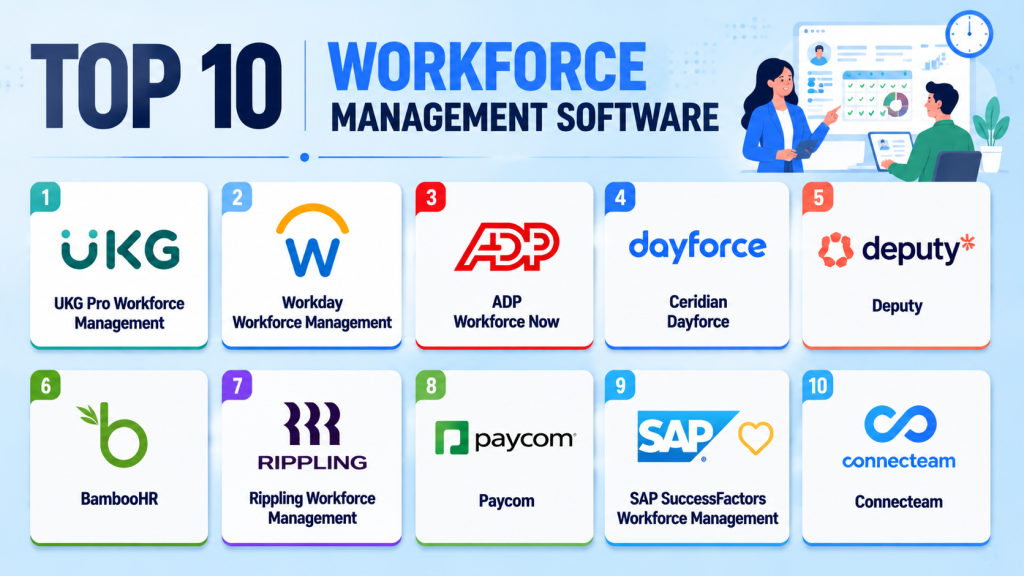
Top 10 Workforce Management Software Tools
1 — UKG Pro Workforce Management
Short description: UKG Pro Workforce Management is an enterprise-grade workforce platform focused on scheduling, attendance, payroll coordination, and labor forecasting for large organizations.
Key Features
- AI-driven labor forecasting
- Employee scheduling and shift management
- Attendance and leave tracking
- Payroll coordination
- Compliance monitoring
- Workforce analytics dashboards
- Mobile workforce management
Pros
- Strong enterprise scalability
- Excellent workforce forecasting capabilities
- Deep HR and payroll integration ecosystem
Cons
- Complex implementation for SMBs
- Premium enterprise pricing
- Advanced configuration may require training
Platforms / Deployment
- Web / iOS / Android
- Cloud
Security & Compliance
- SSO/SAML, MFA, RBAC, encryption
- SOC 2, GDPR
Integrations & Ecosystem
Supports integrations with enterprise HR and payroll ecosystems.
- SAP
- Workday
- Oracle
- Payroll systems
- APIs
Support & Community
Comprehensive enterprise onboarding, consulting, and training ecosystem.
2 — Workday Workforce Management
Short description : Workday Workforce Management combines workforce planning, scheduling, payroll coordination, and HR analytics into a unified enterprise platform.
Key Features
- Workforce scheduling
- Labor cost forecasting
- Attendance and leave management
- Payroll synchronization
- Compliance monitoring
- Workforce analytics
- Mobile workforce support
Pros
- Unified HR and workforce ecosystem
- Strong enterprise analytics capabilities
- Excellent scalability for global organizations
Cons
- Higher implementation complexity
- Premium pricing model
- SMB adoption may be limited
Platforms / Deployment
- Web / iOS / Android
- Cloud
Security & Compliance
- SSO/SAML, MFA, encryption, RBAC
- SOC 2, ISO 27001, GDPR
Integrations & Ecosystem
Deep integration ecosystem for enterprise workforce operations.
- ERP systems
- Payroll providers
- HR platforms
- APIs
Support & Community
Strong enterprise consulting and support network.
3 — ADP Workforce Now
Short description : ADP Workforce Now delivers workforce scheduling, payroll management, attendance tracking, and compliance tools for SMBs and enterprises.
Key Features
- Workforce scheduling
- Payroll and tax management
- Time and attendance tracking
- Employee self-service
- Compliance reporting
- Workforce analytics
- Mobile workforce management
Pros
- Strong payroll ecosystem
- Good SMB and enterprise support
- Broad HR functionality
Cons
- UI complexity for some users
- Advanced reporting setup can be challenging
- Pricing varies by modules selected
Platforms / Deployment
- Web / iOS / Android
- Cloud
Security & Compliance
- MFA, encryption, RBAC
- SOC 2, GDPR
Integrations & Ecosystem
Supports integrations across HR, payroll, and accounting systems.
- QuickBooks
- ERP systems
- HRIS platforms
- APIs
Support & Community
Strong onboarding resources and payroll-focused support ecosystem.
4 — Ceridian Dayforce
Short description : Ceridian Dayforce provides workforce management, payroll, compliance tracking, and employee scheduling for enterprise organizations.
Key Features
- Workforce scheduling
- Payroll and benefits management
- Labor forecasting
- Attendance tracking
- Compliance monitoring
- Mobile workforce apps
- Reporting dashboards
Pros
- Strong payroll and compliance capabilities
- Unified workforce management suite
- Good enterprise scalability
Cons
- Complex implementation process
- Higher learning curve for administrators
- Premium enterprise pricing
Platforms / Deployment
- Web / iOS / Android
- Cloud
Security & Compliance
- SSO, MFA, encryption
- SOC 2, GDPR
Integrations & Ecosystem
Supports enterprise HR and payroll integrations.
- ERP systems
- Payroll providers
- APIs
Support & Community
Enterprise onboarding and implementation consulting available.
5 — Deputy
Short description : Deputy focuses on employee scheduling, shift management, attendance tracking, and workforce communication for SMBs and distributed teams.
Key Features
- Employee scheduling
- Shift swapping and approvals
- Attendance tracking
- GPS and geolocation clock-ins
- Workforce communication
- Labor cost forecasting
- Mobile scheduling apps
Pros
- Very easy to use
- Strong mobile workforce capabilities
- Excellent scheduling flexibility
Cons
- Limited deep enterprise governance
- Advanced analytics are limited
- Premium features increase costs
Platforms / Deployment
- Web / iOS / Android
- Cloud
Security & Compliance
- Encryption, SSO
- GDPR support
Integrations & Ecosystem
Supports integrations for SMB workforce operations.
- QuickBooks
- Xero
- Payroll systems
- APIs and Zapier
Support & Community
Strong SMB onboarding and scheduling-focused support ecosystem.
6 — BambooHR
Short description : BambooHR combines HR management, attendance tracking, leave management, and employee self-service for SMB organizations.
Key Features
- Attendance and leave tracking
- Employee records management
- Workforce reporting
- Self-service employee portal
- Payroll integrations
- Workflow automation
- Mobile workforce accessibility
Pros
- Excellent SMB usability
- Strong employee experience focus
- Easy onboarding process
Cons
- Limited enterprise workforce forecasting
- Scheduling depth is limited
- Advanced reporting requires configuration
Platforms / Deployment
- Web / iOS / Android
- Cloud
Security & Compliance
- MFA, encryption
- GDPR support
Integrations & Ecosystem
Supports HR and payroll integrations for SMB operations.
- Payroll systems
- Slack
- QuickBooks
- APIs
Support & Community
Good documentation and SMB-focused support ecosystem.
7 — Rippling Workforce Management
Short description : Rippling combines workforce management, device management, payroll, HR, and IT operations into a unified operational platform.
Key Features
- Workforce scheduling
- Payroll automation
- Attendance management
- HR and IT management
- Employee onboarding workflows
- Compliance reporting
- Workforce analytics dashboards
Pros
- Strong automation capabilities
- Unified HR and IT management
- Modern and intuitive interface
Cons
- Advanced enterprise reporting may vary
- Pricing can increase with modules
- Global compliance support varies by region
Platforms / Deployment
- Web / iOS / Android
- Cloud
Security & Compliance
- MFA, SSO, encryption
- SOC 2, GDPR
Integrations & Ecosystem
Broad integration ecosystem across HR and IT workflows.
- Slack
- Google Workspace
- Payroll providers
- APIs
Support & Community
Strong onboarding resources and growing enterprise support ecosystem.
8 — Paycom
Short description : Paycom provides workforce scheduling, payroll management, employee self-service, and compliance reporting for SMBs and enterprises.
Key Features
- Workforce scheduling
- Payroll and tax management
- Attendance tracking
- Employee self-service
- Labor cost forecasting
- Workforce reporting
- Compliance automation
Pros
- Strong payroll capabilities
- Unified employee experience
- Good workforce visibility
Cons
- Learning curve for administrators
- Premium features increase costs
- Custom reporting may require setup
Platforms / Deployment
- Web / iOS / Android
- Cloud
Security & Compliance
- MFA, encryption, RBAC
- SOC 2, GDPR
Integrations & Ecosystem
Supports integrations with payroll and workforce systems.
- HR platforms
- Payroll providers
- APIs
Support & Community
Good onboarding and workforce management support ecosystem.
9 — SAP SuccessFactors Workforce Management
Short description : SAP SuccessFactors Workforce Management delivers enterprise scheduling, attendance tracking, labor forecasting, and workforce analytics.
Key Features
- Enterprise scheduling
- Attendance and leave management
- Workforce forecasting
- Payroll synchronization
- Compliance reporting
- Workforce analytics
- Employee self-service
Pros
- Strong enterprise scalability
- Excellent analytics and forecasting
- Deep SAP ecosystem integration
Cons
- Complex deployment process
- Premium enterprise pricing
- Requires experienced administrators
Platforms / Deployment
- Web / iOS / Android
- Cloud / Hybrid
Security & Compliance
- SSO/SAML, MFA, encryption
- ISO 27001, GDPR
Integrations & Ecosystem
Deep SAP integration ecosystem for enterprise operations.
- SAP ERP
- Payroll systems
- APIs
Support & Community
Strong enterprise support and implementation partner network.
10 — Connecteam
Short description : Connecteam is a mobile-first workforce management platform focused on scheduling, communication, attendance tracking, and field workforce operations.
Key Features
- Employee scheduling
- Time clock and attendance tracking
- Workforce communication
- Task management
- Mobile workforce operations
- Shift management
- Reporting dashboards
Pros
- Excellent mobile workforce support
- Easy onboarding experience
- Strong field workforce management capabilities
Cons
- Enterprise analytics depth is limited
- Advanced integrations are fewer
- Complex compliance reporting is limited
Platforms / Deployment
- Web / iOS / Android
- Cloud
Security & Compliance
- Encryption, MFA
- GDPR support
Integrations & Ecosystem
Supports integrations for SMB and field workforce operations.
- Payroll systems
- QuickBooks
- APIs and Zapier
Support & Community
Strong onboarding resources and SMB-focused support ecosystem.
Comparison Table
| Tool Name | Best For | Platform(s) Supported | Deployment | Standout Feature | Public Rating |
|---|---|---|---|---|---|
| UKG Pro Workforce Management | Enterprise workforce operations | Web, Mobile | Cloud | AI labor forecasting | N/A |
| Workday Workforce Management | Global workforce planning | Web, Mobile | Cloud | Unified HR ecosystem | N/A |
| ADP Workforce Now | Payroll and attendance | Web, Mobile | Cloud | Payroll integration | N/A |
| Ceridian Dayforce | Enterprise workforce compliance | Web, Mobile | Cloud | Unified payroll and scheduling | N/A |
| Deputy | SMB scheduling | Web, Mobile | Cloud | Shift management | N/A |
| BambooHR | SMB HR and attendance | Web, Mobile | Cloud | Employee self-service | N/A |
| Rippling Workforce Management | HR and IT automation | Web, Mobile | Cloud | Unified workforce automation | N/A |
| Paycom | Payroll-focused workforce ops | Web, Mobile | Cloud | Workforce visibility | N/A |
| SAP SuccessFactors Workforce Management | Enterprise analytics | Web, Mobile | Cloud / Hybrid | SAP ecosystem integration | N/A |
| Connecteam | Mobile field workforce | Web, Mobile | Cloud | Mobile-first workforce tools | N/A |
Evaluation & Scoring of Workforce Management Software
| Tool Name | Core (25%) | Ease (15%) | Integrations (15%) | Security (10%) | Performance (10%) | Support (10%) | Value (15%) | Weighted Total |
|---|---|---|---|---|---|---|---|---|
| UKG Pro Workforce Management | 10 | 7 | 9 | 9 | 9 | 8 | 7 | 8.65 |
| Workday Workforce Management | 10 | 7 | 9 | 9 | 9 | 8 | 6 | 8.50 |
| ADP Workforce Now | 9 | 8 | 8 | 8 | 8 | 8 | 8 | 8.20 |
| Ceridian Dayforce | 9 | 7 | 8 | 8 | 8 | 8 | 7 | 7.95 |
| Deputy | 8 | 9 | 7 | 7 | 8 | 8 | 9 | 8.05 |
| BambooHR | 8 | 9 | 7 | 7 | 8 | 8 | 8 | 7.90 |
| Rippling Workforce Management | 9 | 8 | 9 | 8 | 8 | 8 | 7 | 8.15 |
| Paycom | 8 | 7 | 7 | 8 | 8 | 8 | 7 | 7.55 |
| SAP SuccessFactors Workforce Management | 10 | 6 | 9 | 9 | 9 | 8 | 6 | 8.25 |
| Connecteam | 8 | 9 | 6 | 7 | 7 | 7 | 9 | 7.75 |
These scores are comparative and designed to help buyers evaluate workforce scheduling depth, usability, integrations, security, scalability, and operational value. Enterprise-focused platforms generally score higher in governance and forecasting, while SMB-focused platforms excel in simplicity and affordability. Buyers should align scoring priorities with workforce size, compliance requirements, and operational complexity.
Which Workforce Management Software Is Right for You?
Solo / Freelancer
Connecteam and Deputy are useful for small teams and lightweight workforce coordination with mobile scheduling capabilities.
SMB
BambooHR, Deputy, and Rippling Workforce Management provide strong usability, payroll coordination, and workforce visibility for growing businesses.
Mid-Market
ADP Workforce Now, Rippling, and Paycom offer stronger workforce automation, payroll support, and operational analytics for expanding organizations.
Enterprise
UKG Pro Workforce Management, Workday Workforce Management, Ceridian Dayforce, and SAP SuccessFactors Workforce Management are ideal for global workforce governance and labor forecasting.
Budget vs Premium
Budget-conscious teams should evaluate Deputy or Connecteam, while enterprises requiring deep workforce analytics and compliance should prioritize UKG or Workday.
Feature Depth vs Ease of Use
SAP SuccessFactors and UKG provide deeper enterprise functionality, while BambooHR and Deputy focus more on simplicity and onboarding speed.
Integrations & Scalability
Workday, SAP SuccessFactors, Rippling, and UKG provide stronger integration ecosystems and scalability for enterprise workforce operations.
Security & Compliance Needs
Organizations with stricter labor governance requirements should prioritize platforms supporting SSO, MFA, RBAC, audit logs, and compliance reporting.
Frequently Asked Questions (FAQs)
1. What is Workforce Management Software?
Workforce Management Software helps organizations manage employee scheduling, attendance, payroll coordination, productivity tracking, and labor forecasting.
2. Which industries use workforce management platforms the most?
Retail, healthcare, manufacturing, logistics, hospitality, construction, and enterprise operations teams commonly use these platforms.
3. Are workforce management tools suitable for remote teams?
Yes, modern platforms support cloud-based scheduling, attendance tracking, productivity monitoring, and mobile workforce accessibility.
4. What is the difference between HR software and workforce management software?
HR software focuses on employee records and HR processes, while workforce management emphasizes scheduling, attendance, labor forecasting, and workforce productivity.
5. Can workforce management platforms integrate with payroll systems?
Many tools integrate with payroll, HRIS, ERP, accounting, and productivity platforms to streamline workforce operations.
6. Are enterprise workforce management platforms secure?
Leading vendors typically support MFA, SSO, RBAC, encryption, audit logs, and compliance standards such as GDPR and SOC 2.
7. Which workforce management software is easiest for beginners?
Deputy and BambooHR are often considered beginner-friendly because of their intuitive interfaces and simplified onboarding experiences.
8. How important are workforce forecasting features?
Forecasting helps organizations optimize staffing levels, reduce overtime costs, improve scheduling accuracy, and increase operational efficiency.
9. Which platforms are best for large enterprises?
UKG Pro Workforce Management, Workday, and SAP SuccessFactors are strong enterprise choices because of their scalability and compliance capabilities.
10. What should buyers evaluate before choosing workforce management software?
Organizations should evaluate scheduling, forecasting, payroll integrations, security, usability, scalability, compliance reporting, and operational value before selecting a platform.
Conclusion
Workforce Management Software has become a critical operational platform for organizations managing distributed teams, labor forecasting, compliance requirements, and workforce productivity. Modern solutions now combine scheduling, attendance tracking, analytics, payroll coordination, automation, and employee engagement into centralized workforce ecosystems. Enterprises requiring deep forecasting, governance, and global workforce support may prefer UKG Pro Workforce Management, Workday, or SAP SuccessFactors, while SMBs may benefit more from Deputy, BambooHR, or Connecteam because of their usability and affordability. The right solution depends on workforce size, operational complexity, compliance requirements, and integration needs. Organizations should shortlist 2–3 platforms, test scheduling and payroll workflows, validate reporting and compliance capabilities, and review scalability before making a long-term investment decision.

Find Trusted Cardiac Hospitals
Compare heart hospitals by city and services — all in one place.
Explore Hospitals
I now understand how workforce management software helps businesses manage schedules, attendance, and productivity in a more efficient way. I’d like to explore more about how it improves employee planning in real companies.
I now understand how time attendance software helps accurately track employee working hours and reduce errors in payroll and attendance management. I’d like to explore more about how biometric and mobile tracking improve accuracy in real workplaces.