Introduction
Deception Technology Tools are advanced cybersecurity solutions that protect organizations by deploying fake assets such as decoy systems, fake credentials, trap files, and honeytokens across the IT environment. These decoys are designed to look like real systems, so when attackers interact with them, their activity is immediately detected, analyzed, and blocked. Unlike traditional security tools that rely on signatures or known attack patterns, deception technology focuses on attacker behavior. It creates a controlled trap environment where malicious users are misled and exposed early in the attack chain. This allows security teams to detect lateral movement, insider threats, credential abuse, and advanced persistent threats much faster than conventional tools. In modern enterprise environments, where attackers use stealthy techniques to move inside networks undetected, deception technology plays a critical role in strengthening Zero Trust architectures. It adds an additional invisible layer of defense that does not depend on perimeter security.
Common Real-world use cases include:
- Detecting insider threats and malicious employees
- Identifying lateral movement inside enterprise networks
- Protecting high-value assets with decoy systems
- Detecting ransomware behavior early
- Monitoring unauthorized access attempts in cloud and hybrid environments
Buyers should Evaluate:
- Quality and realism of deception assets
- Ease of deployment and maintenance
- Coverage across cloud, endpoint, and network
- Integration with SIEM and SOAR platforms
- Automation and alerting capabilities
- Threat intelligence enrichment
- Scalability across enterprise infrastructure
- Performance impact on production systems
- Customization of decoy environments
- Incident response workflow integration
Best for: Large enterprises, government agencies, financial institutions, critical infrastructure providers, and security operations centers (SOCs).
Not ideal for: Small businesses with limited infrastructure or organizations without dedicated security teams.
Key Trends in Deception Technology
- Integration of deception tools into Zero Trust architectures
- AI-driven automated decoy generation and placement
- Cloud-native deception environments replacing on-prem honeypots
- Integration with XDR and SIEM platforms for faster response
- Use of behavioral analytics to enhance deception accuracy
- Expansion into SaaS and identity-based deception (fake tokens, APIs)
- Automated attacker engagement and tracking systems
- Increased adoption in ransomware defense strategies
- Lightweight deception agents for endpoint coverage
- Deception-as-a-service models gaining popularity
How We Selected These Tools
- Market adoption and enterprise usage
- Real-world effectiveness of deception mechanisms
- Coverage across endpoint, network, and cloud environments
- Integration with SOC workflows and SIEM platforms
- Ability to detect lateral movement and insider threats
- Automation and orchestration capabilities
- Ease of deployment and scalability
- Threat intelligence and analytics depth
- Vendor maturity and enterprise trust
- Flexibility of decoy configuration
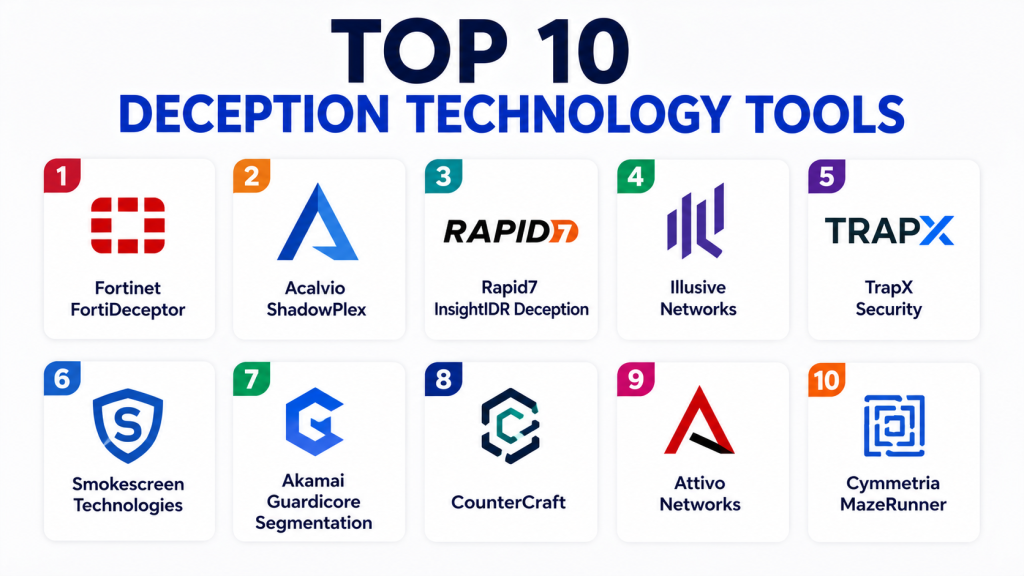
Top 10 Deception Technology Tools
1- Fortinet FortiDeceptor
Short description: FortiDeceptor provides enterprise-grade deception technology using automated decoys to detect attackers moving laterally within networks.
Key Features
- Automated decoy generation
- Lateral movement detection
- Credential theft detection
- Endpoint deception agents
- Network-based traps
- Cloud deception support
- Real-time alerting
Pros
- Strong enterprise integration
- Scalable architecture
- Good Fortinet ecosystem alignment
Cons
- Requires Fortinet environment familiarity
- Complex configuration
- Higher enterprise focus
Platforms / Deployment
Cloud / On-prem / Hybrid
Security & Compliance
RBAC, encryption, audit logs (Not publicly stated certifications)
Integrations & Ecosystem
Integrates with SOC tools and SIEM platforms:
- FortiSIEM
- FortiSOAR
- Third-party SIEM systems
- Endpoint protection tools
Support & Community
Strong enterprise support within Fortinet ecosystem
2- Acalvio ShadowPlex
Short description: Acalvio ShadowPlex delivers AI-powered deception technology for enterprise-scale threat detection and automated attacker engagement.
Key Features
- AI-based decoy placement
- Cloud and hybrid deception
- Identity deception (fake credentials)
- Automated threat response triggers
- Lateral movement detection
- Threat intelligence enrichment
- SOC integration
Pros
- Advanced AI capabilities
- Strong enterprise scalability
- Deep deception coverage
Cons
- Complex deployment
- Premium pricing
- Requires skilled SOC team
Platforms / Deployment
Cloud / Hybrid
Security & Compliance
SSO, MFA, RBAC (Not publicly stated certifications)
Integrations & Ecosystem
- SIEM platforms
- SOAR tools
- IAM systems
- Endpoint security tools
Support & Community
Enterprise-grade support with SOC-focused onboarding
3- Rapid7 Deception Technology (InsightIDR)
Short description: Rapid7 provides deception capabilities within its InsightIDR platform to detect attackers through behavioral traps and honeypots.
Key Features
- Honeypot deployment
- Credential deception
- Endpoint detection integration
- Behavioral analytics
- SOC alerting
- Threat detection automation
- SIEM integration
Pros
- Easy SOC integration
- Strong detection visibility
- Good usability
Cons
- Limited advanced deception depth
- Dependent on InsightIDR ecosystem
- Not standalone-heavy
Platforms / Deployment
Cloud
Security & Compliance
SSO, MFA, RBAC
Integrations & Ecosystem
- InsightIDR platform
- SIEM systems
- Endpoint tools
- Cloud security tools
Support & Community
Strong enterprise SOC support
4- Illusive Networks
Short description: Illusive Networks focuses on identity deception and credential-based traps to detect attackers inside enterprise environments.
Key Features
- Identity deception (fake credentials)
- Endpoint traps
- Lateral movement detection
- Credential misuse detection
- SOC alerts
- Threat visualization
- Enterprise integration
Pros
- Strong identity deception
- Good insider threat detection
- Lightweight deployment
Cons
- Limited cloud-native capabilities
- Complex tuning required
- Enterprise-focused
Platforms / Deployment
Cloud / On-prem
Security & Compliance
SSO, MFA, RBAC (Not publicly stated certifications)
Integrations & Ecosystem
- SIEM platforms
- IAM systems
- Endpoint security tools
- SOC platforms
Support & Community
Enterprise SOC-focused support
5- TrapX Security (Check Point Deception Technology)
Short description: TrapX provides deception-based cybersecurity using decoy systems and trap environments to identify attackers early.
Key Features
- Network decoys
- Fake servers and endpoints
- Malware traps
- Lateral movement detection
- Threat intelligence generation
- SOC integration
- Alert automation
Pros
- Strong deception coverage
- Proven enterprise use cases
- Good SOC integration
Cons
- Maintenance overhead
- Limited modern UI in some deployments
- Requires tuning
Platforms / Deployment
Cloud / On-prem
Security & Compliance
RBAC, encryption (Not publicly stated certifications)
Integrations & Ecosystem
- SIEM tools
- SOC platforms
- Endpoint security systems
- Check Point ecosystem
Support & Community
Enterprise-grade support
6- Smokescreen Technologies
Short description: Smokescreen provides automated deception platforms focused on reducing attacker dwell time and improving SOC visibility.
Key Features
- Automated deception deployment
- Endpoint decoys
- Network traps
- Credential deception
- SOC alerting
- Threat mapping
- Integration with SIEM
Pros
- Easy deployment
- Good automation features
- Strong SOC usability
Cons
- Smaller ecosystem
- Limited advanced analytics
- Enterprise dependency
Platforms / Deployment
Cloud
Security & Compliance
SSO, MFA, RBAC
Integrations & Ecosystem
- SIEM systems
- SOAR platforms
- Endpoint tools
- Cloud environments
Support & Community
Moderate enterprise support
7- Guardicore (Akamai Guardicore Segmentation)
Short description: Guardicore provides deception alongside segmentation-based security to detect lateral movement and insider threats.
Key Features
- Micro-segmentation
- Deception assets
- Lateral movement tracking
- Endpoint monitoring
- Threat visualization
- Policy enforcement
- SOC integration
Pros
- Strong segmentation + deception combo
- Good enterprise visibility
- Scalable architecture
Cons
- Complex deployment
- Requires Akamai ecosystem alignment
- Enterprise pricing
Platforms / Deployment
Cloud / Hybrid
Security & Compliance
SSO, MFA, RBAC
Integrations & Ecosystem
- Akamai security suite
- SIEM platforms
- Endpoint protection tools
- Cloud environments
Support & Community
Strong enterprise infrastructure support
8- CounterCraft
Short description: CounterCraft provides deception intelligence platforms focused on threat hunting and attacker engagement.
Key Features
- Threat intelligence deception
- Attack simulation environments
- Lateral movement detection
- SOC integration
- Decoy systems
- Automated alerts
- Threat tracking
Pros
- Strong threat intelligence focus
- Good attacker engagement capabilities
- SOC-friendly design
Cons
- Smaller vendor ecosystem
- Enterprise pricing
- Requires expertise
Platforms / Deployment
Cloud / Hybrid
Security & Compliance
SSO, RBAC (Not publicly stated certifications)
Integrations & Ecosystem
- SIEM systems
- Threat intelligence platforms
- SOC tools
- Cloud environments
Support & Community
Specialized enterprise support
9- Attivo Networks (Fortinet Deception)
Short description: Attivo Networks, now part of Fortinet, provides deception-based threat detection across enterprise environments.
Key Features
- Identity deception
- Endpoint decoys
- Lateral movement detection
- Credential theft detection
- SOC integration
- Automated response
- Threat analytics
Pros
- Strong enterprise adoption
- Good deception accuracy
- Integrated with Fortinet ecosystem
Cons
- Requires Fortinet alignment
- Complex configuration
- Enterprise-only focus
Platforms / Deployment
Cloud / On-prem
Security & Compliance
RBAC, encryption (Not publicly stated certifications)
Integrations & Ecosystem
- Fortinet Security Fabric
- SIEM systems
- Endpoint tools
- SOC platforms
Support & Community
Strong enterprise support
10- Cymmetria MazeRunner
Short description: Cymmetria MazeRunner provides deception environments designed to simulate enterprise infrastructure and detect attacker movement.
Key Features
- Enterprise decoy environments
- Threat detection traps
- Lateral movement tracking
- SOC integration
- Automated alerts
- Attack path analysis
- Cloud and hybrid support
Pros
- Flexible deception modeling
- Strong attack simulation
- Good SOC integration
Cons
- Smaller market presence
- Requires tuning
- Limited automation compared to leaders
Platforms / Deployment
Cloud / Hybrid
Security & Compliance
SSO, MFA, RBAC (Not publicly stated certifications)
Integrations & Ecosystem
- SIEM tools
- SOC platforms
- Endpoint security
- Cloud systems
Support & Community
Moderate enterprise support
Comparison Table
| Tool | Best For | Platform | Deployment | Standout Feature | Rating |
|---|---|---|---|---|---|
| FortiDeceptor | Enterprise SOC | Web | Hybrid | Fortinet integration | N/A |
| Acalvio | AI deception | Web | Cloud/Hybrid | AI-driven decoys | N/A |
| Rapid7 | SOC teams | Web | Cloud | SIEM integration | N/A |
| Illusive | Identity deception | Web | Hybrid | Credential traps | N/A |
| TrapX | Network deception | Web | Hybrid | Decoy systems | N/A |
| Smokescreen | Automation SOC | Web | Cloud | Automated traps | N/A |
| Guardicore | Segmentation + deception | Web | Hybrid | Micro-segmentation | N/A |
| CounterCraft | Threat intel | Web | Cloud/Hybrid | Attack simulation | N/A |
| Attivo | Enterprise deception | Web | Hybrid | Identity traps | N/A |
| Cymmetria | Attack simulation | Web | Hybrid | MazeRunner platform | N/A |
Evaluation & Scoring
| Tool | Core | Ease | Integrations | Security | Performance | Support | Value | Total |
|---|---|---|---|---|---|---|---|---|
| FortiDeceptor | 9 | 8 | 8.5 | 9 | 8.5 | 9 | 8 | 8.6 |
| Acalvio | 9 | 8 | 9 | 9 | 8.5 | 8.5 | 7.5 | 8.5 |
| Rapid7 | 8.5 | 9 | 9 | 8.5 | 8.5 | 8.5 | 8.5 | 8.6 |
| Illusive | 8.8 | 8 | 8.5 | 9 | 8.5 | 8 | 7.5 | 8.3 |
| TrapX | 8.5 | 8 | 8.5 | 8.5 | 8 | 8 | 7.5 | 8.2 |
| Smokescreen | 8.3 | 8.5 | 8 | 8.5 | 8 | 8 | 8 | 8.1 |
| Guardicore | 9 | 7.5 | 9 | 9 | 8.5 | 8.5 | 7.5 | 8.4 |
| CounterCraft | 8.5 | 7.5 | 8.5 | 8.5 | 8 | 8 | 7.5 | 8.1 |
| Attivo | 9 | 8 | 8.5 | 9 | 8.5 | 8.5 | 8 | 8.6 |
| Cymmetria | 8.3 | 7.5 | 8 | 8.5 | 8 | 8 | 7.5 | 8.0 |
Frequently Asked Questions FAQs
1. What is Deception Technology in cybersecurity?
Deception Technology is a security approach that uses fake systems, credentials, and traps to mislead attackers.
When attackers interact with these decoys, they are detected immediately.
It helps security teams identify threats early in the attack chain.
2. How does Deception Technology work?
It deploys decoy assets like fake servers, files, and credentials inside the network.
When an attacker tries to access them, alerts are triggered instantly.
This allows SOC teams to track attacker behavior in real time.
3. Why is Deception Technology important?
It helps detect advanced attacks that bypass traditional security tools.
It provides early warning for insider threats and lateral movement.
It improves overall visibility into hidden attacks.
4. What are common use cases of Deception Technology?
It is used for detecting ransomware activity, insider threats, and credential theft.
It also helps in monitoring unauthorized network movement.
Many organizations use it for protecting high-value assets.
5. Is Deception Technology better than traditional security tools?
It is not a replacement but a complementary layer of security.
Traditional tools block attacks, while deception tools detect hidden threats.
Together they strengthen overall cybersecurity.
6. Where is Deception Technology used?
It is widely used in enterprises, government agencies, and financial institutions.
SOC teams use it to improve threat detection accuracy.
It is especially useful in large, complex networks.
7. Does Deception Technology slow down systems?
No, deception assets are lightweight and isolated.
They do not affect production systems or user performance.
They operate quietly in the background.
8. Can attackers detect deception systems?
Modern deception systems are designed to look real and highly convincing.
However, very advanced attackers may sometimes identify them.
Still, they remain highly effective for detection.
9. Does Deception Technology use AI?
Yes, many modern tools use AI for decoy placement and threat analysis.
AI helps improve detection accuracy and reduce false alerts.
It also automates attacker behavior analysis.
10. What should companies consider before using Deception Technology?
Companies should evaluate integration with SIEM and SOC tools.
They should also check scalability and deployment complexity.
Ease of management and detection accuracy are also important factors.
Conclusion
Deception Technology Tools have become a powerful layer in modern cybersecurity architectures, enabling organizations to detect attackers early by luring them into controlled environments. As threats become more advanced and stealthy, deception-based detection provides high-fidelity alerts that traditional tools often miss. Leading platforms like Fortinet FortiDeceptor, Acalvio, and Attivo Networks dominate enterprise adoption due to their scalability and SOC integration. At the same time, solutions like Smokescreen and Cymmetria offer flexible deployment for organizations building modern threat detection strategies. The effectiveness of deception technology depends heavily on proper deployment, integration with SOC workflows, and continuous tuning. Organizations should evaluate tools through pilot deployments to ensure alignment with their threat detection strategy and security architecture.

Find Trusted Cardiac Hospitals
Compare heart hospitals by city and services — all in one place.
Explore Hospitals
Deception technology is a smart cybersecurity approach, and this article clearly explains how these tools help detect attackers early by using decoys and traps before real systems are affected.