Introduction
Security Orchestration Automation & Response SOAR platforms help security teams automate investigations, connect security tools, manage incidents, and respond to threats faster. In simple terms, SOAR tools act as the operational command center for a security operations team. They take alerts from SIEM, EDR, email security, identity, cloud, and threat intelligence systems, then help analysts enrich, prioritize, assign, automate, and close incidents with repeatable workflows. SOAR matters because modern security teams face too many alerts, too many tools, and too little time. Without automation, analysts often waste hours copying indicators, checking threat intelligence, updating tickets, isolating devices, notifying teams, and documenting actions manually. A good SOAR platform reduces repetitive work and improves response consistency.
Common Real-world use cases include:
- Phishing investigation and mailbox remediation
- Suspicious login enrichment and identity response
- Endpoint isolation and malware investigation
- IOC enrichment using threat intelligence
- Vulnerability response workflow automation
- Cloud alert triage and escalation
- Security incident case management
- SOC reporting and audit documentation
When Evaluating SOAR platforms, buyers should consider:
- Playbook automation depth
- No-code and low-code workflow design
- Security tool integration ecosystem
- Case management and incident timelines
- Human approval and control gates
- Analyst usability and learning curve
- Deployment flexibility
- Reporting and audit logging
- Scalability for high alert volumes
- Pricing predictability and operational effort
Best for: SOC teams, MSSPs, MDR providers, incident response teams, regulated enterprises, financial services, healthcare organizations, technology companies, and mid-sized businesses with repeatable security workflows.
Not ideal for: Very small businesses with low alert volume, teams without dedicated security operations processes, or organizations that only need basic ticketing instead of automated response workflows.
Key Trends in Security Orchestration Automation & Response SOAR
- AI-assisted investigation workflows are becoming more common, helping analysts summarize alerts, enrich indicators, and recommend next steps.
- SOAR and SIEM convergence is increasing as vendors combine detection, automation, case management, and response in one security platform.
- No-code playbook builders are becoming a priority because many SOC teams do not have dedicated automation engineers.
- Human-in-the-loop automation is now essential for risky actions such as disabling users, blocking domains, or isolating endpoints.
- Cloud-native SOAR adoption is growing as organizations move security operations into SaaS and hybrid environments.
- Case management is becoming more important, especially for audit trails, breach response, compliance documentation, and incident ownership.
- Integration depth is now a major buying factor because SOAR tools must connect with SIEM, EDR, IAM, cloud, email, ticketing, and messaging tools.
- MSSPs and MDR providers increasingly need multi-tenant automation, reusable workflows, customer-level reporting, and scalable alert handling.
- Security teams are focusing on measurable automation value, such as time saved, mean time to respond, analyst workload reduction, and incident closure rates.
- SOAR platforms are expanding beyond classic SOC use cases into vulnerability response, cloud operations, IT workflows, and compliance automation.
How We Selected These Tools
The tools below were selected based on multiple practical evaluation criteria:
- Enterprise and mid-market adoption
- Security operations reputation and market visibility
- Breadth of automation and orchestration capabilities
- Playbook maturity and workflow flexibility
- Case management and investigation experience
- Integration ecosystem strength
- Fit with SIEM, XDR, EDR, IAM, cloud, and ITSM tools
- Deployment flexibility across cloud, self-hosted, and hybrid environments
- Suitability for different company sizes and SOC maturity levels
- Support for reporting, governance, auditability, and operational scalability
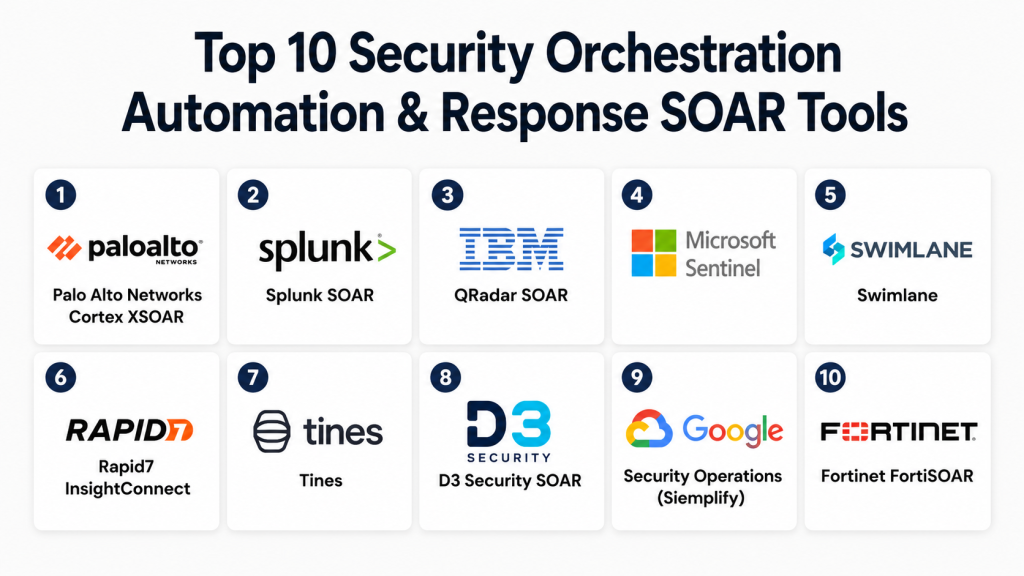
Top 10 Security Orchestration Automation & Response SOAR Tools
1 — Palo Alto Networks Cortex XSOAR
Short description: Cortex XSOAR is a mature enterprise SOAR platform designed for incident response automation, case management, threat intelligence, and SOC collaboration. It is widely used by large security teams that need deep playbooks and broad integrations.
Key Features
- Visual playbook automation for incident response workflows
- Case management for investigations, tasks, and evidence
- Real-time collaboration workspace for security analysts
- Threat intelligence management and indicator enrichment
- Large marketplace of integrations and automation content
- Human approval steps for sensitive remediation actions
- Strong support for enterprise SOC workflows
Pros
- Deep automation capabilities for mature SOC teams
- Strong integration marketplace and security ecosystem
- Excellent fit for complex enterprise incident response
Cons
- Can be complex for smaller teams
- Requires planning and skilled administration
- May involve higher operational effort for advanced workflows
Platforms / Deployment
Cloud / Self-hosted / Hybrid
Security & Compliance
RBAC
SSO/SAML
Audit logging
Encryption support
MFA support
Compliance details vary by deployment
Integrations & Ecosystem
Cortex XSOAR has a broad ecosystem designed to connect security tools, threat intelligence sources, identity platforms, ticketing systems, and communication channels. It works well for teams that need centralized response actions across many security products.
- Palo Alto Networks security tools
- SIEM platforms
- EDR and endpoint security tools
- Threat intelligence feeds
- Identity and access platforms
- ITSM and collaboration tools
Support & Community
Strong enterprise support ecosystem with documentation, training resources, professional services, partner support, and a large security operations user base.
2 — Splunk SOAR
Short description: Splunk SOAR is a security automation platform focused on playbooks, app-based integrations, incident workflows, and automated response. It is especially valuable for organizations already using Splunk Enterprise Security.
Key Features
- Visual playbook editor for automated workflows
- Large app and connector ecosystem
- Automated actions for enrichment and remediation
- Case management and incident collaboration
- Custom functions and reusable workflow logic
- Dashboards for automation performance
- Strong alignment with Splunk security analytics
Pros
- Strong choice for Splunk-centered SOC environments
- Mature automation and orchestration capabilities
- Flexible playbook design for advanced use cases
Cons
- Best value often requires Splunk ecosystem adoption
- Advanced workflows may need technical expertise
- Can be expensive for smaller teams
Platforms / Deployment
Cloud / Self-hosted / Hybrid
Security & Compliance
RBAC
SSO/SAML
Audit logging
Encryption support
MFA support
Compliance support varies by deployment
Integrations & Ecosystem
Splunk SOAR integrates with a wide range of security and IT systems, making it useful for organizations that need to automate actions across existing tools rather than replace them.
- Splunk Enterprise Security
- Endpoint detection tools
- Firewalls and network security tools
- Threat intelligence platforms
- Ticketing platforms
- ChatOps and communication systems
Support & Community
Strong documentation, enterprise support, training programs, and a large Splunk user community make it easier for mature SOC teams to build and maintain workflows.
3 — Microsoft Sentinel
Short description: Microsoft Sentinel is a cloud-native security analytics platform with SOAR capabilities through automation rules and playbooks. It is best suited for organizations invested in Microsoft security, Azure, Microsoft Defender, and Entra ID.
Key Features
- Cloud-native security operations platform
- Automation rules for incident handling
- Playbook-based response workflows
- Strong Microsoft Defender integration
- Identity-focused investigation capabilities
- Threat intelligence and hunting support
- Scalable automation through cloud workflows
Pros
- Excellent fit for Microsoft-centric environments
- Strong cloud-native scalability
- Good automation options for identity and endpoint response
Cons
- Best experience requires Microsoft ecosystem adoption
- Advanced workflows may require cloud automation knowledge
- Pricing can vary based on data and workflow usage
Platforms / Deployment
Cloud
Security & Compliance
RBAC
MFA
SSO/SAML
Audit logging
Encryption support
Microsoft cloud compliance ecosystem support
Integrations & Ecosystem
Microsoft Sentinel works especially well when connected with Microsoft security products, but it also supports third-party data sources and automation workflows.
- Microsoft Defender
- Microsoft Entra ID
- Microsoft 365
- Azure security services
- AWS
- ServiceNow and Jira
Support & Community
Strong enterprise documentation, Microsoft partner support, training resources, and a large community around security analytics and cloud automation.
4 — IBM QRadar SOAR
Short description: IBM QRadar SOAR is an enterprise incident response and automation platform focused on case management, breach response, playbooks, and security process standardization. It is a strong option for regulated organizations.
Key Features
- Structured incident case management
- Playbook-driven response workflows
- Breach response and privacy incident support
- Artifact enrichment and investigation tracking
- Dashboards for incident metrics
- Task assignment and analyst collaboration
- Strong governance and audit support
Pros
- Strong fit for regulated industries
- Mature incident response process management
- Good alignment with IBM QRadar environments
Cons
- Can feel heavy for smaller SOC teams
- Implementation requires process planning
- Interface and workflow setup may require training
Platforms / Deployment
Cloud / Self-hosted / Hybrid
Security & Compliance
RBAC
MFA
SSO/SAML
Audit logging
Encryption support
Compliance support varies by deployment
Integrations & Ecosystem
IBM QRadar SOAR integrates with security monitoring, threat intelligence, endpoint, network, identity, and ticketing systems. It is useful for teams that need consistent response processes and strong incident documentation.
- IBM QRadar SIEM
- Threat intelligence platforms
- Endpoint security tools
- Network security products
- Identity systems
- ITSM platforms
Support & Community
Enterprise-focused support with global consulting, documentation, implementation guidance, and security operations expertise.
5 — Swimlane Turbine
Short description: Swimlane Turbine is a security automation platform focused on low-code workflows, AI-assisted operations, case management, and security process automation. It is useful for teams that want flexible automation beyond traditional SOC use cases.
Key Features
- Low-code automation builder
- AI-assisted workflow support
- Case management and collaboration
- Dashboard and reporting capabilities
- Integration marketplace
- Reusable playbooks and automation components
- Support for security, IT, and compliance workflows
Pros
- Strong low-code automation experience
- Useful for cross-functional security workflows
- Good fit for teams modernizing SOC operations
Cons
- Advanced workflows still require governance
- May be more platform than smaller teams need
- Pricing details are not publicly stated
Platforms / Deployment
Cloud / Hybrid
Security & Compliance
RBAC
SSO/SAML
Audit logging
Encryption support
Compliance details are not publicly stated
Integrations & Ecosystem
Swimlane Turbine supports a broad set of integrations for security operations, IT service management, identity, endpoint, cloud, and collaboration workflows.
- Microsoft security tools
- CrowdStrike
- Palo Alto Networks
- Okta
- Splunk
- ServiceNow and Jira
Support & Community
Enterprise support, onboarding guidance, documentation, and professional services are available. The platform is best suited for teams that want structured support during automation rollout.
6 — Tines
Short description: Tines is a no-code automation platform widely used by security, IT, and operations teams. It is popular with teams that want flexible workflow automation without the complexity of traditional enterprise SOAR platforms.
Key Features
- No-code workflow builder
- API-first automation design
- Human approval and decision steps
- Webhook and event-driven workflows
- Strong support for custom automation
- Templates for common security workflows
- Useful for lean security engineering teams
Pros
- Easy to start compared with heavier SOAR tools
- Very flexible for API-driven workflows
- Strong fit for modern security engineering teams
Cons
- Traditional SOAR case management may be lighter
- Workflow governance depends on team discipline
- Some enterprise requirements may need careful validation
Platforms / Deployment
Cloud
Security & Compliance
RBAC
SSO/SAML
Audit logging
Encryption support
Compliance details vary by plan and agreement
Integrations & Ecosystem
Tines is strong for teams that want to connect tools quickly using APIs, webhooks, email triggers, and workflow logic. It is often used for phishing, alert enrichment, identity automation, and ticket routing.
- SIEM platforms
- EDR tools
- Identity providers
- Ticketing systems
- Slack and Microsoft Teams
- Cloud and DevOps tools
Support & Community
Strong documentation, workflow examples, customer education resources, and an active security automation community.
7 — Torq
Short description: Torq is a security hyperautomation platform designed to automate alert triage, investigation, response, and operational workflows. It is a good fit for teams looking for modern automation and AI-assisted SOC operations.
Key Features
- Security workflow automation
- AI-assisted triage and investigation support
- Case handling and response workflows
- Integrations across security and cloud tools
- Automated enrichment and remediation
- Human approval steps for sensitive actions
- Scalable workflows for high-volume alerts
Pros
- Modern approach to SOC automation
- Good fit for alert-heavy environments
- Strong automation potential across security operations
Cons
- Requires workflow design discipline
- Newer approach may require process changes
- Pricing details are not publicly stated
Platforms / Deployment
Cloud
Security & Compliance
RBAC
SSO/SAML
Audit logging
Encryption support
Compliance details are not publicly stated
Integrations & Ecosystem
Torq integrates with common security, cloud, identity, ticketing, and communication tools. It is useful for teams that want to automate alert enrichment, investigation routing, containment actions, and SOC reporting.
- SIEM tools
- EDR platforms
- Cloud security tools
- Identity systems
- Ticketing platforms
- Collaboration tools
Support & Community
Enterprise support, onboarding assistance, documentation, and customer success resources are available. Teams should evaluate it through real alert workflows before scaling.
8 — Rapid7 InsightConnect
Short description: Rapid7 InsightConnect is a security automation and orchestration platform designed for no-code workflows, plugin-based integrations, and practical SOC automation. It is a strong fit for Rapid7 users and mid-market security teams.
Key Features
- No-code workflow automation
- Plugin-based integration model
- Human decision and approval steps
- Workflow templates for common SOC tasks
- Cloud and on-premises connection options
- Phishing and vulnerability response automation
- Reporting and workflow visibility
Pros
- Easier to adopt than many heavy SOAR platforms
- Strong fit with Rapid7 security ecosystem
- Practical automation for mid-market teams
Cons
- May offer less depth than enterprise SOAR platforms
- Best value often comes with Rapid7 adoption
- Advanced customization may require technical effort
Platforms / Deployment
Cloud / Hybrid
Security & Compliance
RBAC
MFA
SSO/SAML
Audit logging
Encryption support
Compliance support varies by deployment
Integrations & Ecosystem
Rapid7 InsightConnect integrates with many cloud, endpoint, threat intelligence, email security, and ticketing tools. It is particularly useful for connecting detection, vulnerability, and response workflows.
- Rapid7 InsightIDR
- Rapid7 InsightVM
- Email security tools
- Threat intelligence platforms
- Endpoint security platforms
- Jira and ServiceNow
Support & Community
Good customer support, approachable documentation, workflow templates, and Rapid7 ecosystem resources make it a practical choice for teams starting their automation journey.
9 — FortiSOAR
Short description: FortiSOAR is Fortinet’s security orchestration and incident response platform. It helps organizations automate response workflows, manage incidents, and connect security tools across IT, OT, and SOC environments.
Key Features
- Incident response automation
- Playbook and workflow design
- Centralized incident management
- Collaboration and war room capabilities
- Connector-based integration ecosystem
- Reporting and dashboards
- Support for IT, OT, and security operations
Pros
- Strong fit for Fortinet security environments
- Useful for IT and OT security operations
- Good incident management and playbook capabilities
Cons
- Non-Fortinet environments may need extra setup
- Workflow customization can require planning
- Pricing details are not publicly stated
Platforms / Deployment
Cloud / Self-hosted / Hybrid
Security & Compliance
RBAC
SSO/SAML
Audit logging
Encryption support
Compliance details vary by deployment
Integrations & Ecosystem
FortiSOAR integrates well within the Fortinet Security Fabric and also supports connections to third-party security and IT tools. It is useful for organizations standardizing response workflows across network, endpoint, cloud, and operational systems.
- Fortinet Security Fabric
- SIEM platforms
- Firewalls
- Endpoint security tools
- Threat intelligence feeds
- ITSM tools
Support & Community
Fortinet provides enterprise support, partner services, documentation, and a large security product ecosystem. It is especially useful for Fortinet-focused organizations.
10 — ServiceNow Security Incident Response
Short description: ServiceNow Security Incident Response extends the ServiceNow platform into security operations with case management, workflows, automation, and cross-team response. It is best for enterprises already using ServiceNow ITSM and CMDB.
Key Features
- Security incident case management
- Playbook and workflow automation
- Integration with ITSM and CMDB
- Incident task assignment and tracking
- Reporting and governance capabilities
- Collaboration between security and IT teams
- Strong enterprise process alignment
Pros
- Excellent fit for ServiceNow-heavy enterprises
- Strong case management and governance
- Useful for cross-functional incident response
Cons
- Not always a full replacement for pure-play SOAR tools
- Requires ServiceNow platform maturity
- Implementation can be complex
Platforms / Deployment
Cloud
Security & Compliance
RBAC
SSO/SAML
Audit logging
Encryption support
MFA support
Compliance support varies by ServiceNow environment
Integrations & Ecosystem
ServiceNow Security Incident Response works well when security incidents need to connect with IT service management, change management, asset management, and enterprise workflow processes.
- ServiceNow ITSM
- ServiceNow CMDB
- SIEM tools
- Vulnerability management tools
- Identity systems
- Collaboration platforms
Support & Community
Strong enterprise support, implementation partner ecosystem, documentation, training, and a large ServiceNow administrator community.
Comparison Table
| Tool Name | Best For | Platform(s) Supported | Deployment | Standout Feature | Public Rating |
|---|---|---|---|---|---|
| Palo Alto Networks Cortex XSOAR | Mature enterprise SOCs | Web | Cloud / Self-hosted / Hybrid | Deep playbooks and incident collaboration | N/A |
| Splunk SOAR | Splunk-centered SOC teams | Web | Cloud / Self-hosted / Hybrid | Large app ecosystem and automated actions | N/A |
| Microsoft Sentinel | Microsoft security environments | Web | Cloud | Cloud-native playbook automation | N/A |
| IBM QRadar SOAR | Regulated enterprises | Web | Cloud / Self-hosted / Hybrid | Case management and breach response | N/A |
| Swimlane Turbine | Low-code automation teams | Web | Cloud / Hybrid | AI-assisted security automation | N/A |
| Tines | Security engineering teams | Web | Cloud | API-first no-code workflows | N/A |
| Torq | High-volume SOC automation | Web | Cloud | Security hyperautomation workflows | N/A |
| Rapid7 InsightConnect | Mid-market SOC teams | Web | Cloud / Hybrid | No-code security workflows | N/A |
| FortiSOAR | Fortinet and IT OT environments | Web | Cloud / Self-hosted / Hybrid | Centralized incident automation | N/A |
| ServiceNow Security Incident Response | ServiceNow enterprises | Web | Cloud | Enterprise workflow and case management | N/A |
Evaluation & Scoring of Security Orchestration Automation & Response SOAR
| Tool Name | Core | Ease | Integrations | Security | Performance | Support | Value | Weighted Total |
|---|---|---|---|---|---|---|---|---|
| Palo Alto Networks Cortex XSOAR | 10 | 7 | 10 | 9 | 9 | 9 | 7 | 8.8 |
| Splunk SOAR | 9 | 7 | 10 | 9 | 9 | 9 | 7 | 8.6 |
| Microsoft Sentinel | 9 | 8 | 9 | 9 | 9 | 8 | 8 | 8.6 |
| IBM QRadar SOAR | 9 | 7 | 8 | 9 | 8 | 9 | 7 | 8.2 |
| Swimlane Turbine | 9 | 8 | 9 | 8 | 9 | 8 | 8 | 8.5 |
| Tines | 8 | 9 | 9 | 8 | 8 | 8 | 9 | 8.5 |
| Torq | 8 | 8 | 8 | 8 | 9 | 8 | 8 | 8.1 |
| Rapid7 InsightConnect | 8 | 9 | 8 | 8 | 8 | 8 | 8 | 8.2 |
| FortiSOAR | 8 | 7 | 8 | 8 | 8 | 8 | 8 | 7.9 |
| ServiceNow Security Incident Response | 8 | 7 | 8 | 9 | 8 | 9 | 7 | 8.0 |
These scores are comparative rather than absolute. Organizations should prioritize the criteria that matter most to their operating model. Mature SOC teams may value playbook depth and integrations more heavily, while smaller teams may care more about ease of use and faster deployment. Existing ecosystem fit can also change the final decision, because a tool aligned with current SIEM, ITSM, identity, and endpoint platforms may deliver better value than a higher-scoring standalone option.
Which Security Orchestration Automation & Response SOAR Tool Is Right for You?
Solo / Freelancer
Most solo users do not need a full enterprise SOAR platform. Lightweight workflow automation tools or managed security services are usually more practical. If automation is still needed, Tines can be a strong option because it supports flexible no-code workflows without the operational overhead of a large enterprise platform.
SMB
SMBs should focus on simple automation, easy integrations, and clear operational value. Rapid7 InsightConnect, Microsoft Sentinel, and Tines are practical choices depending on the existing security stack. SMB teams should start with a few repeatable workflows such as phishing triage, suspicious login enrichment, ticket creation, and endpoint escalation.
Mid-Market
Mid-market organizations often need stronger case management, more integrations, and better analyst collaboration. Swimlane Turbine, Splunk SOAR, Microsoft Sentinel, Torq, and FortiSOAR can be strong options. The best choice depends on whether the company prioritizes low-code automation, Microsoft integration, Splunk alignment, or broader security operations workflow coverage.
Enterprise
Large enterprises should prioritize governance, scalability, access control, auditability, approval workflows, reporting, and integration depth. Cortex XSOAR, Splunk SOAR, IBM QRadar SOAR, ServiceNow Security Incident Response, and Swimlane Turbine are strong enterprise candidates. Enterprises should also validate support quality, workflow governance, and change control before rollout.
Budget vs Premium
Budget-sensitive teams should avoid overbuying a platform before they have mature incident response processes. Tines, Rapid7 InsightConnect, and Microsoft Sentinel can offer practical entry points depending on the environment. Premium buyers with large SOC teams may prefer Cortex XSOAR, Splunk SOAR, IBM QRadar SOAR, or ServiceNow Security Incident Response for deeper governance and enterprise-scale workflows.
Feature Depth vs Ease of Use
Cortex XSOAR, Splunk SOAR, and IBM QRadar SOAR offer strong feature depth but may require more setup and skilled administration. Tines, Rapid7 InsightConnect, and Swimlane Turbine are easier for many teams to adopt. Buyers should decide whether they need maximum customization or faster operational rollout.
Integrations & Scalability
Organizations with many security tools should prioritize integration depth and API flexibility. Cortex XSOAR, Splunk SOAR, Swimlane Turbine, FortiSOAR, and Microsoft Sentinel are strong options for broad ecosystems. Teams should test real integrations during evaluation rather than relying only on connector lists.
Security & Compliance Needs
Regulated organizations should evaluate RBAC, SSO, MFA, encryption, audit logs, approval gates, incident timelines, evidence tracking, data retention, and reporting. IBM QRadar SOAR, ServiceNow Security Incident Response, Cortex XSOAR, and Splunk SOAR are strong candidates for compliance-heavy environments.
Frequently Asked Questions FAQs
1. What does a SOAR platform actually do?
A SOAR platform connects security tools, automates repetitive response tasks, manages incidents, and helps analysts follow repeatable playbooks. It improves speed and consistency across security operations.
2. Is SOAR only for large enterprises?
No. While many SOAR platforms are enterprise-focused, smaller teams can also benefit from lightweight workflow automation. The key is choosing a platform that matches alert volume, staffing, and tool complexity.
3. What is the difference between SIEM and SOAR?
SIEM focuses on collecting, analyzing, and correlating security events. SOAR focuses on automating investigation, response, escalation, documentation, and collaboration after an alert is created.
4. Can SOAR replace security analysts?
No. SOAR reduces repetitive work but does not replace human judgment. Analysts are still needed for complex investigations, risk decisions, tuning, approval, and incident leadership.
5. What are common SOAR use cases?
Common use cases include phishing response, IOC enrichment, endpoint isolation, suspicious login investigation, vulnerability ticketing, cloud alert triage, malware response, and incident reporting.
6. How long does SOAR implementation take?
Implementation depends on workflow complexity, integration readiness, and team maturity. Simple playbooks can be built quickly, while enterprise-wide automation programs may require phased rollout and governance.
7. Why do SOAR projects fail?
SOAR projects often fail when teams automate broken processes, build too many playbooks at once, skip approval controls, ignore integration maintenance, or fail to measure real operational value.
8. What integrations are most important for SOAR?
Important integrations include SIEM, EDR, IAM, email security, threat intelligence, firewall, vulnerability management, cloud security, ticketing, and collaboration platforms.
9. Is SOAR useful for compliance?
Yes. SOAR can help maintain incident timelines, approval logs, response documentation, evidence records, and reporting workflows. This is useful for regulated industries and audit-heavy environments.
10. What should buyers prioritize first when choosing a SOAR tool?
Buyers should prioritize real use cases, integration fit, playbook usability, analyst experience, security controls, reporting needs, and total operational effort. A pilot with real incidents is the best way to validate fit.
Conclusion
Security Orchestration Automation & Response SOAR platforms are now essential for security teams that need faster investigations, consistent response workflows, and better coordination across complex security stacks. The best SOAR tool depends on company size, SOC maturity, existing tools, compliance needs, automation goals, and team skill level. Cortex XSOAR and Splunk SOAR are strong for mature enterprise SOCs, Microsoft Sentinel is a strong fit for Microsoft-first environments, IBM QRadar SOAR and ServiceNow Security Incident Response work well for process-heavy enterprises, while Tines, Swimlane Turbine, Rapid7 InsightConnect, Torq, and FortiSOAR provide practical automation paths for different operating models. Before choosing a platform, shortlist two or three tools, test real workflows such as phishing response and endpoint containment, validate integrations and access controls, review pricing carefully, and scale automation gradually with clear governance.

Find Trusted Cardiac Hospitals
Compare heart hospitals by city and services — all in one place.
Explore Hospitals
This article really helped me understand SOAR tools in a simple way. I didn’t know automation could improve security response this much.