Introduction
Lakehouse Platforms combine the flexibility of data lakes with the performance and governance of data warehouses. In simple terms, they help organizations store large volumes of structured, semi-structured, and unstructured data while still supporting analytics, AI, machine learning, reporting, and real-time data processing from one unified environment. As AI, generative AI, real-time analytics, and enterprise data governance become more important, lakehouse platforms are becoming a core part of modern data architecture. They reduce data silos, support open table formats, and help teams connect analytics, engineering, BI, and AI workflows more efficiently.
Common Real-world use cases include:
- Enterprise data lake modernization
- AI and machine learning pipelines
- Business intelligence and reporting
- Real-time analytics and streaming data
- Customer analytics and personalization
- Data governance and compliance management
When Evaluating lakehouse platforms, buyers should consider:
- Support for open table formats
- Data governance and access controls
- Query performance
- AI and machine learning capabilities
- Data integration ecosystem
- Cloud and hybrid deployment flexibility
- Cost optimization features
- Security and compliance controls
- Support for BI tools
- Ease of administration
Best for: Data engineering teams, analytics teams, AI teams, enterprises, cloud architects, BI teams, and organizations modernizing from traditional data warehouses or fragmented data lakes.
Not ideal for: Very small teams with simple reporting needs, organizations with minimal data volume, or businesses that only need a basic relational database or lightweight BI tool.
Key Trends in Lakehouse Platforms
- AI-native lakehouse architecture is becoming more important as organizations build generative AI, RAG, and machine learning workloads on governed enterprise data.
- Open table formats such as Delta Lake, Apache Iceberg, and Apache Hudi are improving interoperability across tools and clouds.
- Unified governance is becoming a key buying factor as teams need consistent access control, lineage, masking, and auditing.
- Real-time data processing is moving closer to standard lakehouse functionality through streaming ingestion and event-driven pipelines.
- Serverless analytics is reducing operational complexity for teams that do not want to manage clusters manually.
- Data sharing and collaboration are becoming more important for cross-team and cross-company analytics.
- Cost governance is a major priority as cloud storage, compute, and AI workloads scale quickly.
- Semantic layers and business-friendly analytics are helping business users work with complex lakehouse data more easily.
- Hybrid and multi-cloud strategies are growing as enterprises avoid vendor lock-in and meet data residency requirements.
- Vector search and AI-ready data layers are increasingly being added to lakehouse ecosystems.
How We Selected These Tools
The tools in this list were selected using the following evaluation logic:
- Market adoption and enterprise mindshare
- Ability to support lakehouse architecture at scale
- Strength of data engineering and analytics features
- AI and machine learning ecosystem maturity
- Support for open data formats and interoperability
- Security, governance, and compliance posture
- Cloud-native and hybrid deployment flexibility
- Integration with BI, ETL, streaming, and ML tools
- Suitability for SMB, mid-market, and enterprise users
- Documentation, community, and support ecosystem
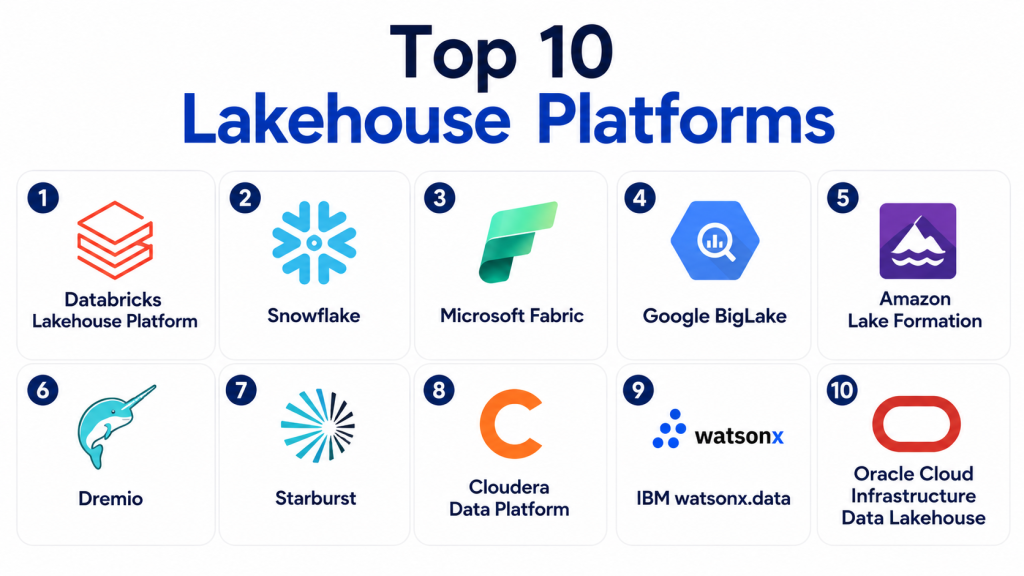
Top 10 Lakehouse Platforms Tools
1 — Databricks Lakehouse Platform
Short description: Databricks Lakehouse Platform is one of the most recognized platforms for combining data engineering, analytics, AI, and machine learning on a unified lakehouse architecture. It is best suited for organizations building large-scale data and AI workloads.
Key Features
- Unified lakehouse architecture for data engineering, analytics, and AI
- Delta Lake support for reliable data management
- Collaborative notebooks for data teams
- Machine learning and AI workflow support
- Data governance through Unity Catalog
- Streaming and batch processing capabilities
- Integration with major cloud platforms
Pros
- Strong fit for AI, ML, and advanced analytics teams
- Mature lakehouse ecosystem with strong developer adoption
- Good scalability for enterprise data workloads
Cons
- Can require skilled data engineering resources
- Cost management needs careful monitoring
- Advanced setup may be complex for smaller teams
Platforms / Deployment
Cloud / Hybrid
Security & Compliance
RBAC, encryption, audit logs, SSO/SAML, and governance features are available. Compliance certifications vary by deployment and cloud environment.
Integrations & Ecosystem
Databricks has a broad ecosystem across data engineering, BI, AI, and cloud platforms.
- Apache Spark
- Delta Lake
- MLflow
- Power BI
- Tableau
- AWS, Azure, and Google Cloud
Support & Community
Databricks has strong enterprise support, extensive documentation, a large data engineering community, and broad partner ecosystem coverage.
2 — Snowflake
Short description: Snowflake is a cloud data platform that supports data warehouse, lakehouse, data sharing, and AI-ready analytics use cases. It is best for organizations seeking managed analytics with strong scalability.
Key Features
- Separation of storage and compute
- Support for structured and semi-structured data
- Data sharing and collaboration features
- Snowpark for developer and data science workloads
- Governance and access control capabilities
- Multi-cloud availability
- Integration with BI and data engineering tools
Pros
- Easy to use compared with many complex data platforms
- Strong performance and scalability
- Excellent ecosystem for BI and analytics
Cons
- Costs can rise with high compute usage
- Less open-engine focused than some lakehouse alternatives
- Advanced optimization requires governance discipline
Platforms / Deployment
Cloud
Security & Compliance
RBAC, encryption, MFA, SSO/SAML, audit logging, and governance features are available. Compliance support varies by region and edition.
Integrations & Ecosystem
Snowflake integrates widely with modern data stacks and analytics tools.
- dbt
- Tableau
- Power BI
- Fivetran
- Matillion
- AWS, Azure, and Google Cloud
Support & Community
Snowflake has strong enterprise support, extensive documentation, and a mature partner marketplace.
3 — Microsoft Fabric
Short description: Microsoft Fabric is a unified analytics platform that combines data engineering, data warehousing, lakehouse, real-time analytics, and BI capabilities. It is best for Microsoft-centric organizations.
Key Features
- Unified analytics workspace
- Lakehouse and warehouse experiences
- Deep Power BI integration
- OneLake centralized data storage layer
- Data Factory integration
- Real-time analytics support
- AI and Copilot-assisted workflows
Pros
- Strong fit for Microsoft ecosystem users
- Combines BI, engineering, and analytics in one platform
- Simplifies collaboration across business and technical teams
Cons
- Best value is for Microsoft-aligned environments
- Feature depth may vary across workloads
- Requires governance planning for enterprise-scale adoption
Platforms / Deployment
Cloud
Security & Compliance
RBAC, encryption, Microsoft Entra ID integration, audit capabilities, and governance features are available. Compliance support varies by Microsoft cloud configuration.
Integrations & Ecosystem
Microsoft Fabric integrates closely with Microsoft data and productivity tools.
- Power BI
- Azure Data Factory
- Microsoft OneLake
- Azure Synapse
- Microsoft Purview
- Excel
Support & Community
Microsoft provides strong enterprise support, documentation, learning resources, and partner ecosystem coverage.
4 — Google BigLake
Short description: Google BigLake is a lakehouse storage engine that helps organizations unify data lakes and warehouses across Google Cloud environments. It is best for teams using BigQuery and Google Cloud analytics.
Key Features
- Unified access across data lakes and warehouses
- Integration with BigQuery
- Fine-grained access control
- Support for open data formats
- Serverless analytics experience
- Multi-cloud data access capabilities
- Governance through Google Cloud services
Pros
- Strong fit for Google Cloud users
- Simplifies analytics across lake and warehouse data
- Works well with BigQuery-based teams
Cons
- Best suited for Google Cloud-centric architectures
- May require cloud expertise for advanced governance
- Ecosystem depends heavily on Google Cloud services
Platforms / Deployment
Cloud
Security & Compliance
IAM, encryption, access controls, and audit logging are supported through Google Cloud. Compliance support varies by service configuration.
Integrations & Ecosystem
BigLake connects with Google Cloud analytics, AI, and data tools.
- BigQuery
- Vertex AI
- Looker
- Dataflow
- Dataproc
- Cloud Storage
Support & Community
Google Cloud provides enterprise support, technical documentation, and strong cloud-native analytics resources.
5 — Amazon Lake Formation
Short description: Amazon Lake Formation helps build, secure, and manage data lakes on AWS. It is best for AWS users who need governance, access control, and lakehouse-style analytics across AWS data services.
Key Features
- Centralized data lake governance
- Fine-grained access control
- Integration with AWS analytics services
- Data catalog support
- Security policy management
- Data sharing capabilities
- Support for lakehouse architecture patterns
Pros
- Strong AWS ecosystem integration
- Useful for governed enterprise data lakes
- Works with multiple AWS analytics services
Cons
- AWS-centric platform
- Setup and permissions can be complex
- Requires broader AWS architecture knowledge
Platforms / Deployment
Cloud
Security & Compliance
IAM integration, encryption, access control, audit logging, and governance features are available through AWS services. Compliance depends on the AWS environment.
Integrations & Ecosystem
Lake Formation integrates across AWS analytics and data services.
- AWS Glue
- Amazon S3
- Amazon Athena
- Amazon Redshift
- Amazon EMR
- AWS IAM
Support & Community
AWS provides strong enterprise support, documentation, and a large cloud architecture community.
6 — Dremio
Short description: Dremio is a lakehouse platform focused on fast SQL analytics directly on data lake storage. It is best for teams that want high-performance BI and analytics on open data formats.
Key Features
- SQL query engine for data lakes
- Apache Iceberg support
- Data reflection acceleration
- Semantic layer capabilities
- BI tool integration
- Cloud and self-managed options
- Open lakehouse architecture
Pros
- Strong fit for open lakehouse analytics
- Good BI acceleration capabilities
- Reduces data movement for analytics workloads
Cons
- Requires planning for performance optimization
- Enterprise features may require paid tiers
- Best results depend on data architecture quality
Platforms / Deployment
Cloud / Self-hosted / Hybrid
Security & Compliance
RBAC, encryption, SSO/SAML, and access controls are available. Compliance details vary by deployment and edition.
Integrations & Ecosystem
Dremio integrates with open data lake, BI, and cloud ecosystems.
- Apache Iceberg
- Amazon S3
- Azure Data Lake Storage
- Tableau
- Power BI
- dbt
Support & Community
Dremio offers documentation, enterprise support options, and a growing community around open lakehouse analytics.
7 — Starburst
Short description: Starburst is a distributed SQL analytics platform built around Trino, enabling lakehouse-style querying across multiple data sources. It is best for federated analytics and open data architectures.
Key Features
- Distributed SQL query engine
- Trino-based architecture
- Federated query support
- Open data lake analytics
- Access control and governance features
- Support for multiple data sources
- Cloud and hybrid deployment options
Pros
- Excellent for querying distributed data sources
- Strong open ecosystem alignment
- Good fit for multi-cloud and hybrid analytics
Cons
- Requires skilled teams for architecture design
- Performance depends on data source configuration
- Governance needs careful setup across environments
Platforms / Deployment
Cloud / Self-hosted / Hybrid
Security & Compliance
RBAC, SSO/SAML, encryption, and access control features are available. Compliance details vary by deployment.
Integrations & Ecosystem
Starburst integrates with many enterprise data sources and open lakehouse tools.
- Trino
- Apache Iceberg
- Hive Metastore
- AWS S3
- Azure Data Lake Storage
- Tableau
- Power BI
Support & Community
Starburst has enterprise support and benefits from the broader Trino open-source ecosystem.
8 — Cloudera Data Platform
Short description: Cloudera Data Platform is an enterprise data platform supporting hybrid cloud data lakes, analytics, machine learning, and governance. It is best for large enterprises with complex data environments.
Key Features
- Hybrid cloud data platform
- Data lake and analytics capabilities
- Machine learning support
- Security and governance features
- Data lifecycle management
- Multi-workload support
- Enterprise-grade data management
Pros
- Strong fit for large hybrid enterprises
- Mature governance and data management capabilities
- Supports complex regulated environments
Cons
- Can be complex to implement and manage
- Enterprise pricing may be high
- Requires experienced data platform teams
Platforms / Deployment
Cloud / Self-hosted / Hybrid
Security & Compliance
RBAC, encryption, audit logs, access controls, and governance capabilities are available. Compliance support depends on deployment configuration.
Integrations & Ecosystem
Cloudera integrates with enterprise data, AI, and analytics ecosystems.
- Apache Spark
- Apache Hive
- Apache Kafka
- Kubernetes
- BI tools
- Cloud object storage
Support & Community
Cloudera offers enterprise support, professional services, and mature documentation for complex data environments.
9 — IBM watsonx.data
Short description: IBM watsonx.data is a data store and lakehouse platform designed for AI and analytics workloads across hybrid environments. It is best for enterprises using IBM ecosystems and governed AI initiatives.
Key Features
- Lakehouse architecture for AI and analytics
- Open data format support
- Query engine flexibility
- Hybrid cloud support
- Governance-focused design
- Cost optimization for analytics workloads
- Integration with IBM AI ecosystem
Pros
- Strong fit for enterprise AI governance
- Good hybrid cloud positioning
- Useful for IBM-centric organizations
Cons
- Best suited for enterprise environments
- Smaller mainstream adoption than some competitors
- Implementation may require IBM ecosystem expertise
Platforms / Deployment
Cloud / Hybrid
Security & Compliance
RBAC, encryption, governance features, and access controls are available. Compliance details vary by deployment.
Integrations & Ecosystem
IBM watsonx.data integrates with IBM analytics, AI, and open data tools.
- IBM watsonx
- Presto
- Spark
- Object storage
- BI tools
- Open table formats
Support & Community
IBM provides enterprise support, consulting, documentation, and strong governance-focused resources.
10 — Oracle Cloud Infrastructure Data Lakehouse
Short description: Oracle Cloud Infrastructure Data Lakehouse combines Oracle data services for data lake, warehouse, analytics, and AI workloads. It is best for organizations already invested in Oracle Cloud and Oracle enterprise systems.
Key Features
- Integration with Oracle Cloud data services
- Data lake and warehouse architecture support
- Object storage-based data lake
- Analytics and AI service integration
- Enterprise security controls
- Data catalog and governance capabilities
- Support for Oracle business workloads
Pros
- Strong fit for Oracle customers
- Good enterprise data management alignment
- Useful for regulated and business-critical workloads
Cons
- Best suited for Oracle-centric environments
- Smaller lakehouse mindshare than Databricks or Snowflake
- Requires cloud architecture planning
Platforms / Deployment
Cloud / Hybrid
Security & Compliance
RBAC, encryption, identity integration, and audit capabilities are available through Oracle Cloud services. Compliance support varies by deployment.
Integrations & Ecosystem
Oracle lakehouse architecture integrates with Oracle data and analytics services.
- Oracle Autonomous Database
- Oracle Object Storage
- Oracle Analytics
- Oracle Data Integration
- Oracle Cloud Infrastructure
- Enterprise applications
Support & Community
Oracle provides enterprise support, documentation, and professional services for cloud and database customers.
Comparison Table
| Tool Name | Best For | Platform(s) Supported | Deployment | Standout Feature | Public Rating |
|---|---|---|---|---|---|
| Databricks Lakehouse Platform | AI, ML, and data engineering | Web | Cloud / Hybrid | Unified lakehouse with Delta Lake | N/A |
| Snowflake | Cloud analytics and data sharing | Web | Cloud | Scalable managed analytics platform | N/A |
| Microsoft Fabric | Microsoft ecosystem analytics | Web | Cloud | Unified analytics with OneLake | N/A |
| Google BigLake | Google Cloud lakehouse workloads | Web | Cloud | BigQuery-connected lakehouse access | N/A |
| Amazon Lake Formation | AWS governed data lakes | Web | Cloud | Centralized lake governance | N/A |
| Dremio | Open lakehouse SQL analytics | Web / Linux | Cloud / Self-hosted / Hybrid | Fast SQL on data lakes | N/A |
| Starburst | Federated lakehouse analytics | Web / Linux | Cloud / Self-hosted / Hybrid | Trino-based distributed SQL | N/A |
| Cloudera Data Platform | Hybrid enterprise data platforms | Web / Linux | Cloud / Self-hosted / Hybrid | Enterprise hybrid data management | N/A |
| IBM watsonx.data | Governed AI and analytics | Web | Cloud / Hybrid | AI-ready lakehouse architecture | N/A |
| Oracle OCI Data Lakehouse | Oracle enterprise environments | Web | Cloud / Hybrid | Oracle cloud data integration | N/A |
Evaluation & Scoring of Lakehouse Platforms
| Tool Name | Core 25% | Ease 15% | Integrations 15% | Security 10% | Performance 10% | Support 10% | Value 15% | Weighted Total |
|---|---|---|---|---|---|---|---|---|
| Databricks Lakehouse Platform | 10 | 7 | 9 | 9 | 9 | 9 | 7 | 8.7 |
| Snowflake | 9 | 9 | 9 | 9 | 9 | 9 | 7 | 8.8 |
| Microsoft Fabric | 8 | 9 | 9 | 9 | 8 | 8 | 8 | 8.4 |
| Google BigLake | 8 | 8 | 8 | 9 | 8 | 8 | 8 | 8.1 |
| Amazon Lake Formation | 8 | 7 | 9 | 9 | 8 | 8 | 8 | 8.1 |
| Dremio | 8 | 8 | 8 | 8 | 8 | 8 | 8 | 8.0 |
| Starburst | 8 | 7 | 9 | 8 | 8 | 8 | 8 | 8.0 |
| Cloudera Data Platform | 8 | 6 | 8 | 9 | 8 | 9 | 7 | 7.8 |
| IBM watsonx.data | 8 | 7 | 8 | 9 | 8 | 8 | 7 | 7.9 |
| Oracle OCI Data Lakehouse | 7 | 7 | 8 | 9 | 8 | 8 | 7 | 7.7 |
These scores are comparative and should be interpreted based on business context. A higher score does not mean the tool is automatically the best choice for every organization. For example, Snowflake may be ideal for managed analytics, while Databricks may be better for advanced AI and engineering teams. Cloud-native organizations may prefer a platform aligned with their existing provider, while hybrid enterprises may prioritize Cloudera, Starburst, Dremio, or IBM watsonx.data.
Which Lakehouse Platforms Tool Is Right for You?
Solo / Freelancer
Solo users and independent consultants usually need simplicity, low setup effort, and flexible experimentation. Dremio, Snowflake, and Microsoft Fabric can be practical options depending on the preferred cloud and BI ecosystem. If the goal is learning lakehouse concepts, a managed platform is usually easier than building a full open-source stack from scratch.
SMB
SMBs should prioritize ease of use, predictable cost, and fast time to value. Snowflake, Microsoft Fabric, and Dremio are strong options because they simplify analytics workflows and reduce infrastructure overhead. SMBs already using Microsoft tools may benefit from Fabric, while analytics-focused teams may prefer Snowflake.
Mid-Market
Mid-market organizations often need stronger governance, more integrations, and support for both BI and AI workloads. Databricks, Snowflake, Starburst, and Google BigLake are good candidates depending on the company’s cloud strategy. Teams with strong data engineering skills may prefer Databricks, while BI-heavy teams may prefer Snowflake or Microsoft Fabric.
Enterprise
Enterprises should focus on governance, scalability, security, multi-cloud flexibility, and workload isolation. Databricks, Snowflake, Cloudera Data Platform, IBM watsonx.data, and Starburst are strong enterprise options. Highly regulated industries should validate access control, audit logging, encryption, lineage, and compliance requirements before adoption.
Budget vs Premium
Budget-conscious teams may prefer open and modular platforms like Dremio, Starburst, or cloud-native services already included in their preferred cloud ecosystem. Premium managed platforms like Snowflake and Databricks can reduce operational complexity but require careful cost governance. The right choice depends on whether the organization wants to optimize for lower platform cost or lower engineering overhead.
Feature Depth vs Ease of Use
Databricks offers deep feature capabilities for AI, ML, streaming, and data engineering, but it may require stronger technical expertise. Snowflake and Microsoft Fabric generally offer smoother managed experiences for analytics teams. Dremio and Starburst provide strong open lakehouse capabilities but may require thoughtful architecture planning.
Integrations & Scalability
For Microsoft-heavy organizations, Microsoft Fabric is a strong choice. For AWS environments, Amazon Lake Formation works well with AWS-native analytics. For Google Cloud teams, BigLake aligns naturally with BigQuery and Vertex AI. Multi-cloud or open architecture teams may prefer Databricks, Snowflake, Starburst, or Dremio.
Security & Compliance Needs
Security-focused buyers should prioritize RBAC, encryption, SSO/SAML, audit logs, data lineage, data masking, and centralized governance. Enterprises should also validate data residency, retention, compliance requirements, and integration with existing identity systems. Regulated organizations should avoid choosing only by performance and should evaluate governance depth carefully.
Frequently Asked Questions
1. What is a lakehouse platform?
A lakehouse platform combines the low-cost storage flexibility of a data lake with the analytics performance and governance features of a data warehouse. It supports BI, AI, ML, and data engineering workloads in one architecture.
2. How is a lakehouse different from a data warehouse?
A data warehouse is mainly optimized for structured analytics, while a lakehouse can handle structured, semi-structured, and unstructured data. Lakehouses are often more flexible for AI, ML, and large-scale data engineering.
3. How is a lakehouse different from a data lake?
A data lake stores raw data but often lacks strong governance and performance features. A lakehouse adds transaction support, query acceleration, schema management, and stronger analytics capabilities.
4. Which lakehouse platform is best for AI workloads?
Databricks is commonly preferred for AI and machine learning workloads because of its engineering, notebook, Spark, and ML ecosystem. However, Snowflake, Microsoft Fabric, and IBM watsonx.data also support AI-focused analytics workflows.
5. Are lakehouse platforms expensive?
Costs vary based on storage, compute, query volume, data movement, and managed service usage. Teams should monitor compute usage, retention policies, workload patterns, and data duplication to avoid unexpected costs.
6. What are common lakehouse implementation mistakes?
Common mistakes include poor data governance, unclear ownership, excessive data duplication, weak metadata management, and no cost monitoring. Teams should define architecture, access policies, and workload priorities early.
7. Do lakehouse platforms support real-time analytics?
Many lakehouse platforms support streaming ingestion or near real-time analytics. The exact capability depends on the platform, data pipelines, query engine, and architecture design.
8. What security features should buyers look for?
Important features include RBAC, encryption, SSO/SAML, MFA, audit logs, data masking, lineage, and policy-based access control. Regulated industries should also validate compliance and data residency requirements.
9. Can lakehouse platforms replace data warehouses?
In some organizations, yes. However, many companies use lakehouses alongside warehouses during migration. The decision depends on workload complexity, performance needs, governance maturity, and existing investments.
10. Which lakehouse platform is best for Microsoft users?
Microsoft Fabric is a strong option for Microsoft-centric organizations because it integrates with Power BI, OneLake, Data Factory, and Microsoft governance services. It is especially useful when business users and data teams already work in Microsoft tools.
Conclusion
Lakehouse platforms are becoming a key foundation for modern data, analytics, and AI strategies because they bring together the flexibility of data lakes and the reliability of warehouse-style analytics. The best platform depends on the organization’s cloud strategy, technical maturity, governance needs, AI goals, budget, and existing ecosystem. Databricks is especially strong for AI and data engineering, Snowflake is strong for managed analytics and sharing, Microsoft Fabric is attractive for Microsoft-first teams, and Starburst or Dremio work well for open and federated lakehouse architectures. Enterprises with complex hybrid environments may prefer Cloudera, IBM watsonx.data, or Oracle OCI Data Lakehouse depending on their existing stack. The best next step is to shortlist two or three platforms, run a realistic pilot using actual data and workloads, validate security and integration requirements, and compare total cost before making a long-term decision.

Find Trusted Cardiac Hospitals
Compare heart hospitals by city and services — all in one place.
Explore Hospitals
Good article. It clearly explains different lakehouse platforms and helps in understanding their pros and cons.