Introduction
Fraud Prevention for E-commerce tools help online businesses detect, block, review, and reduce fraudulent transactions before they become chargebacks, refund abuse, account takeovers, fake orders, promo abuse, or payment disputes. These tools analyze signals such as device fingerprinting, payment behavior, customer history, IP risk, location mismatch, velocity patterns, order value, shipping address risk, and behavioral data. E-commerce fraud prevention matters because online sellers face increasingly sophisticated attacks while also needing to protect legitimate customers from unnecessary checkout friction. A good fraud prevention platform helps merchants approve more valid orders, reduce chargebacks, prevent account abuse, protect promotions, and automate manual review workflows.
Real World Use Cases
- Detecting stolen card purchases before fulfillment
- Preventing account takeover and suspicious login behavior
- Reducing chargebacks, refund abuse, and policy abuse
- Screening risky orders without blocking legitimate customers
- Protecting promotions, coupons, gift cards, and loyalty programs from abuse
Evaluation Criteria for Buyers
- Fraud detection accuracy and false-positive control
- Chargeback prevention and liability support
- Machine learning and rule-based decisioning
- Device fingerprinting and behavioral analytics
- Account takeover and bot detection capabilities
- Manual review workflow and case management
- Integration with ecommerce, payment, OMS, CRM, and help desk tools
- Reporting for fraud trends, approval rates, and chargebacks
- Security, permissions, and audit controls
- Total cost, implementation effort, and operational savings
Best for: E-commerce brands, marketplaces, digital goods sellers, subscription businesses, retailers, payment teams, fraud analysts, risk teams, finance teams, and operations leaders that need to reduce fraud losses while preserving customer experience.
Not ideal for: Very small stores with low order volume and minimal fraud exposure, businesses that rely entirely on marketplace-managed payments and fraud protection, or teams that only need basic payment gateway fraud rules without broader risk analysis.
Key Trends in Fraud Prevention for E-commerce
- AI-driven fraud decisioning: Fraud tools increasingly use machine learning to evaluate hundreds of signals in real time, helping teams detect suspicious patterns faster than static rules alone.
- False-positive reduction: Merchants are focusing not only on blocking fraud but also on approving more legitimate orders that older systems might reject.
- Account takeover protection: Fraud prevention now extends beyond checkout to login, registration, password reset, wallet changes, saved payment methods, and loyalty account access.
- Promo and policy abuse detection: Fraud teams are paying closer attention to coupon abuse, referral abuse, refund abuse, return abuse, reseller misuse, and multi-account behavior.
- Behavioral analytics: Tools increasingly analyze typing patterns, device behavior, session signals, and user journey data to distinguish real shoppers from bots or suspicious users.
- Chargeback automation: Merchants need systems that help prevent chargebacks, collect evidence, manage disputes, and understand root causes.
- Marketplace fraud complexity: Marketplaces must manage both buyer fraud and seller fraud, including fake listings, payout abuse, collusion, identity risk, and account manipulation.
- Integrated identity signals: Fraud systems are becoming more connected with identity verification, email risk, phone risk, address validation, payment risk, and device intelligence.
- Real-time API decisioning: Fast checkout experiences require fraud decisions in milliseconds, especially for high-volume ecommerce, digital goods, tickets, and instant delivery products.
- Risk orchestration: Larger teams are combining fraud tools with payment gateways, identity verification, bot detection, chargeback systems, and internal rules into one decisioning workflow.
How We Selected These Tools
- We selected tools widely recognized in ecommerce fraud prevention, chargeback protection, payment risk, identity risk, account security, and transaction monitoring.
- We prioritized platforms that support real-time order screening, risk scoring, machine learning, rules, device intelligence, and fraud analytics.
- We included a mix of enterprise fraud platforms, ecommerce-focused tools, payment-native fraud systems, chargeback-oriented tools, and developer-friendly risk APIs.
- We considered fit across ecommerce stores, marketplaces, digital goods businesses, subscription companies, retailers, and high-risk transaction environments.
- We evaluated integration potential with ecommerce platforms, payment gateways, OMS systems, CRM tools, help desks, identity tools, and analytics platforms.
- We considered usability for fraud analysts, finance teams, operations leaders, ecommerce managers, developers, and customer support teams.
- We looked at risk coverage across checkout fraud, account takeover, chargebacks, refund abuse, promo abuse, and suspicious customer behavior.
- We considered security expectations such as role permissions, auditability, data protection, encryption, and admin governance.
- We avoided guessing public ratings, certifications, exact pricing, or unsupported compliance claims.
- We focused on practical buyer fit rather than naming one universal best fraud prevention platform.
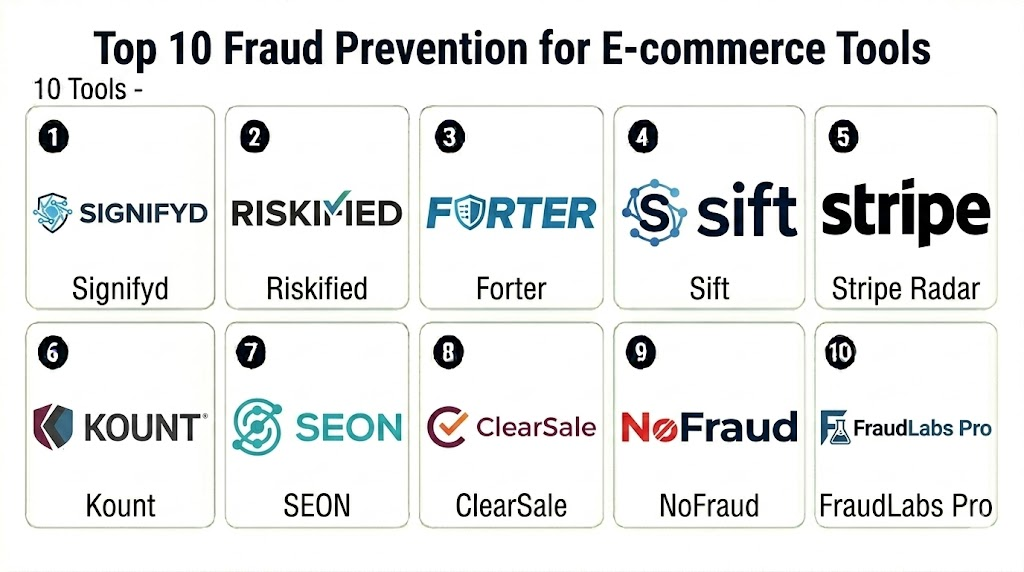
Top 10 Fraud Prevention for E-commerce Tools
1- Signifyd
Short description: Signifyd is an ecommerce fraud protection platform focused on order risk decisioning, chargeback protection, abuse prevention, and revenue optimization. It is well suited for retailers and brands that want to reduce fraud losses while approving more legitimate orders.
Key Features
- Real-time ecommerce order risk scoring
- Machine learning-based fraud detection
- Chargeback protection workflows
- Abuse prevention for returns, refunds, and promotions
- Automated approve, decline, and review decisions
- Order and customer behavior analysis
- Reporting for fraud trends and approval performance
Pros
- Strong fit for ecommerce retailers and D2C brands
- Helps reduce manual review burden
- Useful for balancing fraud prevention with order approval rates
Cons
- May be more advanced than very small stores need
- Best value depends on order volume and fraud exposure
- Implementation should be tested against existing payment and fulfillment workflows
Platforms / Deployment
Web / API-based
Cloud
Security & Compliance
Security capabilities vary by plan and configuration. Buyers should verify SSO, RBAC, encryption, audit logs, data handling, payment data controls, and compliance documentation directly with the vendor.
Integrations & Ecosystem
Signifyd fits ecommerce teams that need fraud decisions connected with commerce, payments, order processing, and customer support workflows.
- Ecommerce platforms
- Payment gateways
- Order management systems
- Customer support tools
- Chargeback workflows
- APIs and custom integrations
Support & Community
Signifyd provides implementation guidance, documentation, customer success resources, and fraud operations support. Support depth may vary by agreement and merchant size.
2- Riskified
Short description: Riskified is an ecommerce fraud and risk intelligence platform that helps merchants approve good orders, block fraud, and manage chargeback risk. It is especially useful for larger merchants that want automated risk decisions and better conversion protection.
Key Features
- Real-time order risk analysis
- Machine learning fraud detection
- Chargeback protection workflows
- Account and policy abuse detection
- Decision automation for approvals and declines
- Customer identity and transaction analysis
- Fraud and revenue performance reporting
Pros
- Strong focus on improving approval rates while reducing fraud
- Useful for merchants with high order volume
- Supports broader abuse prevention beyond stolen payment fraud
Cons
- May require operational alignment with payment and fulfillment systems
- Better suited to merchants with meaningful transaction volume
- Exact fit depends on risk model, business category, and fraud profile
Platforms / Deployment
Web / API-based
Cloud
Security & Compliance
Security capabilities vary by contract and configuration. Buyers should verify SSO, permissions, encryption, audit controls, data protection, and compliance documentation.
Integrations & Ecosystem
Riskified works well in ecommerce environments where fraud decisions need to connect with checkout, payments, OMS, fulfillment, and customer operations.
- Ecommerce platforms
- Payment systems
- Order management tools
- Chargeback workflows
- Customer support systems
- APIs and custom data feeds
Support & Community
Riskified provides implementation support, fraud expertise, account management, and reporting guidance. Support scope depends on contract and merchant needs.
3- Forter
Short description: Forter is a digital commerce fraud prevention platform that protects checkout, accounts, payments, promotions, and customer journeys. It is best for enterprises and marketplaces that need broad fraud, abuse, and identity risk coverage.
Key Features
- Real-time fraud decisioning
- Identity and device intelligence
- Account takeover protection
- Payment fraud prevention
- Promo, policy, and abuse detection
- Marketplace risk support
- Fraud analytics and decision reporting
Pros
- Strong coverage across the customer journey
- Useful for enterprise ecommerce and marketplace environments
- Helps reduce friction for legitimate customers while detecting risky behavior
Cons
- May be too broad for simple ecommerce fraud screening
- Implementation requires data and workflow planning
- Best value depends on traffic volume and risk complexity
Platforms / Deployment
Web / API-based
Cloud
Security & Compliance
Security capabilities vary by agreement and configuration. Buyers should verify SSO, RBAC, encryption, audit logs, API security, data governance, and compliance documentation.
Integrations & Ecosystem
Forter fits commerce teams that need fraud prevention connected across login, checkout, payments, promotions, and post-purchase workflows.
- Ecommerce platforms
- Payment processors
- Identity and account systems
- Marketplaces
- Order management systems
- APIs and data integrations
Support & Community
Forter provides enterprise onboarding, documentation, fraud strategy guidance, and customer success support. Support depth depends on agreement and implementation scope.
4- Sift
Short description: Sift is a digital trust and safety platform used for fraud detection, account defense, payment protection, and abuse prevention. It is suitable for ecommerce, marketplaces, fintech, on-demand platforms, and digital businesses with complex fraud patterns.
Key Features
- Payment fraud detection
- Account takeover protection
- Device and behavioral risk signals
- Machine learning decisioning
- Content and abuse risk support depending on use case
- Case management and analyst workflows
- Fraud analytics and dashboards
Pros
- Strong fit for digital businesses with multiple fraud types
- Useful for account, payment, and abuse risk workflows
- Case management helps fraud teams investigate suspicious activity
Cons
- Requires quality event data for best results
- May need technical implementation and ongoing tuning
- Smaller merchants may not need the full platform depth
Platforms / Deployment
Web / API-based
Cloud
Security & Compliance
Security capabilities vary by plan and configuration. Buyers should verify SSO, permissions, encryption, audit logs, API security, data handling, and compliance documentation.
Integrations & Ecosystem
Sift is useful when fraud signals must be collected across accounts, transactions, devices, and user behavior.
- Ecommerce platforms
- Payment systems
- Account and login systems
- Marketplaces
- Customer support tools
- APIs and event streams
Support & Community
Sift provides documentation, developer resources, customer success support, and fraud operations guidance. Support scope varies by plan and implementation size.
5- Stripe Radar
Short description: Stripe Radar is a fraud detection tool built into the Stripe payments ecosystem. It is useful for businesses that already process payments through Stripe and want machine learning-based fraud detection with customizable rules.
Key Features
- Payment fraud detection within Stripe
- Machine learning risk scoring
- Custom fraud rules
- Payment and chargeback risk signals
- Review workflows for suspicious payments
- Integration with Stripe payment data
- Fraud analytics and dispute insights
Pros
- Strong fit for Stripe-based merchants
- Easy to use when payment workflows already run through Stripe
- Useful for combining automated fraud scoring with custom rules
Cons
- Best suited for businesses using Stripe
- May not cover broader non-payment fraud as deeply as specialized platforms
- Complex enterprise risk workflows may require additional fraud tools
Platforms / Deployment
Web / API-based
Cloud
Security & Compliance
Security depends on Stripe account configuration and implementation. Buyers should verify permissions, access controls, encryption, audit capabilities, payment data controls, and compliance documentation through their Stripe environment.
Integrations & Ecosystem
Stripe Radar works best when fraud prevention is directly tied to Stripe payments and checkout workflows.
- Stripe Payments
- Ecommerce platforms using Stripe
- Custom checkout flows
- Subscription billing workflows
- Payment dispute workflows
- APIs and webhooks
Support & Community
Stripe provides documentation, developer resources, support options, and payment risk guidance. Support depth may vary by account type and business needs.
6- Kount
Short description: Kount is a fraud prevention and identity trust platform used by ecommerce, payment, financial, and digital businesses. It helps teams detect transaction fraud, account risk, bots, and suspicious behavior across digital channels.
Key Features
- Transaction fraud detection
- Identity trust and risk signals
- Device fingerprinting
- Bot and account protection capabilities
- AI and rule-based decisioning
- Chargeback and dispute risk insights
- Reporting and case management workflows
Pros
- Strong identity and transaction risk capabilities
- Useful for businesses with complex fraud and account abuse concerns
- Supports rule customization and analyst workflows
Cons
- Implementation can require technical and fraud operations planning
- Smaller merchants may find it more advanced than needed
- Exact feature fit should be validated by use case
Platforms / Deployment
Web / API-based
Cloud
Security & Compliance
Security capabilities vary by plan and configuration. Buyers should verify SSO, permissions, encryption, audit logs, API security, data controls, and compliance documentation.
Integrations & Ecosystem
Kount fits companies that need fraud and identity risk signals connected with payments, accounts, checkout, and digital interactions.
- Payment gateways
- Ecommerce platforms
- Account systems
- CRM and support tools
- Fraud review workflows
- APIs and data feeds
Support & Community
Kount provides documentation, implementation resources, fraud expertise, and customer support options. Support depth depends on plan and contract.
7- SEON
Short description: SEON is a fraud prevention platform that uses digital footprint analysis, device intelligence, email and phone risk, IP signals, and rules to detect suspicious users and transactions. It is useful for ecommerce, fintech, gaming, marketplaces, and digital platforms.
Key Features
- Email and phone risk analysis
- Device fingerprinting
- IP and location risk signals
- Rule-based fraud scoring
- Machine learning support
- Account and transaction fraud detection
- API and dashboard workflows
Pros
- Strong digital footprint and identity signal coverage
- Useful for detecting suspicious accounts before payment
- Flexible for ecommerce, marketplaces, and digital businesses
Cons
- Teams need to configure rules carefully to avoid false positives
- Best results depend on available customer and transaction data
- Broader chargeback guarantee workflows may require another solution
Platforms / Deployment
Web / API-based
Cloud
Security & Compliance
Security capabilities vary by plan and configuration. Buyers should verify API security, permissions, encryption, audit logs, data protection, and compliance documentation.
Integrations & Ecosystem
SEON fits businesses that need identity and fraud signals integrated into registration, login, checkout, and review workflows.
- Ecommerce systems
- Payment gateways
- CRM tools
- Account registration workflows
- Marketplaces
- APIs and automation systems
Support & Community
SEON provides documentation, onboarding resources, API guides, and support options. Support depth may vary by plan and implementation needs.
8- ClearSale
Short description: ClearSale is an ecommerce fraud prevention and chargeback protection platform that combines technology with manual review support. It is useful for merchants that want fraud screening while minimizing false declines.
Key Features
- Ecommerce order fraud screening
- Chargeback prevention support
- Manual review workflows
- Machine learning risk analysis
- Fraud analyst review support
- Order approval and decline recommendations
- Reporting and performance insights
Pros
- Strong focus on reducing false declines
- Useful for merchants that want human review support
- Helps teams manage suspicious orders without relying only on automation
Cons
- Manual review models may not fit every high-speed checkout environment
- Exact coverage and workflows should be validated by region and use case
- May be more useful for merchants with meaningful order volume
Platforms / Deployment
Web
Cloud
Security & Compliance
Security capabilities vary by contract and configuration. Buyers should verify user permissions, encryption, audit logs, customer data handling, and compliance documentation.
Integrations & Ecosystem
ClearSale works well for ecommerce brands that need fraud screening connected with store platforms, payment systems, and order workflows.
- Ecommerce platforms
- Payment gateways
- Order management workflows
- Customer support tools
- Chargeback workflows
- Reporting systems
Support & Community
ClearSale provides implementation support, fraud analyst expertise, documentation, and customer success resources. Support scope depends on agreement and order volume.
9- NoFraud
Short description: NoFraud is an ecommerce fraud prevention platform focused on automated fraud screening, order review, and chargeback protection. It is useful for online retailers that want to reduce fraud risk without managing every suspicious order manually.
Key Features
- Real-time order fraud screening
- Automated approve or decline decisions
- Chargeback protection workflows
- Manual review support depending on setup
- Ecommerce platform integrations
- Fraud reporting and order insights
- Customer verification workflows depending on use case
Pros
- Good fit for ecommerce merchants needing simplified fraud protection
- Helps reduce manual order review
- Useful for reducing chargeback exposure
Cons
- May not provide as broad account abuse coverage as larger risk platforms
- Best fit depends on ecommerce platform and order profile
- Advanced customization should be validated before purchase
Platforms / Deployment
Web
Cloud
Security & Compliance
Security capabilities vary by plan and configuration. Buyers should verify permissions, encryption, audit logs, customer data handling, and compliance documentation.
Integrations & Ecosystem
NoFraud fits ecommerce teams that want fraud decisions connected with checkout, payments, and order fulfillment.
- Ecommerce platforms
- Payment gateways
- Order management tools
- Customer support workflows
- Chargeback systems
- Reporting tools
Support & Community
NoFraud provides onboarding, fraud support, documentation, and customer assistance. Support depth depends on plan and merchant requirements.
10- FraudLabs Pro
Short description: FraudLabs Pro is a fraud detection tool for ecommerce merchants that need transaction scoring, rules, blacklist checks, and order screening. It is practical for smaller teams that want affordable fraud analysis and configurable fraud controls.
Key Features
- Order fraud risk scoring
- IP, email, location, and proxy checks
- Custom fraud validation rules
- Blacklist and whitelist controls
- Transaction review workflows
- API and plugin integrations
- Fraud reports and analytics
Pros
- Practical for smaller ecommerce teams
- Configurable rules and risk checks
- Supports plugins and API-based workflows
Cons
- May not match enterprise platforms for advanced AI or chargeback guarantee models
- Requires careful tuning to avoid false positives
- Advanced support and analytics may be limited compared with larger tools
Platforms / Deployment
Web / API-based
Cloud
Security & Compliance
Security capabilities vary by plan and configuration. Buyers should verify API security, permissions, encryption, data handling, audit controls, and compliance documentation.
Integrations & Ecosystem
FraudLabs Pro fits merchants that need fraud scoring embedded into ecommerce platforms or custom checkout workflows.
- Ecommerce plugins
- Payment workflows
- Custom APIs
- Order management tools
- Blacklist and whitelist workflows
- Reporting dashboards
Support & Community
FraudLabs Pro provides documentation, API resources, plugins, and support options. Support scope may vary by plan.
Comparison Table
| Tool Name | Best For | Platform Supported | Deployment | Standout Feature | Public Rating |
|---|---|---|---|---|---|
| Signifyd | Ecommerce fraud and chargeback protection | Web / API-based | Cloud | Fraud decisioning with revenue protection focus | N/A |
| Riskified | Large merchants needing approval optimization | Web / API-based | Cloud | Approving good orders while reducing fraud | N/A |
| Forter | Enterprise commerce and marketplace fraud | Web / API-based | Cloud | Fraud, abuse, identity, and account protection | N/A |
| Sift | Digital trust and multi-signal fraud prevention | Web / API-based | Cloud | Payment, account, and abuse risk detection | N/A |
| Stripe Radar | Stripe-based merchants | Web / API-based | Cloud | Fraud detection built into Stripe payments | N/A |
| Kount | Identity and transaction risk teams | Web / API-based | Cloud | Device, identity, and transaction risk signals | N/A |
| SEON | Digital footprint and identity risk analysis | Web / API-based | Cloud | Email, phone, IP, and device intelligence | N/A |
| ClearSale | Ecommerce fraud screening with human review | Web | Cloud | Fraud prevention with manual review support | N/A |
| NoFraud | Ecommerce order screening and chargeback reduction | Web | Cloud | Automated ecommerce fraud decisions | N/A |
| FraudLabs Pro | SMB ecommerce fraud scoring | Web / API-based | Cloud | Configurable fraud rules and transaction scoring | N/A |
Evaluation & Scoring of Fraud Prevention for E-commerce
| Tool Name | Core 25% | Ease 15% | Integrations 15% | Security 10% | Performance 10% | Support 10% | Value 15% | Weighted Total |
|---|---|---|---|---|---|---|---|---|
| Signifyd | 9 | 8 | 9 | 8 | 9 | 8 | 8 | 8.45 |
| Riskified | 9 | 8 | 9 | 8 | 9 | 8 | 8 | 8.45 |
| Forter | 10 | 7 | 9 | 9 | 9 | 8 | 8 | 8.65 |
| Sift | 9 | 7 | 9 | 8 | 9 | 8 | 8 | 8.35 |
| Stripe Radar | 8 | 9 | 8 | 9 | 9 | 8 | 9 | 8.50 |
| Kount | 9 | 7 | 8 | 8 | 8 | 8 | 8 | 8.05 |
| SEON | 8 | 8 | 8 | 8 | 8 | 8 | 8 | 8.00 |
| ClearSale | 8 | 8 | 8 | 8 | 8 | 8 | 8 | 8.00 |
| NoFraud | 8 | 8 | 7 | 7 | 8 | 8 | 8 | 7.75 |
| FraudLabs Pro | 7 | 8 | 7 | 7 | 7 | 7 | 9 | 7.40 |
Which Fraud Prevention for E-commerce Tool Is Right for You?
Solo / Freelancer
Solo sellers and very small ecommerce businesses usually need simple fraud rules, payment gateway protections, and basic order review. Stripe Radar or FraudLabs Pro may be practical depending on payment setup and ecommerce platform. If order volume is low, start with gateway-level rules, address verification, manual checks, and clear refund policies before adopting a larger fraud platform.
SMB
SMBs should focus on easy implementation, transaction scoring, chargeback reduction, ecommerce integrations, and clear decisioning. NoFraud, FraudLabs Pro, SEON, Stripe Radar, ClearSale, and Signifyd are worth evaluating depending on business size and payment stack. These teams should prioritize reducing manual review without blocking too many legitimate customers.
Mid-Market
Mid-market ecommerce brands often need better chargeback protection, account risk detection, fraud analytics, policy abuse controls, and integration with support and fulfillment workflows. Signifyd, Riskified, SEON, Kount, Sift, and ClearSale are good candidates. These buyers should test false positives, review queues, refund abuse, delivery address risk, and high-value order handling.
Enterprise
Enterprise retailers, marketplaces, and digital platforms should prioritize real-time risk scoring, account takeover protection, policy abuse detection, identity signals, custom rules, fraud operations workflows, scalability, and auditability. Forter, Sift, Riskified, Signifyd, Kount, and SEON are strong candidates depending on the risk profile. Enterprises should test the tools using real transaction history, chargeback data, customer events, and account behavior.
Budget vs Premium
Budget-conscious businesses may start with Stripe Radar, FraudLabs Pro, SEON, or basic fraud tools in their ecommerce and payment platforms. Premium buyers may choose Forter, Riskified, Signifyd, Sift, Kount, ClearSale, or NoFraud when fraud losses, chargebacks, false declines, and operational review costs justify the investment. Total cost should include software fees, chargeback losses, manual review time, false declines, customer friction, and fulfillment risk.
Feature Depth vs Ease of Use
Stripe Radar and FraudLabs Pro are easier starting points for smaller teams. NoFraud and ClearSale simplify ecommerce fraud decisions for merchants that want less manual review. Signifyd and Riskified offer strong ecommerce order protection. Forter, Sift, Kount, and SEON provide deeper risk signals and broader fraud coverage but may require more configuration and integration planning.
Integrations & Scalability
Fraud prevention tools should connect with ecommerce platforms, payment gateways, checkout systems, OMS, CRM, customer support tools, identity systems, chargeback tools, and data warehouses. Buyers should test risk decisions at checkout, post-payment review, fulfillment hold workflows, chargeback tracking, account login protection, and refund abuse monitoring. Scalability matters when transaction volume, markets, payment methods, and fraud patterns expand.
Security & Compliance Needs
Fraud prevention systems process sensitive customer, transaction, device, identity, and behavioral data. Buyers should verify SSO, MFA, RBAC, encryption, API security, audit logs, data retention, access reviews, and compliance documentation. Fraud tools should also align with privacy requirements and internal data governance policies, especially when ingesting customer events, payment signals, and identity attributes.
Frequently Asked Questions
1. What is ecommerce fraud prevention software?
Ecommerce fraud prevention software helps online businesses detect and prevent fraudulent orders, stolen card purchases, account takeovers, chargebacks, promo abuse, refund abuse, and suspicious customer behavior.
2. How does fraud prevention software work?
Fraud tools analyze transaction details, device signals, customer history, IP location, payment behavior, velocity patterns, and behavioral data. They assign risk scores or decisions such as approve, decline, or send for review.
3. What is the best fraud prevention tool for ecommerce?
There is no single best tool for every business. Signifyd, Riskified, Forter, Sift, Stripe Radar, Kount, SEON, ClearSale, NoFraud, and FraudLabs Pro each fit different fraud profiles, budgets, and technical needs.
4. What is chargeback protection?
Chargeback protection helps merchants reduce or recover losses from disputed transactions. Some fraud platforms support chargeback workflows or liability models, but exact coverage varies by vendor and contract.
5. Can fraud tools reduce false declines?
Yes, strong fraud tools can reduce false declines by using better risk signals and machine learning to identify legitimate customers. This helps merchants approve more good orders while still blocking risky transactions.
6. Do small ecommerce stores need fraud prevention tools?
Small stores may start with payment gateway fraud checks, address verification, and manual review. Dedicated fraud tools become more useful when order volume, chargebacks, high-value items, or suspicious behavior increase.
7. Can fraud tools prevent account takeover?
Some fraud tools support account takeover detection by analyzing login behavior, device signals, velocity, credential risk, location changes, and suspicious account activity. Buyers should validate this feature if account fraud is a major concern.
8. What are common ecommerce fraud types?
Common fraud types include stolen card fraud, account takeover, refund abuse, return abuse, promo abuse, gift card fraud, friendly fraud, chargeback fraud, fake accounts, and bot-driven checkout attacks.
9. What are common mistakes when choosing fraud software?
Common mistakes include focusing only on fraud blocking, ignoring false positives, not testing integration workflows, skipping manual review design, and failing to measure chargeback losses against approval rate improvements.
10. Can fraud prevention tools integrate with Shopify or WooCommerce?
Yes, many fraud prevention tools integrate with ecommerce platforms such as Shopify, WooCommerce, BigCommerce, and Adobe Commerce. Buyers should test order screening, payment flow, review queues, and fulfillment holds before launch.
Conclusion
Fraud Prevention for E-commerce tools help online businesses protect revenue, reduce chargebacks, block suspicious activity, and approve more legitimate customers with less manual work. The right solution depends on business size, fraud exposure, order volume, product category, payment stack, customer journey, and operational maturity. Signifyd, Riskified, ClearSale, and NoFraud are strong ecommerce-focused options for order fraud and chargeback reduction. Forter, Sift, Kount, and SEON are stronger fits when businesses need broader account, identity, behavior, and abuse protection. Stripe Radar is a practical choice for Stripe-based merchants, while FraudLabs Pro can work well for smaller teams needing configurable fraud scoring. Start by shortlisting two or three tools, test them against historical fraud and chargeback data, measure false positives, validate integrations with checkout and fulfillment workflows, review security controls, and choose the platform that protects revenue without creating unnecessary friction for real customers.

Find Trusted Cardiac Hospitals
Compare heart hospitals by city and services — all in one place.
Explore Hospitals
Fraud prevention tools are very important for e-commerce businesses because they help reduce fake transactions and protect both customers and sellers.