Introduction
Restaurant Delivery Dispatch Tools help restaurants, cloud kitchens, food chains, and delivery-first businesses manage how orders move from the kitchen to the customer. In simple terms, these platforms help assign orders to drivers, optimize delivery routes, track drivers in real time, notify customers, and reduce late or missed deliveries. Restaurant delivery has become more complex because customers expect fast ETAs, live tracking, proof of delivery, smooth refunds, and consistent service across ordering channels. Restaurants also need better control over their own fleets, third-party couriers, peak-hour overflow, and multi-location delivery operations.
Real World Use Cases:
- Assigning delivery orders automatically to nearby drivers
- Tracking drivers and orders in real time
- Managing own fleet and third-party courier partners
- Reducing delivery delays during peak hours
- Improving customer communication through ETA alerts
- Optimizing routes for multiple deliveries in one trip
Evaluation Criteria for Buyers:
- Dispatch automation and route optimization
- POS and online ordering integrations
- Driver mobile app quality
- Real-time tracking and ETA accuracy
- Customer notifications and branded tracking
- Multi-location support
- Reporting and delivery performance analytics
- API availability and integration flexibility
- Security, roles, and access controls
- Pricing fit for order volume
Best for: Restaurant groups, cloud kitchens, QSR chains, pizzerias, ghost kitchens, grocery delivery teams, and local food delivery operators that need better control over last-mile delivery.
Not ideal for: Very small restaurants with only a few manual deliveries per week may not need a full dispatch platform. In such cases, a basic POS delivery module, marketplace delivery option, or simple route planner may be enough.
Key Trends in Restaurant Delivery Dispatch Tools
- AI-assisted dispatching: More platforms are using automation to assign orders based on driver location, capacity, delivery windows, and order urgency.
- Hybrid delivery models: Restaurants increasingly combine in-house drivers with third-party delivery partners for overflow and peak-hour coverage.
- Branded customer tracking: Customers expect live order status pages, ETA updates, and delivery notifications without calling the restaurant.
- Multi-location control: Growing food brands need centralized visibility across stores, cloud kitchens, and regional delivery zones.
- POS-first integrations: Dispatch tools are becoming more valuable when they connect directly with restaurant POS, ordering platforms, and kitchen workflows.
- Driver app improvements: Mobile apps now focus on proof of delivery, route guidance, task updates, customer communication, and shift visibility.
- Data-driven delivery operations: Restaurants are tracking delivery time, driver performance, failed deliveries, customer feedback, and cost per order.
- API-based ecosystems: Modern tools are expected to support APIs, webhooks, ordering system integrations, and workflow automation.
- Delivery cost optimization: Businesses are comparing own fleet cost, outsourced courier cost, batch delivery efficiency, and route density.
- Security and access control expectations: Multi-location operators increasingly expect MFA, role-based access, auditability, and secure API access.
How We Selected These Tools
The tools below were selected using practical restaurant delivery and last-mile dispatch evaluation logic:
- Market visibility and adoption across food delivery, retail delivery, courier, and restaurant use cases
- Fit for restaurants, cloud kitchens, ghost kitchens, and multi-location food businesses
- Dispatch automation, driver assignment, routing, and tracking capabilities
- Ability to support in-house fleets, third-party couriers, or hybrid delivery models
- Integration potential with POS, online ordering, delivery apps, and APIs
- Customer-facing delivery experience such as ETA tracking and notifications
- Scalability for single-location, SMB, mid-market, and enterprise teams
- Reporting, analytics, and operational visibility
- Practical usability for dispatchers, managers, and drivers
- Security and administration expectations where publicly stated
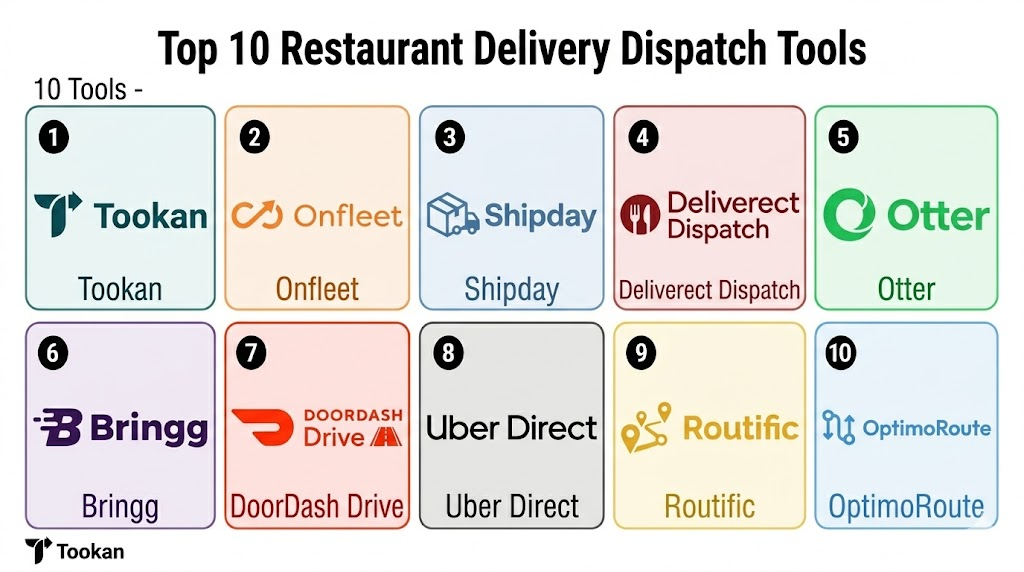
Top 10 Restaurant Delivery Dispatch Tools
1- Tookan
Short description: Tookan is a delivery and field workforce management platform often used by businesses that need dispatching, driver tracking, task assignment, and proof of delivery. It fits restaurants, food delivery teams, grocery operations, and local logistics teams that want a customizable dispatch workflow.
Key Features
- Automated task assignment and dispatch management
- Real-time driver tracking and delivery status visibility
- Route optimization for multiple delivery tasks
- Driver mobile apps for iOS and Android
- Proof of delivery with photos, notes, and signatures
- Customer notifications and tracking links
- Admin dashboards for delivery performance monitoring
Pros
- Flexible enough for restaurants, local delivery, and broader field operations
- Useful for teams that want configurable workflows
- Good fit for growing businesses that need driver visibility
Cons
- Setup may require configuration for restaurant-specific workflows
- Some advanced use cases may need integrations or API work
- Smaller restaurants may find it more feature-rich than necessary
Platforms / Deployment
Web / iOS / Android
Cloud
Security & Compliance
Varies / N/A. Common business security controls may be available depending on plan and configuration, but specific certifications should be validated directly with the vendor.
Integrations & Ecosystem
Tookan is useful when restaurants need to connect delivery tasks with ordering, dispatch, and driver workflows. It can support API-based integrations and operational workflows across multiple delivery scenarios.
- POS and ordering systems
- Driver mobile apps
- Customer notification tools
- API-based workflows
- Delivery and logistics dashboards
- Business reporting tools
Support & Community
Tookan offers documentation, onboarding resources, and business support options. Support depth may vary by plan, region, and implementation needs.
2- Onfleet
Short description: Onfleet is a last-mile delivery management platform known for dispatching, driver tracking, route optimization, analytics, and customer communication. It is a strong choice for restaurants and delivery businesses that need polished delivery visibility and scalable dispatch operations.
Key Features
- Dispatch dashboard for order and driver visibility
- Real-time driver tracking with customer-facing ETAs
- Route optimization and delivery task management
- Driver mobile apps for delivery execution
- Proof of delivery and customer feedback collection
- Analytics for delivery performance and operations
- APIs and webhooks for custom integrations
Pros
- Strong user experience for dispatchers, drivers, and customers
- Good analytics and visibility for delivery performance
- Suitable for growing and multi-location delivery operations
Cons
- May be more premium than simple delivery apps
- Smaller restaurants may not need all advanced capabilities
- Custom integration work may be needed for complex systems
Platforms / Deployment
Web / iOS / Android
Cloud
Security & Compliance
Varies / N/A. Security features such as access controls and data protection should be validated based on the required plan and business needs.
Integrations & Ecosystem
Onfleet fits restaurants that want delivery tracking connected with ordering systems, customer messaging, and operations data. Its API ecosystem makes it useful for brands with custom delivery workflows.
- POS and online ordering platforms
- APIs and webhooks
- Customer notification systems
- Driver apps
- Analytics dashboards
- E-commerce and retail delivery workflows
Support & Community
Onfleet provides documentation, onboarding resources, and support options for delivery operators. It has strong market visibility in last-mile delivery software.
3- Shipday
Short description: Shipday is a delivery management platform designed for restaurants, pizzerias, couriers, retailers, and local delivery teams. It is especially attractive for small and mid-sized businesses that want fast setup, driver tracking, route planning, and customer notifications.
Key Features
- Local delivery dispatch management
- Real-time driver tracking and order status updates
- Branded customer tracking links
- Driver management and mobile app support
- Route planning and delivery optimization
- Proof of delivery and review collection
- Integrations with ordering and commerce platforms
Pros
- Easy to adopt for small restaurants and local delivery teams
- Good balance of delivery features and usability
- Useful for restaurants starting or improving direct delivery
Cons
- May not match enterprise-level orchestration platforms for very complex networks
- Advanced customization may depend on plan and integrations
- Large multi-brand operators may require deeper workflow control
Platforms / Deployment
Web / iOS / Android
Cloud
Security & Compliance
Varies / N/A. Buyers should verify SSO, audit logs, access controls, and data security requirements directly before deployment.
Integrations & Ecosystem
Shipday works well for restaurants that need delivery tools connected to ordering, commerce, and customer communication workflows. It is practical for direct delivery and local fleet operations.
- Online ordering platforms
- E-commerce platforms
- Driver mobile apps
- Customer notifications
- Review and feedback workflows
- Third-party delivery overflow options
Support & Community
Shipday offers product documentation and support resources. It is particularly approachable for restaurants and local businesses that need simpler onboarding.
4- Deliverect Dispatch
Short description: Deliverect Dispatch helps restaurants manage delivery operations by connecting orders, own drivers, and third-party delivery providers. It is useful for restaurants already managing multiple delivery channels and needing better order-to-dispatch coordination.
Key Features
- Dispatching for own fleet and delivery partners
- Automatic driver or provider assignment
- Centralized delivery workflow management
- Integration with restaurant ordering workflows
- Support for multi-channel delivery operations
- Delivery tracking and status updates
- Useful for direct-to-consumer delivery models
Pros
- Strong fit for restaurants managing multiple order channels
- Helpful for hybrid delivery using own drivers and external providers
- Good option for brands already focused on delivery operations
Cons
- Best value is often tied to broader restaurant order management needs
- Setup may require integration planning
- May be more than needed for restaurants with simple delivery volume
Platforms / Deployment
Web
Cloud
Security & Compliance
Varies / N/A. Buyers should validate security features, access controls, and compliance needs directly with the vendor.
Integrations & Ecosystem
Deliverect Dispatch is designed around restaurant delivery workflows and order operations. It can be valuable when dispatching needs to work closely with online orders, delivery marketplaces, and internal restaurant systems.
- POS systems
- Online ordering channels
- Delivery provider networks
- Restaurant order management workflows
- Multi-location operations
- Delivery status and reporting tools
Support & Community
Deliverect generally serves restaurants and foodservice operators with onboarding and support options. Support availability may vary by region, product package, and account size.
5- Otter
Short description: Otter is widely known for helping restaurants centralize delivery app orders, menus, and operations. For dispatch-focused workflows, it is useful when restaurants want a broader delivery operations hub that connects ordering channels, kitchen workflows, and delivery execution.
Key Features
- Centralized delivery order management
- Menu management across delivery platforms
- Operational dashboards for restaurant teams
- Support for delivery marketplace workflows
- Order status visibility
- Multi-location restaurant operations support
- Reporting and performance insights
Pros
- Strong fit for restaurants handling multiple delivery platforms
- Helps reduce operational chaos from fragmented tablets and channels
- Useful for brands that need broader delivery operations visibility
Cons
- Not always a pure dispatch-only tool
- Delivery fleet management depth may depend on setup and integrations
- Businesses needing advanced route optimization may need a dedicated dispatch platform
Platforms / Deployment
Web
Cloud
Security & Compliance
Varies / N/A. Buyers should verify admin controls, data access, and security requirements directly.
Integrations & Ecosystem
Otter’s ecosystem is most useful for restaurants that operate across multiple delivery apps and digital ordering channels. It can help simplify restaurant-side order operations.
- Delivery marketplaces
- POS workflows
- Menu management systems
- Kitchen operations tools
- Reporting dashboards
- Multi-location restaurant operations
Support & Community
Otter provides restaurant-focused onboarding and support resources. Support depth may vary by plan, region, and operational complexity.
6- Bringg
Short description: Bringg is an enterprise delivery management platform designed for large-scale delivery orchestration. It is suitable for restaurant chains, retailers, grocers, and logistics-heavy businesses that need advanced dispatching, fleet control, third-party delivery orchestration, and scalable last-mile operations.
Key Features
- Enterprise-grade delivery orchestration
- Automated dispatch and carrier selection
- Real-time delivery tracking and visibility
- Route optimization and fleet management
- Customer communication and delivery experience tools
- Multi-location and multi-region support
- Analytics for performance, cost, and service quality
Pros
- Strong fit for enterprise and high-volume delivery networks
- Supports complex delivery models and third-party partner orchestration
- Good for brands that need scalable, centralized delivery control
Cons
- May be too complex or costly for small restaurants
- Implementation can require planning, integrations, and change management
- Best suited for teams with mature logistics operations
Platforms / Deployment
Web / iOS / Android
Cloud
Security & Compliance
Varies / N/A. Enterprise buyers should validate SSO, RBAC, audit logs, encryption, and compliance requirements during procurement.
Integrations & Ecosystem
Bringg is built for large delivery ecosystems where restaurants or food brands need to connect ordering, dispatch, carrier networks, and analytics. It works best where delivery is a strategic business function.
- POS and order management systems
- Carrier and delivery partner networks
- APIs and enterprise integrations
- Customer notification workflows
- Fleet management systems
- Reporting and analytics platforms
Support & Community
Bringg typically supports larger implementations with onboarding, account management, and enterprise support models. Support details vary by contract.
7- DoorDash Drive
Short description: DoorDash Drive is a white-label delivery fulfillment option that lets businesses use DoorDash’s delivery network for orders placed through their own channels. It is useful for restaurants that want delivery coverage without managing a large in-house fleet.
Key Features
- Third-party delivery fulfillment for direct orders
- Access to DoorDash delivery network
- Delivery tracking and status updates
- Useful for overflow delivery coverage
- Supports restaurants without dedicated driver teams
- Helps extend delivery radius and capacity
- Can support branded ordering workflows depending on setup
Pros
- Reduces the need to hire and manage drivers
- Helpful during peak hours or staffing shortages
- Strong option for restaurants wanting delivery fulfillment quickly
Cons
- Less control than managing an in-house driver fleet
- Costs can vary by order model and business arrangement
- Delivery experience depends partly on external courier execution
Platforms / Deployment
Web / API-based workflows
Cloud
Security & Compliance
Varies / N/A. Buyers should validate data sharing, customer data handling, and access control requirements.
Integrations & Ecosystem
DoorDash Drive is most useful when connected to a restaurant’s own ordering experience, POS, or digital storefront. It acts more like a fulfillment layer than a traditional dispatch dashboard.
- Direct online ordering systems
- POS workflows
- API-based order handoff
- Customer tracking updates
- Delivery fulfillment workflows
- Restaurant digital storefronts
Support & Community
Support depends on business arrangement, region, and account model. Restaurants should review onboarding, service-level expectations, and delivery coverage before adoption.
8- Uber Direct
Short description: Uber Direct is a delivery-as-a-service option that lets businesses use Uber’s delivery network for orders from their own channels. Restaurants can use it for last-mile delivery fulfillment, overflow delivery, and direct ordering support without fully managing drivers.
Key Features
- On-demand delivery fulfillment
- Access to Uber’s courier network
- API-based delivery request workflows
- Real-time delivery tracking
- Useful for peak-hour overflow
- Supports direct-to-consumer delivery models
- Can reduce internal fleet management burden
Pros
- Good for restaurants that need fast delivery capacity
- Useful as a flexible alternative to in-house fleets
- Can support direct orders without relying only on marketplaces
Cons
- Less operational control than dedicated in-house dispatching
- Cost structure may vary by geography and volume
- Availability and delivery performance can depend on market coverage
Platforms / Deployment
Web / API-based workflows
Cloud
Security & Compliance
Varies / N/A. Businesses should verify customer data handling, API security, and operational requirements directly.
Integrations & Ecosystem
Uber Direct works as a delivery fulfillment layer for restaurants and businesses that already have ordering demand. It is useful when integrated into digital ordering, POS, or custom commerce workflows.
- Online ordering systems
- POS workflows
- API integrations
- Customer tracking notifications
- Delivery fulfillment workflows
- Direct commerce channels
Support & Community
Support options vary by business account type, geography, and implementation model. Restaurants should validate onboarding, delivery coverage, and escalation processes.
9- Routific
Short description: Routific is a route optimization platform focused on planning efficient delivery routes. It is useful for restaurants, meal delivery companies, catering operations, and local delivery teams that manage scheduled or multi-stop delivery routes.
Key Features
- Route optimization for delivery planning
- Multi-stop route scheduling
- Driver route assignment
- Delivery tracking and route visibility
- Customer notifications
- Delivery planning for recurring operations
- Useful for reducing drive time and delivery costs
Pros
- Strong route planning and optimization focus
- Good for meal delivery, catering, and scheduled deliveries
- Helps improve route efficiency and driver productivity
Cons
- May not be as restaurant-dispatch-specific as some tools
- Real-time high-pressure food delivery workflows may need additional systems
- Advanced order channel integrations may require planning
Platforms / Deployment
Web
Cloud
Security & Compliance
Varies / N/A. Buyers should verify role management, data security, and account controls based on business requirements.
Integrations & Ecosystem
Routific is useful when route efficiency is the main priority. It can support delivery planning workflows for businesses that need optimized routes rather than full restaurant order management.
- Delivery planning workflows
- Customer notification tools
- Driver route assignments
- Spreadsheet or operational data imports
- APIs or integration workflows where available
- Reporting and route performance review
Support & Community
Routific provides support and documentation for route optimization users. It is practical for operations teams that need cleaner planning and route execution.
10- OptimoRoute
Short description: OptimoRoute is a route planning and delivery scheduling platform used by delivery, field service, and logistics teams. Restaurants can use it for planned deliveries, catering routes, meal delivery, and multi-stop delivery scheduling.
Key Features
- Route planning and optimization
- Delivery scheduling and driver assignment
- Real-time route updates
- Driver mobile app support
- Customer notifications and ETA updates
- Workload balancing across drivers
- Analytics for route and delivery performance
Pros
- Strong for multi-stop route planning and scheduled delivery operations
- Useful beyond restaurants for field and logistics workflows
- Helps reduce manual route planning effort
Cons
- Not a restaurant-native order aggregation platform
- May need integration with POS or ordering systems
- Best suited for planned routes rather than only instant food dispatch
Platforms / Deployment
Web / iOS / Android
Cloud
Security & Compliance
Varies / N/A. Buyers should validate access controls, data protection, and compliance needs directly.
Integrations & Ecosystem
OptimoRoute is valuable for businesses that need route planning connected with delivery execution. Restaurants with catering, meal prep, grocery, or scheduled delivery operations may benefit most.
- Driver mobile apps
- Delivery scheduling workflows
- Customer notifications
- Route planning tools
- API or data import workflows
- Reporting and operations dashboards
Support & Community
OptimoRoute offers documentation and support options for delivery and field operations teams. Support depth may vary by plan and operational scale.
Comparison Table
| Tool Name | Best For | Platform Supported | Deployment | Standout Feature | Public Rating |
|---|---|---|---|---|---|
| Tookan | Flexible restaurant and local delivery dispatch | Web, iOS, Android | Cloud | Configurable dispatch and field task workflows | N/A |
| Onfleet | Premium last-mile delivery management | Web, iOS, Android | Cloud | Real-time tracking, analytics, and customer ETAs | N/A |
| Shipday | Small and mid-sized restaurant delivery teams | Web, iOS, Android | Cloud | Easy direct delivery management and branded tracking | N/A |
| Deliverect Dispatch | Restaurants using hybrid delivery models | Web | Cloud | Own fleet plus third-party provider dispatching | N/A |
| Otter | Restaurants managing multiple delivery channels | Web | Cloud | Centralized delivery order operations | N/A |
| Bringg | Enterprise delivery orchestration | Web, iOS, Android | Cloud | Large-scale fleet and carrier orchestration | N/A |
| DoorDash Drive | Restaurants needing outsourced delivery fulfillment | Web, API workflows | Cloud | Access to DoorDash delivery network | N/A |
| Uber Direct | On-demand delivery fulfillment for direct orders | Web, API workflows | Cloud | Uber network fulfillment for business orders | N/A |
| Routific | Route optimization for planned deliveries | Web | Cloud | Efficient multi-stop route planning | N/A |
| OptimoRoute | Scheduled delivery and route planning | Web, iOS, Android | Cloud | Delivery scheduling and workload balancing | N/A |
Evaluation & Scoring of Restaurant Delivery Dispatch Tools
| Tool Name | Core 25% | Ease 15% | Integrations 15% | Security 10% | Performance 10% | Support 10% | Value 15% | Weighted Total |
|---|---|---|---|---|---|---|---|---|
| Tookan | 8.4 | 8.0 | 8.0 | 7.2 | 8.0 | 7.8 | 8.1 | 8.0 |
| Onfleet | 9.0 | 8.6 | 8.7 | 7.8 | 8.8 | 8.2 | 7.8 | 8.5 |
| Shipday | 8.2 | 8.8 | 8.0 | 7.1 | 8.0 | 7.8 | 8.8 | 8.2 |
| Deliverect Dispatch | 8.5 | 8.0 | 8.8 | 7.5 | 8.2 | 8.0 | 7.8 | 8.2 |
| Otter | 7.8 | 8.3 | 8.5 | 7.3 | 8.0 | 7.8 | 7.9 | 8.0 |
| Bringg | 9.2 | 7.5 | 9.0 | 8.2 | 9.0 | 8.4 | 7.2 | 8.5 |
| DoorDash Drive | 7.8 | 8.5 | 8.0 | 7.4 | 8.3 | 7.8 | 7.6 | 7.9 |
| Uber Direct | 7.8 | 8.4 | 8.1 | 7.4 | 8.2 | 7.8 | 7.6 | 7.9 |
| Routific | 8.0 | 8.5 | 7.4 | 7.2 | 8.4 | 7.6 | 8.2 | 8.0 |
| OptimoRoute | 8.1 | 8.3 | 7.5 | 7.2 | 8.4 | 7.7 | 8.1 | 8.0 |
Which Restaurant Delivery Dispatch Tool Is Right for You?
Solo / Freelancer
Solo operators, small kitchens, and independent food businesses should focus on ease of use, low setup effort, and affordability. Shipday, Tookan, Routific, and OptimoRoute can be practical choices depending on whether the business needs instant dispatch, planned routes, or basic delivery tracking.
For restaurants that do not want to manage drivers, DoorDash Drive or Uber Direct may be easier than building a delivery fleet.
SMB
Small and mid-sized restaurants should look for tools that combine dispatch, tracking, driver apps, customer notifications, and simple integrations. Shipday is a strong fit for direct delivery operations, while Tookan works well for businesses that want more workflow flexibility.
Onfleet is a good option for SMBs that want a more polished delivery experience and are ready for a premium last-mile platform.
Mid-Market
Mid-market restaurant groups need multi-location visibility, better reporting, stronger integrations, and consistent delivery workflows. Onfleet, Deliverect Dispatch, Otter, and Tookan are strong candidates depending on whether the priority is direct delivery, order aggregation, or hybrid dispatch.
Restaurants with planned delivery routes, catering, or meal delivery operations should also evaluate Routific and OptimoRoute.
Enterprise
Enterprise restaurant chains and large delivery operations should prioritize scalability, carrier orchestration, API flexibility, analytics, permissions, and operational reliability. Bringg is the strongest enterprise-focused option in this list for complex delivery networks.
Onfleet and Deliverect Dispatch can also fit larger teams depending on use case, integrations, and delivery model.
Budget vs Premium
Budget-conscious teams should evaluate Shipday, Routific, OptimoRoute, and Tookan first. These tools can provide strong delivery capabilities without forcing every restaurant into enterprise complexity.
Premium buyers should consider Onfleet, Bringg, and Deliverect Dispatch when delivery experience, automation, analytics, and scalability are more important than lowest cost.
Feature Depth vs Ease of Use
If ease of use matters most, Shipday, Routific, and OptimoRoute are easier starting points. If deeper dispatch control and operational scale matter more, Onfleet, Tookan, Bringg, and Deliverect Dispatch are stronger candidates.
Restaurants should avoid choosing the most feature-rich platform if their team only needs basic delivery assignment and tracking.
Integrations & Scalability
Restaurants using POS systems, online ordering platforms, and multiple delivery channels should prioritize Deliverect Dispatch, Otter, Onfleet, and Bringg. Businesses with custom workflows should check API availability, webhook support, and implementation resources.
For simple delivery planning, Routific and OptimoRoute may be enough without heavy integration work.
Security & Compliance Needs
Larger restaurant groups should validate SSO, MFA, RBAC, audit logs, encryption, API security, and data handling policies. Bringg, Onfleet, Deliverect Dispatch, and enterprise-grade configurations are better starting points for more complex security expectations.
Small restaurants should still check user permissions, driver data access, and customer information handling before rollout.
Frequently Asked Questions
1. What is a Restaurant Delivery Dispatch Tool?
A Restaurant Delivery Dispatch Tool helps assign delivery orders to drivers, optimize routes, track deliveries, and notify customers. It acts as the control center between the kitchen, dispatcher, driver, and customer.
2. How much do Restaurant Delivery Dispatch Tools cost?
Pricing varies by vendor, order volume, number of drivers, locations, and feature requirements. Some tools are SMB-friendly, while enterprise platforms usually require custom pricing.
3. Can these tools replace third-party delivery apps?
Not always. Some tools help restaurants manage their own delivery fleet, while others connect to third-party courier networks. Many restaurants use both direct delivery and marketplace delivery together.
4. Which tool is best for small restaurants?
Shipday, Tookan, Routific, and OptimoRoute are practical starting points for many small restaurants. The best choice depends on whether the restaurant needs real-time dispatch, route planning, or outsourced delivery.
5. Which tool is best for enterprise restaurant chains?
Bringg is strong for enterprise delivery orchestration. Onfleet and Deliverect Dispatch can also fit larger restaurant groups depending on delivery complexity, integrations, and operating model.
6. Do these tools integrate with POS systems?
Many restaurant delivery dispatch tools support POS or ordering system integrations, but availability varies. Buyers should confirm the exact POS, ordering platform, and API requirements before purchase.
7. What is the difference between dispatch software and route optimization software?
Dispatch software focuses on assigning orders, tracking drivers, and managing delivery execution. Route optimization software focuses more on planning efficient routes, especially for multi-stop or scheduled deliveries.
8. Can restaurants use both in-house drivers and third-party couriers?
Yes. Hybrid delivery is becoming common. Tools like Deliverect Dispatch, Bringg, DoorDash Drive, and Uber Direct can help restaurants combine own fleet delivery with external courier capacity.
9. What are common mistakes when choosing a dispatch tool?
Common mistakes include ignoring POS integration, underestimating driver app usability, choosing enterprise software too early, not testing peak-hour workflows, and failing to calculate delivery cost per order.
10. How long does implementation usually take?
Simple tools can often be adopted quickly, especially for single-location restaurants. Multi-location or enterprise implementations may require integration planning, workflow mapping, training, and security review.
Conclusion
Restaurant Delivery Dispatch Tools are now essential for restaurants that want faster deliveries, better driver visibility, lower delivery costs, and improved customer communication. The best platform depends on the restaurant’s size, delivery model, order volume, integration needs, and level of operational complexity. Shipday and Tookan are practical options for smaller and growing teams, while Onfleet and Deliverect Dispatch offer stronger delivery visibility and workflow depth. Bringg is best suited for enterprise delivery orchestration, while DoorDash Drive and Uber Direct help restaurants use third-party delivery capacity without building a large fleet. Routific and OptimoRoute are strong choices when route planning and scheduled delivery efficiency matter most. The smartest next step is to shortlist two or three tools, test them with real order flows, validate POS and ordering integrations, check security requirements, and compare the actual cost per successful delivery before scaling.

Find Trusted Cardiac Hospitals
Compare heart hospitals by city and services — all in one place.
Explore Hospitals