Introduction
Work Order Management Software helps teams create, assign, track, prioritize, complete, and report on maintenance or service tasks from one digital system. It replaces scattered emails, paper forms, phone calls, spreadsheets, and manual task lists with structured workflows for requests, approvals, technicians, assets, schedules, notes, photos, and completion history. This software matters because operations teams need faster response times, better accountability, fewer missed tasks, and clearer visibility into work status. Whether a company manages buildings, equipment, field service, IT assets, production lines, retail locations, or customer service requests, work order software helps teams standardize execution and reduce operational friction.
Real World Use Cases:
- Creating and assigning maintenance requests
- Tracking repair status from request to completion
- Managing technician schedules and workloads
- Capturing photos, notes, parts, and labor details
- Prioritizing urgent repairs and recurring tasks
- Reporting on backlog, response time, completion rate, and cost
Evaluation Criteria for Buyers:
- Work order creation and assignment flow
- Mobile app usability for technicians
- Preventive and recurring work support
- Asset and equipment history tracking
- Request portals and approval workflows
- Scheduling, dispatch, and prioritization tools
- Notifications and escalation rules
- Reporting and operational analytics
- Integration with CMMS, ERP, finance, and IoT tools
- Security, permissions, audit logs, and admin controls
Best for: Maintenance teams, facility managers, field service teams, operations leaders, property managers, manufacturing teams, schools, hospitals, hotels, retail chains, utilities, and service organizations that need structured task tracking and better work execution visibility.
Not ideal for: Very small teams with only occasional repair requests may not need dedicated work order software. A shared inbox, spreadsheet, task board, or simple form may be enough until work volume, technician count, asset complexity, or accountability needs increase.
Key Trends in Work Order Management Software
- Mobile-first execution is now expected: Technicians need mobile access to tasks, asset history, photos, notes, checklists, signatures, and completion updates while working in the field.
- AI-assisted prioritization is emerging: AI may help classify requests, suggest priority levels, route work orders, summarize technician notes, and flag recurring asset problems.
- Preventive work is becoming more automated: Work order tools increasingly support recurring schedules, meter-based triggers, checklists, and maintenance calendars to reduce reactive repairs.
- IoT-triggered work orders are growing: Sensors, meters, equipment alerts, and building systems can automatically trigger work orders when thresholds are crossed.
- Request portals are improving user experience: Employees, tenants, customers, and operators can submit requests through forms, QR codes, apps, or portals instead of calling or emailing.
- Operational analytics are more important: Managers want dashboards for backlog, SLA performance, technician productivity, asset downtime, recurring issues, and maintenance cost.
- Integration with CMMS and ERP is critical: Work order data often needs to connect with asset records, inventory, procurement, billing, payroll, finance, and enterprise reporting systems.
- Digital checklists reduce missed steps: Standardized procedures, safety checks, inspection forms, and completion requirements help teams improve consistency.
- Vendor and contractor workflows are expanding: Organizations increasingly need to assign, track, and verify work completed by third-party service providers.
- Security and auditability matter more: Work order systems store operational records, asset data, technician activity, vendor details, and compliance evidence, so buyers need permission controls and audit trails.
How We Selected These Tools
The tools below were selected using practical work order, maintenance, facilities, and operations management evaluation logic:
- Market recognition among maintenance, facilities, field service, property, manufacturing, and operations teams
- Strength of work order creation, assignment, tracking, prioritization, and completion workflows
- Fit across SMBs, mid-market companies, enterprise organizations, schools, hospitals, hotels, factories, and property teams
- Mobile usability for technicians, supervisors, vendors, and field workers
- Support for recurring work, preventive maintenance, checklists, inspections, and task templates
- Ability to connect work orders with assets, inventory, parts, labor, vendors, and costs
- Reporting depth for backlog, response time, completion rate, downtime, SLA performance, and technician productivity
- Integration potential with CMMS, ERP, finance, procurement, sensors, and workplace systems
- Security and admin controls for multi-site teams and regulated environments
- Practical value for improving accountability, reducing missed work, and standardizing service execution
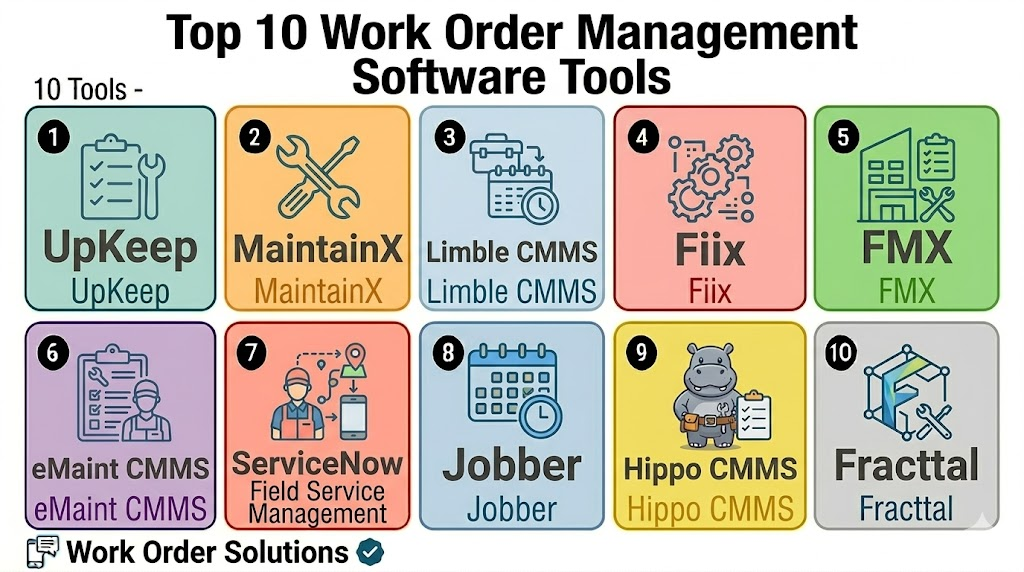
Top 10 Work Order Management Software Tools
1- UpKeep
Short description: UpKeep is a mobile-first work order and maintenance management platform for facilities, maintenance, manufacturing, and operations teams. It helps users create work orders, assign tasks, track assets, schedule preventive work, and manage technician updates from web and mobile apps.
Key Features
- Work order creation, assignment, and tracking
- Mobile technician app for field updates
- Preventive maintenance scheduling
- Asset and equipment history
- Parts and inventory tracking
- Photos, notes, checklists, and completion records
- Maintenance reporting dashboards
Pros
- Strong mobile experience for technicians
- Good fit for teams moving away from paper and spreadsheets
- Useful for maintenance, facilities, and operational task tracking
Cons
- Advanced enterprise workflows may require deeper evaluation
- Data quality depends on consistent technician usage
- Complex integrations should be validated before rollout
Platforms / Deployment
Web / iOS / Android
Cloud
Security & Compliance
Varies / N/A. Buyers should validate user roles, mobile access controls, encryption, audit logs, data privacy, and admin permissions directly.
Integrations & Ecosystem
UpKeep fits teams that need work orders connected with assets, preventive maintenance, inventory, and mobile execution.
- Asset records
- Parts and inventory workflows
- Preventive maintenance schedules
- Mobile technician workflows
- Reporting dashboards
- Integration workflows where available
Support & Community
UpKeep provides onboarding resources, help documentation, training content, and support options. Support scope may vary by plan, team size, and implementation needs.
2- MaintainX
Short description: MaintainX is a work execution platform for work orders, digital procedures, preventive maintenance, inspections, and frontline team communication. It is useful for maintenance, manufacturing, facilities, food service, hospitality, and operations teams that need fast mobile adoption.
Key Features
- Work order and task management
- Digital procedures and checklists
- Preventive maintenance workflows
- Asset and equipment records
- Mobile technician app
- Team communication and updates
- Reporting and operational insights
Pros
- Strong mobile-first experience for frontline teams
- Good fit for checklists, inspections, and daily operational work
- Easy adoption for maintenance and operations teams
Cons
- Advanced enterprise asset lifecycle needs should be validated
- Complex reliability workflows may need additional tools
- Best results depend on consistent field usage
Platforms / Deployment
Web / iOS / Android
Cloud
Security & Compliance
Varies / N/A. Buyers should validate permissions, mobile access controls, encryption, audit logs, data access, and compliance requirements directly.
Integrations & Ecosystem
MaintainX is useful when work orders need to connect with standard operating procedures, inspections, asset records, and frontline communication.
- Work order workflows
- Asset records
- Digital procedures
- Mobile communication
- Operational checklists
- Reporting dashboards
Support & Community
MaintainX provides onboarding, documentation, learning resources, and support for maintenance and operations teams. Support depth may vary by plan and usage level.
3- Limble CMMS
Short description: Limble CMMS helps teams manage work orders, preventive maintenance, assets, parts, request portals, and maintenance reports. It is a strong option for maintenance teams that want practical work order control with an easy user experience.
Key Features
- Work order and request management
- Preventive maintenance scheduling
- Asset and equipment tracking
- Parts and inventory management
- Mobile maintenance workflows
- Request portals and task tracking
- Maintenance performance reporting
Pros
- Easy-to-use work order and CMMS workflows
- Strong fit for SMB and mid-market maintenance teams
- Useful for standardizing preventive maintenance and repairs
Cons
- Broader enterprise asset management depth may be limited
- Integration needs should be reviewed before purchase
- Asset setup must be accurate for best results
Platforms / Deployment
Web / iOS / Android
Cloud
Security & Compliance
Varies / N/A. Buyers should validate user roles, encryption, audit logs, mobile access, and admin controls directly.
Integrations & Ecosystem
Limble CMMS supports teams that need work orders connected with asset records, preventive maintenance, inventory, and maintenance reporting.
- Request portals
- Asset records
- Preventive maintenance workflows
- Inventory and parts tracking
- Mobile technician updates
- Reporting dashboards
Support & Community
Limble provides onboarding, support resources, and implementation guidance for maintenance teams. Support availability may vary by plan and organization size.
4- Fiix
Short description: Fiix is a cloud CMMS and work order management platform for maintenance teams that need asset records, preventive maintenance, inventory visibility, and connected maintenance workflows. It is useful for manufacturers, facilities, and operations teams modernizing maintenance processes.
Key Features
- Work order and request management
- Preventive maintenance scheduling
- Asset and equipment records
- Inventory and spare parts management
- Mobile technician workflows
- Maintenance analytics and KPIs
- Integration support for connected maintenance
Pros
- Good balance of usability and maintenance depth
- Useful for teams moving from reactive to planned maintenance
- Strong fit for maintenance teams needing connected asset data
Cons
- Data migration and asset setup require planning
- Advanced enterprise workflows should be validated
- Integration depth may vary by environment and package
Platforms / Deployment
Web / iOS / Android
Cloud
Security & Compliance
Varies / N/A. Buyers should validate permissions, data protection, encryption, audit logs, and enterprise security requirements directly.
Integrations & Ecosystem
Fiix works well when work order data needs to connect with assets, inventory, production, and business systems.
- ERP and business systems
- Asset records
- Inventory workflows
- Mobile technician apps
- Maintenance analytics
- Connected maintenance workflows
Support & Community
Fiix provides onboarding resources, documentation, and support options for maintenance teams. Support depth may vary by plan and organization size.
5- FMX
Short description: FMX is facility and maintenance management software for work requests, preventive maintenance, inspections, equipment, scheduling, and facility operations. It is a practical fit for schools, universities, public sector teams, community organizations, and mid-sized facility teams.
Key Features
- Maintenance request and work order management
- Preventive maintenance scheduling
- Equipment and asset tracking
- Facility scheduling workflows
- Inspection and checklist management
- Reporting and maintenance dashboards
- Mobile-friendly access
Pros
- Easy to use for facility and maintenance teams
- Strong fit for education, public sector, and community facilities
- Combines work orders, scheduling, and facility workflows
Cons
- May not match enterprise EAM depth
- Large global organizations should validate scalability
- Advanced integrations may require review during evaluation
Platforms / Deployment
Web / Mobile access varies
Cloud
Security & Compliance
Varies / N/A. Buyers should validate user permissions, data privacy, audit trails, encryption, and admin controls directly.
Integrations & Ecosystem
FMX is useful for teams that need maintenance requests, PMs, inspections, equipment tracking, and facility scheduling in one system.
- Maintenance request portals
- Equipment records
- Inspection checklists
- Facility scheduling
- Reporting dashboards
- Calendar workflows
Support & Community
FMX provides onboarding, documentation, support resources, and implementation guidance. Support depth may vary by plan and organization size.
6- eMaint CMMS
Short description: eMaint CMMS is a maintenance management platform for work orders, assets, preventive maintenance, inventory, inspections, and reporting. It is useful for asset-heavy teams that need more structured maintenance operations and reporting depth.
Key Features
- Work order management
- Preventive maintenance scheduling
- Asset and equipment tracking
- Parts and inventory management
- Maintenance dashboards and reports
- Mobile maintenance access
- Inspection and compliance workflows
Pros
- Strong CMMS depth for structured maintenance teams
- Useful for asset-heavy organizations
- Good reporting and preventive maintenance capabilities
Cons
- Setup may take time for assets, PMs, and workflows
- Small teams may find it more detailed than necessary
- Integration requirements should be reviewed before purchase
Platforms / Deployment
Web / Mobile access varies
Cloud / Varies / N/A
Security & Compliance
Varies / N/A. Buyers should validate user roles, permissions, encryption, audit trails, and compliance requirements directly.
Integrations & Ecosystem
eMaint CMMS works well for maintenance teams that need work order data connected with assets, inventory, PMs, inspections, and reporting.
- Asset management workflows
- Inventory and parts tracking
- Preventive maintenance schedules
- Inspection records
- Reporting dashboards
- Enterprise maintenance workflows
Support & Community
eMaint provides CMMS-focused onboarding, documentation, training, and support resources. Support scope may vary by package, deployment size, and implementation complexity.
7- ServiceNow Field Service Management
Short description: ServiceNow Field Service Management supports work orders, dispatch, field service, service requests, technician scheduling, and workflow automation. It is best suited for enterprise teams that need work order management connected with broader service operations.
Key Features
- Work order and service request management
- Technician dispatch and scheduling
- Mobile field service workflows
- SLA and service performance tracking
- Asset and service history visibility
- Workflow automation and approvals
- Enterprise reporting and dashboards
Pros
- Strong fit for enterprise service operations
- Useful when field service, facilities, and IT workflows need to connect
- Scalable workflow automation and reporting depth
Cons
- May be too broad for simple work order tracking
- Implementation can require specialized configuration
- Smaller teams may find it more complex than needed
Platforms / Deployment
Web / iOS / Android
Cloud
Security & Compliance
Varies / N/A. Buyers should validate SSO, MFA, RBAC, audit logs, encryption, data privacy, and enterprise security requirements directly.
Integrations & Ecosystem
ServiceNow is valuable when work order workflows need to connect with enterprise service management, IT, HR, assets, and customer service operations.
- IT service management workflows
- Asset management systems
- HR and employee service workflows
- Mobile technician apps
- Workflow automation tools
- Enterprise analytics and reporting
Support & Community
ServiceNow provides enterprise documentation, implementation partners, training, and support resources. Support scope depends on contract and platform configuration.
8- Jobber
Short description: Jobber is field service and work management software for small service businesses that need scheduling, job tracking, quotes, invoices, client communication, and technician dispatch. It is useful for service contractors and local field teams managing customer work orders.
Key Features
- Job and work order scheduling
- Dispatch and technician assignment
- Quotes, invoices, and payment workflows
- Client communication and notifications
- Mobile app for field teams
- Customer records and job history
- Reporting for service business operations
Pros
- Strong fit for small field service businesses
- Combines work orders, scheduling, customers, and billing
- Easy for service contractors to adopt
Cons
- Not designed as a deep enterprise CMMS
- Asset-heavy industrial maintenance may need other tools
- Advanced enterprise integrations should be validated
Platforms / Deployment
Web / iOS / Android
Cloud
Security & Compliance
Varies / N/A. Buyers should validate payment security, user permissions, customer data protection, mobile access controls, and privacy requirements directly.
Integrations & Ecosystem
Jobber works well for service businesses that need work orders connected with scheduling, customer management, invoices, and payments.
- Payment workflows
- Customer communication
- Scheduling and dispatch
- Mobile field service workflows
- Accounting workflows
- Reporting dashboards
Support & Community
Jobber provides onboarding resources, help documentation, and support options for small service businesses. Support depth may vary by plan and business size.
9- Hippo CMMS
Short description: Hippo CMMS is maintenance software that supports work orders, preventive maintenance, assets, floor plans, inventory, and request management. It is suitable for facilities, healthcare, education, hospitality, and property operations teams.
Key Features
- Work order management
- Preventive maintenance scheduling
- Asset and equipment tracking
- Interactive floor plan support
- Parts and inventory tracking
- Maintenance reports and dashboards
- Request management workflows
Pros
- Good fit for facility and property maintenance teams
- Useful asset location and floor plan visibility
- Practical for organizations moving from manual maintenance logs
Cons
- Advanced enterprise asset optimization may require other platforms
- Interface and setup should be tested by technicians
- Integration depth should be validated for complex environments
Platforms / Deployment
Web / Mobile access varies
Cloud
Security & Compliance
Varies / N/A. Buyers should confirm user permissions, data security, audit controls, encryption, and compliance needs directly.
Integrations & Ecosystem
Hippo CMMS fits teams that need work orders connected with assets, locations, floor plans, PMs, and maintenance reporting.
- Work order request portals
- Asset and equipment tracking
- Floor plan workflows
- Inventory management
- Preventive maintenance schedules
- Reporting dashboards
Support & Community
Hippo CMMS provides onboarding, training, documentation, and support resources. Support scope may vary by plan and implementation requirements.
10- Fracttal
Short description: Fracttal is a cloud-based maintenance management platform for work orders, assets, preventive maintenance, IoT, inventory, and analytics. It is useful for companies that want modern connected maintenance and asset intelligence workflows.
Key Features
- Work order management
- Asset and equipment tracking
- Preventive maintenance scheduling
- Mobile maintenance workflows
- IoT and connected maintenance support
- Inventory and spare parts visibility
- Maintenance analytics and dashboards
Pros
- Modern CMMS approach with connected maintenance capabilities
- Useful for organizations interested in IoT-enabled work orders
- Supports mobile work execution and asset visibility
Cons
- Buyers should validate regional support and implementation fit
- Advanced enterprise requirements should be reviewed carefully
- Integration depth may vary by environment
Platforms / Deployment
Web / iOS / Android
Cloud
Security & Compliance
Varies / N/A. Buyers should validate user permissions, encryption, audit logs, privacy controls, and integration security directly.
Integrations & Ecosystem
Fracttal fits teams that want work order management connected with asset records, mobile execution, IoT alerts, and maintenance analytics.
- IoT and sensor workflows
- Asset records
- Work order management
- Mobile technician apps
- Inventory workflows
- Maintenance analytics
Support & Community
Fracttal provides documentation, onboarding, and support resources. Support availability may vary by region, package, and implementation needs.
Comparison Table
| Tool Name | Best For | Platform Supported | Deployment | Standout Feature | Public Rating |
|---|---|---|---|---|---|
| UpKeep | Mobile-first maintenance teams | Web, iOS, Android | Cloud | Work orders and preventive maintenance on mobile | N/A |
| MaintainX | Frontline maintenance and operations teams | Web, iOS, Android | Cloud | Mobile work execution and digital procedures | N/A |
| Limble CMMS | Easy-to-use maintenance teams | Web, iOS, Android | Cloud | Simple work orders, PMs, assets, and inventory | N/A |
| Fiix | Connected maintenance teams | Web, iOS, Android | Cloud | Cloud CMMS with connected maintenance workflows | N/A |
| FMX | Schools and mid-sized facility teams | Web, mobile access varies | Cloud | Maintenance requests plus facility scheduling | N/A |
| eMaint CMMS | Structured maintenance and asset teams | Web, mobile access varies | Cloud / Varies | CMMS workflows for assets, PMs, and inventory | N/A |
| ServiceNow Field Service Management | Enterprise service operations | Web, iOS, Android | Cloud | Workflow automation and service operations at scale | N/A |
| Jobber | Small field service businesses | Web, iOS, Android | Cloud | Work orders, scheduling, customers, and billing | N/A |
| Hippo CMMS | Facility and property maintenance teams | Web, mobile access varies | Cloud | Asset locations and floor plan support | N/A |
| Fracttal | IoT-enabled maintenance teams | Web, iOS, Android | Cloud | Connected maintenance and asset intelligence | N/A |
Evaluation & Scoring of Work Order Management Software
| Tool Name | Core 25% | Ease 15% | Integrations 15% | Security 10% | Performance 10% | Support 10% | Value 15% | Weighted Total |
|---|---|---|---|---|---|---|---|---|
| UpKeep | 8.6 | 8.8 | 8.0 | 7.5 | 8.4 | 8.0 | 8.3 | 8.3 |
| MaintainX | 8.5 | 8.9 | 8.0 | 7.5 | 8.4 | 8.0 | 8.4 | 8.3 |
| Limble CMMS | 8.4 | 8.7 | 7.9 | 7.5 | 8.3 | 8.0 | 8.3 | 8.2 |
| Fiix | 8.7 | 8.4 | 8.4 | 7.8 | 8.5 | 8.1 | 8.1 | 8.4 |
| FMX | 8.2 | 8.7 | 7.8 | 7.4 | 8.1 | 8.1 | 8.4 | 8.1 |
| eMaint CMMS | 8.8 | 8.0 | 8.3 | 7.8 | 8.5 | 8.1 | 7.9 | 8.3 |
| ServiceNow Field Service Management | 9.0 | 7.6 | 9.0 | 8.5 | 8.9 | 8.6 | 7.3 | 8.5 |
| Jobber | 8.0 | 8.8 | 7.8 | 7.4 | 8.2 | 8.0 | 8.3 | 8.1 |
| Hippo CMMS | 8.0 | 8.3 | 7.6 | 7.3 | 8.0 | 7.8 | 8.0 | 7.9 |
| Fracttal | 8.3 | 8.2 | 8.2 | 7.5 | 8.2 | 7.8 | 8.0 | 8.1 |
Which Work Order Management Software Tool Is Right for You?
Solo / Freelancer
Solo service contractors, small property managers, and independent maintenance operators should focus on simple scheduling, mobile updates, customer communication, and basic work tracking. Jobber, UpKeep, MaintainX, Hippo CMMS, and Limble CMMS can be practical starting points.
If work volume is low, a shared task board or spreadsheet may work until scheduling and accountability become harder.
SMB
Small and mid-sized organizations need work request intake, task assignment, mobile completion updates, preventive work, asset records, and simple reporting. UpKeep, MaintainX, Limble CMMS, Fiix, FMX, Jobber, and Hippo CMMS are strong options.
SMBs should prioritize technician adoption, mobile usability, request portals, and easy dashboards over overly complex enterprise workflows.
Mid-Market
Mid-market organizations often need multi-site support, approval rules, asset history, parts tracking, vendor coordination, and better analytics. Fiix, eMaint CMMS, Fracttal, FMX, UpKeep, and Limble CMMS are useful candidates depending on industry.
This segment should validate integrations, data migration, preventive maintenance, reporting exports, and user permissions.
Enterprise
Enterprise teams need workflow governance, role-based access, SLA tracking, integrations, automation, compliance records, and multi-location reporting. ServiceNow Field Service Management, eMaint CMMS, Fiix, Fracttal, and UpKeep are strong candidates depending on complexity.
Enterprise buyers should involve operations, IT, facilities, procurement, finance, security, and maintenance leaders before final selection.
Budget vs Premium
Budget-conscious teams should evaluate MaintainX, UpKeep, Limble CMMS, Jobber, FMX, and Hippo CMMS first. These tools can digitize common work order workflows without heavy enterprise implementation.
Premium buyers should consider ServiceNow Field Service Management, eMaint CMMS, Fiix, and Fracttal when automation, integrations, governance, and scalability matter more than lowest cost.
Feature Depth vs Ease of Use
If ease of use matters most, MaintainX, UpKeep, Jobber, Limble CMMS, and FMX are strong starting points. If feature depth matters more, ServiceNow Field Service Management, eMaint CMMS, Fiix, and Fracttal should be reviewed more closely.
The best system should match the team’s daily workflow and not slow down technicians or requesters.
Integrations & Scalability
Work order tools should integrate with CMMS, ERP, finance, procurement, HR, IoT sensors, building systems, inventory tools, calendars, and reporting systems. ServiceNow, Fiix, eMaint CMMS, Fracttal, and UpKeep are strong options for integration-focused buyers.
Organizations with multiple sites should test role permissions, reporting, mobile performance, and workflow routing before rollout.
Security & Compliance Needs
Work order systems may store asset data, technician records, vendor details, safety notes, customer information, compliance documents, and operational histories. Buyers should review SSO, MFA, RBAC, encryption, audit logs, mobile access controls, and data retention policies.
Regulated and enterprise organizations should include IT and security teams during procurement.
Frequently Asked Questions
1. What is Work Order Management Software?
Work Order Management Software helps teams create, assign, track, complete, and report on maintenance or service tasks.
It organizes requests, technicians, assets, notes, photos, labor, parts, and completion history in one system.
Teams use it to reduce missed tasks, improve accountability, and speed up service delivery.
It is useful for facilities, field service, property management, manufacturing, and operations teams.
2. Who needs Work Order Management Software?
Maintenance teams, facility managers, field service businesses, property managers, hotels, schools, hospitals, factories, and retail chains can use it.
It is useful when work requests come from many people and need clear ownership.
Teams with technicians, assets, vendors, or recurring tasks benefit the most.
Very small teams may start with simpler task tools before upgrading.
3. How much does Work Order Management Software cost?
Pricing varies by vendor, number of users, technicians, assets, locations, modules, and integrations.
Some tools are affordable for SMBs, while enterprise systems usually require custom pricing and implementation planning.
Buyers should compare subscription fees, mobile access, onboarding, data migration, and support costs.
Total cost should be reviewed before selecting a platform.
4. What is the difference between work order software and CMMS?
Work order software focuses mainly on creating, assigning, tracking, and completing service or maintenance tasks.
CMMS is broader and often includes assets, preventive maintenance, parts inventory, inspections, and maintenance analytics.
Many CMMS platforms include work order management as a core feature.
The right choice depends on how much asset and maintenance depth the team needs.
5. Can work order software support preventive maintenance?
Yes, many tools support recurring and preventive work orders.
Teams can schedule inspections, equipment checks, cleaning tasks, safety procedures, and routine maintenance.
This helps reduce emergency repairs and improve planning.
Good preventive maintenance depends on accurate schedules and clear task instructions.
6. Which tool is best for small businesses?
UpKeep, MaintainX, Limble CMMS, Jobber, FMX, and Hippo CMMS are practical options for many small businesses.
They provide mobile work tracking, request management, task assignment, and basic reporting without heavy complexity.
The best fit depends on whether the business is facility-focused, field-service-focused, or maintenance-focused.
Small teams should prioritize ease of use and fast adoption.
7. Which tool is best for enterprise teams?
ServiceNow Field Service Management, eMaint CMMS, Fiix, Fracttal, and UpKeep are strong options for larger teams.
They can support multi-site operations, integrations, reporting, permissions, and more structured workflows.
Enterprise buyers should validate security, scalability, workflow automation, and integration depth.
A pilot with real work orders is recommended before full rollout.
8. What are common mistakes when choosing work order software?
Common mistakes include choosing a tool before mapping workflows, ignoring technician usability, and skipping mobile testing.
Teams also fail when request categories, priorities, user roles, and escalation rules are not defined.
Another mistake is buying more complexity than the team can realistically adopt.
A phased rollout helps improve usage and data quality.
9. Can work order software integrate with IoT sensors?
Many modern work order and CMMS platforms can connect with IoT sensors, meters, equipment alerts, or building systems.
These integrations can trigger work orders automatically when equipment behaves abnormally.
Integration depth varies by vendor and technical environment.
Buyers should validate requirements before purchase.
10. What are alternatives to Work Order Management Software?
Alternatives include email inboxes, spreadsheets, paper forms, shared task boards, ticketing tools, and basic maintenance logs.
These may work for small teams with simple request volumes.
As work volume, assets, technicians, and reporting needs grow, manual systems become unreliable.
Dedicated software becomes valuable when accountability and visibility matter.
Conclusion
Work Order Management Software helps organizations improve task visibility, response time, accountability, and operational consistency across maintenance, facilities, field service, and service request workflows. The best platform depends on team size, work complexity, asset needs, mobile requirements, integrations, and reporting expectations. UpKeep, MaintainX, Limble CMMS, Fiix, FMX, and Hippo CMMS are strong options for maintenance and facility teams that want practical daily execution. Jobber is useful for small field service businesses, while ServiceNow Field Service Management, eMaint CMMS, and Fracttal are stronger choices for enterprise, connected maintenance, and more complex workflows. The smartest next step is to shortlist two or three systems, map real work order processes, test mobile updates and request portals, validate integrations and security, and run a pilot before scaling across teams or locations.

Find Trusted Cardiac Hospitals
Compare heart hospitals by city and services — all in one place.
Explore Hospitals
Work order management software is most valuable when it helps organizations efficiently create, assign, track, and complete maintenance and service tasks through a centralized platform. By providing work order creation, task scheduling, automated assignment, technician tracking, preventive maintenance management, asset history, mobile access, inventory integration, reporting, analytics, and workflow automation, these platforms enable businesses to improve maintenance efficiency, reduce equipment downtime, optimize resource allocation, enhance team collaboration, and ensure timely completion of service requests.