Introduction
Incident Reporting Safety Tools help organizations document, track, investigate, and manage workplace incidents, hazards, near misses, injuries, and compliance events through centralized digital workflows. These platforms improve workplace safety visibility, reduce manual reporting, strengthen compliance management, and help organizations respond faster to operational risks. Businesses across manufacturing, construction, healthcare, logistics, energy, and industrial sectors rely on these tools to improve safety culture and operational accountability. Modern buyers should evaluate mobile reporting capabilities, workflow automation, analytics, compliance support, integrations, scalability, ease of use, security controls, and reporting flexibility before selecting a platform.
Real World Use Cases
- Manufacturing companies use incident reporting tools to track workplace injuries and safety audits.
- Construction firms manage hazard reports and field incident investigations through mobile apps.
- Healthcare organizations document employee injuries and compliance incidents digitally.
- Logistics providers track fleet safety incidents and operational hazards across locations.
- Energy companies use centralized reporting systems for operational risk and environmental incidents.
- Enterprises improve workplace compliance visibility through real-time safety dashboards.
Evaluation Criteria for Buyers
- Ease of incident reporting
- Mobile accessibility for field workers
- Workflow automation capabilities
- Compliance tracking and reporting
- Integration with HR and ERP systems
- Real-time analytics and dashboards
- Scalability across multiple locations
- Security and audit logging
- User adoption and onboarding simplicity
- Pricing flexibility and operational value
Best for
Manufacturing companies, construction firms, logistics providers, healthcare organizations, industrial enterprises, and compliance-focused businesses that need centralized incident reporting and workplace safety management.
Not ideal for
Very small teams or businesses with minimal workplace safety requirements that can manage incidents manually using spreadsheets or basic documentation systems.
Key Trends in Incident Reporting Safety Tools
- AI-powered incident analysis is improving workplace risk detection.
- Mobile-first reporting apps are increasing frontline worker participation.
- Workflow automation is reducing manual compliance tasks.
- Real-time dashboards are improving operational safety visibility.
- Cloud-native platforms are replacing legacy reporting systems.
- Predictive analytics are helping organizations identify recurring risks.
- ESG and sustainability reporting integrations are becoming more common.
- API-driven integrations are improving interoperability with enterprise systems.
- Voice-to-text incident reporting is simplifying field reporting workflows.
- Automated corrective action tracking is improving response efficiency.
How We Selected These Tools
The tools below were selected using a practical evaluation framework focused on workplace safety operations and incident management requirements.
- Enterprise adoption and market reputation
- Incident reporting and investigation capabilities
- Mobile usability and field accessibility
- Workflow automation depth
- Integration ecosystem maturity
- Security and compliance support
- Analytics and dashboard functionality
- Scalability across industries
- Ease of onboarding and usability
- Operational flexibility and reliability
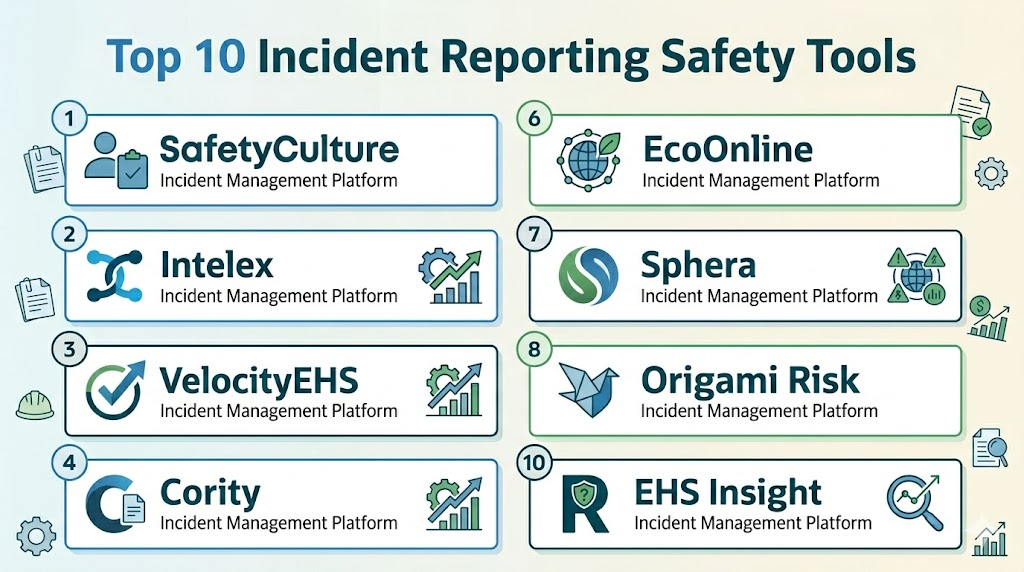
Top 10 Incident Reporting Safety Tools
1- SafetyCulture
Short description: SafetyCulture is a mobile-first safety and inspection platform widely used for workplace incident reporting, inspections, audits, and operational compliance management. It is especially popular among construction, logistics, and manufacturing organizations.
Key Features
- Incident reporting workflows
- Mobile inspections
- Hazard reporting
- Audit management
- Corrective action tracking
- Real-time dashboards
- Workflow automation
Pros
- Excellent mobile usability
- Fast deployment process
- Strong frontline worker adoption
Cons
- Advanced enterprise analytics may be limited
- Complex workflows may require integrations
- Enterprise customization varies
Platforms / Deployment
- Web / iOS / Android
- Cloud
Security & Compliance
- Encryption
- Audit logs
- RBAC reportedly supported
- SSO reportedly available
Integrations & Ecosystem
SafetyCulture integrates with operational reporting and workforce collaboration systems to improve incident management workflows.
- Microsoft Teams
- Slack
- APIs
- Zapier
- HR systems
Support & Community
Strong onboarding experience with broad community adoption and extensive self-service documentation.
2- Intelex
Short description: Intelex provides enterprise-grade incident reporting and EHS management capabilities for organizations requiring advanced compliance tracking, investigations, and operational safety workflows.
Key Features
- Incident investigation workflows
- Corrective action management
- Compliance automation
- Risk assessments
- Audit tracking
- Mobile reporting
- Advanced analytics
Pros
- Strong enterprise scalability
- Highly configurable workflows
- Broad compliance support
Cons
- Implementation complexity can be high
- Requires training investment
- Premium pricing for advanced modules
Platforms / Deployment
- Web / iOS / Android
- Cloud
Security & Compliance
- MFA
- Encryption
- Audit logs
- SSO
- GDPR support
Integrations & Ecosystem
Intelex supports enterprise integrations across ERP, HR, and reporting systems for centralized compliance visibility.
- SAP
- Oracle
- APIs
- Microsoft Power BI
- ERP systems
Support & Community
Comprehensive onboarding and enterprise customer support with implementation consulting services.
3- VelocityEHS
Short description: VelocityEHS offers workplace safety and incident reporting tools focused on industrial operations, manufacturing environments, and enterprise compliance management.
Key Features
- Incident tracking
- Hazard management
- Compliance workflows
- Mobile inspections
- Risk assessments
- Audit management
- Analytics dashboards
Pros
- Strong industrial safety focus
- Good operational reporting
- Broad EHS functionality
Cons
- Reporting customization may vary
- Enterprise onboarding can take time
- Premium modules may increase costs
Platforms / Deployment
- Web / iOS / Android
- Cloud
Security & Compliance
- Encryption
- RBAC
- Audit logs
- SSO reportedly supported
Integrations & Ecosystem
VelocityEHS integrates with enterprise systems for centralized workplace safety and operational reporting.
- SAP
- Oracle
- APIs
- HR systems
- Microsoft tools
Support & Community
Strong implementation services and enterprise support programs for industrial organizations.
4- Cority
Short description: Cority delivers enterprise incident reporting, occupational health, and compliance management capabilities for large organizations and regulated industries.
Key Features
- Incident management
- Occupational health tracking
- Compliance workflows
- Risk analytics
- Corrective actions
- Safety observations
- ESG reporting
Pros
- Strong occupational health tools
- Enterprise-grade scalability
- Advanced analytics support
Cons
- Learning curve for advanced workflows
- Premium pricing structure
- Setup complexity may require support
Platforms / Deployment
- Web / iOS / Android
- Cloud
Security & Compliance
- Encryption
- SSO/SAML
- RBAC
- Audit logs
- GDPR support
Integrations & Ecosystem
Cority integrates with operational and enterprise business systems for centralized compliance reporting.
- SAP
- Oracle
- APIs
- Workday
- Analytics platforms
Support & Community
Strong enterprise onboarding and consulting services for global deployments.
5- Benchmark Gensuite
Short description: Benchmark Gensuite provides incident reporting, ESG management, workplace safety tracking, and operational compliance workflows for enterprises.
Key Features
- Incident reporting
- Mobile inspections
- ESG tracking
- Compliance management
- Risk assessments
- Audit automation
- Dashboard reporting
Pros
- Strong ESG integration
- Flexible workflow automation
- Modern mobile capabilities
Cons
- Enterprise-focused pricing
- SMBs may underuse advanced features
- Reporting setup may require configuration
Platforms / Deployment
- Web / iOS / Android
- Cloud
Security & Compliance
- Encryption
- Audit logs
- RBAC reportedly supported
- SSO reportedly available
Integrations & Ecosystem
Benchmark Gensuite integrates with enterprise operational and analytics systems for centralized reporting.
- SAP
- APIs
- Microsoft systems
- ERP tools
- Analytics platforms
Support & Community
Established enterprise onboarding and training ecosystem with dedicated customer support.
6- EcoOnline
Short description: EcoOnline focuses on incident reporting, chemical safety management, workplace compliance, and operational risk management for industrial and mid-market organizations.
Key Features
- Incident tracking
- Chemical safety management
- Compliance workflows
- Risk assessments
- Training management
- Mobile reporting
- Corrective actions
Pros
- Strong chemical safety support
- User-friendly interface
- Good compliance automation
Cons
- Enterprise analytics depth varies
- Advanced customization may require support
- Industry specialization may not fit all sectors
Platforms / Deployment
- Web / iOS / Android
- Cloud
Security & Compliance
- Encryption
- Audit logs
- GDPR support
- MFA reportedly available
Integrations & Ecosystem
EcoOnline supports integrations with compliance and operational management systems for centralized workflows.
- APIs
- Microsoft systems
- ERP integrations
- HR software
Support & Community
Good onboarding experience with accessible support and operational guidance resources.
7- Sphera
Short description: Sphera provides enterprise incident reporting and operational risk management capabilities for industrial organizations and global enterprises.
Key Features
- Incident management
- Operational risk analytics
- Compliance reporting
- Audit management
- Environmental tracking
- Corrective actions
- Dashboard analytics
Pros
- Strong operational risk focus
- Enterprise analytics capabilities
- Broad compliance support
Cons
- Complex deployment process
- Premium pricing structure
- Training requirements for advanced workflows
Platforms / Deployment
- Web
- Cloud / Hybrid
Security & Compliance
- Encryption
- SSO/SAML
- Audit logs
- GDPR support
Integrations & Ecosystem
Sphera supports enterprise integrations for operational compliance and risk reporting environments.
- SAP
- Oracle
- APIs
- ERP systems
- Analytics tools
Support & Community
Enterprise consulting, onboarding, and implementation support with industry-focused expertise.
8- Origami Risk
Short description: Origami Risk offers workplace incident reporting and risk management workflows for organizations needing centralized compliance, claims management, and operational reporting.
Key Features
- Incident reporting
- Claims workflows
- Compliance tracking
- Audit tools
- Corrective action workflows
- Risk analytics
- Dashboard reporting
Pros
- Strong workflow flexibility
- Modern cloud-based platform
- Good risk management integration
Cons
- Enterprise setup can be complex
- Smaller teams may underuse advanced features
- Reporting customization may require expertise
Platforms / Deployment
- Web
- Cloud
Security & Compliance
- Encryption
- Audit logs
- RBAC
- SSO reportedly supported
Integrations & Ecosystem
Origami Risk integrates with operational and HR systems for centralized workplace safety visibility.
- APIs
- ERP systems
- HR software
- Analytics platforms
Support & Community
Comprehensive onboarding and enterprise customer support services.
9- EHS Insight
Short description: EHS Insight provides practical workplace incident reporting and compliance management capabilities for SMBs and mid-market organizations.
Key Features
- Incident reporting
- Audit tracking
- Compliance management
- Risk assessments
- Corrective actions
- Mobile reporting
- Dashboard analytics
Pros
- Easy-to-use interface
- Good SMB fit
- Flexible reporting workflows
Cons
- Enterprise customization may be limited
- ESG functionality less extensive
- Complex integrations may require support
Platforms / Deployment
- Web / iOS / Android
- Cloud
Security & Compliance
- Encryption
- Audit logs
- MFA reportedly available
Integrations & Ecosystem
EHS Insight supports operational reporting and compliance workflows through integrations and APIs.
- APIs
- Microsoft systems
- ERP tools
- HR software
Support & Community
Responsive onboarding and support suitable for growing organizations.
10- Resolver
Short description: Resolver provides incident reporting, operational risk management, and compliance workflows for enterprises focused on workplace safety and governance management.
Key Features
- Incident management
- Risk analytics
- Compliance tracking
- Corrective actions
- Investigation workflows
- Reporting dashboards
- Audit management
Pros
- Strong governance workflows
- Good enterprise reporting
- Broad operational visibility
Cons
- Advanced setup complexity
- Learning curve for new users
- Premium enterprise pricing
Platforms / Deployment
- Web
- Cloud
Security & Compliance
- Encryption
- Audit logs
- RBAC reportedly supported
- SSO reportedly available
Integrations & Ecosystem
Resolver integrates with enterprise reporting and governance systems for centralized operational management.
- APIs
- ERP systems
- HR platforms
- Analytics tools
Support & Community
Enterprise onboarding support with implementation consulting and customer success services.
Comparison Table
| Tool Name | Best For | Platforms Supported | Deployment | Standout Feature | Public Rating |
|---|---|---|---|---|---|
| SafetyCulture | Mobile-first inspections | Web, iOS, Android | Cloud | Frontline incident reporting | N/A |
| Intelex | Enterprise compliance | Web, iOS, Android | Cloud | Configurable incident workflows | N/A |
| VelocityEHS | Industrial operations | Web, iOS, Android | Cloud | Workplace hazard management | N/A |
| Cority | Occupational health management | Web, iOS, Android | Cloud | Health and compliance tracking | N/A |
| Benchmark Gensuite | ESG-focused enterprises | Web, iOS, Android | Cloud | ESG and safety integration | N/A |
| EcoOnline | Chemical safety operations | Web, iOS, Android | Cloud | Chemical incident management | N/A |
| Sphera | Operational risk management | Web | Cloud, Hybrid | Enterprise risk analytics | N/A |
| Origami Risk | Risk and claims workflows | Web | Cloud | Incident and claims integration | N/A |
| EHS Insight | SMB safety operations | Web, iOS, Android | Cloud | Easy-to-use compliance tools | N/A |
| Resolver | Governance and compliance | Web | Cloud | Enterprise incident investigations | N/A |
Evaluation & Scoring of Incident Reporting Safety Tools
| Tool Name | Core Features 25% | Ease of Use 15% | Integrations 15% | Security 10% | Performance 10% | Support 10% | Value 15% | Weighted Total |
|---|---|---|---|---|---|---|---|---|
| SafetyCulture | 8 | 9 | 7 | 7 | 8 | 8 | 9 | 8.05 |
| Intelex | 9 | 7 | 9 | 8 | 9 | 8 | 7 | 8.10 |
| VelocityEHS | 9 | 8 | 8 | 8 | 9 | 8 | 7 | 8.15 |
| Cority | 9 | 7 | 8 | 9 | 9 | 8 | 7 | 8.15 |
| Benchmark Gensuite | 8 | 8 | 8 | 8 | 8 | 8 | 7 | 7.85 |
| EcoOnline | 8 | 8 | 7 | 8 | 8 | 7 | 8 | 7.80 |
| Sphera | 9 | 6 | 8 | 9 | 9 | 8 | 6 | 7.95 |
| Origami Risk | 8 | 7 | 8 | 8 | 8 | 8 | 7 | 7.75 |
| EHS Insight | 7 | 8 | 7 | 7 | 8 | 7 | 8 | 7.50 |
| Resolver | 8 | 7 | 8 | 8 | 8 | 8 | 7 | 7.75 |
Which Incident Reporting Safety Tool Is Right for You?
Solo / Freelancer
Independent consultants and smaller teams usually benefit from lightweight incident reporting tools that provide simple deployment, mobile accessibility, and fast reporting workflows. Easy-to-use platforms with mobile inspections and basic compliance tracking are often sufficient for smaller operational environments. Organizations with limited IT resources typically prioritize usability and faster onboarding over advanced analytics. Cloud-based solutions also help smaller teams reduce infrastructure and maintenance complexity.
SMB
Small and medium-sized businesses should focus on platforms that balance usability, compliance automation, reporting flexibility, and pricing efficiency. SMBs often need scalable incident reporting systems that improve workplace safety without introducing unnecessary operational complexity. Mobile reporting, dashboard visibility, and corrective action tracking are especially valuable for growing teams. Cloud-native tools usually provide easier onboarding and lower long-term management overhead.
Mid-Market
Mid-market organizations benefit from stronger integrations, analytics, centralized reporting, and multi-location incident management capabilities. These businesses often require more advanced workflow automation and compliance visibility as operations expand across departments and facilities. Platforms with mature APIs and operational reporting flexibility are typically the best fit. Mid-market organizations also benefit from scalable architectures that support long-term growth.
Enterprise
Large enterprises should prioritize advanced governance, operational risk management, audit automation, compliance workflows, and enterprise-grade analytics. Organizations operating across multiple regions often require highly configurable incident reporting platforms with centralized dashboards and strict security controls. Enterprise deployments also demand mature integrations with ERP, HR, and operational systems. Scalability, compliance reporting, and workflow customization become critical selection factors.
Budget vs Premium
Budget-focused tools usually prioritize simplicity, mobile usability, and essential incident reporting workflows for smaller organizations. Premium enterprise platforms deliver advanced analytics, operational risk management, governance controls, ESG support, and deeper workflow automation. Organizations should compare long-term operational value rather than focusing only on initial pricing. Premium platforms are often more suitable for highly regulated industries and complex operational environments.
Feature Depth vs Ease of Use
Some incident reporting platforms provide extensive workflow customization, advanced analytics, and governance controls but require more onboarding and training. Other solutions focus on operational simplicity, mobile reporting, and fast deployment for frontline teams. Businesses should balance advanced feature requirements with user adoption and reporting consistency. Highly complex systems may reduce usability if workflows become difficult for employees to follow.
Integrations & Scalability
Organizations using ERP, HR, analytics, and operational systems should prioritize platforms with mature APIs and broad integration ecosystems. Strong integrations improve centralized compliance visibility and reduce manual data duplication across departments. Scalable platforms also help businesses expand incident management workflows without requiring major infrastructure changes later. Long-term scalability is especially important for multi-location organizations.
Security & Compliance Needs
Regulated industries should prioritize encryption, RBAC, audit logging, SSO, compliance automation, and centralized governance controls when evaluating incident reporting tools. Security capabilities become increasingly important when handling sensitive operational and workforce data. Businesses operating in healthcare, manufacturing, energy, and logistics environments often require advanced compliance reporting and audit readiness. Strong governance features also improve long-term operational accountability.
Frequently Asked Questions
1. What are Incident Reporting Safety Tools?
Incident Reporting Safety Tools help organizations digitally report, track, investigate, and manage workplace incidents, injuries, hazards, and near misses. These platforms centralize safety workflows and improve operational visibility across teams and locations. Many organizations use them to strengthen compliance management and workplace accountability. Modern platforms also support automation, analytics, and mobile reporting capabilities.
2. Which industries use incident reporting tools the most?
Manufacturing, construction, logistics, healthcare, mining, energy, and industrial sectors are among the largest users of incident reporting platforms. These industries often operate under strict workplace safety regulations and require centralized reporting systems. Incident reporting tools help reduce operational risks and improve compliance visibility. They are also increasingly adopted by enterprises managing ESG and governance programs.
3. Are cloud-based incident reporting tools secure?
Most modern incident reporting platforms include encryption, access controls, audit logging, and secure cloud infrastructure to support enterprise security requirements. Many vendors also provide role-based permissions and centralized governance capabilities. Organizations handling sensitive workforce or operational data should carefully review vendor compliance and security controls. Security requirements vary depending on industry and operational complexity.
4. How much do incident reporting tools typically cost?
Pricing varies based on organization size, number of users, deployment scale, integrations, and advanced workflow requirements. Some vendors offer subscription-based pricing while enterprise platforms may require customized licensing agreements. Advanced analytics, ESG capabilities, and governance modules can increase total ownership costs. Businesses should evaluate both implementation expenses and long-term operational value before selecting a platform.
5. Do incident reporting platforms support mobile reporting?
Yes, most modern incident reporting systems provide mobile applications for field reporting, inspections, audits, and corrective action management. Mobile accessibility is especially valuable for construction, manufacturing, logistics, and industrial operations. Real-time reporting improves response times and operational visibility. Mobile-first workflows also encourage stronger frontline employee participation in workplace safety programs.
6. Can these tools integrate with ERP and HR systems?
Many enterprise incident reporting tools integrate with ERP, HR, analytics, and operational management systems through APIs and connectors. Integrations help organizations centralize safety reporting and reduce manual administrative work. Businesses using SAP, Oracle, Microsoft, or Workday environments often prioritize mature integration ecosystems. Strong integrations also improve scalability and compliance visibility across departments.
7. What are the biggest implementation challenges?
Organizations often underestimate workflow customization, onboarding, employee training, and integration planning during implementation. Frontline user adoption is especially important for successful incident reporting processes. Some enterprise platforms may also require dedicated administrators for governance and workflow management. Proper planning and phased deployment strategies usually improve long-term operational success.
8. Are AI features becoming important in incident reporting tools?
AI-powered analytics, predictive risk detection, automated reporting, and trend analysis are becoming increasingly valuable in modern workplace safety environments. Some platforms use AI to identify recurring incident patterns and operational risks before they escalate. Automation also helps reduce manual compliance workloads and improve investigation workflows. These capabilities support faster and more proactive workplace safety management.
9. What should buyers prioritize first when selecting a tool?
Organizations should prioritize compliance requirements, scalability, reporting flexibility, mobile usability, integrations, and operational fit before comparing advanced features. Security capabilities such as encryption, RBAC, audit logging, and SSO are also important for regulated industries. Buyers should evaluate how well the platform supports real operational workflows and frontline reporting processes. Pilot testing is strongly recommended before final deployment.
10. Are Incident Reporting Safety Tools suitable for SMBs?
Yes, many vendors now provide SMB-friendly incident reporting platforms with simplified workflows, cloud-based deployment, and mobile accessibility. Smaller organizations often benefit from centralized reporting, corrective action tracking, and operational visibility without needing enterprise-scale infrastructure. SMB-focused tools also tend to prioritize usability and faster implementation. Choosing a scalable platform can support future operational growth.
Conclusion
Incident Reporting Safety Tools play an important role in improving workplace safety, reducing operational risks, and strengthening compliance management across organizations. These platforms help businesses streamline incident reporting, automate corrective actions, improve workplace visibility, and maintain centralized safety records through digital workflows. Modern tools also provide mobile accessibility, analytics dashboards, workflow automation, and integrations that support faster and more accurate decision-making. The right platform depends on operational size, industry requirements, compliance complexity, reporting needs, and integration expectations. SMBs may prioritize usability and affordability, while enterprises often focus on scalability, governance, analytics, and advanced compliance capabilities. Instead of selecting a tool based only on features, organizations should evaluate real operational fit, user adoption, and long-term scalability. A practical approach is to shortlist a few platforms, test real reporting workflows, validate integrations and security capabilities, and then choose the solution that aligns best with long-term workplace safety and operational goals.

Find Trusted Cardiac Hospitals
Compare heart hospitals by city and services — all in one place.
Explore Hospitals
Incident reporting and safety tools are most valuable when they help organizations capture, investigate, manage, and prevent workplace incidents, safety hazards, near misses, and compliance issues. By providing digital incident reporting, workflow automation, corrective and preventive action (CAPA) tracking, risk assessments, root cause analysis, audit management, regulatory compliance, analytics, and mobile reporting capabilities, these platforms improve workplace safety, accelerate incident resolution, strengthen compliance, reduce operational risks, and foster a proactive safety culture.