Introduction
Execution Management Systems EMS help trading firms manage trade execution workflows across brokers, liquidity venues, exchanges, and asset classes. These platforms are designed to optimize order routing, improve execution quality, reduce latency, and provide traders with real-time visibility into market activity and trading performance. Modern EMS platforms are essential because institutional trading environments have become faster, more fragmented, and increasingly data-driven. Traders now execute across multiple markets, regions, dark pools, and algorithmic venues simultaneously. An EMS helps trading desks manage execution strategies, monitor liquidity, reduce market impact, and maintain regulatory compliance while supporting high-speed institutional trading operations.
Real-World Use Cases Include:
- Executing large institutional trade orders
- Managing algorithmic trading workflows
- Connecting to brokers and liquidity venues
- Monitoring execution quality and market impact
- Running low-latency multi-asset trading strategies
Evaluation Criteria for Buyers:
- Multi-asset execution support
- Broker and venue connectivity
- Algorithmic trading capabilities
- Latency and execution performance
- Real-time analytics and monitoring
- OMS and PMS integrations
- Compliance and audit workflows
- Scalability for high-volume trading
- Deployment flexibility
- Vendor support and operational maturity
Best for: hedge funds, broker-dealers, proprietary trading firms, asset managers, institutional trading desks, quantitative trading teams, and banks that require sophisticated execution workflows and market connectivity.
Not ideal for: casual retail investors or very small firms that only need basic brokerage execution tools without advanced routing, analytics, or multi-venue trading requirements.
Key Trends in Execution Management Systems EMS
- OMS and EMS convergence is accelerating as firms seek unified trading and execution workflows.
- AI-assisted execution optimization is improving routing efficiency and reducing market impact.
- Cloud-enabled EMS deployments are becoming more common for scalability and operational flexibility.
- Low-latency infrastructure remains critical for institutional and quantitative trading desks.
- Cross-asset execution support is expanding across equities, fixed income, FX, futures, options, and crypto.
- Real-time execution analytics are becoming standard for performance measurement and trade cost analysis.
- API-first architectures are improving integration with OMS, PMS, risk, and analytics systems.
- Algorithmic execution strategies are becoming more adaptive and data-driven.
- Regulatory transparency requirements continue driving stronger audit and reporting workflows.
- Crypto and digital asset execution connectivity is increasingly integrated into institutional EMS platforms.
How We Selected These Tools
The platforms below were selected using a practical institutional trading evaluation framework:
- Market adoption across institutional trading environments
- Execution quality and low-latency infrastructure
- Multi-asset and multi-venue connectivity
- Algorithmic trading support
- Integration ecosystem strength
- Scalability for enterprise trading operations
- Compliance and operational workflow coverage
- Vendor reputation within capital markets
- Cloud and hybrid deployment flexibility
- Long-term relevance for modern electronic trading
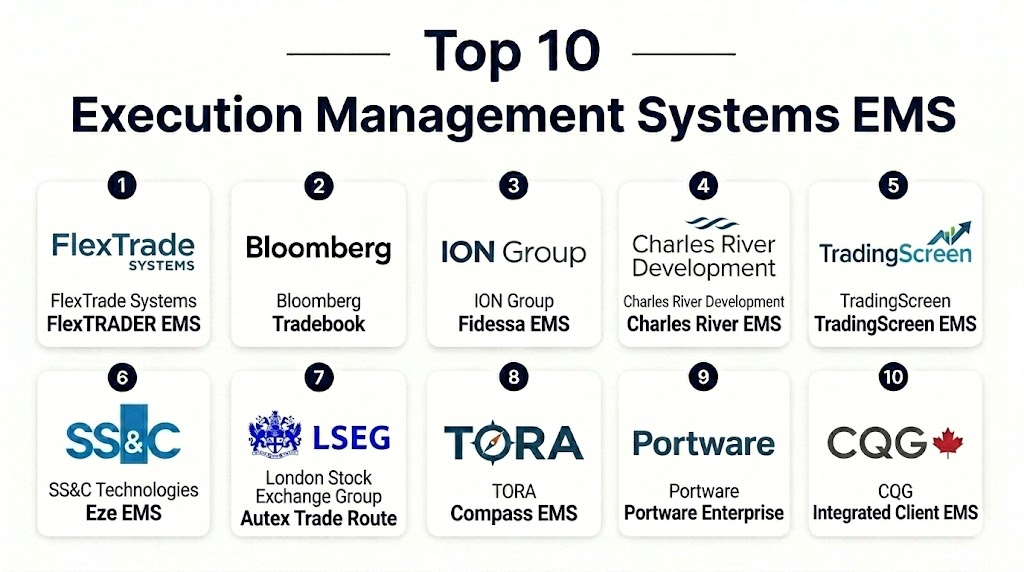
Top 10 Execution Management Systems EMS Tools
1- FlexTrade FlexTRADER EMS
Short description: FlexTrade FlexTRADER EMS is a multi-asset execution management platform used by institutional trading desks, hedge funds, and broker-dealers for high-performance trading workflows.
Key Features
- Multi-asset execution workflows
- Algorithmic trading support
- Broker-neutral trading architecture
- Real-time analytics and monitoring
- Advanced order routing
- Low-latency execution infrastructure
- Cross-market connectivity
Pros
- Strong institutional adoption
- Highly configurable trading workflows
- Excellent multi-asset execution support
Cons
- Complex enterprise implementation
- Requires experienced trading operations teams
- Premium pricing model
Platforms / Deployment
Cloud / Hybrid / Self-hosted
Security & Compliance
Enterprise-grade security controls available. Specific certifications not publicly stated.
Integrations & Ecosystem
FlexTRADER integrates with brokers, liquidity venues, OMS systems, market data providers, and algorithmic execution engines.
- OMS integrations
- FIX connectivity
- Market data feeds
- Broker networks
- Trading analytics tools
Support & Community
Strong enterprise support with institutional onboarding and implementation services.
2- Bloomberg Tradebook
Short description: Bloomberg Tradebook is an EMS platform integrated into Bloomberg’s broader financial ecosystem, providing execution, analytics, and market connectivity for institutional traders.
Key Features
- Multi-asset execution management
- Integrated Bloomberg analytics
- Algorithmic trading workflows
- Broker and venue connectivity
- Trade cost analysis
- Real-time execution monitoring
- Portfolio trading capabilities
Pros
- Deep Bloomberg ecosystem integration
- Strong analytics environment
- Reliable institutional infrastructure
Cons
- Best value comes within Bloomberg ecosystem
- Premium enterprise pricing
- Less suitable for smaller firms
Platforms / Deployment
Web / Desktop ecosystem / Cloud-supported deployment
Security & Compliance
Enterprise security controls available.
Integrations & Ecosystem
Tradebook integrates tightly with Bloomberg market data, analytics, OMS workflows, and institutional trading infrastructure.
- Bloomberg Terminal ecosystem
- Market analytics
- Execution venues
- Compliance workflows
- Portfolio management systems
Support & Community
Bloomberg provides professional institutional support, onboarding, and trading operations assistance.
3- Fidessa EMS
Short description: Fidessa EMS from ION Group is a global execution platform supporting equities, derivatives, and multi-venue institutional trading workflows.
Key Features
- Multi-market connectivity
- Execution analytics
- Algorithmic trading tools
- Smart order routing
- Portfolio trading workflows
- Real-time market monitoring
- Cross-border trading support
Pros
- Strong global market connectivity
- Reliable institutional execution workflows
- Good high-volume trading support
Cons
- Enterprise-focused complexity
- Requires specialist implementation expertise
- Premium operational costs
Platforms / Deployment
Cloud / Hybrid
Security & Compliance
Enterprise security controls available.
Integrations & Ecosystem
Fidessa integrates with brokers, exchanges, OMS platforms, and institutional execution workflows.
- Exchange connectivity
- OMS integrations
- Trading analytics systems
- Broker networks
- Market data platforms
Support & Community
Strong institutional support backed by ION Group trading infrastructure expertise.
4- Charles River EMS
Short description: Charles River EMS provides execution and trading workflow capabilities for buy-side institutions seeking integrated investment and execution management.
Key Features
- Multi-asset execution workflows
- Portfolio and order integration
- Real-time trading analytics
- Compliance support
- Algorithmic execution
- Execution quality monitoring
- Institutional trading workflows
Pros
- Strong buy-side integration
- Useful OMS and EMS convergence capabilities
- Good compliance workflow support
Cons
- Enterprise implementation effort
- Higher operational complexity
- Better suited to institutional users
Platforms / Deployment
Cloud / Hybrid
Security & Compliance
Enterprise-grade controls available.
Integrations & Ecosystem
Charles River EMS integrates execution workflows with portfolio management, compliance, and investment operations.
- OMS integrations
- Compliance systems
- Broker connectivity
- Market data feeds
- Trading analytics workflows
Support & Community
Professional enterprise support with implementation and institutional onboarding services.
5- TradingScreen EMS
Short description: TradingScreen EMS is a multi-asset execution platform supporting institutional trading desks with global market access and algorithmic execution capabilities.
Key Features
- Multi-asset trading
- Smart order routing
- Algorithmic execution support
- Real-time execution analytics
- Global market connectivity
- Trade monitoring workflows
- Institutional execution management
Pros
- Broad market connectivity
- Strong execution workflow tools
- Flexible institutional trading support
Cons
- Enterprise-focused platform
- Can require custom workflow configuration
- Public pricing details limited
Platforms / Deployment
Cloud / Hybrid
Security & Compliance
Enterprise security controls available.
Integrations & Ecosystem
TradingScreen integrates brokers, exchanges, analytics systems, and OMS workflows for institutional trading operations.
- Broker connectivity
- Execution venues
- Trading analytics
- OMS integrations
- FIX connectivity
Support & Community
Institutional support and implementation services available for global trading firms.
6- SS&C Eze EMS
Short description: SS&C Eze EMS is designed for institutional investment firms requiring execution management integrated with broader investment operations and compliance workflows.
Key Features
- Multi-asset execution workflows
- Algorithmic trading support
- Real-time trade monitoring
- Compliance integration
- Broker-neutral execution
- Workflow automation
- Institutional analytics support
Pros
- Good integration with Eze ecosystem
- Strong buy-side workflow coverage
- Institutional-grade execution tools
Cons
- Enterprise deployment complexity
- Smaller firms may not need full platform depth
- Pricing details not publicly transparent
Platforms / Deployment
Cloud / Hybrid
Security & Compliance
Enterprise security controls available.
Integrations & Ecosystem
SS&C Eze EMS connects execution workflows with compliance, OMS, and portfolio management environments.
- OMS systems
- Broker integrations
- Market analytics
- Compliance workflows
- FIX connectivity
Support & Community
Enterprise onboarding and support services available through SS&C ecosystem.
7- LSEG Autex Trade Route
Short description: LSEG Autex Trade Route supports electronic trading communication and execution workflows for institutional trading organizations.
Key Features
- Electronic order routing
- Institutional connectivity
- Trading communication workflows
- Broker integrations
- Execution monitoring
- Global market support
- Trade routing infrastructure
Pros
- Strong institutional network connectivity
- Good interoperability support
- Useful for broker communication workflows
Cons
- Less feature-rich than full OEMS platforms
- Primarily execution communication-focused
- Enterprise-oriented deployment
Platforms / Deployment
Cloud / Hybrid
Security & Compliance
Security controls available.
Integrations & Ecosystem
Autex Trade Route integrates with institutional broker and execution ecosystems.
- Broker connectivity
- OMS systems
- Trade communication workflows
- Market routing systems
- Institutional trading environments
Support & Community
Institutional support backed by LSEG trading infrastructure expertise.
8- TORA Compass EMS
Short description: TORA Compass EMS provides cloud-based execution management for hedge funds and institutional investment firms with multi-asset trading requirements.
Key Features
- Cloud-native EMS workflows
- Multi-asset execution support
- Smart order routing
- Real-time analytics
- Algorithmic trading support
- Compliance monitoring
- Broker-neutral architecture
Pros
- Modern cloud-first deployment
- Good usability for active trading desks
- Strong multi-asset support
Cons
- Smaller ecosystem than larger legacy vendors
- Enterprise onboarding still required
- Public pricing transparency limited
Platforms / Deployment
Cloud
Security & Compliance
Enterprise security controls available.
Integrations & Ecosystem
TORA Compass integrates execution, analytics, compliance, and institutional broker workflows.
- Broker integrations
- OMS connectivity
- Compliance workflows
- Trading analytics systems
- Market data feeds
Support & Community
Professional support and onboarding services for institutional trading teams.
9- Portware Enterprise
Short description: Portware Enterprise is an institutional EMS platform focused on execution automation, analytics, and algorithmic trading workflows.
Key Features
- Execution automation
- Smart order routing
- Real-time execution analytics
- Algorithmic strategy support
- Multi-broker connectivity
- Portfolio trading tools
- Low-latency infrastructure
Pros
- Strong execution optimization capabilities
- Useful analytics environment
- Good institutional trading flexibility
Cons
- Enterprise-focused deployment
- Requires technical trading expertise
- Public pricing details limited
Platforms / Deployment
Cloud / Hybrid
Security & Compliance
Enterprise security controls available.
Integrations & Ecosystem
Portware integrates with broker networks, trading venues, analytics systems, and institutional OMS platforms.
- Broker connectivity
- Execution venues
- Analytics platforms
- OMS systems
- Trading infrastructure
Support & Community
Institutional support with trading workflow implementation expertise.
10- CQG Integrated Client EMS
Short description: CQG Integrated Client provides execution and market connectivity tools widely used in futures, derivatives, and commodities trading environments.
Key Features
- Futures and derivatives execution
- Real-time market connectivity
- Advanced charting and analytics
- Smart routing workflows
- Risk monitoring
- Multi-market access
- Trading automation support
Pros
- Strong derivatives market expertise
- Reliable low-latency infrastructure
- Good global futures market connectivity
Cons
- Stronger in futures than broader asset classes
- Enterprise features vary by deployment
- Less comprehensive than some full OEMS suites
Platforms / Deployment
Windows / Web / Cloud-supported workflows
Security & Compliance
Security controls available.
Integrations & Ecosystem
CQG integrates trading workflows with futures exchanges, broker connectivity, and execution infrastructure.
- Futures exchange connectivity
- Trading APIs
- Broker integrations
- Risk systems
- Market data feeds
Support & Community
Strong institutional support within derivatives and futures trading ecosystems.
Comparison Table
| Tool Name | Best For | Platform Supported | Deployment | Standout Feature | Public Rating |
|---|---|---|---|---|---|
| FlexTrade FlexTRADER EMS | Institutional multi-asset trading | Web / Cloud | Cloud / Hybrid | Broker-neutral EMS workflows | N/A |
| Bloomberg Tradebook | Bloomberg ecosystem users | Web / Desktop | Cloud / Hybrid | Integrated Bloomberg analytics | N/A |
| Fidessa EMS | Global institutional trading | Web / Cloud | Cloud / Hybrid | Global execution connectivity | N/A |
| Charles River EMS | Buy-side firms | Web / Cloud | Cloud / Hybrid | OMS and EMS integration | N/A |
| TradingScreen EMS | Institutional trading desks | Web / Cloud | Cloud / Hybrid | Global execution workflows | N/A |
| SS&C Eze EMS | Buy-side execution operations | Web / Cloud | Cloud / Hybrid | Integrated compliance workflows | N/A |
| LSEG Autex Trade Route | Institutional connectivity | Web / Cloud | Cloud / Hybrid | Trading communication infrastructure | N/A |
| TORA Compass EMS | Cloud-focused hedge funds | Web / Cloud | Cloud | Modern cloud-native EMS | N/A |
| Portware Enterprise | Execution optimization teams | Web / Cloud | Cloud / Hybrid | Advanced execution automation | N/A |
| CQG Integrated Client EMS | Futures and derivatives trading | Windows / Web | Cloud-supported | Derivatives execution infrastructure | N/A |
Evaluation & Scoring of Execution Management Systems EMS
| Tool Name | Core 25% | Ease 15% | Integrations 15% | Security 10% | Performance 10% | Support 10% | Value 15% | Weighted Total |
|---|---|---|---|---|---|---|---|---|
| FlexTrade FlexTRADER EMS | 10 | 7 | 9 | 9 | 10 | 9 | 6 | 8.60 |
| Bloomberg Tradebook | 9 | 7 | 10 | 9 | 9 | 9 | 6 | 8.35 |
| Fidessa EMS | 9 | 7 | 9 | 9 | 9 | 8 | 7 | 8.25 |
| Charles River EMS | 8 | 7 | 9 | 8 | 8 | 8 | 7 | 7.85 |
| TradingScreen EMS | 8 | 7 | 8 | 8 | 8 | 8 | 7 | 7.70 |
| SS&C Eze EMS | 8 | 7 | 8 | 8 | 8 | 8 | 7 | 7.70 |
| LSEG Autex Trade Route | 7 | 7 | 8 | 8 | 8 | 8 | 7 | 7.40 |
| TORA Compass EMS | 8 | 8 | 8 | 8 | 8 | 7 | 8 | 7.95 |
| Portware Enterprise | 8 | 7 | 8 | 8 | 9 | 7 | 7 | 7.75 |
| CQG Integrated Client EMS | 7 | 8 | 7 | 7 | 9 | 7 | 8 | 7.50 |
Which Execution Management Systems EMS Tool Is Right for You?
Solo / Freelancer
Most solo traders do not require a full institutional EMS. Broker platforms or lightweight execution tools are usually sufficient unless high-frequency or multi-venue trading is involved.
SMB
Small hedge funds and proprietary trading firms should focus on usability, broker connectivity, and manageable operational complexity. TORA Compass EMS and selected cloud-based EMS deployments may be more practical.
Mid-Market
Mid-sized trading organizations often require stronger integrations, execution analytics, and compliance workflows. SS&C Eze EMS, TradingScreen EMS, and Charles River EMS can provide balanced institutional functionality.
Enterprise
Large banks, broker-dealers, exchanges, and institutional asset managers should evaluate FlexTrade FlexTRADER EMS, Bloomberg Tradebook, Fidessa EMS, and Portware Enterprise for scalability and advanced execution workflows.
Budget vs Premium
Premium EMS platforms provide broader connectivity, lower latency, advanced analytics, and deeper execution optimization. Budget-conscious firms should prioritize execution quality and operational fit before buying large enterprise suites.
Feature Depth vs Ease of Use
Enterprise EMS tools provide extensive customization and execution depth but often require experienced trading operations teams. Cloud-native tools may offer easier deployment and lower operational overhead.
Integrations & Scalability
Broker connectivity, FIX integration, OMS workflows, market data feeds, and execution analytics pipelines are critical evaluation areas. Poor integration design can create operational and compliance issues.
Security & Compliance Needs
Institutional EMS platforms must support auditability, access controls, encrypted communication, and regulatory oversight workflows because they handle sensitive trading activity and execution data.
Frequently Asked Questions FAQs
1. What is an Execution Management System EMS?
An EMS is a trading platform that helps institutional traders manage execution workflows, broker connectivity, routing, analytics, and market interaction across multiple venues.
2. How is an EMS different from an OMS?
An OMS focuses on order lifecycle management and compliance workflows, while an EMS focuses more on execution quality, routing, liquidity access, and trading performance.
3. Who uses EMS platforms?
Hedge funds, broker-dealers, banks, proprietary trading firms, asset managers, and institutional trading desks commonly use EMS platforms.
4. Why are EMS platforms important?
They improve execution quality, reduce latency, optimize routing, provide analytics visibility, and support institutional trading operations across fragmented markets.
5. What features matter most in an EMS?
Important features include smart order routing, broker connectivity, algorithmic execution, real-time analytics, low-latency infrastructure, and integration support.
6. Can EMS platforms support algorithmic trading?
Yes. Most institutional EMS platforms support algorithmic execution strategies and integration with trading algorithms and analytics engines.
7. Are cloud EMS deployments secure?
Many cloud EMS platforms provide enterprise-grade security controls, but firms should still evaluate encryption, access management, auditability, and vendor operational controls.
8. What integrations are most important?
Key integrations include OMS systems, market data providers, FIX connectivity, compliance systems, execution venues, and broker infrastructure.
9. What mistakes should buyers avoid?
Common mistakes include overlooking latency requirements, underestimating integration complexity, ignoring operational workflows, and failing to involve traders early in evaluation.
10. Can EMS platforms support crypto trading?
Some modern EMS platforms support crypto and digital asset execution workflows, though support depth varies significantly by vendor.
Conclusion
Execution Management Systems EMS have become essential infrastructure for institutional electronic trading. As markets become more fragmented, data-driven, and latency-sensitive, firms need execution platforms capable of routing orders intelligently, managing broker relationships, monitoring execution quality, and supporting algorithmic trading workflows. The right EMS depends on trading volume, asset classes, latency requirements, integration needs, operational maturity, and budget. Enterprise trading organizations may prioritize FlexTrade FlexTRADER EMS, Bloomberg Tradebook, Fidessa EMS, and Portware Enterprise for scale and execution sophistication, while growing hedge funds may find value in modern cloud-oriented platforms like TORA Compass EMS. Before selecting an EMS, firms should validate broker connectivity, test execution workflows, evaluate analytics capabilities, confirm integration requirements, and run pilot trading scenarios using realistic operational conditions.

Find Trusted Cardiac Hospitals
Compare heart hospitals by city and services — all in one place.
Explore Hospitals
Execution Management Systems (EMS) are most valuable when they enable organizations to plan, coordinate, execute, and monitor complex business operations across teams, processes, and enterprise applications. By providing workflow automation, real-time tracking, task orchestration, analytics, collaboration, and system integrations, these platforms improve operational efficiency, enhance visibility into execution, reduce process bottlenecks, and help organizations achieve faster, more consistent business outcomes.