Introduction
Service discovery tools are platforms that automatically detect, register, and track services in dynamic computing environments such as cloud, microservices, and containerized architectures. In simple terms, these tools help applications locate other services without manual configuration, enabling automated communication, orchestration, and scaling. Service discovery is critical in 2026+ because modern applications increasingly rely on distributed microservices, ephemeral containers, multi-cloud environments, and dynamic IPs. Without automated service discovery, developers would struggle to maintain reliable connectivity between services, resulting in failures, latency, or operational overhead.
Real World Use Cases
- Microservices orchestration: Automatically register and locate microservices in Kubernetes or containerized environments.
- Load balancing and failover: Integrate with load balancers to direct traffic to healthy service instances.
- Dynamic scaling: Support auto-scaling by registering new service instances and removing stale ones.
- Multi-cloud and hybrid environments: Enable services to discover each other across cloud providers and on-premises infrastructure.
- API and backend routing: Facilitate API gateway or reverse proxy routing to the correct backend service.
Evaluation Criteria for Buyers
- Protocol and platform support (HTTP, gRPC, TCP, UDP, Kubernetes, Docker)
- Auto-registration and deregistration features
- Integration with load balancers, API gateways, and service meshes
- Health checks and failover capabilities
- Security and compliance features
- Observability and monitoring
- Scalability and high availability
- Ease of deployment and automation
- API and CLI extensibility
- Support for hybrid and multi-cloud architectures
Best for: DevOps engineers, platform engineers, SRE teams, cloud architects, microservices developers, SaaS companies, fintech platforms, and enterprises running dynamic applications.
Not ideal for: Small single-service applications, static monolithic apps, or simple internal tools that do not require dynamic service routing.
Key Trends in Service Discovery Tools
- Cloud-native service discovery is now standard for Kubernetes and containerized platforms.
- Service meshes (like Istio and Linkerd) increasingly integrate discovery capabilities.
- AI-assisted routing and intelligent health evaluation are emerging.
- Multi-cloud and hybrid discovery is a growing requirement for large enterprises.
- API-first design in service discovery tools enables easier automation.
- Security-aware discovery, including mTLS, RBAC, and access policies.
- Observability integration with logs, metrics, and tracing is expected.
- Dynamic scaling and ephemeral instance registration support is a must.
- Lightweight, developer-friendly tools are emerging for small teams.
- Open-source adoption is complemented by managed cloud discovery services.
How We Selected These Tools (Methodology)
- Market adoption and mindshare in cloud-native, container, and microservices ecosystems
- Feature completeness covering registration, deregistration, health checks, scaling, and API access
- Reliability and performance signals for high-availability production environments
- Security posture evaluation including TLS, RBAC, and authentication
- Integration capability with API gateways, load balancers, and service meshes
- Customer fit across solo developers, SMBs, mid-market, and enterprise teams
- Ease of deployment and automation for CI/CD and DevOps workflows
- Observability, logging, and metrics integration
- Open-source activity, community strength, and commercial support
- Real-world production usage in dynamic, distributed architectures
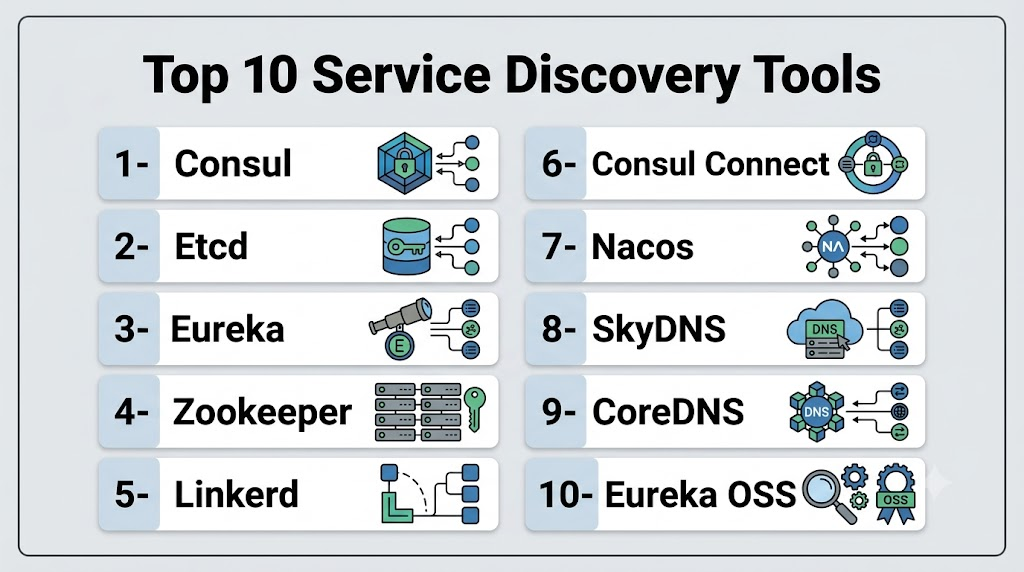
Top 10 Service Discovery Tools
1- Consul
Short description: HashiCorp Consul provides service discovery, configuration, and segmentation for microservices across cloud, on-prem, and hybrid deployments. Ideal for enterprises with dynamic services needing high scalability.
Key Features
- Service registration and discovery
- Health checks and failover management
- Key-value store for configuration
- Multi-datacenter support
- Integrates with load balancers and service meshes
- ACLs for security and access control
Pros
- Robust enterprise features
- Multi-cloud and hybrid-ready
- Mature ecosystem and documentation
Cons
- Configuration complexity can be high
- Requires maintenance for large deployments
- Enterprise features require paid licenses
Platforms / Deployment
Linux / macOS / Windows
Cloud / Self-hosted / Hybrid
Security & Compliance
- ACLs, TLS, encryption for service communication
- Role-based access control
- Not publicly stated for SOC 2/ISO
Integrations & Ecosystem
- Kubernetes, Nomad, Docker
- Envoy, HAProxy
- Terraform
- CI/CD pipelines
Support & Community
Commercial support available; strong open-source community and documentation.
2- Etcd
Short description: Etcd is a distributed key-value store that provides service registration and configuration storage for Kubernetes and other cloud-native platforms.
Key Features
- Highly consistent distributed store
- Leader election and cluster coordination
- Watch mechanism for dynamic configuration
- Supports health check and service metadata
- Easy integration with Kubernetes
Pros
- Core to Kubernetes service discovery
- Lightweight and high-performance
- Open-source with strong adoption
Cons
- Requires monitoring for cluster health
- Not a full-featured discovery platform alone
- Manual integration for non-Kubernetes systems
Platforms / Deployment
Linux / macOS
Cloud / Self-hosted / Kubernetes
Security & Compliance
- TLS, encryption, RBAC for cluster access
- Not publicly stated for SOC 2/ISO
Integrations & Ecosystem
- Kubernetes
- Docker
- Prometheus for monitoring
- CI/CD pipelines
Support & Community
Strong community, open-source; support available through cloud providers.
3- Eureka
Short description: Netflix Eureka is a REST-based service registry for Java microservices, commonly used in Spring Cloud environments.
Key Features
- REST-based service registry
- Self-preservation mode for high availability
- Integration with Spring Cloud
- Heartbeat and health checks
- Client-side load balancing support
Pros
- Strong for Spring/Java ecosystems
- Lightweight and simple
- Community adoption and examples
Cons
- Java-centric
- Limited multi-cloud support
- Requires maintenance for large deployments
Platforms / Deployment
Linux / Cloud / Self-hosted
Security & Compliance
- TLS support for service communication
- Authentication possible via Spring Security
- Not publicly stated for SOC 2/ISO
Integrations & Ecosystem
- Spring Cloud
- Netflix OSS ecosystem
- Load balancers
- CI/CD pipelines
Support & Community
Open-source community with active adoption; commercial support varies.
4- Zookeeper
Short description: Apache Zookeeper is a centralized service for maintaining configuration information, naming, and distributed synchronization, often used for service discovery in Hadoop and Kafka environments.
Key Features
- Centralized coordination
- Distributed configuration storage
- Leader election and health monitoring
- Watch and notification mechanism
- Reliable and fault-tolerant
Pros
- Stable and mature
- Strong coordination and metadata management
- High availability for critical systems
Cons
- Complex to configure and maintain
- Not microservices-native by default
- Requires operational expertise
Platforms / Deployment
Linux / Cloud / Self-hosted
Security & Compliance
- ACL and TLS support
- Not publicly stated for SOC 2/ISO
Integrations & Ecosystem
- Kafka, Hadoop, Solr
- Load balancers
- Service orchestration platforms
Support & Community
Strong Apache community; commercial support available via ecosystem vendors.
5- Linkerd
Short description: Linkerd is a lightweight service mesh with built-in service discovery, routing, and observability for Kubernetes environments.
Key Features
- Kubernetes-native service discovery
- Automatic mTLS for secure communication
- Traffic routing and load balancing
- Observability dashboards
- Failure handling and retries
Pros
- Developer-friendly
- Lightweight and performant
- Easy integration with Kubernetes
Cons
- Limited non-Kubernetes support
- Requires understanding of service mesh concepts
- Some advanced features require paid extensions
Platforms / Deployment
Kubernetes / Linux / Cloud
Security & Compliance
- mTLS encryption
- RBAC and access policies
- Not publicly stated for SOC 2/ISO
Integrations & Ecosystem
- Kubernetes
- Prometheus, Grafana
- CI/CD pipelines
Support & Community
Open-source with active community; commercial support through Buoyant.
6- Consul Connect
Short description: A Consul module providing secure service-to-service connections with service discovery, routing, and mTLS encryption.
Key Features
- Integrated service discovery
- Secure service-to-service communication
- Intentions for traffic control
- Observability and metrics
- Integrates with existing Consul clusters
Pros
- Security-first approach
- Integrated with broader Consul ecosystem
- Scalable and multi-cloud ready
Cons
- Requires Consul knowledge
- Complex for small teams
- Enterprise features may require paid plan
Platforms / Deployment
Linux / macOS / Cloud / Self-hosted / Kubernetes
Security & Compliance
- Built-in mTLS
- RBAC and ACLs
- Not publicly stated for SOC 2/ISO
Integrations & Ecosystem
- Envoy, HAProxy
- Kubernetes
- Terraform, CI/CD pipelines
Support & Community
Active HashiCorp community; commercial support available.
7- Nacos
Short description: Nacos is a dynamic service registry platform for cloud-native Java and microservices applications, providing service discovery, configuration management, and dynamic DNS.
Key Features
- Service registration and discovery
- Dynamic DNS support
- Configuration management
- Health checks and failover
- Multi-cloud and cluster support
Pros
- Strong support for Spring Cloud and Java microservices
- Dynamic configuration capabilities
- Open-source and cloud-native
Cons
- Java-centric
- Smaller community outside Asia
- Requires operational expertise
Platforms / Deployment
Linux / Cloud / Self-hosted / Kubernetes
Security & Compliance
- TLS for secure connections
- ACL-based access control
- Not publicly stated for SOC 2/ISO
Integrations & Ecosystem
- Spring Cloud
- Docker, Kubernetes
- Load balancers, API gateways
- Observability platforms
Support & Community
Open-source community support; commercial support available from Nacos ecosystem vendors.
8- SkyDNS
Short description: SkyDNS provides DNS-based service discovery for distributed systems and microservices.
Key Features
- DNS-based service registry
- Automatic service registration
- Simple key-value backend
- Integration with etcd
- Lightweight and fast
Pros
- Lightweight and easy to deploy
- Simple service registration via DNS
- Suitable for small microservice clusters
Cons
- Limited advanced features
- Requires manual integration for health checks and metrics
- Less community activity than Consul or Eureka
Platforms / Deployment
Linux / Cloud / Self-hosted
Security & Compliance
- TLS possible through DNS/TLS integration
- Not publicly stated for SOC 2/ISO
Integrations & Ecosystem
- etcd, Kubernetes, Docker
- Load balancers
- CI/CD pipelines
Support & Community
Smaller community; documentation is available; support primarily community-based.
9- CoreDNS
Short description: CoreDNS is a DNS server and service discovery platform widely used in Kubernetes for dynamic service lookup and routing.
Key Features
- DNS-based service discovery
- Kubernetes integration
- Plugin-based architecture
- Health checks and metrics support
- Scalable and lightweight
Pros
- Native Kubernetes integration
- Flexible plugin system
- Efficient and lightweight
Cons
- Kubernetes-centric
- Requires plugin configuration for advanced features
- Limited enterprise support
Platforms / Deployment
Linux / Cloud / Kubernetes
Security & Compliance
- TLS support for DNS-over-TLS
- Not publicly stated for SOC 2/ISO
Integrations & Ecosystem
- Kubernetes, Docker
- Prometheus/Grafana
- CI/CD pipelines
Support & Community
Active open-source community; widely used in production Kubernetes clusters.
10- Eureka OSS
Short description: Eureka OSS is Netflix’s open-source service registry for Java microservices, enabling clients to discover services dynamically.
Key Features
- REST-based service registry
- Heartbeat and self-preservation
- Client-side service discovery
- Integration with Spring Cloud
- Lightweight for Java microservices
Pros
- Ideal for Spring Cloud Java stacks
- Lightweight and easy to integrate
- Mature and documented
Cons
- Java-centric
- Limited multi-cloud features
- Requires maintenance for large deployments
Platforms / Deployment
Linux / Cloud / Self-hosted
Security & Compliance
- TLS and authentication possible via Spring Security
- Not publicly stated for SOC 2/ISO
Integrations & Ecosystem
- Spring Cloud ecosystem
- Load balancers
- Docker, Kubernetes
- CI/CD pipelines
Support & Community
Open-source community; widely adopted in Java microservices.
Comparison Table (Top 10)
| Tool Name | Best For | Platform(s) Supported | Deployment | Standout Feature | Public Rating |
|---|---|---|---|---|---|
| Consul | Multi-cloud dynamic microservices | Linux, macOS, Windows | Cloud / Self-hosted / Hybrid | Enterprise-ready service discovery | N/A |
| Etcd | Kubernetes core discovery | Linux, macOS | Cloud / Self-hosted / Kubernetes | High-consistency key-value store | N/A |
| Eureka | Spring Cloud/Java | Linux | Cloud / Self-hosted | REST-based registry for Java microservices | N/A |
| Zookeeper | Hadoop, Kafka, legacy systems | Linux | Cloud / Self-hosted | Centralized coordination | N/A |
| Linkerd | Kubernetes microservices | Linux / Kubernetes | Cloud / Self-hosted | Lightweight service mesh with discovery | N/A |
| Consul Connect | Service-to-service secure discovery | Linux / Kubernetes | Cloud / Self-hosted / Hybrid | Secure mTLS service communication | N/A |
| Nacos | Java/cloud-native services | Linux / Kubernetes | Cloud / Self-hosted | Dynamic DNS & configuration | N/A |
| SkyDNS | DNS-based discovery | Linux | Cloud / Self-hosted | Lightweight DNS registry | N/A |
| CoreDNS | Kubernetes DNS & discovery | Linux / Kubernetes | Cloud / Self-hosted | Plugin-based DNS for service discovery | N/A |
| Eureka OSS | Java microservices | Linux | Cloud / Self-hosted | REST-based registry | N/A |
Evaluation & Scoring of Service Discovery Tools
| Tool Name | Core 25% | Ease 15% | Integrations 15% | Security 10% | Performance 10% | Support 10% | Value 15% | Weighted Total |
|---|---|---|---|---|---|---|---|---|
| Consul | 10 | 8 | 9 | 9 | 9 | 8 | 8 | 8.85 |
| Etcd | 9 | 7 | 8 | 8 | 9 | 7 | 9 | 8.20 |
| Eureka | 8 | 7 | 7 | 7 | 8 | 7 | 8 | 7.50 |
| Zookeeper | 8 | 6 | 7 | 8 | 8 | 7 | 7 | 7.25 |
| Linkerd | 9 | 9 | 8 | 8 | 9 | 8 | 8 | 8.55 |
| Consul Connect | 9 | 8 | 8 | 9 | 9 | 8 | 8 | 8.55 |
| Nacos | 8 | 7 | 7 | 7 | 8 | 7 | 8 | 7.50 |
| SkyDNS | 7 | 8 | 6 | 6 | 7 | 6 | 8 | 7.05 |
| CoreDNS | 8 | 8 | 7 | 7 | 8 | 7 | 8 | 7.55 |
| Eureka OSS | 7 | 7 | 6 | 6 | 7 | 6 | 7 | 6.85 |
Which Service Discovery Tool Is Right for You?
Solo / Freelancer
- Lightweight tools like SkyDNS, Eureka OSS, or CoreDNS are simple to deploy.
- Open-source tools reduce costs and provide learning opportunities.
SMB
- Consul, Linkerd, and Nacos provide balance of automation, security, and ease of integration.
- Ideal for small teams with dynamic microservices.
Mid-Market
- Consul Connect, Linkerd, and CoreDNS help with Kubernetes and multi-service architectures.
- Strong observability and automated registration are key.
Enterprise
- Consul, Zookeeper, Etcd, and Nacos support multi-datacenter, multi-cloud, and hybrid deployments.
- Strong security, governance, and compliance features required.
Budget vs Premium
- Open-source options like Etcd, CoreDNS, SkyDNS, and Eureka OSS reduce costs.
- Enterprise-ready tools like Consul Connect and Nacos provide paid support and extra governance features.
Feature Depth vs Ease of Use
- Developers favor lightweight and automated tools (Linkerd, CoreDNS, SkyDNS) for speed.
- Operations teams may prefer enterprise-grade tools (Consul, Etcd, Zookeeper) for robustness and governance.
Integrations & Scalability
- Kubernetes-native: Linkerd, CoreDNS, Consul Connect
- Multi-cloud: Consul, Nacos, Etcd
- API/Load balancer integration: Consul, Nacos
Security & Compliance Needs
- mTLS and ACLs: Consul Connect, Linkerd
- TLS and secure communication: Etcd, CoreDNS, Nacos
- Compliance: Verify enterprise or paid plans.
Frequently Asked Questions
1. What is a service discovery tool?
A service discovery tool helps applications automatically find and connect with other services in a network.
It removes the need to hardcode IP addresses or manually update service locations.
This is especially useful in microservices, Kubernetes, cloud, and container environments.
It improves reliability by keeping service communication dynamic and updated.
2. Why is service discovery important for microservices?
Microservices often run across many containers, servers, or cloud regions.
Their IP addresses and locations can change frequently due to scaling or restarts.
Service discovery ensures each microservice can find the correct service endpoint automatically.
This reduces downtime, manual configuration, and communication failures.
3. Which service discovery tool is best for Kubernetes?
CoreDNS is widely used inside Kubernetes for DNS-based service discovery.
Etcd is also important because Kubernetes uses it to store cluster state and configuration.
Linkerd, Consul Connect, and Nacos can add advanced discovery, routing, and security features.
The best choice depends on whether you need basic discovery, service mesh, or multi-cloud support.
4. Are service discovery tools only for large enterprises?
No, service discovery tools are useful for startups, SMBs, and enterprises.
Small teams may use simple DNS-based or Kubernetes-native discovery.
Larger teams often need advanced tools with health checks, access controls, and multi-cloud support.
The right tool depends on application complexity, traffic scale, and operational needs.
5. What is the difference between service discovery and a service mesh?
Service discovery helps services find each other automatically.
A service mesh goes further by managing traffic policies, retries, encryption, observability, and security.
Tools like Linkerd and Consul Connect combine service discovery with service mesh capabilities.
For simple environments, service discovery alone may be enough.
6. Do service discovery tools improve application uptime?
Yes, service discovery can improve uptime by routing traffic only to healthy service instances.
When a service fails, health checks can remove it from the active registry.
New service instances can be added automatically when scaling occurs.
This helps applications remain available during failures, deployments, and traffic changes.
7. Can service discovery tools work across multiple clouds?
Yes, some tools support hybrid and multi-cloud service discovery.
Consul and Nacos are often used in environments that span cloud and on-prem systems.
They help services communicate across regions, clusters, and infrastructure boundaries.
However, multi-cloud discovery needs careful planning around security, latency, and networking.
8. What are common mistakes when using service discovery tools?
Common mistakes include weak health checks, poor access control, and missing monitoring.
Teams also sometimes leave stale service records active, which can cause traffic failures.
Another mistake is choosing a complex tool when basic Kubernetes discovery is enough.
A good rollout should include testing, observability, failover checks, and clear ownership.
9. Are open-source service discovery tools reliable?
Yes, many open-source tools are reliable when configured and maintained properly.
Etcd, CoreDNS, Eureka, Zookeeper, and Nacos are used in many production environments.
The main challenge is operational responsibility, including upgrades, backups, and monitoring.
Teams that need vendor support may prefer commercial or managed options.
10. How do I choose the right service discovery tool?
Start by reviewing your architecture, such as Kubernetes, Java microservices, hybrid cloud, or legacy systems.
Then evaluate health checks, security, integrations, scalability, and ease of operation.
For Kubernetes, CoreDNS and Etcd are important; for hybrid cloud, Consul is a strong option.
Shortlist two or three tools and test them with real services before final selection.
Conclusion
Service discovery tools are now essential for modern cloud-native applications because services are no longer static. Microservices, containers, Kubernetes clusters, hybrid cloud systems, and auto-scaling environments all require a reliable way for applications to find and communicate with each other. The right service discovery platform improves uptime, reduces manual configuration, supports dynamic scaling, and helps teams build more resilient distributed systems.
There is no single best tool for every organization. Consul is a strong all-around choice for hybrid and multi-cloud environments, Etcd and CoreDNS are deeply important in Kubernetes ecosystems, Eureka fits Java and Spring Cloud teams, Zookeeper remains useful for coordination-heavy legacy environments, Linkerd and Consul Connect are strong for secure service-to-service communication, and Nacos works well for cloud-native Java and configuration-heavy environments. A smart next step is to shortlist two or three tools, test them with real services, validate health checks, review security controls, and confirm integration with your Kubernetes, load balancer, API gateway, and monitoring stack before making a final decision.

Find Trusted Cardiac Hospitals
Compare heart hospitals by city and services — all in one place.
Explore Hospitals
Service discovery tools are most valuable when they automatically detect, register, and locate services across dynamic cloud-native and microservices environments. By providing real-time service registration, health checks, load balancing, DNS-based discovery, and seamless integration with orchestration platforms, these tools simplify service communication, improve application resilience, reduce manual configuration, and ensure reliable connectivity as infrastructure scales.