Introduction
Infrastructure Monitoring Tools are software platforms that provide visibility into an organization’s IT environment, including servers, network devices, cloud resources, applications, containers, and storage systems. They collect metrics, logs, and events in real time, enabling IT teams to proactively detect performance issues, identify failures, and ensure system reliability. With the complexity of hybrid and multi-cloud architectures increasing in 2026, monitoring has become critical to avoid downtime, maintain compliance, and optimize costs.
Real-world use cases include:
- Proactively detecting server, network, and application performance issues.
- Monitoring cloud infrastructure and usage metrics for cost optimization.
- Supporting DevOps and SRE teams in managing CI/CD pipelines and deployments.
- Ensuring compliance and security through system activity tracking and alerts.
- Generating reports for capacity planning and trend analysis.
Evaluation criteria for buyers:
- Ease of deployment and configuration.
- Coverage across on-prem, cloud, hybrid, and containerized environments.
- Real-time alerting and anomaly detection.
- Integrations with ITSM, DevOps, and security platforms.
- Scalability and reliability under high data volumes.
- Customization, dashboards, and reporting capabilities.
- AI or ML-driven insights for predictive monitoring.
- Pricing model and total cost of ownership.
Best for: IT managers, DevOps and SRE teams, cloud architects, enterprises, and mid-sized organizations needing proactive monitoring, alerting, and performance management.
Not ideal for: Small businesses with minimal infrastructure, or teams relying solely on basic OS-level monitoring; lightweight scripts may suffice in those cases.
Key Trends in Infrastructure Monitoring Tools
- Adoption of AI/ML for predictive alerting and root-cause analysis.
- Unified monitoring across hybrid and multi-cloud architectures.
- Integration with DevOps pipelines and CI/CD workflows for automated observability.
- Container and Kubernetes-native monitoring capabilities.
- Real-time metrics visualization with customizable dashboards.
- Cloud-native, SaaS-first deployment models with flexible subscription pricing.
- Enhanced security and compliance monitoring, including SOC 2, ISO 27001, and GDPR-ready workflows.
- Event-driven alerting and automated remediation.
- Expansion of observability to include network, storage, and IoT/edge devices.
- Interoperability through robust APIs and plugin ecosystems.
How We Selected These Tools (Methodology)
- Evaluated market adoption and customer mindshare across global IT organizations.
- Analyzed feature completeness, including metric collection, alerting, and dashboards.
- Assessed reliability and performance signals from benchmarks and case studies.
- Reviewed security posture and compliance capabilities.
- Considered integrations with cloud providers, DevOps, ITSM, and observability platforms.
- Examined scalability for enterprise, mid-market, and SMB environments.
- Balanced open-source, cloud-native, and enterprise SaaS tools.
- Evaluated community strength, support tiers, and documentation quality.
- Prioritized modern relevance and continuous updates in 2026.
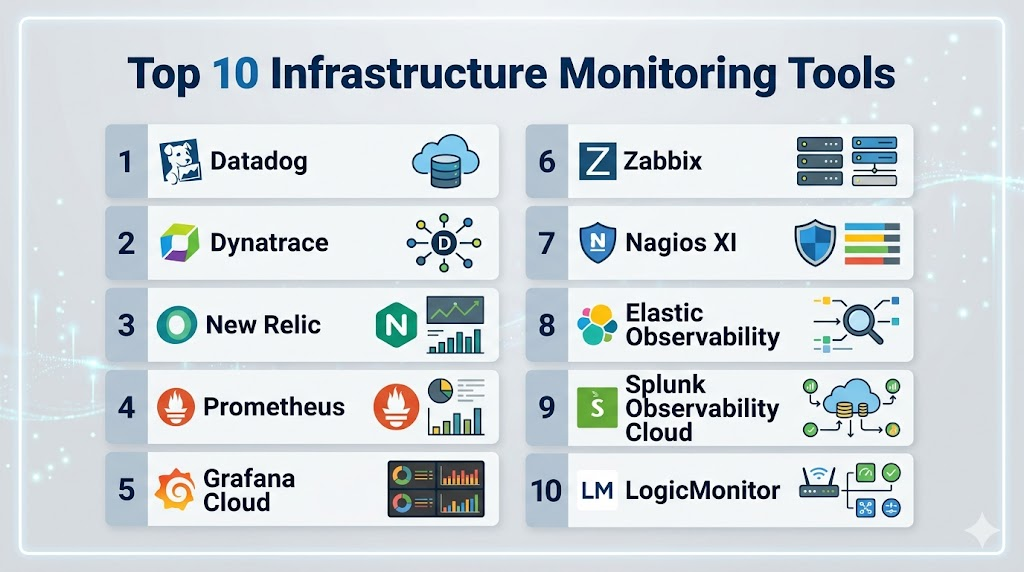
Top 10 Infrastructure Monitoring Tools
1- Datadog
Short description:
Datadog is a SaaS-based monitoring and analytics platform designed for full-stack observability. It aggregates metrics, logs, traces, and events from servers, applications, and cloud infrastructure.
Key Features
- Unified dashboards for servers, apps, and cloud services.
- Real-time alerts and anomaly detection.
- Distributed tracing and log management.
- AI-driven performance insights.
- Cloud-native integrations with AWS, Azure, GCP.
- Container and Kubernetes monitoring.
Pros
- Highly scalable and cloud-native.
- Supports multi-cloud and hybrid environments.
- Advanced AI analytics for predictive monitoring.
Cons
- Cost can rise significantly with large-scale deployment.
- Complexity for first-time users due to feature richness.
Platforms / Deployment
Web / Linux / Windows / macOS
Cloud / SaaS
Security & Compliance
- Supports SSO, MFA, encrypted communication, and RBAC.
- SOC 2 and GDPR compliance.
Integrations & Ecosystem
Datadog integrates with over 500 services and tools.
- AWS, Azure, GCP, Kubernetes
- CI/CD pipelines (Jenkins, GitLab, GitHub Actions)
- ITSM tools like ServiceNow
- Security monitoring platforms
- Cloud cost optimization tools
Support & Community
- Enterprise support plans with 24/7 assistance
- Active documentation, forums, and learning resources
2- Dynatrace
Short description:
Dynatrace provides AI-powered monitoring for applications, cloud, infrastructure, and user experience. It automatically discovers dependencies and provides full-stack observability.
Key Features
- Automatic topology detection and dependency mapping.
- AI-driven root cause analysis.
- Real-time infrastructure and application monitoring.
- Synthetic and real-user monitoring.
- Kubernetes and microservices monitoring.
- Cloud and hybrid environment support.
Pros
- AI-powered insights reduce troubleshooting time.
- Comprehensive full-stack visibility.
- Cloud and container-native features.
Cons
- Higher cost for smaller teams.
- Complexity may require dedicated monitoring teams.
Platforms / Deployment
Web / Linux / Windows / macOS
Cloud / Hybrid
Security & Compliance
- Supports encrypted communication, RBAC, SSO
- SOC 2 and ISO 27001 certifications
Integrations & Ecosystem
- CI/CD tools, ITSM integrations
- Cloud platforms and container orchestration
- Logging and analytics services
Support & Community
- Enterprise-grade support and training
- Active community forums
3- New Relic
Short description:
New Relic offers full-stack observability, combining infrastructure, application, and log monitoring with analytics. It provides actionable insights through real-time dashboards.
Key Features
- Unified observability platform.
- AI-assisted anomaly detection.
- End-to-end tracing and performance metrics.
- Cloud and on-prem monitoring.
- Alerts and notification system.
- Integrations with DevOps and CI/CD tools.
Pros
- Flexible and modular pricing tiers.
- Easy dashboard customization.
- Good coverage for applications and infrastructure.
Cons
- Steep learning curve for complex deployments.
- Pricing may scale quickly with high data volumes.
Platforms / Deployment
Web / Linux / Windows / macOS
Cloud / SaaS
Security & Compliance
- Encryption, RBAC, and audit logs
- SOC 2 and GDPR compliance
Integrations & Ecosystem
- Cloud providers (AWS, Azure, GCP)
- Container platforms and Kubernetes
- Logging and alerting systems
- CI/CD pipelines integration
Support & Community
- Commercial support plans
- Strong community and documentation
4- Prometheus
Short description:
Prometheus is an open-source monitoring and alerting toolkit optimized for time-series data. It is widely used in cloud-native and containerized environments.
Key Features
- Multi-dimensional data model and powerful query language.
- Flexible alerting rules and integrations with Alertmanager.
- Kubernetes and container monitoring.
- Pull-based metrics collection.
- Open-source extensibility.
Pros
- Free and open-source with a strong community.
- Excellent for microservices and cloud-native architectures.
- Highly customizable alerting and dashboards.
Cons
- Limited long-term data storage without additional tools.
- Requires setup and configuration for scaling.
Platforms / Deployment
Linux / macOS
Self-hosted / Cloud
Security & Compliance
- TLS encryption, basic auth
- Not publicly stated for formal certifications
Integrations & Ecosystem
- Grafana dashboards
- Kubernetes, Docker, container orchestrators
- Alertmanager for notifications
- Cloud provider metrics exporters
Support & Community
- Large open-source community
- Active forums and documentation
5- Grafana Cloud
Short description:
Grafana Cloud provides metrics, logs, and traces visualization as a managed SaaS service. It allows teams to centralize monitoring data for analytics and observability.
Key Features
- Real-time dashboards with customizable panels.
- Integration with Prometheus, Loki, and Tempo.
- Cloud-based hosting for observability stack.
- Alerts and notifications.
- Multi-source metric aggregation.
Pros
- Easy visualization of metrics across sources.
- Scalable SaaS model with managed infrastructure.
- Extensible with plugins and integrations.
Cons
- Some advanced features require paid tiers.
- Metrics storage limits in free tier.
Platforms / Deployment
Web
Cloud / SaaS
Security & Compliance
- TLS encryption, RBAC
- Not publicly stated for SOC 2/ISO certifications
Integrations & Ecosystem
- Prometheus, Loki, Tempo
- Cloud metrics (AWS, Azure, GCP)
- Alerting tools and webhook integration
- Plugin ecosystem
Support & Community
- Commercial support for paid tiers
- Active community with plugin contributions
6- Zabbix
Short description:
Zabbix is an open-source enterprise-level monitoring platform for networks, servers, cloud, and applications. It provides real-time metrics, alerting, and dashboards.
Key Features
- Network, server, cloud, and application monitoring.
- Alerts, triggers, and notifications.
- Templates for rapid setup.
- Auto-discovery of devices.
- Graphs, reports, and dashboards.
Pros
- Fully open-source and free to use.
- Highly customizable with templates and scripts.
- Strong community support.
Cons
- Complex initial setup for large environments.
- UI may feel dated compared to SaaS solutions.
Platforms / Deployment
Linux / Windows
Self-hosted / Cloud
Security & Compliance
- Encrypted communication, RBAC
- Not publicly stated for certifications
Integrations & Ecosystem
- SNMP, IPMI, and JMX
- Alerting through email, Slack, and webhook
- APIs for custom integration
Support & Community
- Community support, paid enterprise options
- Active user forums and documentation
7- Nagios XI
Short description:
Nagios XI is an enterprise-grade IT infrastructure monitoring platform offering visualization, alerts, and reporting for networks, servers, and applications.
Key Features
- Centralized monitoring and alerting.
- Custom dashboards and reports.
- Supports SNMP, agent-based, and agentless monitoring.
- Event and log correlation.
- Multi-tenant support for large organizations.
Pros
- Comprehensive monitoring features.
- Scalable for mid-market and enterprise.
- Extensible through plugins.
Cons
- Commercial product with licensing costs.
- Can be complex to configure for advanced use cases.
Platforms / Deployment
Linux / Windows
Self-hosted / Hybrid
Security & Compliance
- SSO, encrypted communication, RBAC
- Not publicly stated for ISO certifications
Integrations & Ecosystem
- Plugins and add-ons for cloud, apps, and networking
- ITSM and alerting integrations
- API access for automation
Support & Community
- Enterprise support available
- Documentation and active community
8- Elastic Observability
Short description:
Elastic Observability provides logs, metrics, traces, and uptime monitoring within the Elastic Stack. It helps teams identify issues and improve operational visibility.
Key Features
- Unified metrics, logs, and tracing.
- Real-time dashboards and alerts.
- AI-driven anomaly detection.
- Supports container, cloud, and hybrid environments.
- Searchable event data with Elasticsearch.
Pros
- Powerful analytics and search capabilities.
- Flexible dashboards and visualizations.
- Cloud and on-prem support.
Cons
- Requires knowledge of the Elastic Stack.
- Resource-intensive for large-scale deployments.
Platforms / Deployment
Linux / Windows / macOS
Cloud / Self-hosted / Hybrid
Security & Compliance
- Encryption, RBAC, audit logging
- Not publicly stated
Integrations & Ecosystem
- Beats agents, Logstash, APM integrations
- Kubernetes and cloud provider metrics
- Alerting systems and ITSM tools
Support & Community
- Commercial support options
- Large open-source community
9- Splunk Observability Cloud
Short description:
Splunk Observability Cloud is a SaaS platform for monitoring, observability, and analytics across cloud infrastructure and applications. It provides real-time insights into system health and performance.
Key Features
- Real-time metrics, logs, and traces.
- AI-driven anomaly detection.
- Application performance monitoring (APM).
- Cloud-native and hybrid environment monitoring.
- Custom dashboards and alerting.
Pros
- Comprehensive full-stack observability.
- AI and machine learning for predictive insights.
- Integrates with cloud and DevOps tools.
Cons
- Expensive for small to mid-sized teams.
- Complexity may require dedicated monitoring engineers.
Platforms / Deployment
Web / Linux / Windows
Cloud / SaaS
Security & Compliance
- SSO, MFA, encryption, RBAC
- SOC 2 and GDPR compliance
Integrations & Ecosystem
- AWS, Azure, GCP, Kubernetes
- CI/CD pipelines and ITSM systems
- Logging, APM, and security tools
Support & Community
- Enterprise support with training
- Active documentation and forums
10- LogicMonitor
Short description:
LogicMonitor is a SaaS-based infrastructure monitoring platform for networks, servers, cloud, and hybrid systems. It provides automated discovery, alerting, and performance analysis.
Key Features
- Automated device discovery and monitoring.
- Real-time alerting and dashboards.
- Cloud and hybrid environment support.
- Integrates with applications, networks, and servers.
- Predictive analytics for capacity planning.
Pros
- SaaS-based, minimal setup.
- Strong cloud and hybrid support.
- Predictive monitoring reduces downtime.
Cons
- Subscription cost can be high for large environments.
- Some advanced features may require training.
Platforms / Deployment
Web / Linux / Windows / macOS
Cloud / SaaS
Security & Compliance
- Encrypted communication, RBAC, audit logs
- Not publicly stated
Integrations & Ecosystem
- Cloud providers and SaaS applications
- CI/CD and ITSM tools
- APIs for custom integration
Support & Community
- Commercial support with 24/7 options
- Documentation and active user community
Comparison Table (Top 10)
| Tool Name | Best For | Platform(s) Supported | Deployment | Standout Feature | Public Rating |
|---|---|---|---|---|---|
| Datadog | Full-stack observability | Linux, Windows, macOS | Cloud / SaaS | Unified dashboards & AI analytics | N/A |
| Dynatrace | AI-driven monitoring | Linux, Windows, macOS | Cloud / Hybrid | Automatic topology & root-cause analysis | N/A |
| New Relic | Application & infra monitoring | Linux, Windows, macOS | Cloud / SaaS | End-to-end tracing & AI insights | N/A |
| Prometheus | Open-source time-series monitoring | Linux, macOS | Self-hosted / Cloud | Kubernetes-native metrics collection | N/A |
| Grafana Cloud | Metrics visualization SaaS | Web | Cloud / SaaS | Real-time dashboards & visualization | N/A |
| Zabbix | Enterprise open-source | Linux, Windows | Self-hosted / Cloud | Templates & auto-discovery | N/A |
| Nagios XI | Enterprise monitoring | Linux, Windows | Self-hosted / Hybrid | Centralized alerting & reporting | N/A |
| Elastic Observability | Logs, metrics, tracing | Linux, Windows, macOS | Cloud / Self-hosted / Hybrid | Unified analytics & dashboards | N/A |
| Splunk Observability Cloud | Full-stack SaaS observability | Linux, Windows, Web | Cloud / SaaS | AI-driven anomaly detection | N/A |
| LogicMonitor | SaaS hybrid monitoring | Linux, Windows, macOS | Cloud / SaaS | Automated discovery & predictive analytics | N/A |
Evaluation & Scoring of Infrastructure Monitoring Tools
| Tool Name | Core (25%) | Ease (15%) | Integrations (15%) | Security (10%) | Performance (10%) | Support (10%) | Value (15%) | Weighted Total |
|---|---|---|---|---|---|---|---|---|
| Datadog | 9 | 8 | 9 | 9 | 9 | 8 | 7 | 8.6 |
| Dynatrace | 9 | 7 | 8 | 9 | 9 | 8 | 7 | 8.4 |
| New Relic | 8 | 7 | 8 | 8 | 8 | 7 | 7 | 7.7 |
| Prometheus | 8 | 7 | 7 | 7 | 8 | 7 | 9 | 7.8 |
| Grafana Cloud | 7 | 8 | 8 | 7 | 7 | 7 | 8 | 7.6 |
| Zabbix | 8 | 7 | 7 | 7 | 8 | 7 | 8 | 7.7 |
| Nagios XI | 8 | 7 | 7 | 8 | 8 | 7 | 7 | 7.6 |
| Elastic Observability | 8 | 7 | 8 | 7 | 8 | 7 | 7 | 7.6 |
| Splunk Observability Cloud | 9 | 7 | 8 | 9 | 9 | 8 | 6 | 8.2 |
| LogicMonitor | 8 | 8 | 8 | 7 | 8 | 7 | 7 | 7.7 |
Which Infrastructure Monitoring Tool Is Right for You?
Choosing the right infrastructure monitoring tool depends on your team size, budget, infrastructure complexity, and integration needs. Small setups need lightweight, affordable tools, while enterprises require scalable, AI-driven platforms with deep observability.
Solo / Freelancer
- Prometheus, Grafana Cloud, or Zabbix are ideal for small teams.
- Lightweight, cost-effective, and sufficient for a few servers or containerized environments.
SMB
- New Relic, Datadog, or Grafana Cloud offer easy deployment and flexible dashboards.
- Good balance of cost, monitoring coverage, and integrations.
Mid-Market
- Datadog, LogicMonitor, Elastic Observability, Dynatrace, and New Relic scale well across hybrid and multi-cloud environments.
- Suitable for mid-size companies needing automated alerting, logs, metrics, and predictive insights.
Enterprise
- Datadog, Dynatrace, Splunk Observability Cloud, LogicMonitor, and Elastic Observability handle large-scale infrastructure, containerized workloads, and hybrid clouds.
- Enterprise-grade scalability, security, and support make them ideal for critical systems.
Budget vs Premium
- Open-source: Prometheus, Zabbix, Grafana Cloud – low cost, more hands-on setup.
- Premium SaaS: Datadog, Dynatrace, Splunk, LogicMonitor – managed features, AI insights, enterprise support.
Feature Depth vs Ease of Use
- Easy-to-use: Datadog, New Relic, Grafana Cloud – intuitive dashboards, minimal setup.
- Customizable: Prometheus, Zabbix, Elastic Observability – more control but requires technical skill.
Integrations & Scalability
- Cloud-native and container environments: Datadog, Dynatrace, Prometheus, Grafana Cloud.
- Hybrid infrastructure: LogicMonitor, Zabbix, Nagios XI.
Security & Compliance
- Tools with strong RBAC, audit logs, encryption, and enterprise support: Datadog, Dynatrace, Splunk Observability Cloud, LogicMonitor, Elastic Observability.
- Essential for regulated industries like finance, healthcare, and government.
Niche remaining part complete kar diya hai, aap isko blog ke end me add kar sakte ho.
Security & Compliance Needs
For organizations with strict compliance, security governance, or audit requirements, tools such as Datadog, Dynatrace, Splunk Observability Cloud, LogicMonitor, and Elastic Observability are stronger choices. These platforms usually provide better access control, audit logs, alert governance, encryption, and enterprise support workflows. For regulated industries, the final decision should include security review, data retention policy review, access model review, and vendor compliance validation.
Frequently Asked Questions
1- What are infrastructure monitoring tools?
Infrastructure monitoring tools track the health, performance, and availability of servers, networks, cloud resources, containers, databases, and related systems.
They collect metrics such as CPU usage, memory, disk space, latency, uptime, and error rates.
These tools help IT teams detect problems early and prevent outages before they affect users.
2- Why do businesses need infrastructure monitoring?
Businesses need infrastructure monitoring to maintain uptime, performance, and service reliability.
Without monitoring, teams may discover issues only after users report them.
Monitoring tools provide alerts, dashboards, and reports that help teams respond faster and plan capacity better.
3- Which infrastructure monitoring tool is best for small teams?
For small teams, Prometheus, Grafana Cloud, Zabbix, and New Relic can be practical choices depending on budget and technical skill.
Prometheus and Zabbix are strong open-source options, while Grafana Cloud and New Relic offer easier managed experiences.
The best tool depends on whether the team prefers self-hosting or SaaS-based monitoring.
4- Which infrastructure monitoring tool is best for enterprises?
Enterprises often prefer Datadog, Dynatrace, Splunk Observability Cloud, LogicMonitor, or Elastic Observability.
These platforms support large-scale infrastructure, hybrid environments, advanced alerting, and deeper integrations.
They are better suited for organizations that need governance, security controls, and dedicated support.
5- Are open-source monitoring tools reliable?
Yes, open-source tools like Prometheus and Zabbix can be very reliable when configured and maintained properly.
They are widely used for infrastructure, Kubernetes, and network monitoring.
However, teams must manage setup, scaling, storage, security, upgrades, and support responsibilities themselves.
6- What is the difference between monitoring and observability?
Monitoring tells teams when something is wrong by tracking known metrics, logs, and alerts.
Observability helps teams understand why something is wrong by connecting metrics, logs, traces, events, and dependencies.
Modern infrastructure tools increasingly combine both monitoring and observability features.
7- Do infrastructure monitoring tools support cloud environments?
Yes, most modern infrastructure monitoring tools support AWS, Azure, Google Cloud, Kubernetes, containers, and hybrid cloud environments.
SaaS platforms usually provide built-in cloud integrations and automated discovery.
Open-source tools may also support cloud monitoring through exporters, agents, APIs, and plugins.
8- How much do infrastructure monitoring tools cost?
Pricing varies based on the tool, deployment model, number of hosts, metrics volume, logs, traces, users, and data retention.
Open-source tools may reduce licensing cost but require internal maintenance.
SaaS platforms may be easier to run but can become expensive as infrastructure and data volume grow.
9- What are common mistakes when choosing monitoring tools?
A common mistake is selecting a tool only based on features without checking cost, data volume, or integration needs.
Teams also often create too many alerts, which leads to alert fatigue.
The best approach is to define critical services, set meaningful alerts, and review dashboards regularly.
10- Can infrastructure monitoring tools improve security?
Yes, infrastructure monitoring tools can support security by detecting unusual behavior, failed services, unexpected traffic, resource spikes, and unauthorized changes.
They are not a replacement for security tools, but they improve visibility into system health and operational risks.
When combined with SIEM, incident response, and access controls, monitoring becomes an important security layer.
Conclusion
Infrastructure Monitoring Tools are now essential for modern IT operations because businesses depend on reliable cloud, hybrid, containerized, and distributed systems. The right monitoring platform helps teams detect performance problems early, reduce downtime, improve incident response, and make better capacity planning decisions. Datadog, Dynatrace, New Relic, Splunk Observability Cloud, and LogicMonitor are strong choices for organizations that want managed, enterprise-ready observability, while Prometheus, Grafana Cloud, Zabbix, Nagios XI, and Elastic Observability provide flexible options for technical teams that want customization and control. There is no single best tool for every company because each organization has different infrastructure size, budget, compliance needs, team maturity, and integration requirements. The best next step is to shortlist two or three tools, run a pilot on real infrastructure, test alert quality, validate integrations, review security requirements, and then scale the selected solution across production environments.

Find Trusted Cardiac Hospitals
Compare heart hospitals by city and services — all in one place.
Explore Hospitals
Infrastructure monitoring tools are most effective when they provide real-time visibility into the health, performance, and availability of servers, networks, cloud services, containers, and other IT infrastructure. By combining automated monitoring, alerting, performance analytics, log correlation, and customizable dashboards, these platforms help IT teams detect issues early, minimize downtime, optimize resource utilization, and maintain reliable, high-performing systems.