Introduction
Conversation Intelligence Platforms are specialized tools that record, transcribe, and analyze conversations across sales calls, customer support interactions, and team meetings. By leveraging AI and natural language processing, these platforms help organizations extract actionable insights from every interaction, enabling improved decision-making, training, and operational efficiency. with hybrid work models and AI-driven customer engagement becoming standard, understanding conversation data is more critical than ever. Companies are not only measuring performance but also analyzing sentiment, identifying trends, and ensuring compliance in regulated industries.
Real-world use cases include:
- Sales teams identifying patterns that lead to successful deals.
- Customer support monitoring for agent performance and customer satisfaction.
- Marketing teams analyzing call transcripts to optimize messaging.
- HR and internal teams reviewing meeting effectiveness and alignment.
- Compliance teams ensuring that sensitive interactions meet regulatory standards.
Best for: Sales leaders, customer success managers, enterprise teams, SMBs scaling operations, regulated industries needing conversation monitoring.
Not ideal for: Organizations with minimal call volume, purely asynchronous communication, or teams with basic CRM analytics needs.
Key Trends in Conversation Intelligence Platforms
- AI-powered sentiment and emotion analysis in real-time.
- Automatic transcription with multilingual support and regional accent detection.
- Integration with CRM, collaboration tools, and AI assistants.
- Predictive insights for sales coaching, churn prevention, and upsell opportunities.
- Embedded compliance monitoring for HIPAA, GDPR, and industry-specific regulations.
- AI-driven conversation summaries and highlights for executive reporting.
- Increased adoption of hybrid deployment: cloud and on-premise options.
- Personalized training recommendations for agents based on interaction data.
- Automation of manual call tagging and categorization using AI.
- Enhanced analytics dashboards with cross-team benchmarking and ROI measurement.
How We Selected These Tools (Methodology)
- Evaluated market adoption and brand recognition in conversation intelligence.
- Analyzed feature completeness: transcription, AI insights, analytics, integrations.
- Reviewed reliability and performance signals from user reviews and case studies.
- Verified security posture and compliance certifications where available.
- Considered integration ecosystems with CRMs, helpdesk, and collaboration platforms.
- Assessed customer fit across solo, SMB, mid-market, and enterprise segments.
- Examined AI-specific capabilities: sentiment, intent detection, call scoring.
- Verified vendor support structures: onboarding, documentation, community presence.
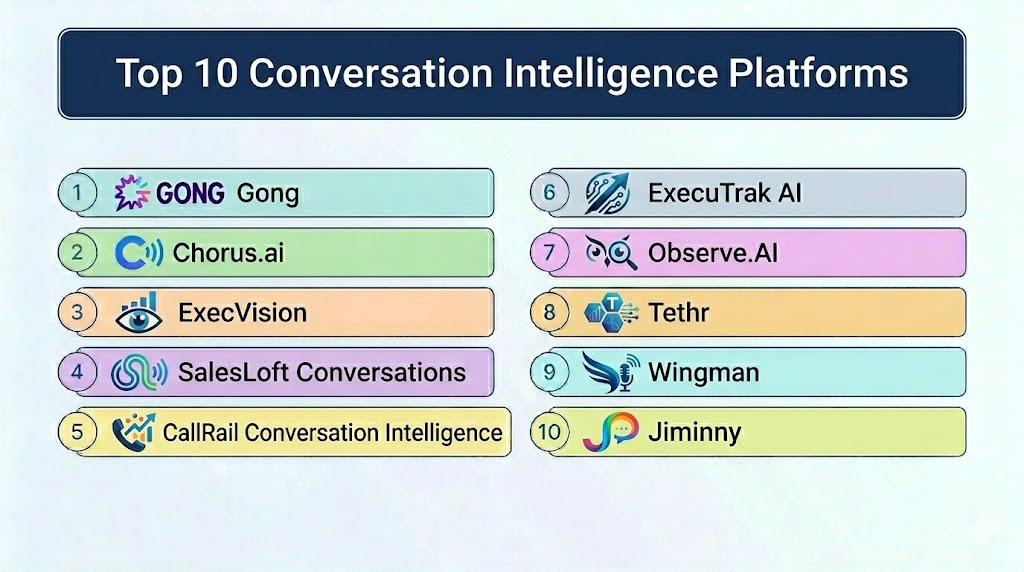
Top 10 Conversation Intelligence Platforms
1- Gong
Short description: Gong captures sales and customer conversations, providing AI-driven insights for revenue growth and team performance.
Key Features
- Real-time conversation transcription and analysis.
- Deal intelligence and risk scoring.
- AI-generated conversation highlights and coaching recommendations.
- Multi-channel integration (calls, emails, meetings).
- Advanced analytics dashboards with trend tracking.
Pros
- Strong sales performance analytics.
- Highly detailed conversation insights.
Cons
- Higher cost for small teams.
- Learning curve for advanced analytics.
Platforms / Deployment
- Web / Windows / macOS / iOS / Android
- Cloud
Security & Compliance
- SOC 2, GDPR, ISO 27001
- SSO/SAML, MFA, encryption
Integrations & Ecosystem
Integrates seamlessly with CRM, email, and collaboration platforms.
- Salesforce, HubSpot, Microsoft Teams
- Zoom, Slack
- API access for custom integrations
Support & Community
Extensive documentation, structured onboarding, responsive support tiers.
2- Chorus.ai
Short description: Chorus.ai provides conversation analytics focused on sales and customer-facing interactions, helping teams close deals faster.
Key Features
- AI transcription with keyword and topic detection.
- Call scoring for coaching and training.
- Deal progression insights and forecasting analytics.
- Multi-channel conversation capture.
- Collaboration and feedback loops for team alignment.
Pros
- Deep insight into sales conversations.
- Helps identify risk early in sales pipeline.
Cons
- Limited support for non-sales use cases.
- Analytics dashboards can be complex.
Platforms / Deployment
- Web / iOS / Android
- Cloud
Security & Compliance
- Not publicly stated
Integrations & Ecosystem
Works with major CRMs and communication tools.
- Salesforce, HubSpot
- Zoom, Slack, Microsoft Teams
- REST APIs for customization
Support & Community
Structured onboarding and active support community.
3- ExecVision
Short description: ExecVision emphasizes coaching and agent development by analyzing conversations for actionable insights.
Key Features
- Conversation tagging and call scoring.
- AI-powered insights for training and performance improvement.
- Integration with contact centers and CRMs.
- Reporting dashboards for manager review.
- Role-based access and permission control.
Pros
- Strong focus on coaching and skill development.
- Flexible reporting tools.
Cons
- Less focused on deal intelligence.
- Customization requires setup effort.
Platforms / Deployment
- Web / iOS / Android
- Cloud
Security & Compliance
- Not publicly stated
Integrations & Ecosystem
Supports contact centers and CRM platforms.
- Salesforce, Zendesk, HubSpot
- API for custom workflows
Support & Community
Provides onboarding, coaching guides, and responsive support.
4- SalesLoft Conversations
Short description: SalesLoft Conversations integrates conversation intelligence into sales engagement workflows to improve close rates.
Key Features
- Automated call capture and transcription.
- AI-driven conversation insights and sentiment analysis.
- Coaching feedback and performance benchmarking.
- Integration with SalesLoft engagement sequences.
- Real-time alerts on opportunity risk.
Pros
- Tight integration with sales workflows.
- Detailed conversation intelligence.
Cons
- Focused primarily on sales teams.
- Advanced features require higher-tier plans.
Platforms / Deployment
- Web / Windows / macOS / iOS / Android
- Cloud
Security & Compliance
- Not publicly stated
Integrations & Ecosystem
- Salesforce, HubSpot, Outreach
- Zoom, Microsoft Teams, Slack
Support & Community
Comprehensive help center, onboarding, and customer success teams.
5- CallRail Conversation Intelligence
Short description: CallRail offers conversation intelligence for marketing attribution and lead tracking across phone and web channels.
Key Features
- Call recording and transcription.
- Keyword spotting and sentiment analysis.
- Marketing attribution analytics.
- Integration with CRM and marketing tools.
- Custom reporting dashboards.
Pros
- Excellent for marketing analytics and lead attribution.
- Multi-channel tracking.
Cons
- Less focused on deep sales coaching.
- Limited AI insights compared to enterprise platforms.
Platforms / Deployment
- Web / iOS / Android
- Cloud
Security & Compliance
- SOC 2, GDPR
- Not publicly stated
Integrations & Ecosystem
- Salesforce, HubSpot, Marketo
- Google Analytics, Zapier
- API access
Support & Community
Offers online guides, responsive support, and community forums.
6- ExecuTrak AI
Short description: ExecuTrak AI provides conversation analytics focused on operational performance and customer experience management.
Key Features
- AI-driven conversation transcription and tagging.
- Customer satisfaction and sentiment metrics.
- Real-time coaching alerts.
- Integration with CRM and contact center platforms.
- Role-based dashboards.
Pros
- Optimized for customer experience improvement.
- Customizable scoring and dashboards.
Cons
- Less known in the SMB market.
- Advanced analytics require configuration.
Platforms / Deployment
- Web / iOS / Android
- Cloud
Security & Compliance
- Not publicly stated
Integrations & Ecosystem
- Salesforce, Zendesk, ServiceNow
- API access for custom analytics
Support & Community
Documentation and dedicated support teams; community resources vary.
7- Observe.AI
Short description: Observe.AI enhances contact center performance with AI-powered conversation intelligence and coaching tools.
Key Features
- AI transcription with sentiment and intent detection.
- Real-time agent assistance and alerts.
- Automated scoring for QA and compliance.
- Workforce performance dashboards.
- Integration with cloud contact centers.
Pros
- Strong QA and compliance focus.
- Real-time coaching and feedback.
Cons
- Primarily for contact center teams.
- Limited standalone sales insights.
Platforms / Deployment
- Web / iOS / Android
- Cloud
Security & Compliance
- SOC 2, HIPAA (for healthcare clients)
- Encryption and RBAC
Integrations & Ecosystem
- Five9, Genesys, Salesforce
- Slack, Teams
- REST API
Support & Community
Offers onboarding, online resources, and dedicated account managers.
8- Tethr
Short description: Tethr provides enterprise-grade conversation intelligence, focusing on actionable insights from customer interactions.
Key Features
- Call and chat transcription with AI analysis.
- Emotion and sentiment tracking.
- Automated alerts for critical interactions.
- Integration with CRM and helpdesk tools.
- Trend detection and operational dashboards.
Pros
- Enterprise-grade analytics and insights.
- AI-driven risk and opportunity identification.
Cons
- May be complex for small teams.
- Requires setup to leverage full analytics.
Platforms / Deployment
- Web / iOS / Android
- Cloud
Security & Compliance
- Not publicly stated
Integrations & Ecosystem
- Salesforce, Zendesk, HubSpot
- API for custom integrations
- Slack and Teams notifications
Support & Community
Structured support and onboarding; community forums limited.
9- Wingman
Short description: Wingman is a sales-focused conversation intelligence platform that records and analyzes calls to improve pipeline performance.
Key Features
- AI call transcription and highlight generation.
- Conversation coaching and guidance.
- Deal and pipeline analytics.
- Integration with CRMs and dialers.
- Real-time conversation alerts and notes.
Pros
- Strong for sales teams and pipeline acceleration.
- Real-time insights and guidance.
Cons
- Limited multi-channel support beyond calls.
- Advanced AI features require higher-tier plan.
Platforms / Deployment
- Web / iOS / Android
- Cloud
Security & Compliance
- Not publicly stated
Integrations & Ecosystem
- Salesforce, HubSpot, Outreach
- Zoom, Slack
Support & Community
Comprehensive onboarding, responsive support, and active user community.
10- Jiminny
Short description: Jiminny captures, analyzes, and coaches on conversations across sales and service interactions for data-driven improvement.
Key Features
- Call recording and AI transcription.
- Analytics for deal health and coaching.
- Real-time conversation insights.
- Multi-channel conversation capture.
- CRM integration and activity logging.
Pros
- Easy-to-use interface for sales teams.
- Strong integration with sales workflows.
Cons
- Limited AI depth compared to enterprise platforms.
- Less focus on contact center QA.
Platforms / Deployment
- Web / iOS / Android
- Cloud
Security & Compliance
- Not publicly stated
Integrations & Ecosystem
- Salesforce, HubSpot, Microsoft Dynamics
- Slack, Teams, Zoom
- API access for customization
Support & Community
Offers guides, webinars, and dedicated support tiers.
Comparison Table (Top 10)
| Tool Name | Best For | Platform(s) Supported | Deployment | Standout Feature | Public Rating |
|---|---|---|---|---|---|
| Gong | Sales teams | Web, Windows, macOS, iOS, Android | Cloud | Deal intelligence & AI insights | N/A |
| Chorus.ai | Sales & customer interactions | Web, iOS, Android | Cloud | Pipeline risk detection | N/A |
| ExecVision | Coaching & agent development | Web, iOS, Android | Cloud | Call scoring & training insights | N/A |
| SalesLoft Conversations | Sales engagement | Web, Windows, macOS, iOS, Android | Cloud | Real-time coaching alerts | N/A |
| CallRail | Marketing attribution | Web, iOS, Android | Cloud | Multi-channel conversation tracking | N/A |
| ExecuTrak AI | Customer experience | Web, iOS, Android | Cloud | Sentiment & CX metrics | N/A |
| Observe.AI | Contact centers | Web, iOS, Android | Cloud | Real-time coaching & QA | N/A |
| Tethr | Enterprise insights | Web, iOS, Android | Cloud | Emotion & trend detection | N/A |
| Wingman | Sales pipeline | Web, iOS, Android | Cloud | Real-time conversation guidance | N/A |
| Jiminny | Sales & service | Web, iOS, Android | Cloud | Multi-channel conversation capture | N/A |
Evaluation & Scoring of Conversation Intelligence Platforms
| Tool Name | Core (25%) | Ease (15%) | Integrations (15%) | Security (10%) | Performance (10%) | Support (10%) | Value (15%) | Weighted Total |
|---|---|---|---|---|---|---|---|---|
| Gong | 9 | 8 | 9 | 8 | 9 | 8 | 7 | 8.5 |
| Chorus.ai | 8 | 8 | 8 | 7 | 8 | 7 | 7 | 7.7 |
| ExecVision | 7 | 8 | 7 | 7 | 8 | 8 | 7 | 7.5 |
| SalesLoft Conversations | 8 | 8 | 8 | 7 | 8 | 7 | 7 | 7.6 |
| CallRail | 7 | 8 | 7 | 7 | 8 | 7 | 8 | 7.5 |
| ExecuTrak AI | 7 | 7 | 7 | 7 | 7 | 7 | 7 | 7.0 |
| Observe.AI | 8 | 8 | 8 | 8 | 8 | 7 | 7 | 7.8 |
| Tethr | 8 | 7 | 8 | 7 | 8 | 7 | 7 | 7.5 |
| Wingman | 8 | 8 | 7 | 7 | 8 | 7 | 7 | 7.5 |
| Jiminny | 7 | 8 | 7 | 7 | 7 | 7 | 7 | 7.2 |
Which Conversation Intelligence Tool Is Right for You?
Solo / Freelancer
Lightweight tools like Wingman or Jiminny provide transcription and insights without complex setup, perfect for individual sellers or consultants.
SMB
Chorus.ai or CallRail offer balance between affordability and multi-channel intelligence for growing sales and marketing teams.
Mid-Market
Gong and SalesLoft Conversations provide deeper AI insights, CRM integration, and performance analytics to optimize pipelines and coaching.
Enterprise
Observe.AI, Tethr, and ExecVision scale across teams with regulatory compliance, advanced AI analytics, and robust dashboards for multi-site operations.
Budget vs Premium
Budget-conscious buyers can start with Jiminny or CallRail; premium buyers benefit from Gong or Observe.AI for enterprise-grade analytics.
Feature Depth vs Ease of Use
Gong and Observe.AI offer extensive insights but require training; Wingman and Jiminny are easier to adopt with fewer advanced features.
Integrations & Scalability
Evaluate CRM, helpdesk, and communication tool integration; enterprise platforms scale across multiple teams and channels more effectively.
Security & Compliance Needs
Regulated industries should prioritize SOC 2, HIPAA, and GDPR-compliant solutions, typically available in Observe.AI and Gong.
Here’s an updated FAQs section for Conversation Intelligence Platforms, with each answer expanded to roughly 6 lines for depth and clarity:
1. What pricing models do Conversation Intelligence Platforms use?
Most platforms follow subscription-based pricing, typically per user per month. Pricing often varies by feature tiers, including transcription limits, AI insights, and analytics depth. Enterprise packages may include additional onboarding, custom integrations, and priority support. Some vendors offer free trials or scaled-down plans for SMBs. Cost considerations should include long-term usage, scalability, and ROI from AI-driven insights. Always request a detailed quote based on your team size and call volume.
2. How long does onboarding typically take?
Onboarding timelines vary depending on the platform, team size, and integration complexity. Cloud-native solutions can often deploy in a few days, whereas hybrid or on-premise setups may require weeks. Training your sales, customer success, or contact center teams is crucial to maximize AI insights. Platforms may provide guided setup, documentation, and dedicated support during this period. Integrating with CRM and other collaboration tools adds additional steps. Effective onboarding ensures accurate transcription, analytics, and compliance.
3. Can these platforms handle multi-language conversations?
Yes, many conversation intelligence platforms support multiple languages and accents, leveraging AI transcription models. However, accuracy may differ based on regional dialects and audio quality. Enterprise-grade tools often provide customizable models or correction features. International teams should verify language support for calls, video meetings, and chats. Multi-language support is critical for global sales, support, and marketing teams. Testing transcription quality in your primary languages before adoption is recommended.
4. What are common mistakes when implementing these tools?
Common pitfalls include insufficient team training, underutilizing AI insights, and failing to integrate with CRM or communication tools. Another mistake is ignoring data privacy and compliance requirements, which can lead to regulatory issues. Some organizations also overlook the importance of defining measurable KPIs for conversation analytics. Poor adoption often results from choosing overly complex platforms for small teams. Structured onboarding, clear use cases, and pilot testing mitigate these issues effectively.
5. Are these tools suitable for non-sales teams?
While initially designed for sales, many platforms serve customer support, marketing, HR, and operational teams. For example, contact centers can monitor agent performance, while marketing teams analyze customer feedback for messaging optimization. HR teams can review meetings for team alignment and coaching opportunities. Features like sentiment analysis, AI-driven highlights, and performance dashboards are valuable across departments. Verify that the platform supports multi-channel interactions if needed. Cross-department usage increases ROI and insights value.
6. How do integrations impact value?
Integrations with CRM, helpdesk, email, and collaboration tools amplify the utility of conversation intelligence. Automated data flow reduces manual logging, ensures accuracy, and centralizes insights. Real-time syncing enables predictive analytics, deal risk detection, and targeted coaching. Limited integration can restrict analytics scope and reduce ROI. Evaluating API availability and prebuilt connectors helps align with your tech stack. Well-integrated platforms streamline workflows and maximize actionable insights.
7. Can I switch platforms easily?
Switching platforms involves exporting historical conversation data, configuring new integrations, and retraining AI models. Transition time depends on platform compatibility and volume of interactions. Maintaining data integrity and compliance during migration is critical. Some vendors provide migration support to ease the process. Pilot testing the new tool alongside the old one can help identify gaps. Planning and phased migration minimize disruption to teams and operations.
8. Do these platforms ensure compliance?
Enterprise tools often offer security features such as audit logs, role-based access control, encryption, and SSO/SAML. Compliance with SOC 2, GDPR, HIPAA, or industry-specific regulations varies by vendor. Features like automated redaction, consent logging, and secure storage support regulatory requirements. Smaller platforms may not provide full compliance coverage. Organizations in regulated industries should verify certifications and conduct internal risk assessments. Compliance ensures safe handling of sensitive conversations.
9. How scalable are these platforms?
Cloud-based solutions scale effortlessly from small teams to enterprise-wide deployments without significant IT overhead. On-premise or hybrid options may require hardware and IT resources for scaling. AI processing and storage capabilities affect scalability for high-volume interactions. Scalability includes multi-site support, cross-department adoption, and global language coverage. Vendor SLAs and performance guarantees help ensure consistent service at scale. Properly assessing scalability requirements prevents bottlenecks.
10. Are AI insights reliable?
AI insights are highly useful for sentiment detection, intent analysis, call scoring, and coaching recommendations. However, they are not infallible and should be validated by human review for critical decisions. Factors like audio quality, accent diversity, and model training affect accuracy. Combining AI suggestions with manual QA ensures actionable and reliable insights. Continuous feedback loops improve AI model performance over time. Organizations should use AI insights as guidance, not absolute decisions.
Conclusion
Conversation Intelligence Platforms are indispensable for modern sales, customer support, and operational teams seeking actionable insights from every interaction. AI-driven analytics, real-time coaching, and compliance capabilities have become critical differentiators. Selecting the right tool depends on team size, use case, integration needs, and regulatory requirements. Buyers should shortlist 2–3 platforms, run pilots to validate insights and integrations, and scale adoption once performance and security meet organizational standards. Careful evaluation ensures maximum ROI and tangible improvements in revenue, customer experience, and employee performance.

Find Trusted Cardiac Hospitals
Compare heart hospitals by city and services — all in one place.
Explore Hospitals
Conversation intelligence platforms are most effective when they automatically analyze sales and customer conversations to uncover actionable insights. By combining AI-powered call recording, transcription, sentiment analysis, keyword tracking, coaching recommendations, and CRM integration, these platforms help organizations improve sales performance, enhance customer interactions, identify revenue opportunities, and make data-driven coaching decisions.