Introduction
Text-to-Speech (TTS) platforms are AI-powered systems that convert written text into spoken audio using synthetic but increasingly human-like voices.TTS has moved far beyond robotic narration and is now a core layer in digital content creation, accessibility, automation, and conversational AI systems. Modern TTS platforms are widely used because they reduce dependency on recording studios, speed up production cycles, and enable instant multilingual communication at global scale. With improvements in neural voice models, these tools now support emotion control, voice cloning, and real-time speech generation.
Real-world use cases
- AI voiceovers for marketing videos and social media content
- Audiobook and podcast production without human narrators
- E-learning and corporate training narration
- Customer support automation with voice assistants
- Accessibility tools for reading digital content aloud
What buyers should evaluate
- Voice realism and emotional expression quality
- Language and accent coverage
- Voice cloning capabilities and restrictions
- API availability and scalability
- Real-time performance and latency
- Integration with software ecosystems
- Pricing structure and usage limits
- Security, privacy, and compliance posture
Best for
Content creators, developers, SaaS companies, enterprises, educators, and accessibility-focused platforms requiring scalable voice generation.
Not ideal for
High-end cinematic voice acting, emotionally nuanced studio performances, and projects requiring human artistic direction.
Key Trends in Text-to-Speech (TTS) Platforms
- Shift toward near-human neural voice models with emotional intelligence
- Expansion of real-time TTS for live assistants and applications
- Voice cloning with consent-based authentication systems
- API-first architecture becoming standard across vendors
- Increased multilingual and regional accent coverage
- Edge deployment for low-latency speech generation
- Deep integration with video editors and AI content pipelines
- Stronger regulations around deepfake voice usage
- Subscription + usage-based hybrid pricing models
- TTS embedded directly into SaaS platforms and mobile apps
How We Selected These Tools (Methodology)
- Market adoption and global mindshare across industries
- Voice quality, realism, and consistency in production use cases
- Multilingual and accent coverage depth
- API maturity and developer ecosystem strength
- Integration flexibility with modern SaaS workflows
- Performance stability under scale
- Security posture signals and enterprise readiness
- Ease of use for non-technical users
- Product maturity and reliability over time
- Value-for-money across different customer segments
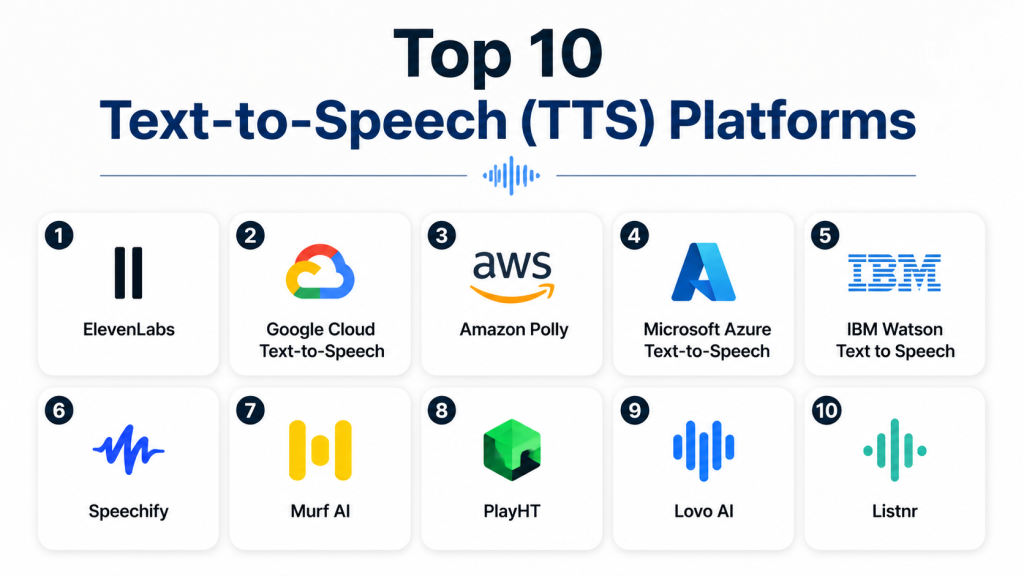
Top 10 Text-to-Speech (TTS) Platforms
1 — ElevenLabs
Short description: AIvoicegenerationplatformthatprovidesultrarealistictexttospeechandvoicecloningforcreatorsdevelopersandenterprisesElevenLabsisusedforaudiobooksvideoeditingandAIdrivenapplicationswithstrongAPIecosystemsupport
Key Features
- Ultra-realistic neural voice generation
- Advanced voice cloning system
- Emotional tone and pacing control
- Multilingual speech synthesis
- Long-form narration support
- API-first architecture
- Custom voice training options
Pros
- Extremely natural-sounding output
- Strong developer ecosystem
- Fast and scalable generation
Cons
- Premium pricing at scale
- Advanced features require learning curve
Platforms / Deployment
Cloud / Web / API
Security & Compliance
Not publicly stated
Integrations & Ecosystem
ElevenLabs integrates with content creation pipelines, AI applications, and automation systems through APIs and third-party tools.
- Developer APIs
- Video editing workflows
- AI assistant systems
- Content automation platforms
Support & Community
Strong documentation and active global developer community
2 — Google Cloud Text-to-Speech
Short description: CloudbasedenterpriseTTSplatformofferingneuralvoicesWaveNetmodelsandhighlyscalableAPIsforapplicationsandAIservicesGoogleTTSiswidelyusedinproductionenvironments
Key Features
- Neural voice synthesis (WaveNet)
- SSML support for advanced control
- Real-time streaming output
- Wide language coverage
- Scalable cloud API
- Integration with Google Cloud services
- Voice tuning options
Pros
- Highly scalable infrastructure
- Reliable enterprise-grade performance
- Strong ecosystem integration
Cons
- Less creative flexibility than AI-native tools
- Pricing complexity for heavy usage
Platforms / Deployment
Cloud / API
Security & Compliance
Enterprise-grade cloud security (varies by configuration)
Integrations & Ecosystem
- Google Cloud Platform services
- AI/ML pipelines
- Mobile and web applications
Support & Community
Strong enterprise documentation and support channels
3 — Amazon Polly
Short description: AWSbasedTTSserviceprovidingneuralvoicesandscalabletexttospeechgenerationforenterpriseapplicationsandcloudworkflowsAmazonPollyintegratesdeeplywithAWSecosystem
Key Features
- Neural text-to-speech voices
- SSML customization support
- Real-time streaming
- AWS ecosystem integration
- Multilingual support
- Voice caching capabilities
- Scalable API architecture
Pros
- Strong enterprise reliability
- Deep AWS integration
- Stable global infrastructure
Cons
- Less human-like than AI-first tools
- Technical setup complexity
Platforms / Deployment
Cloud / API
Security & Compliance
AWS enterprise-grade security framework
Integrations & Ecosystem
- AWS Lambda
- AWS Lex
- Cloud-based applications
Support & Community
Robust enterprise support via AWS ecosystem
4 — Microsoft Azure Text-to-Speech
Short description: CloudbasedAzureTTSplatformofferingneuralvoicesrealtimegenerationandenterpriseintegrationwithMicrosoftAIecosystemAzureTTSiswidelyusedforbusinessapplications
Key Features
- Neural voice synthesis
- Real-time speech generation
- SSML customization
- Multilingual support
- Custom voice creation
- Speech translation capabilities
- Azure AI integration
Pros
- Strong enterprise ecosystem
- High-quality voice output
- Reliable global infrastructure
Cons
- Complex pricing structure
- Requires Azure familiarity
Platforms / Deployment
Cloud / API
Security & Compliance
Enterprise-grade Microsoft security standards
Integrations & Ecosystem
- Microsoft enterprise tools
- Azure AI services
- SaaS applications
Support & Community
Strong enterprise support system
5 — IBM Watson Text to Speech
Short description: EnterprisefocusedAItexttospeechplatformprovidingneuralvoicescustomtuningandbusinessgradeintegrationforcustomerserviceandautomationusecases
Key Features
- Neural speech synthesis
- SSML customization
- Custom voice tuning
- Multilingual output
- API-based integration
- Enterprise scalability
- Audio streaming support
Pros
- Strong enterprise reliability
- Flexible voice customization
- Stable long-term performance
Cons
- Less modern voice realism
- Interface complexity
Platforms / Deployment
Cloud / API
Security & Compliance
Not publicly stated
Integrations & Ecosystem
- IBM Cloud services
- Enterprise applications
- AI workflows
Support & Community
Enterprise-level support structure
6 — Speechify
Short description: ConsumerfocusedTTSplatformforreadingtextaloudproductivityandaccessibilitySpeechifyiswidelyusedbystudentsprofessionalsanduserswhoneedaudioreadingtoolsacrossdevices
Key Features
- Natural reading voices
- Document upload support
- Cross-device syncing
- Browser extension support
- Speed control options
- Mobile applications
- Offline reading features
Pros
- Extremely easy to use
- Strong accessibility focus
- Multi-device support
Cons
- Limited API functionality
- Not developer-oriented
Platforms / Deployment
Web / iOS / Android / Desktop
Security & Compliance
Not publicly stated
Integrations & Ecosystem
- Browser extensions
- Document readers
- Productivity tools
Support & Community
Strong consumer support ecosystem
7 — Murf AI
Short description: AIvoiceoverplatformforcreatorsandbusinessesthatprovidesstudiogradevoicesscripteditingandmultilingualsupportforvideospresentationsandelearning
Key Features
- Studio-quality AI voices
- Script-based editor
- Multilingual support
- Background music integration
- Collaboration tools
- Export options
- Voice customization
Pros
- High-quality output
- Easy workflow design
- Good for business use
Cons
- Limited developer APIs
- Premium pricing tiers
Platforms / Deployment
Cloud / Web
Security & Compliance
Not publicly stated
Integrations & Ecosystem
- Video editing tools
- Presentation software
- E-learning platforms
Support & Community
Good onboarding support
8 — PlayHT
Short description: AItexttospeechplatformofferingrealisticvoicegenerationandvoicecloningwithAPIaccessforcreatorsanddevelopersacrosspodcastvideoandaudioautomationworkflows
Key Features
- AI voice cloning
- Realistic TTS output
- API access
- Multilingual support
- Podcast generation tools
- Audio export formats
- Voice customization controls
Pros
- High-quality voice generation
- Developer-friendly APIs
- Flexible usage options
Cons
- Premium features locked
- Inconsistent voice output in edge cases
Platforms / Deployment
Cloud / API
Security & Compliance
Not publicly stated
Integrations & Ecosystem
- Developer platforms
- Content creation tools
- Automation systems
Support & Community
Active developer and creator community
9 — Lovo AI
Short description: AIvoiceoverplatformforcontentcreatorsandmarketersofferinglargelibraryofvoicesandemotioncontroltoolsforadsocialmediaandvideocontentcreation
Key Features
- Large voice library
- Multilingual support
- Emotion control options
- Script editor
- Video voiceover tools
- Export formats
- Voice customization
Pros
- Wide voice variety
- Easy interface
- Good marketing use case fit
Cons
- Limited advanced controls
- Voice realism varies
Platforms / Deployment
Cloud / Web
Security & Compliance
Not publicly stated
Integrations & Ecosystem
- Marketing platforms
- Video tools
- Creative workflows
Support & Community
Standard SaaS support
10 — NaturalReader
Short description: AccessibilityfocusedTTSplatformforreadingdocumentswebpagesandaudioconversionwithsimpleinterfacedesignedforstudentsandeducationusecases
Key Features
- Text-to-speech reading engine
- Document upload support
- OCR functionality
- Browser extension
- Mobile applications
- Multiple voice options
- Speed control
Pros
- Strong accessibility use case
- Easy to use
- Good for education
Cons
- Limited enterprise APIs
- Less advanced AI capabilities
Platforms / Deployment
Web / Windows / macOS / iOS / Android
Security & Compliance
Not publicly stated
Integrations & Ecosystem
- Browser tools
- Document systems
- Accessibility platforms
Support & Community
Good consumer-level support
Comparison Table (Top 10)
| Tool | Best For | Platforms | Deployment | Standout Feature | Public Rating |
|---|---|---|---|---|---|
| ElevenLabs | AI voice cloning | Web, API | Cloud | Realistic voices | N/A |
| Google TTS | Developers | API | Cloud | Neural voices | N/A |
| Amazon Polly | Enterprise apps | API | Cloud | AWS integration | N/A |
| Azure TTS | Enterprise systems | API | Cloud | Microsoft ecosystem | N/A |
| IBM Watson | Business AI | API | Cloud | Voice tuning | N/A |
| Speechify | Reading | Multi-platform | Cloud | Accessibility | N/A |
| Murf AI | Creators | Web | Cloud | Studio voices | N/A |
| PlayHT | Developers | Web/API | Cloud | Voice cloning | N/A |
| Lovo AI | Marketing | Web | Cloud | Voice library | N/A |
| NaturalReader | Education | Multi-platform | Cloud | Document reading | N/A |
Evaluation & Scoring
| Tool | Core (25%) | Ease (15%) | Integrations (15%) | Security (10%) | Performance (10%) | Support (10%) | Value (15%) | Total |
|---|---|---|---|---|---|---|---|---|
| ElevenLabs | 10 | 8 | 9 | 7 | 10 | 8 | 9 | 9.1 |
| Google TTS | 9 | 8 | 10 | 9 | 9 | 9 | 8 | 8.9 |
| Amazon Polly | 9 | 7 | 10 | 9 | 9 | 9 | 8 | 8.7 |
| Azure TTS | 9 | 7 | 10 | 9 | 9 | 9 | 8 | 8.7 |
| IBM Watson | 8 | 7 | 9 | 9 | 8 | 8 | 7 | 8.0 |
| Speechify | 7 | 10 | 7 | 8 | 8 | 8 | 9 | 8.2 |
| Murf AI | 8 | 9 | 8 | 7 | 8 | 8 | 8 | 8.1 |
| PlayHT | 9 | 8 | 8 | 7 | 9 | 8 | 8 | 8.4 |
| Lovo AI | 8 | 9 | 7 | 7 | 8 | 8 | 8 | 8.0 |
| NaturalReader | 7 | 10 | 7 | 8 | 7 | 8 | 9 | 7.9 |
Which Text-to-Speech Platform Is Right for You?
Solo / Freelancer
Best for quick content creation and simple workflows: Murf AI, Speechify, Lovo AI
SMB
Balanced tools for marketing and scaling: ElevenLabs, PlayHT, Murf AI
Mid-Market
Automation and API-driven workflows: Google TTS, Azure TTS, PlayHT
Enterprise
Large-scale infrastructure and compliance: Amazon Polly, Azure TTS, IBM Watson
Frequently Asked Questions (FAQs)
1. What is Text-to-Speech (TTS)?
Text-to-Speech is AI technology that converts written text into spoken audio. It uses neural models to generate natural human-like voices. Modern TTS can reflect tone, pitch, and emotion. It is widely used in apps, videos, and accessibility tools. It helps users consume content without reading.
2. How does TTS technology work?
TTS systems analyze text and break it into phonetic structures. AI models then convert it into speech waveforms. Neural networks improve natural flow and pronunciation. Advanced systems add emotion and pacing control. The final output sounds like real human speech.
3. Where is TTS commonly used?
TTS is used in videos, podcasts, and audiobooks. It powers virtual assistants and chatbots. It is widely used in education and e-learning platforms. Accessibility tools use it for reading content aloud. Marketing teams use it for scalable voice content.
4. Can TTS replace human voice actors?
TTS can handle large-scale narration and repetitive tasks. However, it cannot fully match human emotional depth. Voice actors are still needed for storytelling and drama. TTS is ideal for speed and cost efficiency. Many workflows use both together.
5. Is TTS technology expensive?
TTS pricing depends on usage and platform type. Some tools offer free limited plans. Enterprise APIs charge based on usage volume. Advanced features like cloning cost extra. It is generally cheaper than recording studios.
6. Can I create my own voice using TTS?
Yes, many platforms support voice cloning features. You record sample audio to train the model. AI then learns tone and speaking style. The voice can be reused for content creation. Proper consent is required for ethical use.
7. Do TTS tools support multiple languages?
Most modern TTS platforms support multiple languages. Some also include regional accents and dialects. This helps global content localization. English usually has the highest quality output. Accuracy varies by language.
8. Do I need coding skills to use TTS?
No coding is required for basic usage. Users can directly type text and generate audio. APIs require programming knowledge for integration. Developers use APIs for automation workflows. Both no-code and pro options exist.
9. What are the limitations of TTS?
TTS may still lack deep emotional expression. Some outputs sound less natural in complex sentences. Rare languages may have lower quality voices. It depends on training data quality. Technology is improving rapidly.
10. Which is the best TTS tool?
There is no single best tool for everyone. ElevenLabs is best for realistic voice generation. Google and Amazon are best for enterprise use. Murf AI and Speechify suit creators and users. Choice depends on specific needs.
Conclusion
Text-to-Speech platforms have become essential infrastructure for modern digital communication, enabling scalable voice generation across industries. From content creation to enterprise automation, these tools significantly reduce production time and cost. The right platform depends on your specific needswhether it is voice realism, developer integration, accessibility, or enterprise scalability. The best approach is to shortlist a few tools and validate them in real workflows before making a final decision.

Find Trusted Cardiac Hospitals
Compare heart hospitals by city and services — all in one place.
Explore Hospitals
I am learning about text-to-speech platforms, and this content helped me understand how different tools can convert text into natural-sounding speech and support various use cases.