Introduction
Speech-to-Text (STT) or transcription platforms are AI-powered systems that convert spoken language into written text. these platforms have become essential infrastructure for businesses handling meetings, customer interactions, video content, and real-time communication workflows. Modern transcription systems go beyond simple dictation. They now include speaker identification, real-time captioning, multilingual transcription, summarization, and integration with collaboration tools. With advances in AI and large language models, accuracy has significantly improved even in noisy environments.
Real-world use cases
- Meeting transcription and AI-generated summaries
- Customer support call analysis and QA monitoring
- Podcast and video subtitle generation
- Legal and compliance documentation
- Voice note conversion in productivity apps
What buyers should evaluate
- Accuracy in noisy and multi-speaker environments
- Real-time vs batch transcription capability
- Language and dialect support
- Speaker identification and diarization
- Integration with workflows and APIs
- Data privacy and compliance readiness
- Scalability for enterprise usage
- Pricing model (per minute, subscription, or usage-based)
Best for
Enterprises, SaaS platforms, media teams, developers, customer support organizations, and productivity-focused users who need scalable and accurate speech-to-text conversion.
Not ideal for
Low-quality audio environments with no preprocessing, or use cases requiring perfect human-level contextual interpretation without review.
Key Trends in Speech-to-Text (Transcription) Platforms
- Real-time transcription with near-zero latency
- AI-powered meeting summarization and action item extraction
- Multilingual live translation during transcription
- Speaker diarization improvements in noisy environments
- Edge-based transcription for privacy-sensitive use cases
- Deep integration with collaboration tools and SaaS ecosystems
- Domain-specific models (legal, medical, finance)
- Hybrid cloud + on-device transcription models
- Stronger data governance and compliance frameworks
- LLM-enhanced context correction for higher accuracy
How We Selected These Tools (Methodology)
- Market adoption and enterprise mindshare
- Accuracy benchmarks in real-world conditions
- Support for real-time and batch transcription
- Multilingual and accent coverage strength
- API maturity and developer experience
- Integration ecosystem with modern tools
- Security posture and compliance readiness signals
- Scalability for enterprise workloads
- Feature depth including diarization and summarization
- Product reliability and long-term stability
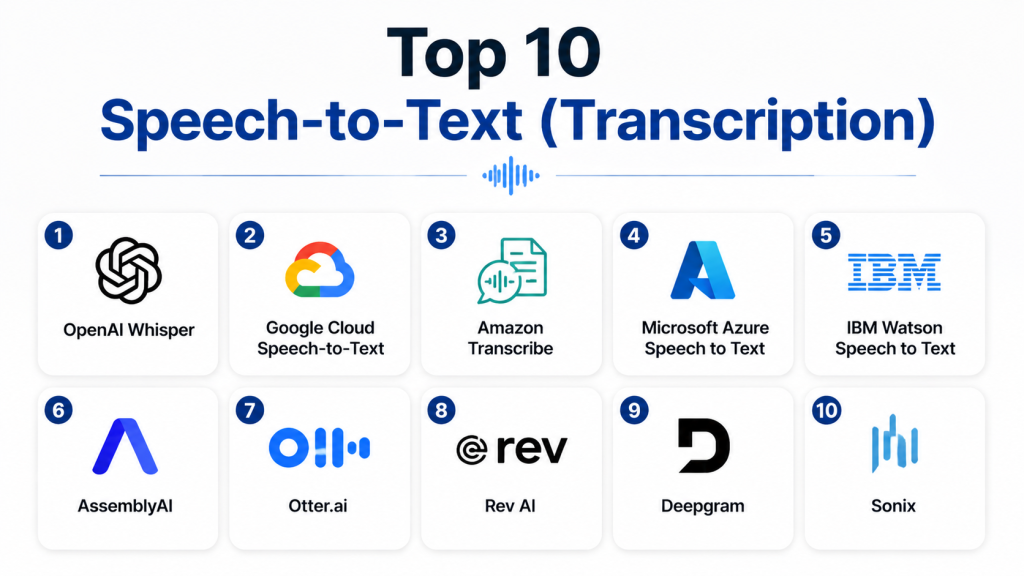
Top 10 Speech-to-Text (Transcription) Platforms
1 — OpenAI Whisper
Short description: AIbasedopensourceSTTmodelthatoffershighaccuracytranscriptionmultilingualsupportanddeveloperfriendlyintegrationforaudioandvideoprocessingapplications
Key Features
- High-accuracy speech recognition
- Strong multilingual support
- Noise-resistant transcription
- Open-source model availability
- Batch audio processing
- Developer API integrations
- Flexible deployment options
Pros
- Excellent accuracy across languages
- Free and open-source availability
- Strong developer flexibility
Cons
- Requires technical setup
- No built-in UI for end users
Platforms / Deployment
Cloud / Self-hosted / API
Security & Compliance
Not publicly stated
Integrations & Ecosystem
Commonly used in developer pipelines and AI systems.
- APIs and SDK integrations
- Audio processing pipelines
- AI applications and assistants
- Media automation tools
Support & Community
Large open-source community support
2 — Google Cloud Speech-to-Text
Short description: EnterprisegradecloudspeechrecognitionserviceprovidingrealtimeandbatchtranscriptionwithscalableAPIsandmultilingualsupportforglobalapplications
Key Features
- Real-time speech recognition
- Batch transcription processing
- Multilingual support
- Speaker diarization
- Noise robustness
- Custom vocabulary tuning
- Cloud scalability
Pros
- Highly scalable infrastructure
- Strong accuracy in production use
- Enterprise-ready ecosystem
Cons
- Pricing complexity at scale
- Requires cloud configuration
Platforms / Deployment
Cloud / API
Security & Compliance
Enterprise-grade Google Cloud security (varies by setup)
Integrations & Ecosystem
- Google Cloud services
- AI/ML pipelines
- Enterprise applications
- Mobile and web apps
Support & Community
Strong enterprise documentation
3 — Amazon Transcribe
Short description: AWSbasedspeechrecognitionserviceprovidingaccuratetranscriptionrealtimeprocessingandenterpriseintegrationforvoiceandcallanalyticsapplications
Key Features
- Real-time transcription
- Batch audio processing
- Speaker identification
- Custom vocabulary support
- Call analytics features
- Multilingual support
- AWS ecosystem integration
Pros
- Strong enterprise reliability
- Deep AWS integration
- Scalable infrastructure
Cons
- Complex for beginners
- Pricing depends on usage
Platforms / Deployment
Cloud / API
Security & Compliance
AWS enterprise security framework
Integrations & Ecosystem
- AWS services
- Contact center systems
- Analytics platforms
- AI workflows
Support & Community
Strong AWS enterprise support
4 — Microsoft Azure Speech to Text
Short description: CloudbasedspeechrecognitionserviceprovidingrealtimebatchtranscriptionandspeechanalyticsintegrateddeeplywithMicrosoftAzureAIecosystem
Key Features
- Real-time transcription
- Batch processing
- Speaker diarization
- Custom speech models
- Multilingual support
- Speech translation
- Azure AI integration
Pros
- Strong enterprise ecosystem
- High scalability
- Good accuracy in business environments
Cons
- Complex pricing structure
- Azure dependency required
Platforms / Deployment
Cloud / API
Security & Compliance
Microsoft enterprise security standards
Integrations & Ecosystem
- Microsoft 365 tools
- Azure AI services
- Enterprise applications
- Productivity systems
Support & Community
Strong enterprise support
5 — IBM Watson Speech to Text
Short description: EnterpriseAItranscriptionplatformofferingrealtimespeechrecognitioncustommodelsandbusinessgradeintegrationforcustomerandindustryspecificusecases
Key Features
- Real-time transcription
- Custom language models
- Speaker separation
- API access
- Multilingual support
- Audio streaming
- Enterprise customization
Pros
- Strong enterprise customization
- Stable performance
- Flexible deployment
Cons
- Less modern UI experience
- Slower innovation pace
Platforms / Deployment
Cloud / API
Security & Compliance
Not publicly stated
Integrations & Ecosystem
- IBM Cloud services
- Enterprise systems
- AI workflows
- Contact center tools
Support & Community
Enterprise-level support
6 — AssemblyAI
Short description: AIPoweredtranscriptionplatformthatprovideshighaccuracySTTrealtimespeechprocessingandsummarizationfeaturesfordevelopersandSaaSapplications
Key Features
- High-accuracy transcription
- Speaker diarization
- Sentiment analysis
- AI summarization
- Real-time streaming
- API-first architecture
- Content moderation tools
Pros
- Developer-friendly APIs
- Strong AI add-on features
- Fast processing
Cons
- Not a full end-user platform
- Requires technical integration
Platforms / Deployment
Cloud / API
Security & Compliance
Not publicly stated
Integrations & Ecosystem
- SaaS applications
- AI pipelines
- Media platforms
- Developer tools
Support & Community
Strong developer documentation
7 — Otter.ai
Short description: MeetingfocusedtranscriptionplatformthatprovidesrealtimetranscriptionAImeetingsummariesandspeakeridentificationforbusinessandteamcollaboration
Key Features
- Real-time meeting transcription
- AI-generated summaries
- Speaker identification
- Searchable transcripts
- Collaboration tools
- Cloud storage
- Mobile and web apps
Pros
- Excellent for meetings
- Easy to use interface
- Strong collaboration features
Cons
- Limited developer APIs
- Less control over customization
Platforms / Deployment
Cloud / Web / Mobile
Security & Compliance
Not publicly stated
Integrations & Ecosystem
- Zoom and meeting tools
- Productivity apps
- Calendar systems
- Collaboration platforms
Support & Community
Strong SMB user base
8 — Rev AI
Short description: ProfessionalgradetranscriptionAPIsolutionprovidinghighaccuracySTTforenterprisevideoaudioandcallcenterapplications
Key Features
- High-accuracy transcription
- API-first architecture
- Speaker diarization
- Real-time processing
- Caption generation
- Language support
- Scalable infrastructure
Pros
- High transcription accuracy
- Strong enterprise reliability
- Developer-focused
Cons
- No full consumer interface
- Pricing may scale with usage
Platforms / Deployment
Cloud / API
Security & Compliance
Not publicly stated
Integrations & Ecosystem
- Media workflows
- SaaS platforms
- Call analytics systems
- Developer APIs
Support & Community
Strong enterprise documentation
9 — Deepgram
Short description: AIpoweredspeechrecognitionplatformofferingrealtimetranscriptionlowlatencyprocessingandhighaccuracyforenterprisestreamingaudioapplications
Key Features
- Real-time transcription engine
- Low-latency processing
- Speaker diarization
- API access
- Custom models
- Multilingual support
- Streaming optimization
Pros
- Very fast processing
- Strong real-time performance
- Developer-friendly
Cons
- Requires technical setup
- Less consumer-focused
Platforms / Deployment
Cloud / API
Security & Compliance
Not publicly stated
Integrations & Ecosystem
- Streaming platforms
- SaaS applications
- Voice analytics systems
- Developer pipelines
Support & Community
Active developer ecosystem
10 — Sonix
Short description: Automatedtranscriptionplatformforvideoaudioandpodcastcontentofferingeditorsummarizationandcollaborationtoolsforcreatorsandbusinesses
Key Features
- Automated transcription
- Multi-language support
- Text editing interface
- Subtitle generation
- Collaboration tools
- Cloud storage
- Export options
Pros
- Easy-to-use interface
- Good for content creators
- Fast transcription workflow
Cons
- Limited advanced AI features
- Not enterprise-heavy
Platforms / Deployment
Cloud / Web
Security & Compliance
Not publicly stated
Integrations & Ecosystem
- Video editing tools
- Media workflows
- Podcast platforms
- Collaboration apps
Support & Community
Good SMB support
Comparison Table (Top 10)
| Tool | Best For | Platforms | Deployment | Standout Feature | Public Rating |
|---|---|---|---|---|---|
| Whisper | Developers | API | Cloud/Self-hosted | Open-source accuracy | N/A |
| Google STT | Enterprise apps | API | Cloud | Real-time transcription | N/A |
| Amazon Transcribe | AWS users | API | Cloud | Call analytics | N/A |
| Azure Speech | Enterprises | API | Cloud | Microsoft integration | N/A |
| IBM Watson | Business AI | API | Cloud | Custom models | N/A |
| AssemblyAI | Developers | API | Cloud | AI summaries | N/A |
| Otter.ai | Meetings | Web/Mobile | Cloud | Meeting notes | N/A |
| Rev AI | Media & SaaS | API | Cloud | High accuracy API | N/A |
| Deepgram | Real-time apps | API | Cloud | Low latency | N/A |
| Sonix | Creators | Web | Cloud | Editing + subtitles | N/A |
Evaluation & Scoring
| Tool | Core (25%) | Ease (15%) | Integrations (15%) | Security (10%) | Performance (10%) | Support (10%) | Value (15%) | Total |
|---|---|---|---|---|---|---|---|---|
| Whisper | 10 | 7 | 9 | 7 | 9 | 8 | 10 | 8.8 |
| Google STT | 9 | 8 | 10 | 9 | 9 | 9 | 8 | 8.9 |
| Amazon Transcribe | 9 | 7 | 10 | 9 | 9 | 9 | 8 | 8.7 |
| Azure Speech | 9 | 7 | 10 | 9 | 9 | 9 | 8 | 8.7 |
| IBM Watson | 8 | 7 | 9 | 9 | 8 | 8 | 7 | 8.0 |
| AssemblyAI | 9 | 8 | 9 | 7 | 9 | 8 | 8 | 8.4 |
| Otter.ai | 8 | 10 | 8 | 7 | 8 | 8 | 9 | 8.3 |
| Rev AI | 9 | 8 | 9 | 8 | 9 | 8 | 8 | 8.6 |
| Deepgram | 9 | 8 | 9 | 7 | 10 | 8 | 8 | 8.6 |
| Sonix | 8 | 9 | 8 | 7 | 8 | 8 | 9 | 8.2 |
Which Speech-to-Text Platform Is Right for You?
Solo / Freelancer
Sonix, Otter.ai, Whisper are ideal for simple transcription needs
SMB
Otter.ai, AssemblyAI, Rev AI work well for teams and creators
Mid-Market
Google STT, Azure Speech, Deepgram for scalable workflows
Enterprise
Amazon Transcribe, Azure Speech, IBM Watson for secure large-scale systems
Frequently Asked Questions (FAQs)
1. What is Speech-to-Text (STT)?
Speech-to-Text is AI technology that converts spoken language into written text. It uses machine learning models trained on large audio datasets. Modern systems can understand multiple languages and accents. They are widely used in meetings, videos, and customer support. STT improves productivity by automating note-taking. It reduces manual transcription work significantly. It is now a core part of AI communication tools.
2. How does Speech-to-Text work?
STT systems analyze audio signals and break them into phonetic patterns. AI models then map these patterns to words and sentences. Deep learning improves accuracy over time. Speaker recognition helps separate different voices. Noise filtering enhances clarity in difficult environments. Some systems work in real-time while others process recordings. The final output is structured text.
3. Where is Speech-to-Text used?
STT is used in business meetings and conference calls. It powers customer service call analytics. Media companies use it for subtitles and captions. Educators use it for lecture transcription. Healthcare uses it for documentation and records. Legal industries use it for case transcription. It is also used in voice assistants and apps.
4. Is Speech-to-Text accurate?
Modern STT systems are highly accurate in clean audio conditions. Accuracy depends on background noise and speaker clarity. Advanced models handle accents and multiple speakers better. Domain-specific tuning improves performance. However, no system is 100% perfect. Human review is sometimes needed for critical tasks. Accuracy continues to improve with AI advancements.
5. Can STT handle multiple speakers?
Yes, most modern platforms support speaker diarization. This means they can identify and separate different speakers. It is useful for meetings and interviews. Each speaker’s text is labeled separately. Accuracy depends on audio quality and overlap. Some tools are better at this than others. It helps improve readability of transcripts.
6. Is real-time transcription possible?
Yes, many STT platforms support real-time transcription. This is used in live meetings and streaming. It converts speech into text instantly with minimal delay. Real-time STT is useful for captions and accessibility. Performance depends on internet speed and processing power. Some tools offer near-zero latency. It is widely used in enterprise communication.
7. Do STT tools support multiple languages?
Most modern STT platforms support many global languages. English typically has the highest accuracy. Some tools also support regional accents and dialects. Multilingual support is important for global businesses. Translation features may also be included. Quality varies depending on training data. Language coverage is improving continuously.
8. Do I need coding skills to use STT?
No coding is required for basic transcription tools. Many platforms offer simple web interfaces. Users can upload audio and get text output easily. However, APIs require programming knowledge. Developers use APIs for automation and integration. Both no-code and pro options are available. It depends on the use case.
9. What are limitations of Speech-to-Text?
STT may struggle with noisy environments. Heavy accents can reduce accuracy in some cases. Overlapping speech can cause errors. Specialized vocabulary may require tuning. It may not fully understand context like humans. Some languages have lower accuracy support. However, AI improvements are reducing these limitations.
10. Which is the best Speech-to-Text tool?
There is no single best tool for everyone. Whisper is strong for accuracy and flexibility. Google and AWS are best for enterprise scalability. Otter.ai is great for meetings and collaboration. Deepgram is strong for real-time use cases. The best choice depends on your needs. Testing multiple tools is recommended.
Conclusion
Speech-to-Text platforms have become essential tools for modern digital workflows.
They help convert spoken content into accurate, searchable written text at scale.
From meetings to media production, their use cases continue to expand rapidly.
AI improvements have significantly increased accuracy and real-time performance.
Different tools serve different needs, from enterprise systems to simple apps.
The best choice depends on accuracy, integrations, and scalability requirements.
Shortlisting and testing a few tools is the most reliable way to choose the right platform.

Find Trusted Cardiac Hospitals
Compare heart hospitals by city and services — all in one place.
Explore Hospitals
I am learning about speech-to-text transcription platforms, and this content helped me understand how different tools can convert spoken language into accurate text and improve productivity.