Introduction
AI Inference Serving Platforms, also known as Model Serving platforms, are specialized software solutions that enable enterprises and developers to deploy, manage, and scale machine learning models in production environments. Unlike training platforms, inference platforms focus on delivering predictions from pre-trained models with low latency, high throughput, and robust reliability. These platforms bridge the gap between AI experimentation and real-world application, powering everything from real-time recommendation engines to computer vision systems. the importance of inference serving platforms has grown due to the proliferation of generative AI, large language models (LLMs), and edge AI applications. Enterprises need solutions that are scalable, secure, and compatible with diverse deployment architectures, while supporting continuous model updates and monitoring.
Real-world use cases include:
- Real-time AI recommendations for e-commerce and streaming services.
- Predictive maintenance in manufacturing using IoT and sensor data.
- Fraud detection in banking and financial services.
- Dynamic personalization for marketing campaigns.
- Autonomous systems and robotics requiring low-latency model inference.
What buyers should evaluate:
- Model compatibility and framework support (PyTorch, TensorFlow, ONNX, etc.)
- Latency and throughput performance
- Scalability (horizontal/vertical and cloud/edge)
- Monitoring and observability features
- Security and compliance (data encryption, SOC 2, GDPR)
- Ease of deployment and management
- Integration with CI/CD pipelines
- Cost efficiency and pricing models
- Support for A/B testing and rollout strategies
- Edge or hybrid deployment capabilities
Best for: Enterprises, AI teams, developers, and organizations deploying AI at scale who need high-performance, reliable inference serving with operational control. Industries include finance, retail, healthcare, automotive, and cloud service providers.
Not ideal for: Small teams or projects experimenting with models that do not require high availability, low latency, or enterprise-grade observability. Lightweight alternatives like API-hosted ML services or serverless endpoints may suffice.
Key Trends in AI Inference Serving Platforms
- Increasing adoption of real-time and low-latency serving for LLMs and multimodal AI models.
- Edge inference deployment for IoT, mobile, and autonomous systems.
- Integration with MLOps pipelines for continuous deployment, monitoring, and rollback.
- Use of containerization and orchestration frameworks (Docker, Kubernetes, KServe, Triton).
- Hybrid and multi-cloud deployments for redundancy and cost optimization.
- Support for model optimization and compression (quantization, pruning, distillation) to improve speed.
- Enhanced security and compliance features, including encryption in transit, RBAC, audit logging, and SOC 2 alignment.
- Advanced observability and metrics dashboards to track model drift, latency, and throughput.
- Pricing shifts toward usage-based and scalable inference credits, especially for cloud-native services.
- Growing ecosystem integrations with analytics, feature stores, and monitoring platforms.
How We Selected These Tools (Methodology)
- Evaluated market adoption and mindshare in AI/ML developer communities.
- Assessed feature completeness including deployment options, monitoring, and optimization tools.
- Analyzed performance and reliability signals from benchmarking and case studies.
- Verified security posture, including encryption, authentication, and compliance features.
- Checked integration capabilities with CI/CD, cloud providers, and orchestration frameworks.
- Considered fit across enterprise, SMB, and developer-focused use cases.
- Balanced support, documentation, and community presence.
- Reviewed scalability and flexibility for edge and hybrid environments.
- Evaluated pricing models and cost transparency.
- Ensured 2026+ relevance including support for LLMs, multimodal AI, and GPU acceleration.
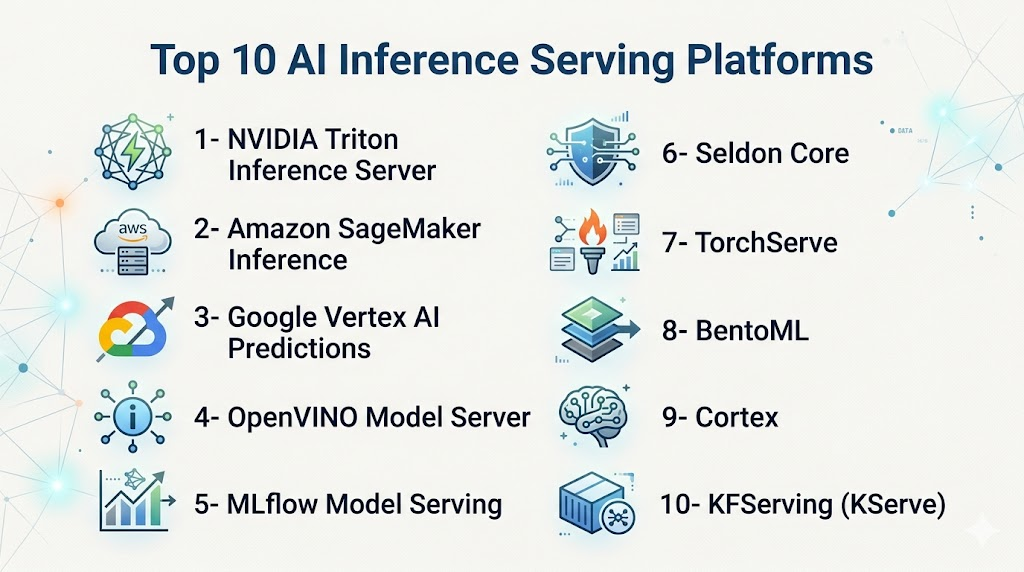
Top 10 AI Inference Serving Platforms
1- NVIDIA Triton Inference Server
Short description: NVIDIA Triton is a high-performance inference server designed for GPUs and CPUs, supporting multiple frameworks like PyTorch, TensorFlow, and ONNX. Ideal for enterprises running GPU-intensive AI workloads.
Key Features
- Multi-framework support (PyTorch, TensorFlow, ONNX, TensorRT)
- GPU and CPU optimization for low-latency serving
- Model ensemble and batching capabilities
- Dynamic model loading and versioning
- Metrics and monitoring integration (Prometheus, Grafana)
- Support for cloud and on-prem deployment
Pros
- High throughput for GPU workloads
- Flexible deployment options
- Strong community and NVIDIA ecosystem support
Cons
- Requires hardware expertise for optimal GPU tuning
- Initial setup complexity for hybrid environments
Platforms / Deployment
- Linux, Docker, Kubernetes
- Cloud / Self-hosted / Hybrid
Security & Compliance
- Not publicly stated
Integrations & Ecosystem
Supports integration with ML pipelines, monitoring dashboards, and Kubernetes operators.
- CI/CD pipelines
- Prometheus/Grafana monitoring
- Cloud-native orchestration (AWS, Azure, GCP)
Support & Community
Active developer forums, documentation, NVIDIA support tiers.
2- Amazon SageMaker Inference
Short description: Fully managed cloud service enabling scalable inference for any ML model with built-in auto-scaling and endpoint deployment. Suited for cloud-native enterprises.
Key Features
- Real-time and batch inference endpoints
- Multi-model endpoints for cost efficiency
- Auto-scaling based on traffic
- Model monitoring and drift detection
- Supports all major ML frameworks
Pros
- Fully managed with minimal operational overhead
- Scales seamlessly with demand
- Strong AWS ecosystem integration
Cons
- Cloud-only; less suitable for on-prem/edge
- Pricing can grow with high traffic volumes
Platforms / Deployment
- Web, Cloud
- Cloud-only
Security & Compliance
- IAM, encryption at rest and in transit, VPC support
- SOC 2, ISO 27001, GDPR compliance
Integrations & Ecosystem
Integrates with AWS ML stack and analytics services.
- S3, Lambda, CloudWatch
- SageMaker Pipelines
- AWS monitoring and alerting
Support & Community
AWS documentation, active forums, enterprise support plans.
3- Google Vertex AI Predictions
Short description: Managed AI platform enabling fast, scalable model deployment with auto-scaling endpoints and integrated monitoring. Best for enterprises using Google Cloud.
Key Features
- Real-time and batch prediction
- Auto-scaling endpoints
- Model versioning and rollback
- Built-in observability and logging
- Supports TensorFlow, PyTorch, XGBoost
Pros
- Strong cloud-native integration
- High scalability and reliability
- Advanced monitoring dashboards
Cons
- Cloud-only deployment
- Dependent on Google Cloud ecosystem
Platforms / Deployment
- Web, Cloud
- Cloud-only
Security & Compliance
- IAM, encryption, audit logs
- Not publicly stated for SOC 2/ISO certifications
Integrations & Ecosystem
- BigQuery, Dataflow, Cloud Logging
- CI/CD via Cloud Build
- Vertex AI pipelines
Support & Community
Google Cloud support tiers, community forums, official documentation.
4- Baseten
Short description: Baseten is an inference platform for running AI models in production, built for engineering teams that treat latency, throughput, and uptime as product requirements. Its Inference Stack pairs optimized runtimes across GenAI modalities with multi-cloud abstraction for high availability.
Key Features:
- Baseten Inference Stack with custom GPU kernels, advanced decoding, and optimized caching
- Optimized runtimes for LLMs, embeddings, image and video generation, transcription, voice synthesis, and compound AI
- Multi-cloud Capacity Manager abstracting 18 cloud providers behind a single deployment
- Active-active redundancy and automated multi-cloud failover targeting 99.99% uptime
- Fully managed, single-tenant, self-hosted, or hybrid with spillover deployment
- Forward deployed engineers supporting the path from prototype to production
Pros:
- Only inference provider that abstracts 18 cloud providers
- Modality-specific runtime optimizations for production GenAI workloads
- Deployment flexibility across managed, self-hosted, and hybrid environments
Cons:
- Purpose-built for GenAI inference rather than general ML training workflows
- Multi-cloud abstraction value is highest for teams with strict uptime targets
Platforms / Deployment:
- Linux, Docker, Kubernetes
- Cloud / Self-hosted / Hybrid / Single-tenant
Security & Compliance:
- Single-tenant clusters and self-hosted deployment options for isolation
- Encryption in transit; further certifications not publicly stated here
Integrations & Ecosystem:
Works across 18 cloud providers globally with fully managed and hybrid options.
- CI/CD pipelines
- Multi-cloud deployment and failover via Multi-cloud Capacity Manager
- Observability for latency, throughput, and uptime
Support & Community:
Forward deployed engineering team provides white-glove support. Companies including OpenEvidence, Writer, and ClickUp run production inference on Baseten.
5- MLflow Model Serving
Short description: Open-source platform for tracking and serving ML models, ideal for organizations needing a flexible, framework-agnostic serving layer.
Key Features
- REST API endpoints for models
- Model versioning and experiment tracking
- Support for PyTorch, TensorFlow, scikit-learn
- Local, cloud, and Kubernetes deployment
- Logging and monitoring integration
Pros
- Open-source and flexible
- Easy integration with ML workflows
- Supports multiple frameworks
Cons
- Not as optimized for high-performance GPU inference
- Requires manual scaling setup
Platforms / Deployment
- Linux, macOS
- Cloud / Self-hosted / Hybrid
Security & Compliance
- Not publicly stated
Integrations & Ecosystem
- CI/CD pipelines
- Prometheus/Grafana
- Cloud deployment scripts
Support & Community
Active open-source community, extensive documentation.
6- Seldon Core
Short description: Open-source platform for deploying, scaling, and monitoring ML models on Kubernetes. Designed for enterprise-grade production environments.
Key Features
- Kubernetes-native deployment
- Multi-framework model support
- Advanced routing and A/B testing
- Integrated metrics and logging
- Supports rolling updates and canary releases
Pros
- Kubernetes-native and scalable
- Supports complex deployment strategies
- Strong observability features
Cons
- Requires Kubernetes expertise
- Setup complexity for small teams
Platforms / Deployment
- Linux, Kubernetes
- Cloud / Self-hosted / Hybrid
Security & Compliance
- Not publicly stated
Integrations & Ecosystem
- Prometheus/Grafana
- MLflow integration
- Kubernetes CRDs
Support & Community
Open-source community support, enterprise subscriptions available.
7- TorchServe
Short description: Serving framework for PyTorch models, optimized for production deployment. Ideal for PyTorch-centric teams needing flexible inference serving.
Key Features
- Multi-model serving
- GPU acceleration support
- Logging and metrics integration
- Batch and asynchronous requests
- Model versioning
Pros
- Optimized for PyTorch workloads
- Easy to deploy and manage
- Supports multiple deployment modes
Cons
- Limited to PyTorch
- Smaller feature set for non-PyTorch models
Platforms / Deployment
- Linux, Docker
- Cloud / Self-hosted / Hybrid
Security & Compliance
- Not publicly stated
Integrations & Ecosystem
- Prometheus/Grafana
- Kubernetes
- CI/CD pipelines
Support & Community
Strong PyTorch community, official documentation.
8- BentoML
Short description: Open-source platform enabling packaging, serving, and scaling ML models with deployment flexibility. Suitable for developer-first AI teams.
Key Features
- Model packaging and versioning
- REST/gRPC API deployment
- Containerized and serverless deployment
- Batch and real-time inference
- CI/CD pipeline integration
Pros
- Flexible deployment
- Framework-agnostic
- Developer-friendly APIs
Cons
- Open-source support primarily community-based
- May require DevOps expertise for scaling
Platforms / Deployment
- Linux, Docker, Kubernetes
- Cloud / Self-hosted / Hybrid
Security & Compliance
- Not publicly stated
Integrations & Ecosystem
- Prometheus, Grafana
- MLflow integration
- Kubernetes and cloud platforms
Support & Community
Active developer community, detailed documentation.
9- Cortex
Short description: Open-source platform for deploying ML models as production APIs with auto-scaling. Targets cloud-native microservice architectures.
Key Features
- Real-time API endpoints
- Auto-scaling and load balancing
- Multi-model deployment
- AWS integration
- Canary deployments and versioning
Pros
- Simplifies cloud-native ML deployment
- Auto-scaling for variable loads
- Supports A/B testing strategies
Cons
- Primarily AWS-focused
- Open-source support may require in-house expertise
Platforms / Deployment
- Linux, Docker
- Cloud / Self-hosted / Hybrid
Security & Compliance
- Not publicly stated
Integrations & Ecosystem
- CI/CD pipelines
- AWS ecosystem
- Monitoring with Prometheus/Grafana
Support & Community
Community support, limited enterprise services.
10- KFServing (KServe)
Short description: Kubernetes-native inference platform enabling serverless, scalable ML deployments. Optimized for enterprises with MLOps pipelines.
Key Features
- Serverless and scalable inference
- Multi-framework support
- Integrated metrics and logging
- Canary deployments and traffic splitting
- GPU and CPU scheduling
Pros
- Native Kubernetes integration
- Supports enterprise deployment patterns
- Highly scalable
Cons
- Kubernetes expertise required
- Complexity for small-scale deployments
Platforms / Deployment
- Linux, Kubernetes
- Cloud / Self-hosted / Hybrid
Security & Compliance
- Not publicly stated
Integrations & Ecosystem
- Prometheus/Grafana
- MLflow integration
- Kubernetes CRDs
Support & Community
Strong open-source support, active community, documentation available.
Comparison Table (Top 10)
| Tool Name | Best For | Platform(s) Supported | Deployment | Standout Feature | Public Rating |
|---|---|---|---|---|---|
| NVIDIA Triton | GPU-intensive inference | Linux, Docker, Kubernetes | Cloud/Self-hosted/Hybrid | Multi-framework GPU optimization | N/A |
| Amazon SageMaker Inference | Managed cloud inference | Web, Cloud | Cloud | Auto-scaling endpoints | N/A |
| Google Vertex AI Predictions | Google Cloud enterprises | Web, Cloud | Cloud | Integrated monitoring and scaling | N/A |
| OpenVINO Model Server | Edge & computer vision | Linux, Windows | Cloud/Self-hosted/Edge | Intel hardware optimization | N/A |
| MLflow Model Serving | Flexible ML workflows | Linux, macOS | Cloud/Self-hosted/Hybrid | Framework-agnostic model serving | N/A |
| Seldon Core | Enterprise Kubernetes deployments | Linux, Kubernetes | Cloud/Self-hosted/Hybrid | Advanced routing & observability | N/A |
| TorchServe | PyTorch-centric teams | Linux, Docker | Cloud/Self-hosted/Hybrid | Optimized PyTorch serving | N/A |
| BentoML | Developer-first deployments | Linux, Docker, Kubernetes | Cloud/Self-hosted/Hybrid | Model packaging & APIs | N/A |
| Cortex | Cloud-native ML APIs | Linux, Docker | Cloud/Self-hosted/Hybrid | Auto-scaling for production APIs | N/A |
| KFServing (KServe) | Kubernetes-native serverless | Linux, Kubernetes | Cloud/Self-hosted/Hybrid | Serverless inference | N/A |
Evaluation & Scoring of AI Inference Serving Platforms
| Tool Name | Core (25%) | Ease (15%) | Integrations (15%) | Security (10%) | Performance (10%) | Support (10%) | Value (15%) | Weighted Total (0–10) |
|---|---|---|---|---|---|---|---|---|
| NVIDIA Triton | 10 | 8 | 9 | 7 | 10 | 8 | 8 | 9.0 |
| Amazon SageMaker Inference | 9 | 9 | 9 | 8 | 9 | 9 | 7 | 8.7 |
| Google Vertex AI | 9 | 8 | 9 | 8 | 9 | 8 | 7 | 8.5 |
| OpenVINO | 8 | 7 | 7 | 7 | 8 | 7 | 8 | 7.6 |
| MLflow | 8 | 8 | 8 | 6 | 7 | 7 | 8 | 7.7 |
| Seldon Core | 9 | 7 | 8 | 7 | 8 | 8 | 8 | 8.0 |
| TorchServe | 8 | 8 | 7 | 6 | 8 | 7 | 8 | 7.6 |
| BentoML | 8 | 9 | 8 | 6 | 7 | 7 | 8 | 7.7 |
| Cortex | 8 | 8 | 7 | 6 | 7 | 7 | 8 | 7.4 |
| KFServing | 9 | 7 | 8 | 7 | 8 | 8 | 8 | 8.0 |
Which AI Inference Serving Platform Is Right for You?
Solo / Freelancer
- Consider lightweight frameworks like MLflow, BentoML, or TorchServe for local testing and low-scale deployment.
SMB
- Seldon Core or Cortex for flexible, Kubernetes-based deployments with moderate scaling requirements.
Mid-Market
- Managed cloud solutions like Amazon SageMaker or Vertex AI Predictions offer ease of use with high reliability.
Enterprise
- NVIDIA Triton, KFServing, and Seldon Core provide high-performance, multi-framework GPU support and enterprise-grade observability.
Budget vs Premium
- Open-source options like MLflow, TorchServe, BentoML, or Seldon Core reduce licensing costs.
- Premium managed services (SageMaker, Vertex AI, Triton Enterprise) reduce operational overhead.
Feature Depth vs Ease of Use
- Open-source platforms offer depth and flexibility.
- Managed cloud services provide ease of use and rapid scaling.
Integrations & Scalability
- Choose platforms supporting CI/CD, monitoring, and orchestration for robust MLOps pipelines.
- Hybrid and edge deployment options are critical for low-latency applications.
Security & Compliance Needs
- Enterprises must prioritize SOC 2, encryption, RBAC, and audit logging.
- Managed cloud services often simplify compliance, while self-hosted options require additional controls.
Frequently Asked Questions (FAQs)
- What are AI inference serving platforms used for?
These platforms deploy pre-trained ML models in production environments. They deliver predictions with low latency and high reliability. Businesses use them for real-time recommendations, computer vision, and personalization. They bridge experimentation and operational AI use cases. - Which deployment options are available?
Platforms can be cloud-native, on-premises, or hybrid. Some support Kubernetes for container orchestration. Edge deployment is also possible for IoT and low-latency applications. Choice depends on scale, security, and latency requirements. - How do I update models in production?
Most platforms offer versioning and canary deployments. This allows gradual rollout of new models with rollback options. Monitoring ensures new versions perform correctly. This minimizes risk and downtime. - What performance metrics should I monitor?
Key metrics include latency, throughput, and error rates. Model drift and prediction accuracy are also critical. Observability dashboards help track these metrics. This ensures models remain reliable in production. - Can these platforms handle multiple models simultaneously?
Yes, multi-model serving is supported by platforms like Triton and Seldon Core. Requests can be routed dynamically to different models. Batch processing can improve throughput efficiency. It’s ideal for complex AI workflows. - Are these platforms secure for enterprise use?
Security features often include TLS encryption, RBAC, and SSO/SAML. Audit logging helps track access and changes. Some managed services provide SOC 2 or GDPR compliance. Enterprises must verify security for sensitive workloads. - How do I integrate inference platforms with CI/CD pipelines?
Integration supports automated deployment, testing, and scaling of models. Tools like Jenkins, GitHub Actions, or GitLab pipelines are commonly used. Kubernetes-native platforms simplify automation. This ensures continuous delivery of AI models. - Do these platforms support GPU acceleration?
Yes, high-performance platforms like NVIDIA Triton and TorchServe leverage GPUs. GPU support reduces latency and increases throughput for large models. Some platforms also optimize for CPU inference. Hardware choice depends on workload requirements. - What are alternatives if I don’t need full-scale serving?
Lightweight options include serverless endpoints or cloud-hosted APIs. These reduce infrastructure complexity and cost. They are ideal for small-scale or experimental workloads. However, they may not scale for high-demand production use. - Can I switch between platforms easily?
Switching requires exporting models in standard formats like ONNX or TorchScript. Reconfiguring deployment pipelines is often needed. Kubernetes-native platforms offer higher portability. Proper testing ensures smooth migration without downtime.
Conclusion
AI Inference Serving Platforms are essential for deploying machine learning models reliably in production. They enable low-latency, high-throughput predictions across industries like finance, healthcare, retail, and autonomous systems. Choosing the right platform depends on scale, deployment environment, and model type. Open-source options provide flexibility and control, while managed cloud services simplify operations. Enterprises must evaluate performance, security, and integration capabilities carefully. Edge and hybrid deployments are increasingly important for real-time applications. Monitoring, observability, and version control ensure consistent model performance. The best choice varies based on team size, technical expertise, and budget.

Find Trusted Cardiac Hospitals
Compare heart hospitals by city and services — all in one place.
Explore Hospitals
I wanted to understand AI inference serving platforms better, and this content helped me learn how different solutions support efficient model deployment and real-time predictions.