Introduction
LLM Gateways & Model Routing Platforms are software solutions that manage, route, and optimize requests between users and large language models (LLMs). They act as intermediaries, orchestrating multiple models, handling scaling, and ensuring reliability, latency optimization, and cost-efficiency. These platforms are increasingly critical as enterprises adopt multiple LLMs from various providers for different workloads. organizations are deploying multi-model AI architectures for chatbots, summarization, code generation, and recommendation engines. LLM gateways simplify this complexity by centralizing API access, controlling routing logic, enforcing quotas, and monitoring performance.
Real-world use cases include:
- Routing user queries to specialized LLMs for domain-specific answers.
- Optimizing inference costs by dynamically selecting models based on request size or latency.
- Combining multiple LLMs in ensemble workflows for higher accuracy.
- Enabling multi-tenant AI applications with controlled access.
- Monitoring and auditing AI responses for compliance and quality.
What buyers should evaluate:
- Multi-model orchestration capabilities
- Low-latency routing performance
- Scalability for high-concurrency traffic
- Observability and analytics dashboards
- Security and access controls
- Quota management and rate limiting
- Integration with CI/CD pipelines and APIs
- Cost optimization and usage tracking
- Model versioning and fallback mechanisms
- Cloud, hybrid, and edge deployment flexibility
Best for: AI teams, IT managers, developers, and enterprises using multiple LLMs or deploying production-grade LLM applications. Ideal for SaaS providers, fintech, healthcare, and customer support AI systems.
Not ideal for: Small projects or experiments relying on a single LLM with minimal scaling needs. Direct API access may suffice for lightweight use cases.
Key Trends in LLM Gateways & Model Routing Platforms
- Growing adoption of multi-LLM orchestration for domain-specific routing and fallback.
- Increased use of dynamic cost optimization based on request complexity and model selection.
- Native observability and monitoring dashboards to track latency, errors, and usage.
- Expanded security and compliance features including RBAC, audit logging, and SOC 2 alignment.
- Integration with MLOps pipelines for CI/CD, automated model updates, and version control.
- Support for hybrid and multi-cloud deployments to improve redundancy and availability.
- AI-driven load balancing and traffic routing based on model performance and latency.
- Standardized API interfaces to simplify integration with third-party LLMs and internal models.
- Increased developer-friendly SDKs for Python, Node.js, and Java environments.
- Emergence of edge-based routing for low-latency inference in decentralized applications.
How We Selected These Tools (Methodology)
- Evaluated market adoption and mindshare within AI/ML developer and enterprise communities.
- Analyzed feature completeness, including multi-model routing, monitoring, and failover.
- Verified performance and reliability via benchmarks and real-world deployments.
- Assessed security posture, including encryption, RBAC, and compliance features.
- Reviewed integration capabilities with CI/CD, orchestration, and analytics tools.
- Considered scalability across cloud, hybrid, and edge deployments.
- Checked support quality and community strength for onboarding and troubleshooting.
- Compared pricing models and operational cost efficiency.
- Ensured 2026+ relevance, with LLM-specific routing, telemetry, and model management.
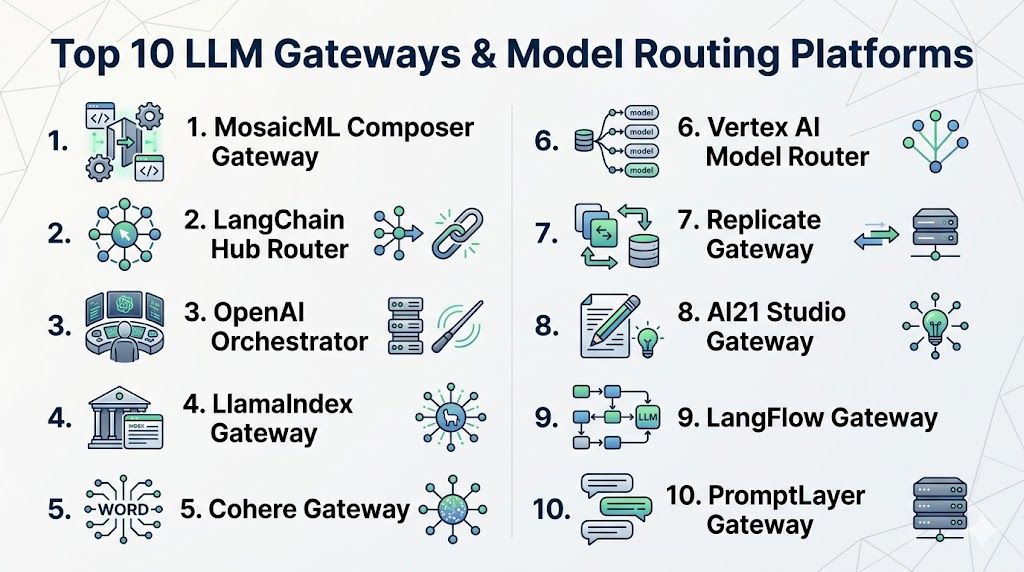
Top 10 LLM Gateways & Model Routing Platforms
1- MosaicML Composer Gateway
Short description: Centralized gateway for orchestrating multiple LLMs from different vendors. Ideal for enterprise AI teams optimizing multi-model workflows.
Key Features
- Multi-LLM orchestration and routing
- Dynamic cost-based model selection
- Model versioning and fallback support
- Metrics and observability dashboards
- API-based integration with existing pipelines
Pros
- Flexible orchestration for multiple models
- Advanced monitoring and logging
- Scales efficiently with enterprise workloads
Cons
- Requires configuration expertise
- Limited pre-built integrations for niche LLMs
Platforms / Deployment
- Web, Linux, Docker
- Cloud / Self-hosted / Hybrid
Security & Compliance
- Not publicly stated
Integrations & Ecosystem
Supports CI/CD pipelines and SDKs for Python and Node.js.
- Prometheus/Grafana monitoring
- API gateway integration
- Cloud platform orchestration
Support & Community
Active developer community, enterprise support plans available.
2- LangChain Hub Router
Short description: Open-source LLM routing platform optimized for multi-model workflows. Best for developers building production-ready AI applications.
Key Features
- LLM chaining and routing
- Asynchronous request handling
- Observability and logging
- Built-in retry and fallback logic
- Multi-cloud model support
Pros
- Developer-friendly and extensible
- Lightweight and framework-agnostic
- Strong open-source community
Cons
- Requires manual scaling
- Minimal enterprise support
Platforms / Deployment
- Linux, macOS
- Cloud / Self-hosted / Hybrid
Security & Compliance
- Not publicly stated
Integrations & Ecosystem
- Python SDK
- Integration with existing orchestration tools
- Supports multi-cloud APIs
Support & Community
Open-source community, detailed documentation.
3- OpenAI Orchestrator
Short description: Managed platform for routing requests across multiple OpenAI models efficiently. Suited for SaaS and enterprise AI applications.
Key Features
- Multi-model routing (GPT-3, GPT-4, custom endpoints)
- Load balancing and latency optimization
- Usage tracking and cost monitoring
- Built-in observability dashboards
- API-based integration
Pros
- Simplifies OpenAI model orchestration
- Low-latency routing
- Cost monitoring and optimization
Cons
- Vendor-specific to OpenAI models
- Less flexible for non-OpenAI LLMs
Platforms / Deployment
- Web, Cloud
- Cloud-only
Security & Compliance
- SOC 2, encryption at rest and in transit
Integrations & Ecosystem
- Cloud-native monitoring
- API for SaaS and enterprise apps
- Compatible with MLOps pipelines
Support & Community
Official support from OpenAI, active user forums.
4- LlamaIndex Gateway
Short description: Open-source model routing platform for LLaMA-based and custom LLMs. Designed for research teams and small to mid-market enterprises.
Key Features
- Supports multiple LLaMA and fine-tuned models
- Request routing and load balancing
- Version control for deployed models
- Observability and metrics
- Python-based SDK
Pros
- Lightweight, flexible, and developer-friendly
- Open-source, low cost
- Easy integration with Python applications
Cons
- Requires technical expertise to scale
- Limited enterprise-grade features
Platforms / Deployment
- Linux, macOS
- Self-hosted / Hybrid
Security & Compliance
- Not publicly stated
Integrations & Ecosystem
- Python SDK
- CI/CD pipelines
- Custom logging frameworks
Support & Community
Active GitHub community, developer guides available.
5- Cohere Gateway
Short description: Managed platform for routing requests across Cohere LLMs. Ideal for NLP-focused SaaS products.
Key Features
- Multi-model orchestration
- Auto-scaling endpoints
- Observability and logging
- Cost-based model selection
- API-first design
Pros
- Cloud-managed with minimal setup
- Scales automatically with traffic
- Integrated logging and monitoring
Cons
- Limited to Cohere models
- Cloud-only deployment
Platforms / Deployment
- Web, Cloud
- Cloud-only
Security & Compliance
- SOC 2, encryption at rest and in transit
Integrations & Ecosystem
- API integration
- SDK support for Python and Node.js
- Compatible with cloud monitoring tools
Support & Community
Official support and documentation, active community.
6- Vertex AI Model Router
Short description: Google Cloud-managed LLM routing platform for enterprise workloads. Optimized for hybrid and cloud-native AI deployments.
Key Features
- Multi-model routing and load balancing
- Canary deployments and A/B testing
- Monitoring dashboards
- Auto-scaling endpoints
- Multi-cloud support
Pros
- Fully managed by Google Cloud
- Enterprise-grade reliability
- Supports hybrid and multi-cloud deployments
Cons
- Limited outside Google Cloud
- Cloud costs can grow with heavy usage
Platforms / Deployment
- Web, Cloud
- Cloud-only
Security & Compliance
- IAM, encryption, audit logging
- GDPR compliance
Integrations & Ecosystem
- Vertex AI ecosystem
- CI/CD pipelines
- Monitoring with Cloud Logging
Support & Community
Google Cloud support, documentation, and forums.
7- Replicate Gateway
Short description: Multi-model gateway for deploying and routing inference requests to open-source and hosted LLMs. Suited for developers and mid-market companies.
Key Features
- Supports multiple model backends
- API-based routing and batching
- Monitoring and metrics
- Retry and fallback mechanisms
- Lightweight deployment
Pros
- Framework-agnostic
- Easy API integration
- Supports rapid experimentation
Cons
- Limited enterprise features
- Community-driven support
Platforms / Deployment
- Linux, macOS, Cloud
- Self-hosted / Cloud / Hybrid
Security & Compliance
- Not publicly stated
Integrations & Ecosystem
- Python and Node.js SDKs
- REST API integration
- Monitoring hooks
Support & Community
Active developer community, community documentation.
8- AI21 Studio Gateway
Short description: Managed gateway for AI21 Labs models. Ideal for enterprise NLP applications with multiple models.
Key Features
- Multi-model orchestration
- Cost optimization
- Load balancing
- Metrics and monitoring
- API-first design
Pros
- Fully managed
- Easy model routing
- Integrates with existing applications
Cons
- Vendor-specific models
- Cloud-only deployment
Platforms / Deployment
- Web, Cloud
- Cloud-only
Security & Compliance
- Not publicly stated
Integrations & Ecosystem
- API integration
- SDK support
- Monitoring dashboards
Support & Community
Official support and documentation.
9- LangFlow Gateway
Short description: Open-source workflow-based LLM routing platform. Suitable for developers needing visual model orchestration.
Key Features
- Drag-and-drop workflow creation
- Multi-model routing
- Observability dashboards
- Python SDK integration
- Open-source extensibility
Pros
- Developer-friendly visual workflow
- Extensible and open-source
- Supports experimentation
Cons
- Requires Kubernetes for scaling
- Limited enterprise-grade features
Platforms / Deployment
- Linux, macOS
- Self-hosted / Hybrid
Security & Compliance
- Not publicly stated
Integrations & Ecosystem
- Python SDK
- REST API integration
- CI/CD pipeline support
Support & Community
Open-source community, GitHub guides.
10- PromptLayer Gateway
Short description: Managed and open-source hybrid platform for routing, tracking, and logging LLM prompts. Ideal for SaaS AI monitoring.
Key Features
- Multi-model orchestration
- Prompt logging and analytics
- Retry and fallback mechanisms
- API-based routing
- Integration with monitoring tools
Pros
- Strong analytics for prompt performance
- Developer-friendly
- Supports hybrid deployment
Cons
- Limited scaling for enterprise workloads
- Mostly API-driven, not visual
Platforms / Deployment
- Linux, Cloud
- Cloud / Self-hosted / Hybrid
Security & Compliance
- Not publicly stated
Integrations & Ecosystem
- REST API
- SDK support
- Monitoring integrations
Support & Community
Documentation and active developer community.
Comparison Table (Top 10)
| Tool Name | Best For | Platform(s) Supported | Deployment | Standout Feature | Public Rating |
|---|---|---|---|---|---|
| MosaicML Composer Gateway | Enterprise multi-LLM orchestration | Linux, Web | Cloud/Self-hosted/Hybrid | Cost-based routing | N/A |
| LangChain Hub Router | Developer experimentation | Linux, macOS | Cloud/Self-hosted/Hybrid | LLM chaining & routing | N/A |
| OpenAI Orchestrator | SaaS apps using OpenAI models | Web, Cloud | Cloud | OpenAI multi-model routing | N/A |
| LlamaIndex Gateway | LLaMA & custom models | Linux, macOS | Self-hosted/Hybrid | Lightweight & flexible | N/A |
| Cohere Gateway | NLP SaaS | Web, Cloud | Cloud-only | Cost-based model selection | N/A |
| Vertex AI Model Router | Enterprise cloud AI | Web, Cloud | Cloud-only | Canary deployments & monitoring | N/A |
| Replicate Gateway | Multi-backend developers | Linux, macOS, Cloud | Cloud/Self-hosted/Hybrid | Framework-agnostic routing | N/A |
| AI21 Studio Gateway | Enterprise NLP | Web, Cloud | Cloud-only | Multi-model orchestration | N/A |
| LangFlow Gateway | Developers needing visual workflows | Linux, macOS | Self-hosted/Hybrid | Drag-and-drop workflow | N/A |
| PromptLayer Gateway | SaaS monitoring & logging | Linux, Cloud | Cloud/Self-hosted/Hybrid | Prompt logging & analytics | N/A |
Evaluation & Scoring of LLM Gateways & Model Routing Platforms
| Tool Name | Core (25%) | Ease (15%) | Integrations (15%) | Security (10%) | Performance (10%) | Support (10%) | Value (15%) | Weighted Total (0–10) |
|---|---|---|---|---|---|---|---|---|
| MosaicML Composer Gateway | 10 | 8 | 9 | 7 | 9 | 8 | 8 | 8.9 |
| LangChain Hub Router | 8 | 9 | 8 | 6 | 7 | 7 | 8 | 7.6 |
| OpenAI Orchestrator | 9 | 8 | 9 | 8 | 9 | 8 | 7 | 8.4 |
| LlamaIndex Gateway | 8 | 8 | 7 | 6 | 7 | 7 | 8 | 7.5 |
| Cohere Gateway | 8 | 9 | 8 | 7 | 8 | 8 | 7 | 7.9 |
| Vertex AI Model Router | 9 | 8 | 9 | 8 | 9 | 8 | 7 | 8.4 |
| Replicate Gateway | 8 | 8 | 8 | 6 | 7 | 7 | 8 | 7.5 |
| AI21 Studio Gateway | 8 | 9 | 8 | 6 | 8 | 7 | 7 | 7.6 |
| LangFlow Gateway | 8 | 8 | 7 | 6 | 7 | 7 | 8 | 7.5 |
| PromptLayer Gateway | 8 | 8 | 8 | 6 | 7 | 7 | 8 | 7.6 |
Which LLM Gateways & Model Routing Platform Is Right for You?
Solo / Freelancer
- LangChain Hub Router, LlamaIndex Gateway, LangFlow Gateway for lightweight, flexible experimentation.
SMB
- Replicate Gateway, PromptLayer Gateway, Cohere Gateway for small teams deploying multi-model AI apps.
Mid-Market
- MosaicML Composer Gateway, OpenAI Orchestrator, AI21 Studio Gateway for scalable routing and monitoring.
Enterprise
- Vertex AI Model Router, MosaicML Composer Gateway, OpenAI Orchestrator for enterprise-grade reliability, observability, and hybrid deployment.
Budget vs Premium
- Open-source: LangChain, LlamaIndex, LangFlow for lower costs.
- Managed: Cohere, OpenAI Orchestrator, Vertex AI for premium support and ease of scaling.
Feature Depth vs Ease of Use
- Open-source platforms provide flexibility and control.
- Managed platforms simplify deployment, monitoring, and cost optimization.
Integrations & Scalability
- Platforms with CI/CD, API, and telemetry integration scale efficiently.
- Multi-cloud and hybrid deployment support improves resilience.
Security & Compliance Needs
- Prioritize SOC 2, RBAC, encryption, and audit logging.
- Managed platforms often simplify compliance implementation.
Frequently Asked Questions (FAQs)
1- What is an LLM gateway or model routing platform?
It manages multiple large language models and routes requests efficiently.
It ensures low-latency, scalable, and reliable AI responses.
Developers and enterprises use it for multi-model orchestration.
It centralizes access, monitoring, and traffic management.
2- Why are LLM gateways important in 2026?
They optimize multi-LLM deployments for latency, cost, and availability.
Enterprises increasingly run several models from different vendors.
Gateways simplify integration with applications and pipelines.
They help maintain observability and performance at scale.
3- How do multi-model routing rules work?
Requests can be routed based on model cost, latency, or specialization.
Fallback models ensure reliability in case of failures.
Rules can be static or dynamically updated based on traffic.
Observability dashboards track routing efficiency and performance.
4- Can these platforms be deployed on-premises?
Yes, many support self-hosted or hybrid cloud setups.
Some platforms are fully cloud-managed for simplicity.
Deployment choice depends on compliance, latency, and cost.
Edge deployment is possible for low-latency or decentralized applications.
5- What metrics should I monitor in production?
Track latency, throughput, error rates, and routing efficiency.
Monitor model version usage and traffic distribution.
Observability helps identify bottlenecks or failed requests.
Dashboards often integrate with Prometheus, Grafana, or built-in tools.
6- Are these platforms secure for enterprise workloads?
Most include RBAC, API keys, and audit logging features.
Managed services often provide encryption and compliance standards.
SOC 2 or GDPR alignment may be included for enterprise deployments.
Security evaluation is critical before scaling production workloads.
7- Do LLM gateways help reduce inference costs?
Yes, dynamic routing can select lower-cost models for non-critical queries.
Auto-scaling endpoints reduce idle compute expenses.
Analytics and logging allow tracking for cost optimization.
Proper configuration ensures efficient resource usage.
8- What are common mistakes when deploying these platforms?
Ignoring monitoring or alerting for latency and errors.
Poorly configured routing rules or insufficient scaling.
Neglecting security controls and access management.
Overcomplicating workflows without performance evaluation.
9- Can I integrate these platforms with CI/CD pipelines?
Yes, most support automated deployment, testing, and rollback.
Kubernetes-native platforms simplify CI/CD integration.
Automated pipelines ensure consistent model updates in production.
Integration reduces operational overhead and downtime risks.
10- What alternatives exist for simple use cases?
Direct API calls to a single LLM are sufficient for small projects.
Serverless endpoints reduce operational complexity and cost.
Lightweight SDKs may handle basic routing and logging needs.
Full-featured gateways are unnecessary for minimal multi-model use.
Conclusion
LLM Gateways & Model Routing Platforms are essential for managing multi-model AI architectures reliably. They ensure low-latency routing, cost optimization, and robust observability. Open-source options provide flexibility and developer control. Managed platforms simplify scaling and compliance. Selection depends on team size, budget, and deployment needs. Edge and hybrid support are increasingly important for real-time applications. Monitoring, versioning, and fallback mechanisms ensure consistent AI performance.

Find Trusted Cardiac Hospitals
Compare heart hospitals by city and services — all in one place.
Explore Hospitals
I wanted to learn more about LLM gateways and model routing platforms, and this content helped me understand how they manage requests and improve the use of different AI models.