Introduction
Mining Operations Management Software refers to digital platforms that help mining companies plan, monitor, optimize, and control all aspects of their operational workflows. These systems consolidate data from planning and scheduling, equipment utilization, safety and compliance tracking, maintenance workflows, and workforce coordination into a unified interface. In plain English, it’s the digital backbone that helps mining teams make better decisions faster, reduce unplanned downtime, and improve safety performance across large, complex sites. mining companies are under increasing pressure to improve operational efficiency, reduce carbon footprint, ensure worker safety, and adapt to market volatility. Modern mining software leverages real‑time telemetry, AI analytics, mobile field apps, and integrated planning to deliver those outcomes. As digital transformation spreads across the industry, these platforms have become essential to running both surface and underground operations.
Real‑world use cases:
- Real‑time fleet monitoring: Tracking heavy equipment across open‑pit and underground sites to optimize utilization and reduce idle time.
- Production planning and scheduling: Coordinating drilling, blasting, hauling, and processing to meet production targets.
- Maintenance and reliability: Using predictive analytics to reduce machine breakdowns and extend asset life.
- Safety and compliance tracking: Recording incidents and monitoring regulatory KPIs to maintain on‑site safety.
- Environmental performance: Tracking emissions, water use, and remediation tasks to meet ESG commitments.
What buyers should evaluate (criteria):
- Real‑time data aggregation and visualization
- Production planning and optimization tools
- Fleet and equipment management capabilities
- Predictive maintenance and analytics
- Scheduling and resource allocation features
- Safety, incident, and compliance management
- Mobile access and offline field support
- Integration with existing systems (ERP, IoT, GIS)
- Security and access controls
- Vendor support, updates, and ecosystem
Best for: Mid‑market to enterprise mining companies, mine planners and operations managers, maintenance teams, safety and compliance officers, and digital transformation leaders in both surface and underground mining.
Not ideal for: Small extractive operations with minimal technology adoption, sites with very simple workflows that can be managed via spreadsheets, or organizations without structured asset fleets.
Key Trends in Mining Operations Management Software
- AI‑driven predictive analytics: More platforms are integrating machine learning to forecast equipment failures and optimize schedules.
- Digital twin adoption: Simulated replicas of mine sites help planners test scenarios before committing resources.
- Cloud‑native and hybrid deployments: Greater scalability and remote accessibility for geographically distributed teams.
- Integration with IoT and edge devices: Real‑time sensor feeds from drills, trucks, and conveyors deepen visibility.
- Focus on ESG metrics: Environmental, social, and governance tracking is becoming a core operational requirement.
- Mobile and offline field tools: Field workers can update inspections, hazards, and work orders even without connectivity.
- Augmented reality (AR) for field assistance: Technicians can use AR aids for complex maintenance tasks.
- Security hardening: Zero‑trust architectures and granular RBAC for sensitive operational data.
- Modular pricing and SaaS subscriptions: More flexible buying options to reduce upfront costs.
- Interoperability standards: Open APIs and connectors for ERP, GIS, and sensor ecosystems.
How We Selected These Tools (Methodology)
- Evaluated market adoption and mindshare among mining operators and industrial customers.
- Assessed feature completeness across fleet management, planning, maintenance, and safety.
- Reviewed performance and reliability signals based on product maturity and uptime expectations.
- Considered security posture through support for authentication, audit logs, encryption, and access controls.
- Measured integration breadth via APIs, connectors, and common industrial system compatibility.
- Analyzed cross‑segment fit from SMB miners to global enterprise operations.
- Looked at analytics and AI capability for trend detection and predictive planning.
- Considered mobile and field support for remote environments.
- Reviewed vendor support structures and documentation accessibility.
- Balanced cloud versus hybrid deployment options to fit diverse IT environments.
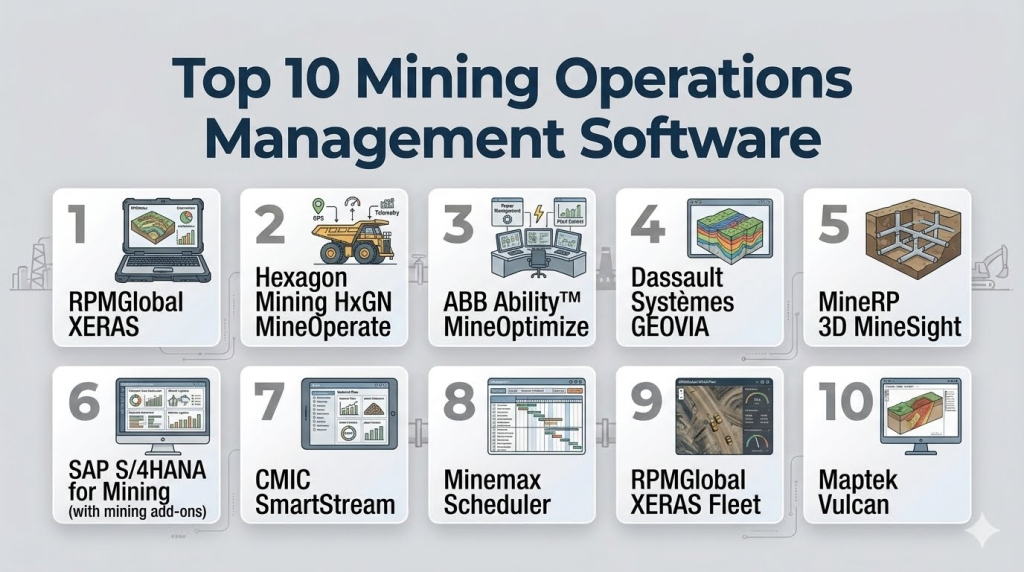
Top 10 Mining Operations Management Software Tools
1 — RPMGlobal XERAS
Short description: Comprehensive end‑to‑end mining operations platform combining scheduling, maintenance planning, and performance optimization for mid‑market to enterprise users.
Key Features
- Long‑term and short‑term mine planning
- Integrated maintenance and reliability workflows
- Real‑time production tracking and dashboards
- Fleet productivity analysis
- Safety and compliance tracking
- Scenario modelling and optimization
Pros
- Deep mine planning and optimization capabilities
- Strong integration between maintenance and operations
- Flexible reporting for performance and safety
Cons
- Steeper learning curve for new users
- Deployment planning can be resource‑intensive
Platforms / Deployment
- Web / Windows
- Cloud / Hybrid
Security & Compliance
- Not publicly stated
Integrations & Ecosystem
Integrates with ERP systems, IoT sensors, fleet telematics, and GIS tools.
- ERP connectors
- Telematics feeds
- API access
Support & Community
Strong documentation and structured onboarding, tiered support plans available.
2 — Hexagon Mining HxGN MineOperate
Short description: Enterprise mining management suite covering fleet telematics, production planning, and worker safety management.
Key Features
- Real‑time fleet monitoring
- Production scheduling and dispatch
- Maintenance and inspection workflow support
- Safety and incident reporting
- Predictive analytics for equipment health
- Geospatial visualization
Pros
- Market‑proven telematics and real‑time operations
- Strong safety and compliance modules
Cons
- Complex for small sites to deploy fully
- Premium pricing for enterprise modules
Platforms / Deployment
- Web / Windows / Android / iOS
- Cloud / Hybrid
Security & Compliance
- Not publicly stated
Integrations & Ecosystem
Strong integration with sensor networks, planning tools, and enterprise systems.
- Fleet telematics
- Planning systems
- IoT platforms
Support & Community
Comprehensive documentation and active user community, global support teams.
3 — ABB Ability™ MineOptimize
Short description: Unified platform focusing on process optimization, energy management, and automation for mining operations.
Key Features
- Process performance analytics
- Energy usage and optimization dashboards
- Automated workflow orchestration
- Equipment health analytics
- Centralized operations monitoring
- Safety event tracking
Pros
- Strong focus on energy and process efficiency
- Scales well across multiple sites
Cons
- Process‑centric may not suffice for full fleet planning
- Integration setup can be detailed
Platforms / Deployment
- Web / Windows
- Cloud / Hybrid
Security & Compliance
- Not publicly stated
Integrations & Ecosystem
Integrates with control systems, ERP platforms, and predictive analytics tools.
- Control system connectors
- ERP integration
- API extensibility
Support & Community
Professional training and global support available, documentation extensive.
4 — Dassault Systèmes GEOVIA
Short description: Advanced mining planning and modelling software with strong geostatistical and optimization capabilities.
Key Features
- Geological modelling tools
- Mine planning and scheduling
- Production forecasting
- Resource estimation
- Scenario analysis and profitability modelling
Pros
- Industry‑leading geological and planning depth
- Excellent scenario modelling
Cons
- Specialized planning focus; operations modules require integrations
- Higher cost and expertise required
Platforms / Deployment
- Windows / Web
- Cloud / Hybrid
Security & Compliance
- Not publicly stated
Integrations & Ecosystem
Extends into ERP, transport systems, and field data capture tools.
- Geostatistical systems
- ERP systems
- Field apps
Support & Community
Robust documentation, global training programs, strong community presence.
5 — MineRP 3D MineSight
Short description: End‑to‑end solution for mine design, planning, and operational control with strong 3D visualization.
Key Features
- 3D modelling and visualization
- Planning and scheduling
- Resource and reserve management
- Production tracking
- Safety and compliance dashboards
Pros
- Excellent 3D visual context for decisions
- Strong planning and reserve tools
Cons
- Operations management depth varies by module
- Interface may feel dated to some users
Platforms / Deployment
- Windows / Web
- Cloud / Hybrid
Security & Compliance
- Not publicly stated
Integrations & Ecosystem
Supports data exchange with fleet systems, control platforms, and GIS.
- Fleet systems
- Sensor networks
- GIS integration
Support & Community
Standard vendor support and user forums, training available.
6 — SAP S/4HANA for Mining with Mining Add‑Ons
Short description: Enterprise resource planning platform tailored for mining operations, integrating finance, procurement, maintenance, and operations workflows.
Key Features
- Integrated ERP core
- Maintenance and reliability workflows
- Material and warehouse management
- Workforce planning
- Finance and cost tracking
- Safety and compliance modules
Pros
- Deep enterprise integration across functions
- Consolidates operational and financial data
Cons
- Not a standalone mining ops tool; requires configuration
- Upfront implementation complexity
Platforms / Deployment
- Web
- Cloud / Hybrid
Security & Compliance
- SOC 2 / ISO 27001 likely for core platform; specifics vary
Integrations & Ecosystem
Integrates with IoT, field service, planning, and analytics ecosystems.
- IoT sensors
- Field service tools
- Analytics platforms
Support & Community
Large global support ecosystem, extensive documentation, community networks.
7 — CMIC SmartStream
Short description: Enterprise workflow and asset management system used in mining for maintenance, safety, and project coordination.
Key Features
- Work order and asset lifecycle management
- Maintenance planning and execution
- Safety and incident tracking
- Document and compliance control
- Mobile field applications
Pros
- Strong maintenance and asset focus
- Field mobile support
Cons
- Less focus on production planning
- Configurable setup required
Platforms / Deployment
- Web / Windows / Android / iOS
- Cloud / Hybrid
Security & Compliance
- Not publicly stated
Integrations & Ecosystem
Integrates with ERP, planning, and equipment telematics.
- ERP systems
- Telematics feeds
- Mobile field apps
Support & Community
Dedicated support tiers, documentation, and user networks.
8 — Minemax Scheduler
Short description: Scheduling and strategic planning software optimized for maximizing mining value and blending operational scenarios.
Key Features
- Short‑ and medium‑term scheduling
- Scenario modelling
- Profit optimization tools
- Resource constraint analysis
- Reporting and dashboards
Pros
- Strong scheduling and value focus
- Easy to iterate scenarios
Cons
- Not a full ops suite; best as part of wider ecosystem
- Integrations needed for telemetry
Platforms / Deployment
- Windows / Web
- Cloud / Hybrid
Security & Compliance
- Not publicly stated
Integrations & Ecosystem
Integrates with planning tools and ERP; requires connectors for operations data.
- Planning systems
- ERP
- Data exports
Support & Community
Standard vendor support; training programs available.
9 — RPMGlobal XERAS Fleet
Short description: Fleet‑centric module from RPMGlobal focusing on heavy equipment utilization and productivity across sites.
Key Features
- Real‑time fleet utilization dashboards
- Productivity and performance metrics
- Truck and loader cycle analysis
- Predictive alerts on utilization drops
- Mobile fleet views
Pros
- Laser focus on fleet productivity
- Helps reduce equipment costs
Cons
- Requires integration with main ops suite
- Not full ops management
Platforms / Deployment
- Web / Android / iOS
- Cloud / Hybrid
Security & Compliance
- Not publicly stated
Integrations & Ecosystem
Works with telematics, planning, and maintenance systems.
- Telematics
- Maintenance tools
- Mobile apps
Support & Community
Documentation and vendor support available.
10 — Maptek Vulcan
Short description: Geological and mine design platform extending into operational planning and visualization.
Key Features
- 3D modelling and geological analysis
- Design tools for pits and underground works
- Scheduling and optimization
- Resource estimation
- Visualization dashboards
Pros
- Strong geological and design depth
- Visualization supports planning clarity
Cons
- Operations modules require add‑ons
- Not focused on fleet or maintenance
Platforms / Deployment
- Windows / Web
- Cloud / Hybrid
Security & Compliance
- Not publicly stated
Integrations & Ecosystem
Connects with planning, GIS, and telemetry systems.
- Planning tools
- GIS
- IoT feeds
Support & Community
Active user forums, documentation, and training.
Comparison Table (Top 10)
| Tool Name | Best For | Platform(s) Supported | Deployment | Standout Feature | Public Rating |
|---|---|---|---|---|---|
| RPMGlobal XERAS | Full ops management | Web / Windows | Cloud / Hybrid | End‑to‑end ops workflows | N/A |
| Hexagon HxGN MineOperate | Fleet + safety | Web / Windows / Mobile | Cloud / Hybrid | Real‑time fleet + safety | N/A |
| ABB Ability MineOptimize | Process + energy | Web / Windows | Cloud / Hybrid | Process optimization | N/A |
| Dassault GEOVIA | Advanced planning | Windows / Web | Cloud / Hybrid | Geological & planning depth | N/A |
| MineRP 3D MineSight | 3D planning & ops | Windows / Web | Cloud / Hybrid | 3D visualization | N/A |
| SAP S/4HANA Mining | ERP + ops | Web | Cloud / Hybrid | Operational finance integration | N/A |
| CMIC SmartStream | Asset & maintenance | Web / Mobile | Cloud / Hybrid | Maintenance workflows | N/A |
| Minemax Scheduler | Scheduling focused | Windows / Web | Cloud / Hybrid | Scheduling & value optimization | N/A |
| RPMGlobal XERAS Fleet | Fleet productivity | Web / Mobile | Cloud / Hybrid | Fleet utilization insights | N/A |
| Maptek Vulcan | Geological + design | Windows / Web | Cloud / Hybrid | Geological modelling | N/A |
Evaluation & Scoring of Mining Operations Management Software
| Tool Name | Core (25%) | Ease (15%) | Integrations (15%) | Security (10%) | Performance (10%) | Support (10%) | Value (15%) | Weighted Total |
|---|---|---|---|---|---|---|---|---|
| RPMGlobal XERAS | 9 | 7 | 8 | 8 | 8 | 8 | 7 | 8.2 |
| Hexagon HxGN MineOperate | 9 | 7 | 8 | 8 | 8 | 8 | 7 | 8.2 |
| ABB MineOptimize | 8 | 7 | 8 | 8 | 8 | 7 | 7 | 7.7 |
| Dassault GEOVIA | 8 | 6 | 7 | 8 | 8 | 8 | 7 | 7.6 |
| MineRP 3D MineSight | 8 | 7 | 7 | 8 | 7 | 7 | 7 | 7.4 |
| SAP S/4HANA Mining | 8 | 6 | 9 | 9 | 8 | 8 | 6 | 7.8 |
| CMIC SmartStream | 7 | 7 | 8 | 8 | 7 | 7 | 7 | 7.4 |
| Minemax Scheduler | 7 | 8 | 7 | 8 | 7 | 7 | 8 | 7.5 |
| RPMGlobal XERAS Fleet | 7 | 8 | 8 | 8 | 7 | 7 | 8 | 7.6 |
| Maptek Vulcan | 8 | 6 | 7 | 8 | 7 | 7 | 7 | 7.2 |
Which Mining Operations Management Tool Is Right for You?
Solo / Freelancer
Most tools in this category are geared toward mid‑market or enterprise mining operations. Solo contractors or consultants may prefer lightweight planning and reporting tools rather than full operations suites.
SMB
Mid‑sized mining operations benefit from tools like RPMGlobal XERAS, CMIC SmartStream, or Minemax Scheduler that balance core capabilities with flexibility and lower complexity.
Mid‑Market
Organizations with larger fleets, complex schedules, and safety compliance requirements can benefit from Hexagon HxGN MineOperate, MineRP 3D MineSight, or SAP S/4HANA with mining add‑ons to unify workflows.
Enterprise
Global mining enterprises should consider platforms with deep analytics and integration breadth such as AbermineOptimize, Dassault GEOVIA, or RPMGlobal XERAS with advanced modules.
Budget vs Premium
- Budget‑friendly: Minemax Scheduler, CMIC SmartStream
- Premium enterprise: Hexagon HxGN, RPMGlobal XERAS, ABB MineOptimize
Feature Depth vs Ease of Use
- Feature depth: Dassault GEOVIA, SAP S/4HANA Mining
- Ease of use: Minemax Scheduler, RPMGlobal XERAS Fleet
Integrations & Scalability
- Strong integrations: SAP S/4HANA Mining, Hexagon HxGN
- Highly scalable: Cloud‑native modules of RPMGlobal and ABB
Security & Compliance Needs
When stringent compliance is needed, platforms backed by broader enterprise security frameworks (like SAP) tend to provide stronger governance and audit capabilities.
Frequently Asked Questions (FAQs)
1- What pricing models are common for mining operations software?
Most platforms use subscription (SaaS) or hybrid licensing models with module‑based costs. Tailored enterprise pricing is common based on modules and deployment scale.
2- How long does implementation typically take?
Implementation can range from 3 to 12 months depending on site complexity, data migrations, and integration scopes.
3- Do these tools support mobile field operations?
Yes. Most modern mining ops solutions include mobile apps for field data capture, inspections, and task workflows with offline capabilities.
4- Can mining ops software integrate with existing ERP and IoT systems?
Yes. Integration with ERP, IoT telematics, and control systems is a core requirement for many organizations to unify data flows.
5- What are common mistakes when choosing mining ops software?
Underestimating integration effort, ignoring field user needs, and selecting tools without future‑proof analytics capabilities are frequent pitfalls.
6- How do these systems support safety and compliance?
They centralize incident reporting, track safety KPIs, generate compliance dashboards, and help align operations with regulatory standards.
7- Are AI and predictive analytics standard features?
AI capability is becoming more prevalent but may require premium modules or integrations with analytics engines.
8- What deployment options are available?
Cloud, hybrid, and on‑prem deployments are common, allowing flexibility based on security policies and infrastructure.
9- Can these tools scale across multiple sites?
Yes. Enterprise tools are designed to manage operations over multiple mine sites with centralized visibility.
10- What alternatives exist to full mining ops platforms?
Smaller operations may choose standalone fleet telematics, maintenance management systems, or general ERP tools with limited mining extensions.
Conclusion
Mining Operations Management Software has evolved into a critical enabler of efficient, safe, and compliant mining operations. As the industry adopts AI analytics, mobile field support, and interconnected planning systems, choosing the right platform has significant operational and financial implications. There’s no one‑size‑fits‑all answer mid‑market teams may prioritize ease of use and specific modules, while global enterprises need deep analytics, integration breadth, and strong governance. The practical

Find Trusted Cardiac Hospitals
Compare heart hospitals by city and services — all in one place.
Explore Hospitals
Mining operations management software is most effective when it provides real-time visibility across production, equipment, and workforce activities. By combining operational data with predictive analytics, these platforms can improve resource utilization, enhance safety, reduce downtime, and support more efficient decision-making throughout the mining lifecycle.