Introduction
Modern data teams face an immense challenge. As organizations demand faster insights, data pipelines grow more complex, brittle, and difficult to manage. A single broken schema or delayed upstream table can corrupt downstream reports, dashboards, and machine learning models. Traditional software deployment methods fall short because data environments involve dynamic state, massive volume variations, and unique quality dependencies.This operational friction is where understanding what is DataOps becomes essential. Rather than treating data engineering as a series of manual scripts and isolated scheduled tasks, DataOps applies agile methodologies, continuous integration, and automated testing to data workflows. It aligns data engineers, analytics engineers, and platform operators to deliver clean, reliable data at scale.In this guide, you will learn the core components of DataOps, how it differs from traditional practices, and how automated workflows improve pipeline reliability across cloud data platforms.
What Is DataOps?
At its core, DataOps is a collaborative, automated practice that improves the design, testing, deployment, and monitoring of data workflows. It combines data engineering, DevOps principles, and agile quality control to reduce cycle times and increase data reliability.Unlike traditional software engineering, data systems process moving, evolving assets. Data changes shape due to upstream schema drift, volume spikes, and unexpected null values. DataOps addresses these variables by introducing rigorous pipeline automation, continuous testing, and real-time observability.When implemented correctly, DataOps shifts a data team from reactive firefighting to proactive platform engineering. Instead of discovering broken dashboards through frustrated business stakeholders, automated tests and alerts catch anomalies inside the pipeline before consumption.
Why Does DataOps Matter?
As data ecosystems expand into multi-cloud data warehouses and lakehouses, manual deployment models break down. Organizations rely on timely data to power financial models, customer personalization, and operational logistics. When pipelines fail silently, business decisions suffer.
DataOps matters because it establishes clear feedback loops. It introduces accountability, version control, and automated checks across the entire lifecycle of information.
- Reduces downtime: Automated testing catches missing records, duplicates, and schema mismatches early.
- Accelerates delivery: CI/CD pipelines allow engineers to push transformation changes to production with confidence.
- Improves collaboration: Shared repositories and documentation bridge the gap between technical data engineers and business analysts.
Key Components of a DataOps Architecture
Building a reliable DataOps environment requires a modular architecture where every stage of the data lifecycle is tracked, tested, and automated.
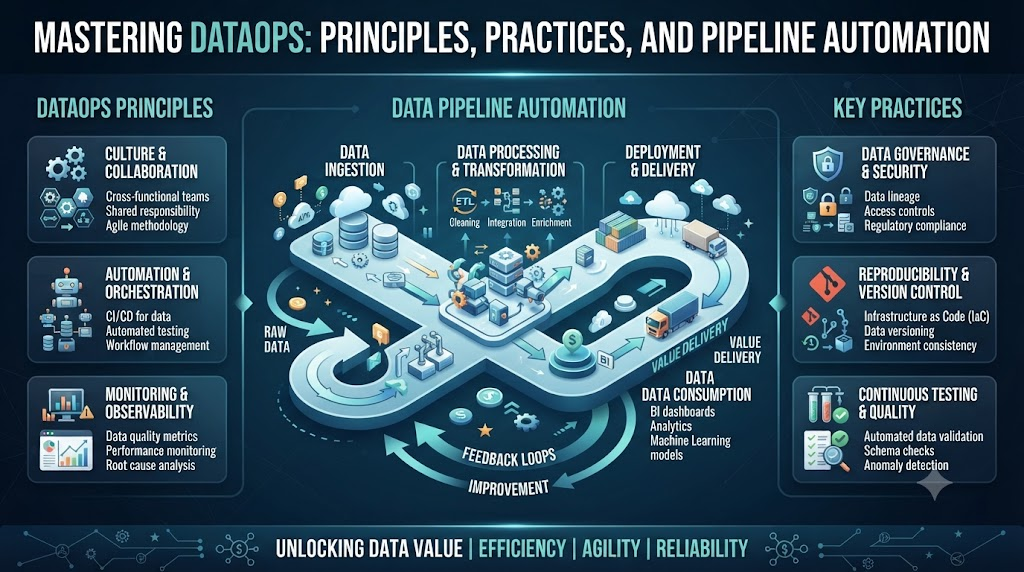
Data Sources → Ingestion → Storage → Transformation → Quality Checks → Deployment → Monitoring → Consumption
1. Version Control and Infrastructure as Code
All code, whether it is orchestration DAGs, SQL transformation models, or infrastructure definitions, lives in version control systems like Git. Infrastructure as Code (IaC) tools like Terraform provision cloud storage and compute resources reproducibly across development, staging, and production environments.
2. Workflow Orchestration
Data pipelines depend on precise sequencing. Orchestrators manage task dependencies, handle retries on transient network failures, and schedule batch or streaming ingestion jobs efficiently.
3. Automated Testing and Data Quality
Data validation cannot wait until production. DataOps integrates automated tests directly into deployment workflows to verify row counts, column uniqueness, accepted value ranges, and relational integrity.
4. Data Observability
While traditional monitoring tracks CPU usage and disk space, data observability tracks data freshness, volume anomalies, schema evolution, and field-level lineage. It helps engineers trace the exact root cause of a downstream metric drop within minutes.
DataOps vs DevOps: Understanding the Differences
While DataOps draws heavy inspiration from DevOps, data engineering introduces unique constraints that pure software deployment pipelines do not face.
| Dimension | DevOps | DataOps |
| Core Asset | Application source code | Data assets, schemas, and code |
| State Dependency | Stateless application logic | Stateful, historical, and evolving data |
| Testing Focus | Code syntax, unit tests, and APIs | Data quality, schema drift, and freshness |
| Failure Impact | Application downtime | Corrupted analytics, reports, and ML models |
DataOps acknowledges that code changes are only half the battle. Even if application code is bug-free, a sudden shift in upstream source data can completely break analytical downstream outputs.
Implementing CI/CD for Data Pipelines
Continuous Integration and Continuous Delivery (CI/CD) form the heartbeat of operational efficiency in DataOps. In a mature setup, whenever an engineer updates a transformation model or ingestion script, automated checks run in an isolated staging environment.
- Linting and Static Analysis: Code is scanned for syntax errors, formatting inconsistencies, and query anti-patterns.
- Integration Testing: Pipelines run against a subset of anonymized or synthetic sample data to verify transformation logic.
- Automated Promotion: Once tests pass, changes merge into the main branch and deploy automatically to production data warehouses.
- Automated Rollbacks: If a deployment introduces runtime errors or schema failures, the orchestration layer rolls back to the last stable state.
Common Challenges in Data Operations
Scaling data operations is rarely straightforward. Engineering teams frequently encounter structural hurdles that slow down delivery and compromise data trust.
- Schema Drift: Upstream third-party APIs or application databases alter column names or data types unexpectedly, breaking downstream ingestion scripts.
- Pipeline Dependencies: Complex dependency graphs create cascading failures where a single delayed batch halts dozens of downstream dashboards.
- Lack of Visibility: Without robust lineage tracking, identifying which downstream report relies on a failing ingestion table can take hours of manual investigation.
- Environment Inconsistency: Development data models that work locally often fail in production due to concurrency limits or volume differences.
Structured DataOps training and professional guidance help engineering teams establish the repeatable patterns needed to navigate these technical roadblocks.
Practical Tips / Key Takeaways
- Start Small with Testing: Do not try to test every single column on day one. Focus initial data quality rules on primary keys, freshness, and null counts for critical tables.
- Treat Data as Code: Keep your transformation logic, pipeline definitions, and configuration files in version control with mandatory pull request reviews.
- Invest in Observability Early: Implement pipeline monitoring and alerting before scaling your ingestion volume to catch failures before your stakeholders do.
- Foster Cross-Team Collaboration: Bring data engineers, analytics engineers, and business consumers together to define what high data quality actually means for your organization.
10 FAQs
1. What is DataOps?
DataOps is a collaborative and automated methodology that combines agile principles, DevOps automation, and data engineering to improve the speed, quality, and reliability of data pipelines.
2. Why is DataOps important?
It reduces pipeline failures, ensures high data quality, and accelerates the delivery of reliable analytics and machine learning models to business stakeholders.
3. What does a DataOps Engineer do?
A DataOps Engineer builds, automates, and monitors data pipelines, manages infrastructure, implements CI/CD workflows, and ensures robust data quality and observability.
4. What is included in DataOps training?
DataOps training covers workflow orchestration, data testing, version control, CI/CD pipelines, cloud data platforms, and automated data quality management.
5. What is a DataOps certification?
A DataOps certification validates an engineer or architect’s practical knowledge of building scalable, automated, and reliable data operations environments using industry-standard tools.
6. Which tools are commonly used in DataOps?
Common tools include Apache Airflow and Dagster for orchestration, dbt for data transformation, Great Expectations and Soda for data testing, and Snowflake or BigQuery for data storage.
7. How does DataOps improve data quality?
It integrates automated tests directly into pipeline deployments, allowing teams to catch missing records, schema drift, and unexpected null values before data reaches production.
8. How is DataOps different from DevOps?
While DevOps focuses on deploying stateless application software, DataOps addresses the unique challenges of stateful data pipelines, schema evolution, and continuous data quality validation.
9. What skills are needed to become a Certified DataOps Engineer?
Essential skills include proficiency in SQL and Python, experience with CI/CD pipelines, workflow orchestration, infrastructure automation, and cloud data platforms.
10. What does DataOps consulting involve?
DataOps consulting helps organizations modernize data platforms, automate messy ingestion pipelines, implement CI/CD frameworks, and improve overall data reliability and governance.
Conclusion
Building resilient data systems requires more than just powerful cloud warehouses or clever SQL queries. It demands a disciplined cultural and technical framework that treats data pipelines with the same operational rigor as production software applications. By embracing pipeline automation, continuous testing, and robust observability, teams can eliminate brittle workflows and deliver trustworthy insights consistently. Exploring structured educational resources and platforms like DataOpsSchool.com helps engineers master these modern operational practices and scale their data infrastructure with confidence.

Find Trusted Cardiac Hospitals
Compare heart hospitals by city and services — all in one place.
Explore Hospitals