Introduction
Integrating intelligence into modern software applications has shifted from an experimental initiative to a core business requirement. Organizations across industries face mounting pressure to process vast amounts of data, automate repetitive workflows, and deliver personalized user experiences. However, moving from traditional software engineering to intelligent application design introduces new architectural, operational, and strategic challenges.Leaders often struggle to determine where machine learning models add genuine value versus where traditional logic remains sufficient. Furthermore, bridging the gap between data science experiments and production-grade software requires disciplined engineering practices.Effective AI software development bridges this gap by combining robust software engineering principles with advanced machine learning capabilities. Whether an organization aims to introduce intelligent search, automate document processing, or build autonomous workflows, a structured approach is essential. This guide explores the core components of modern AI software development, evaluates architectural considerations, and provides actionable insights for organizations partnering with an experienced AI Software Development Company India like Cotocus.in to build scalable, intelligent systems.
What Is AI Software Development?
AI software development refers to the process of designing, building, and deploying software applications that incorporate artificial intelligence and machine learning capabilities. Unlike traditional software that relies exclusively on hard-coded rules and deterministic logic, AI-enabled applications can learn from data, recognize patterns, make predictions, and adapt to changing inputs.
At its core, this discipline blends standard software engineering—such as API design, microservices architecture, and CI/CD pipelines—with data-centric components like model selection, feature engineering, and inference optimization. Building an intelligent application requires more than just integrating a pre-trained model. It involves creating a complete ecosystem that handles data ingestion, preprocessing, secure model execution, and continuous monitoring.
AI-Powered Applications vs. Traditional Software
Traditional software executes predefined instructions predictably. If input A is provided, the system outputs B based on explicit developer logic.
AI-powered applications, by contrast, handle probabilistic outcomes. They interpret unstructured data—such as natural language text, images, or audio streams—and derive actionable outputs. This capability enables systems to handle ambiguous inputs, summarize complex documents, and automate decision-making processes that previously required human intervention.
Why AI Software Development Matters for Businesses
Modern enterprises accumulate massive volumes of operational, transactional, and customer data. Without intelligent tooling, much of this data remains underutilized. AI software development transforms raw data into active business value by automating complex tasks and uncovering deep operational insights.
Driving Operational Efficiency
Organizations spend countless hours on manual data entry, customer support triage, and document review. Intelligent automation streamlines these workflows, allowing human teams to focus on strategic initiatives. By embedding machine learning models into existing enterprise workflows, businesses reduce operational bottlenecks and accelerate processing times.
Enhancing Customer Experiences
Today’s consumers expect personalized, responsive interactions. AI-driven applications analyze user behavior in real-time to deliver tailored recommendations, instant support, and context-aware responses. This level of personalization increases user engagement and strengthens brand loyalty.
Key Components of Modern AI Architecture
Successful AI initiatives rely on a well-architected technical stack. Understanding these components helps engineering teams design resilient and scalable systems.
1. Data Pipelines and Ingestion
High-performing machine learning models require clean, structured, and timely data. Robust data pipelines ingest information from diverse sources, sanitize it, and store it in formats optimized for training or real-time inference.
2. Model Layer and Inference Engines
The model layer hosts the machine learning algorithms, large language models (LLMs), or neural networks. Efficient inference engines ensure that models respond to user requests with minimal latency, even under high concurrency.
3. Orchestration and Business Logic
AI models rarely operate in isolation. Orchestration layers connect model outputs to traditional business logic, databases, and external APIs, ensuring that AI-driven insights translate into concrete system actions.
Practical Business Use Cases
Organizations leverage intelligent software across diverse operational domains to solve complex challenges.
- Intelligent Document Processing: Automating the extraction of key data points from unstructured invoices, contracts, and reports.
- Enterprise Knowledge Assistants: Implementing retrieval-augmented generation systems to help internal teams instantly search and retrieve information from internal knowledge bases.
- Predictive Maintenance: Analyzing IoT sensor data in manufacturing environments to anticipate equipment failures before they cause operational downtime.
- Automated Customer Support: Deploying context-aware AI agents that resolve tier-one support inquiries while seamlessly escalating complex cases to human agents.
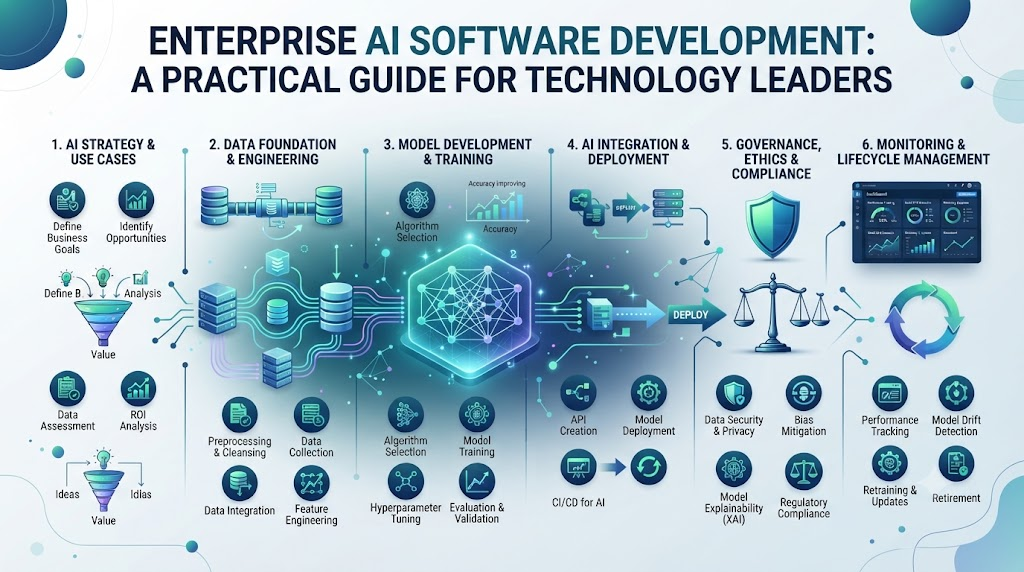
Implementation Process for AI Projects
Building and deploying intelligent software requires a structured, iterative lifecycle that accounts for the probabilistic nature of machine learning.
Step 1: Problem Definition and Feasibility
Before writing code, teams must clearly define the business problem. Not every challenge requires an AI solution; sometimes traditional automation or simple scripting is more cost-effective and reliable.
Step 2: Data Assessment and Preparation
Evaluating data availability, quality, privacy, and compliance is critical. High-quality data ensures that models produce reliable, unbiased outputs.
Step 3: Architecture Design and Prototyping
Engineers select appropriate models, APIs, and frameworks. Building a rapid prototype validates the technical feasibility of the solution before committing to full-scale development.
Step 4: Integration and Testing
Integrating AI components into existing software environments requires specialized testing strategies. Teams must evaluate model accuracy, latency, security vulnerabilities, and edge-case behavior.
Step 5: Deployment and Observability
Deploying the application to production is only the beginning. Continuous monitoring tracks model drift, inference latency, API usage costs, and overall system reliability.
Security, Compliance, and Governance
As AI systems handle increasingly sensitive enterprise data, security and governance become paramount. Organizations must implement robust access controls, encryption standards, and auditing mechanisms.
- Data Privacy: Ensuring that personally identifiable information (PII) is properly masked or excluded from training and inference data.
- Access Management: Restricting model execution and data access based on the principle of least privilege.
- Hallucination and Output Validation: Implementing validation layers to catch incorrect or unintended model outputs before they impact business operations or end-users.
Comparison Table — AI Development vs. Traditional Development
| Development Approach | Primary Objective | Key Challenge | Best Suited For |
| Traditional Software | Execute deterministic business logic | Maintaining rigid rule sets at scale | Core banking, ERP systems, deterministic workflows |
| AI Software Development | Handle probabilistic data and patterns | Managing model drift and data quality | Content summarization, predictive analytics, automation |
| Generative AI Solutions | Generate human-like text and media | Controlling hallucinations and managing costs | Knowledge assistants, creative workflows, code generation |
| AI Agent Development | Execute goal-driven multi-step tasks | Managing complex tool orchestration and state | Autonomous operations, advanced workflow automation |
Practical Tips / Key Takeaways
- Start with a Clear Use Case: Focus on solving a specific business bottleneck rather than adopting AI for its own sake.
- Prioritize Data Quality: Invest early in clean data pipelines, as poor input data inevitably leads to unreliable AI outputs.
- Design for Observability: Implement comprehensive logging and monitoring to track model performance and API latency in production.
- Plan for Iteration: Treat AI models as living components that require ongoing evaluation, tuning, and updating.
- Incorporate Human Oversight: Maintain human-in-the-loop workflows for critical decision-making processes to ensure accuracy and accountability.
- Collaborate with Specialists: Partnering with an experienced team like Cotocus.in ensures that your intelligent applications are built with enterprise-grade security and scalability.
Frequently Asked Questions
1. What is the main difference between traditional software and AI software?
Traditional software relies on fixed rules written by developers to process inputs predictably. AI software uses data-driven models to recognize patterns, handle unstructured inputs, and make probabilistic decisions, enabling it to adapt to novel situations.
2. How do I know if my business needs AI software development?
If your organization struggles to process large volumes of unstructured data, spends excessive time on repetitive manual workflows, or requires advanced personalization for users, exploring AI development is likely beneficial.
3. What role does data quality play in AI development?
Data quality is fundamental. Machine learning models learn directly from provided data. Inaccurate, biased, or messy data results in unreliable outputs, making robust data preparation a critical phase of any AI project.
4. How long does it typically take to build an AI-powered application?
Timelines vary significantly based on project complexity, data readiness, integration requirements, and scope. Simple integrations can take weeks, while complex enterprise-grade systems require several months of iterative development and testing.
5. What are the security risks associated with AI applications?
Key risks include data privacy leaks, unauthorized model access, prompt injection vulnerabilities, and unintended model hallucinations. Implementing strict access controls and validation layers helps mitigate these risks.
6. Can AI features be added to existing software systems?
Yes. Many organizations integrate AI capabilities into legacy applications via APIs, microservices, or wrapper architectures without needing to rebuild their entire core platform from scratch.
7. What is the difference between an AI chatbot and an AI agent?
Traditional chatbots follow scripted conversation paths or simple intent matching. AI agents are goal-driven systems capable of reasoning, selecting appropriate tools, invoking APIs, and executing multi-step workflows autonomously.
8. How are AI development costs determined?
Costs depend on project scope, data preparation requirements, model selection, API usage fees, cloud infrastructure, integration complexity, and ongoing maintenance and monitoring needs.
9. Why is monitoring important after deploying AI software?
Production environments change constantly. Monitoring helps detect model drift (degrading accuracy over time), tracks API response latency, and ensures the application remains cost-effective and reliable.
10. How can Cotocus.in help with our AI initiative?
Cotocus.in provides expert guidance across software engineering, cloud architecture, and AI integration, helping organizations design, build, and scale secure, high-performing intelligent applications tailored to specific business goals.
Conclusion
Embracing intelligent software engineering requires a balance of technical rigor, architectural foresight, and clear business alignment. By moving beyond experimental prototypes and investing in robust, scalable AI architectures, organizations can unlock unprecedented levels of efficiency and innovation. Whether you are building an intelligent SaaS platform or modernizing enterprise workflows, partnering with knowledgeable practitioners ensures sustainable success. To explore how tailored intelligent systems can accelerate your digital roadmap, consider collaborating with Cotocus.in for expert guidance and execution.

Find Trusted Cardiac Hospitals
Compare heart hospitals by city and services — all in one place.
Explore Hospitals