INTRODUCTION
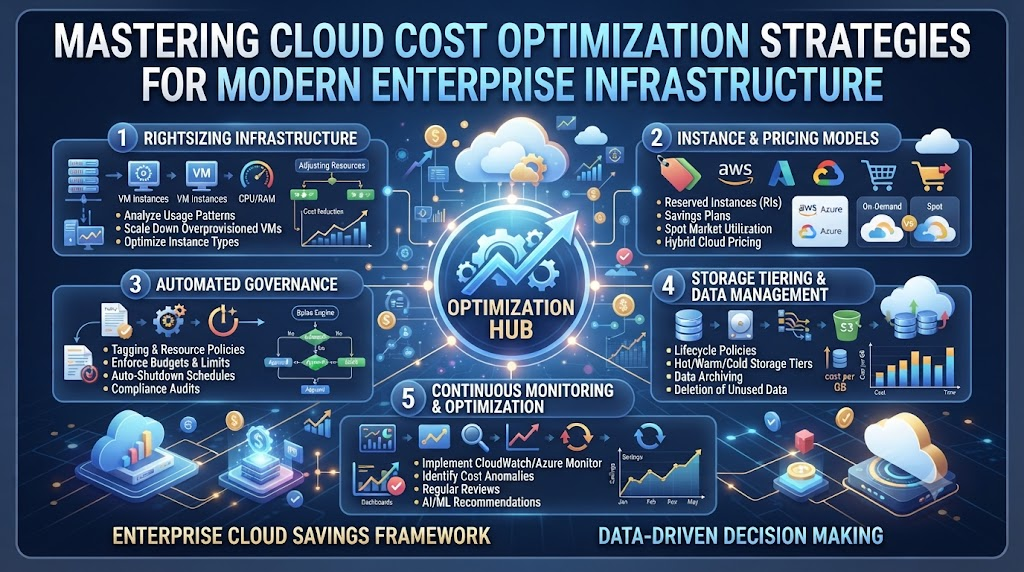
Strategic enterprise engineering teams frequently watch infrastructure invoices outpace overall business revenue when cloud environments scale without rigorous financial governance. As distributed microservices, container orchestrators, and sprawling data pipelines expand, managing resource consumption becomes just as critical as maintaining system uptime. This tension between rapid delivery and fiscal accountability defines modern cloud cost optimization. Without systematic oversight, engineering groups inadvertently provision redundant capacity, leaving idle compute nodes and unattached storage volumes to drain operational budgets.This article explores how platform engineers, SREs, and cloud operations teams can systematically control expenses without degrading application performance or reliability. Readers will learn core financial governance frameworks, architecture patterns for resource right-sizing, platform-agnostic automation strategies, and a step-by-step implementation roadmap designed to foster sustainable fiscal habits. For broader insights into maintaining resilient architectures, visit CloudOpsNow.
WHAT IS CLOUD COST OPTIMIZATION?
Cloud cost optimization is the continuous practice of measuring, analyzing, and reducing financial expenditures associated with cloud infrastructure while maximizing business value. Unlike traditional on-premises data centers where hardware procurement involves multi-year capital expenditure cycles, cloud platforms operate on a pay-as-you-go model.Its primary purpose is aligning software architecture expenses with actual commercial utility. Core concepts include right-sizing compute instances, capitalizing on discount models like reserved instances, and eliminating orphaned resources. Within broader cloud operations, cost control functions as a primary pillar alongside availability and security. Engineering teams utilize optimization techniques to prevent runaway bills caused by misconfigured auto-scaling groups or unmonitored development clusters. Financial analysts, DevOps practitioners, and application developers all benefit from a transparent financial feedback loop.
HOW DOES CLOUD COST OPTIMIZATION WORK?
The technical workflow of managing cloud expenses relies on continuous telemetry, automated policy enforcement, and regular architectural reviews.
- Data Ingestion and Telemetry: Cloud native billing APIs and native telemetry tools capture granular utilization metrics across compute, storage, and networking layers.
- Attribution and Tagging: Costs are mapped to specific business units, applications, or environments using standardized resource tags and metadata labels.
- Anomaly Detection: Automated monitoring pipelines analyze usage trends against historical baselines to flag unexpected expenditure spikes immediately.
- Recommendation Generation: Algorithms evaluate resource efficiency, identifying underutilized virtual machines, stale snapshots, and idle database connections.
- Remediation and Enforcement: Operations teams or automated scripts apply corrective actions, such as terminating orphan volumes or transitioning data to cheaper storage tiers.
CORE COMPONENTS OF CLOUD COST OPTIMIZATION
Infrastructure
Infrastructure right-sizing ensures that virtual servers, containers, and serverless functions match actual workload requirements. Matching peak demands without maintaining excessive headroom prevents unnecessary capital leakage.
Automation
Automation scripts and Infrastructure as Code pipelines prevent human configuration errors by automatically enforcing tagging standards, scheduling development environments to shut down off-hours, and applying patches.
Monitoring and Observability
Comprehensive monitoring tools collect real-time performance and utilization metrics, allowing teams to correlate infrastructure spend directly with application throughput and user traffic.
Cost Optimization
Dedicated financial governance models establish budgets, cost allocation policies, and accountability frameworks across engineering squads to ensure proactive spending awareness.
ROLE OF AWS, AZURE AND GCP
Major cloud providers offer specialized tooling to help organizations analyze and reduce their bills, each with distinct operational characteristics.
- Amazon Web Services (AWS): AWS provides AWS Cost Explorer, Compute Optimizer, and Trusted Advisor. These utilities offer machine learning recommendations for right-sizing EC2 instances and purchasing Savings Plans.
- Microsoft Azure: Azure Cost Management + Billing, combined with Azure Advisor, gives engineering teams granular visibility into subscription spending, hybrid benefit savings, and reserved capacity management.
- Google Cloud Platform (GCP): GCP features comprehensive billing reports, committed use discounts, and active recommendations powered by Recommender API, helping teams optimize BigQuery slots and Compute Engine instances.
CLOUD OPERATIONS AND AUTOMATION CONSIDERATIONS
Integrating financial visibility into daily cloud operations management requires mature automation workflows. Modern teams leverage Infrastructure as Code frameworks like Terraform or OpenTofu to provision resources with mandatory cost-control parameters, such as automated lifecycle rules for object storage. Furthermore, integrating policy-as-code tools ensures that non-compliant, expensive resource types cannot be deployed into production environments. Automation eliminates the latency inherent in manual audits, ensuring financial waste is intercepted at the pull-request stage.
MONITORING, OBSERVABILITY AND RELIABILITY
Balancing financial efficiency with system reliability requires disciplined observability practices. Cutting infrastructure budgets blindly often triggers performance degradation or outage risks. Engineering teams must track Service Level Indicators (SLIs) alongside cost metrics to ensure that resource reduction does not breach Service Level Objectives (SLOs). By correlating trace data and infrastructure metrics, teams can safely shed excess capacity during low-traffic windows while preserving the necessary headroom for unexpected traffic bursts.
SECURITY AND GOVERNANCE
Governance frameworks must encompass both operational security and financial integrity. Implementing strict identity and access management (IAM) policies prevents unauthorized users from provisioning high-cost GPU instances or enterprise-grade databases outside compliance boundaries. Regular access audits ensure that former employees or deprecated service accounts cannot accumulate hidden infrastructure charges. Comprehensive audit logging guarantees complete traceability for every financial or architectural modification within the cloud environment.
BEST PRACTICES
- Establish Standardized Tagging: Enforce strict resource-tagging policies across all cloud environments to ensure every dollar spent maps to a specific owner, project, or department.
- Right-Size Workloads Regularly: Review CPU, memory, and network utilization metrics continuously to downgrade over-provisioned compute instances.
- Leverage Commitment Discounts: Purchase reserved instances or savings plans for predictable, steady-state production workloads to secure substantial discounts.
- Automate Resource Scheduling: Spin down non-production development and staging environments during nights and weekends when engineers are offline.
- Clean Up Orphaned Storage: Implement automated scripts to identify and delete unattached Elastic Block Store volumes, old snapshots, and stale container images.
- Utilize Cheaper Storage Tiers: Migrate infrequently accessed archival data from standard object storage to cold or glacier storage classes.
- Monitor Data Transfer Fees: Optimize inter-region and internet egress traffic patterns to minimize unexpected networking surcharges.
COMMON MISTAKES
- Treating cost reduction as a one-time quarterly audit rather than a continuous engineering habit.
- Over-provisioning infrastructure during initial application setup “just in case” traffic spikes.
- Ignoring data egress fees when designing distributed multi-region application architectures.
- Failing to implement automated alerts for sudden budget threshold breaches.
- Relying entirely on manual spreadsheet tracking instead of native cloud financial APIs.
- Neglecting development and test environments where resource waste frequently accumulates unchecked.
- Applying aggressive cost-cutting measures without consulting application reliability engineers.
REAL-WORLD USE CASES
- E-Commerce Scalability: Retail platforms automate compute scaling to handle massive holiday traffic spikes, then scale down immediately afterward to avoid post-holiday financial waste.
- SaaS Multi-Tenant Isolation: Software providers use granular cost allocation tags to track exact resource consumption per client, improving profit margin calculations.
- Containerized Microservices: Engineering teams optimize Kubernetes cluster resource requests and limits to pack more pods onto fewer worker nodes, drastically reducing idle compute overhead.
- Data Lake Management: Analytics platforms apply lifecycle policies to automatically transition raw logs from expensive block storage to economical cold storage tiers after thirty days.
CHALLENGES AND LIMITATIONS
Implementing comprehensive cloud infrastructure management strategies involves notable friction. Teams often face cultural resistance from developers who fear that performance or deployment velocity will suffer. Tool sprawl presents another hurdle, as disparate multi-cloud environments require complex consolidation dashboards. Additionally, accurately predicting cloud expenditure in fast-growing, highly dynamic software architectures remains exceptionally difficult, requiring ongoing calibration and executive buy-in.
STEP-BY-STEP IMPLEMENTATION GUIDE
- Assess Current Baseline: Audit existing cloud bills to identify top spending drivers across all active subscriptions and accounts.
- Enforce Tagging Hygiene: Deploy policy-as-code checks to ensure all newly provisioned assets carry valid ownership and environment tags.
- Eliminate Low-Hanging Fruit: Immediately terminate unattached storage volumes, old snapshots, and idle IP addresses.
- Right-Size Compute Resources: Analyze historical utilization data to adjust CPU and memory allocations for over-provisioned virtual servers.
- Implement Commitment Strategies: Purchase appropriate savings plans or reserved instances for steady-state workloads.
- Automate Governance Alerts: Configure real-time anomaly detection and budget alert notifications for engineering leads.
- Establish Continuous Review Loops: Schedule recurring cross-functional meetings between finance, DevOps, and engineering teams to review optimization progress.
FUTURE OF CLOUD COST OPTIMIZATION
The future of financial operations heavily integrates artificial intelligence and machine learning into daily workflows. Advanced AIOps platforms will autonomously predict traffic patterns and adjust infrastructure capacity in real time without human intervention. Furthermore, the maturation of FinOps as an organizational discipline will bridge the gap between engineering execution and business finance, making efficiency a core metric of engineering excellence.
Frequently Asked Questions
- What is cloud cost optimization?
Cloud cost optimization is the ongoing practice of reducing cloud infrastructure expenses by eliminating waste, right-sizing resources, and aligning spending with business value.
- How does cloud operations management impact monthly cloud bills?
Active operations management ensures that resources do not run indefinitely without supervision, utilizing automated governance to catch configuration drift and idle assets early.
- What is the difference between right-sizing and reserved instances?
Right-sizing involves adjusting the CPU and memory allocation of a resource to match its actual workload, while reserved instances offer discounted rates in exchange for a long-term usage commitment.
- Why are resource tags important for financial governance?
Standardized tags allow organizations to accurately attribute infrastructure expenses to specific teams, projects, or applications, ensuring clear financial accountability.
- Can automation completely eliminate financial waste in the cloud?
While automation significantly reduces manual oversight errors and cleans up orphaned assets, human architectural oversight remains necessary to design efficient software systems.
- How do data egress fees affect overall cloud expenses?
Data egress fees charge organizations for moving data out of cloud provider networks or between availability zones, which can accumulate rapidly in distributed architectures.
- What role do AWS, Azure, and GCP play in financial tracking?
Major cloud providers offer native billing analytics, cost anomaly detection tools, and automated recommendation engines to help engineers identify savings opportunities.
- How often should engineering teams review their cloud expenditure?
Teams should monitor costs continuously through automated alerts and conduct comprehensive optimization reviews on a monthly basis.
- Does cost reduction compromise application performance or reliability?
When executed carefully using proper observability and metric tracking, cost optimization removes idle waste without impacting user experience or system uptime.
- What is the primary keyword for this guide?
The primary keyword for this guide is cloud cost optimization, representing the foundational strategy for managing modern digital infrastructure expenses.
CONCLUSION
Mastering cloud cost optimization requires a cultural and technical shift away from reactive spending toward proactive architectural efficiency. By combining automated resource tracking, rigorous right-sizing, and cross-functional financial accountability, engineering teams can scale their infrastructure sustainably. Effective cloud financial management ensures that every dollar invested directly supports business growth and application reliability. Embracing these practices empowers modern cloud operations teams to build resilient, cost-effective systems that stand the test of time.

Find Trusted Cardiac Hospitals
Compare heart hospitals by city and services — all in one place.
Explore Hospitals