Introduction
Digital Asset Compliance Tools help crypto businesses, fintech companies, exchanges, banks, payment providers, DeFi teams, and digital asset platforms detect risk, monitor transactions, screen wallets, investigate suspicious activity, and meet regulatory expectations. In simple terms, these tools help organizations understand whether a wallet, transaction, token, customer, or counterparty may be connected to fraud, sanctions, money laundering, scams, hacks, terrorist financing, market manipulation, or other financial crime risks. This category matters now because digital assets are becoming more connected with traditional finance, stablecoins, tokenized assets, Web3 payments, institutional custody, and cross-border settlement. As adoption grows, regulators expect stronger AML, KYT, Travel Rule, transaction monitoring, sanctions screening, case management, and audit-ready reporting.
Real-world use cases include:
- Crypto AML and KYT transaction monitoring
- Wallet screening and sanctions exposure checks
- Travel Rule compliance for VASPs
- Blockchain investigation and law enforcement support
- Stablecoin and token risk monitoring
- Market surveillance and trade abuse detection
- Exchange, custodian, and fintech compliance workflows
What buyers should evaluate:
- Blockchain coverage
- Wallet and transaction risk scoring
- Sanctions and watchlist screening
- Travel Rule support
- Case management workflows
- API and integration quality
- Alert accuracy and explainability
- Compliance reporting
- User roles and audit trails
- Support for regulated environments
Best for: Digital Asset Compliance Tools are best for crypto exchanges, custodians, banks, fintech companies, payment providers, stablecoin issuers, DeFi protocols, law enforcement teams, regulators, compliance officers, risk analysts, fraud teams, and financial institutions entering digital assets.
Not ideal for: These tools may not be necessary for casual crypto users, small hobby projects, or businesses that do not process digital asset transactions. For basic identity checks, a standard KYC provider may be enough, but crypto-native businesses usually need specialized blockchain compliance capabilities.
Key Trends in Digital Asset Compliance Tools
- KYT is becoming a standard compliance layer: Know Your Transaction tools are now essential for exchanges, custodians, wallets, stablecoin platforms, and fintechs that process crypto activity.
- Travel Rule compliance is becoming more operational: VASPs increasingly need systems that can exchange originator and beneficiary information while matching transaction flows across jurisdictions.
- Stablecoin compliance is growing quickly: Stablecoin issuers and payment platforms need stronger controls for sanctions screening, wallet risk, transaction monitoring, and reserve-related oversight.
- AI-assisted investigations are expanding: AI is being used to summarize alerts, cluster risk signals, prioritize cases, and help analysts reduce repetitive review work. Buyers should still validate model governance and false positive rates.
- Cross-chain risk detection is more important: Criminal activity increasingly moves across bridges, mixers, DeFi protocols, and multiple chains, making single-chain monitoring insufficient.
- DeFi compliance is becoming more practical: Protocols, frontends, and institutional DeFi access platforms are adopting wallet screening, token risk scoring, and policy-based transaction controls.
- Market integrity tools are converging with AML tools: Trade surveillance, manipulation detection, wash trading monitoring, and transaction monitoring are increasingly evaluated together.
- Regulators expect stronger auditability: Compliance teams need clear case histories, risk explanations, escalation workflows, evidence exports, and documented decisions.
- API-first compliance is now critical: Modern digital asset businesses need compliance checks embedded into onboarding, deposits, withdrawals, trading, custody, and treasury operations.
- Entity attribution quality is a major differentiator: The ability to connect wallet addresses to known services, scams, darknet markets, exchanges, mixers, hacks, and sanctioned entities is central to tool value.
How We Selected These Tools
The Top 10 Digital Asset Compliance Tools were selected using a practical SaaS and crypto compliance evaluation approach:
- Market adoption and recognition among crypto exchanges, custodians, fintechs, banks, regulators, and law enforcement teams
- Feature completeness across AML, KYT, wallet screening, blockchain analytics, case management, and investigations
- Blockchain and asset coverage across major public networks, tokens, bridges, and digital asset ecosystems
- Risk intelligence quality, including wallet attribution, entity clustering, sanctions exposure, scam detection, and typology coverage
- Workflow readiness for compliance teams, investigators, fraud teams, and regulated digital asset businesses
- API and integration maturity for embedding checks into onboarding, transaction, withdrawal, and monitoring workflows
- Security posture signals, including access controls, auditability, and enterprise deployment readiness
- Travel Rule and regulatory use-case support where applicable
- Customer fit across segments, from startups and VASPs to banks, regulators, and enterprise compliance teams
- Long-term relevance as digital asset markets expand into stablecoins, tokenization, DeFi, and institutional adoption
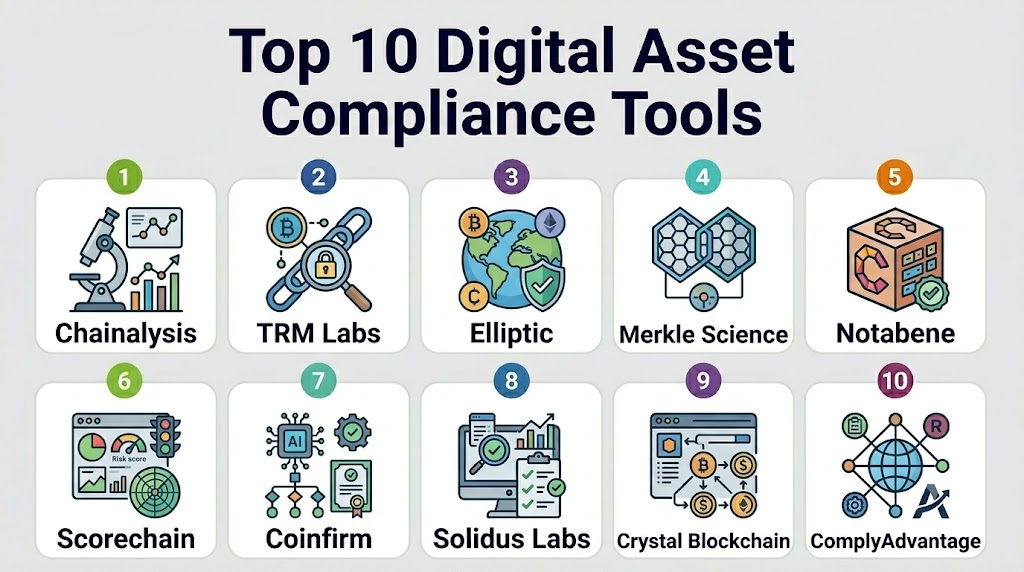
Top 10 Digital Asset Compliance Tools
1- Chainalysis
Short description: Chainalysis is one of the most recognized blockchain analytics and crypto compliance platforms. It helps crypto businesses, financial institutions, governments, and investigators monitor transactions, assess wallet risk, and investigate illicit activity.
Key Features
- Blockchain analytics and transaction monitoring
- Wallet risk scoring and entity attribution
- KYT workflows for crypto transaction monitoring
- Investigation tools for tracing funds
- Sanctions exposure and illicit activity detection
- Case management support for compliance teams
- Useful for exchanges, regulators, law enforcement, and financial institutions
Pros
- Strong market recognition in blockchain analytics
- Broad use across compliance, investigations, and public-sector use cases
- Suitable for mature crypto compliance programs
Cons
- May be expensive for smaller teams
- Advanced workflows require trained analysts
- Buyers should verify chain coverage and pricing for their exact use case
Platforms / Deployment
Web / Cloud / API-based deployment
Security & Compliance
Chainalysis is designed for regulated crypto compliance and investigation workflows. Specific certifications, audit controls, access-management features, and contractual compliance commitments should be verified during procurement.
Integrations & Ecosystem
Chainalysis fits well into compliance programs where wallet screening, transaction monitoring, and investigations need to connect with business operations.
- Crypto exchanges
- Financial institutions
- Custody platforms
- Government and law enforcement workflows
- Case management processes
- API-driven transaction monitoring
Support & Community
Chainalysis provides enterprise support, documentation, training resources, and analyst-focused guidance. Support levels may vary by contract and customer segment.
2- TRM Labs
Short description: TRM Labs provides blockchain intelligence, risk scoring, transaction monitoring, and investigation tools for crypto businesses, financial institutions, and government agencies. It is often used for AML, sanctions, fraud detection, and investigative workflows.
Key Features
- Wallet and transaction risk scoring
- Blockchain investigation and tracing
- Sanctions and illicit finance monitoring
- KYT and transaction monitoring workflows
- Cross-chain risk analysis
- Compliance case management
- API integrations for real-time screening
Pros
- Strong fit for compliance and investigation teams
- Useful for both private-sector and public-sector users
- Good coverage of modern crypto risk workflows
Cons
- May require analyst training for complex investigations
- Pricing and packaging should be validated
- Smaller teams may not need all advanced capabilities
Platforms / Deployment
Web / Cloud / API-based deployment
Security & Compliance
TRM Labs is used in risk and compliance workflows. Specific security controls, certifications, audit features, and compliance commitments should be verified during vendor evaluation.
Integrations & Ecosystem
TRM Labs works well where compliance checks need to be embedded into customer onboarding, deposits, withdrawals, and investigation workflows.
- Crypto exchanges
- Wallet providers
- Financial institutions
- Law enforcement investigations
- Transaction monitoring systems
- Risk and fraud workflows
Support & Community
TRM Labs provides documentation, customer support, and specialized resources for compliance and investigation users. Buyers should confirm onboarding support and training options.
3- Elliptic
Short description: Elliptic provides blockchain analytics and crypto compliance solutions for financial crime risk management. It helps teams screen wallets, monitor transactions, investigate blockchain activity, and manage crypto risk.
Key Features
- Blockchain analytics and wallet screening
- Crypto transaction monitoring
- Risk scoring and exposure analysis
- Investigation workflows
- Sanctions and illicit activity detection
- API-based compliance integration
- Useful for exchanges, banks, fintechs, and regulators
Pros
- Strong crypto compliance and analytics positioning
- Useful for regulated financial institutions entering digital assets
- Supports practical AML and investigation workflows
Cons
- Advanced analytics may require trained compliance staff
- Pricing and chain coverage should be reviewed directly
- Some use cases may need custom implementation
Platforms / Deployment
Web / Cloud / API-based deployment
Security & Compliance
Elliptic is designed for financial crime risk and regulatory compliance workflows. Specific enterprise security features and compliance certifications should be verified during procurement.
Integrations & Ecosystem
Elliptic integrates into digital asset compliance workflows where wallet risk, transaction screening, and investigation support are needed.
- Exchanges and custodians
- Banks and fintech platforms
- AML transaction monitoring workflows
- Sanctions screening systems
- Case investigation processes
- API-based risk checks
Support & Community
Elliptic provides customer support, documentation, and compliance-focused resources. Buyers should validate onboarding, training, and enterprise support availability.
4- Merkle Science
Short description: Merkle Science provides crypto compliance, blockchain analytics, and risk intelligence tools for exchanges, fintechs, law enforcement, and financial institutions. It is suitable for teams that need wallet screening, transaction monitoring, and investigative analytics.
Key Features
- Wallet risk assessment
- Transaction monitoring and KYT
- Blockchain investigation tools
- Risk intelligence and entity attribution
- Compliance workflow support
- API-based screening
- Useful for VASPs and regulated crypto businesses
Pros
- Strong fit for crypto AML and risk teams
- Useful for investigation and monitoring use cases
- Good option for mid-market and growing digital asset businesses
Cons
- Buyers should verify coverage for specific chains and regions
- Enterprise compliance details should be reviewed directly
- Advanced investigation features may need training
Platforms / Deployment
Web / Cloud / API-based deployment
Security & Compliance
Not publicly stated for all certifications or compliance frameworks. Buyers should verify access controls, audit logs, encryption, data handling, and regional compliance readiness.
Integrations & Ecosystem
Merkle Science can support compliance teams looking to embed wallet and transaction risk checks into digital asset operations.
- VASP compliance systems
- Exchange workflows
- Wallet screening APIs
- Investigation casework
- Fraud detection processes
- Law enforcement research workflows
Support & Community
Merkle Science provides product support and compliance-oriented resources. Support scope may vary by plan and implementation requirements.
5- Notabene
Short description: Notabene is focused on Travel Rule compliance and digital asset transaction compliance for VASPs, fintechs, and crypto businesses. It helps organizations exchange required counterparty information and manage regulatory workflows for crypto transfers.
Key Features
- Travel Rule compliance workflows
- Counterparty VASP discovery and messaging
- Transaction policy controls
- Compliance data exchange
- Support for VASP-to-VASP coordination
- API-based integration options
- Useful for regulated crypto transfers
Pros
- Strong Travel Rule specialization
- Useful for VASPs operating across jurisdictions
- Helps operationalize counterparty data exchange
Cons
- Not a full blockchain analytics platform by itself
- May need to be paired with AML and wallet screening tools
- Coverage depends on network participation and integrations
Platforms / Deployment
Web / Cloud / API-based deployment
Security & Compliance
Notabene is built for compliance data exchange and Travel Rule workflows. Buyers should verify security controls, data handling, privacy commitments, audit logs, and jurisdictional support.
Integrations & Ecosystem
Notabene fits well into crypto transfer workflows where Travel Rule requirements must be operationalized.
- VASP compliance systems
- Exchange withdrawal and deposit workflows
- Custody platforms
- AML and KYT tools
- Transaction approval systems
- Regulatory reporting workflows
Support & Community
Notabene provides onboarding and compliance-focused support. Buyers should verify implementation assistance, counterparty network coverage, and operational support.
6- Scorechain
Short description: Scorechain provides crypto AML compliance, blockchain analytics, risk scoring, and KYT tools for VASPs, banks, fintechs, and compliance teams. It is suitable for organizations that need practical transaction monitoring and wallet risk analysis.
Key Features
- Crypto AML and KYT monitoring
- Wallet risk scoring
- Blockchain analytics dashboards
- Transaction investigation tools
- Risk alerts and compliance workflows
- API-based screening support
- Useful for VASPs and banks handling digital assets
Pros
- Practical fit for compliance teams
- Useful for transaction monitoring and risk scoring
- Suitable for VASPs and financial institutions
Cons
- Buyers should validate supported chains and asset coverage
- Advanced enterprise requirements should be checked
- May require configuration to reduce false positives
Platforms / Deployment
Web / Cloud / API-based deployment
Security & Compliance
Scorechain is designed for AML compliance workflows. Specific certifications, data protection controls, audit features, and compliance commitments should be verified directly.
Integrations & Ecosystem
Scorechain can be integrated into crypto compliance workflows where ongoing monitoring and wallet risk checks are required.
- VASP compliance operations
- Banking digital asset workflows
- Crypto transaction monitoring
- Wallet screening APIs
- Investigation workflows
- Risk reporting processes
Support & Community
Scorechain provides support and documentation for compliance teams. Buyers should confirm onboarding, analyst training, and support response expectations.
7- Coinfirm
Short description: Coinfirm provides blockchain analytics, AML risk scoring, and crypto compliance solutions for digital asset businesses and financial institutions. It is useful for teams that need wallet screening, risk intelligence, and AML-focused monitoring.
Key Features
- AML risk scoring
- Wallet address screening
- Blockchain analytics
- Transaction monitoring support
- Risk indicators and exposure analysis
- API-based compliance checks
- Useful for crypto businesses and financial institutions
Pros
- Focused on crypto AML and wallet risk
- Useful for compliance screening workflows
- Can support transaction and counterparty risk analysis
Cons
- Buyers should verify current product scope and support
- Chain coverage and integration depth should be checked
- May need pairing with broader compliance systems
Platforms / Deployment
Web / Cloud / API-based deployment
Security & Compliance
Not publicly stated for all certifications and enterprise frameworks. Buyers should verify security controls, auditability, access management, and compliance support directly.
Integrations & Ecosystem
Coinfirm is relevant for teams that need wallet risk checks and AML screening integrated into crypto operations.
- Crypto exchanges
- Wallet providers
- AML workflows
- Transaction risk checks
- Compliance dashboards
- API-based screening
Support & Community
Support availability may vary by plan and engagement model. Buyers should validate current documentation, onboarding support, and account management.
8- Solidus Labs
Short description: Solidus Labs provides digital asset market surveillance, transaction monitoring, trade surveillance, and compliance technology. It is especially relevant for exchanges, brokerages, trading platforms, and institutions focused on market integrity and risk operations.
Key Features
- Trade surveillance for digital assets
- Transaction monitoring
- Market manipulation detection
- Case management workflows
- Token and market risk monitoring
- Alert management and investigation support
- Compliance automation capabilities
Pros
- Strong fit for trading platforms and exchanges
- Combines market integrity and compliance workflows
- Useful for detecting suspicious trading behavior
Cons
- Not only a wallet-screening or KYT provider
- May be more relevant for trading-heavy businesses
- Smaller teams may not need full surveillance capabilities
Platforms / Deployment
Web / Cloud / API-based deployment
Security & Compliance
Solidus Labs is built for compliance and surveillance workflows. Specific security certifications, access controls, audit logs, and compliance commitments should be verified during vendor review.
Integrations & Ecosystem
Solidus Labs fits digital asset businesses that need surveillance, transaction monitoring, and investigation workflows in one risk environment.
- Crypto exchanges
- Brokerages
- Trading venues
- Market surveillance programs
- Case management workflows
- Compliance operations
Support & Community
Solidus Labs provides enterprise-focused support and compliance resources. Buyers should validate onboarding, tuning support, and analyst training.
9- Crystal Blockchain
Short description: Crystal Blockchain provides blockchain analytics, transaction monitoring, wallet risk scoring, and investigation tools. It is used by compliance teams, investigators, and digital asset businesses that need visibility into on-chain activity.
Key Features
- Blockchain analytics and visualization
- Wallet risk scoring
- Transaction monitoring
- Investigation and fund tracing tools
- Entity attribution and exposure analysis
- Compliance workflow support
- API-based screening options
Pros
- Useful for investigation and blockchain tracing
- Supports AML and transaction monitoring workflows
- Suitable for crypto compliance teams and investigators
Cons
- Buyers should verify current chain coverage and data depth
- Advanced investigation may require trained analysts
- Enterprise compliance details should be reviewed directly
Platforms / Deployment
Web / Cloud / API-based deployment
Security & Compliance
Not publicly stated for all enterprise certifications. Buyers should verify security controls, encryption, access management, audit logs, and compliance documentation.
Integrations & Ecosystem
Crystal Blockchain fits teams that need wallet and transaction visibility across crypto compliance workflows.
- Compliance investigations
- Wallet screening workflows
- Crypto transaction monitoring
- Law enforcement research
- Risk reporting
- API-based blockchain analytics
Support & Community
Crystal Blockchain provides documentation and support resources. Buyers should confirm onboarding, analyst enablement, and support coverage.
10- ComplyAdvantage
Short description: ComplyAdvantage is a financial crime compliance platform that supports AML, sanctions screening, transaction monitoring, and risk intelligence. It is relevant for digital asset businesses that need broader compliance controls alongside crypto-specific risk workflows.
Key Features
- AML and sanctions screening
- Transaction monitoring
- Customer risk intelligence
- Watchlist and adverse media screening
- Compliance workflow automation
- API-based integration options
- Useful for fintech and digital asset compliance programs
Pros
- Strong fit for broader financial crime compliance
- Useful for fintechs and regulated businesses
- Can complement crypto-native blockchain analytics tools
Cons
- Not purely a blockchain analytics platform
- Crypto-specific depth should be validated for each use case
- May need pairing with specialized KYT tools
Platforms / Deployment
Web / Cloud / API-based deployment
Security & Compliance
ComplyAdvantage is built for financial crime compliance workflows. Specific security certifications, audit controls, and compliance commitments should be verified during procurement.
Integrations & Ecosystem
ComplyAdvantage is useful where digital asset compliance needs to connect with broader AML and customer-risk operations.
- KYC and onboarding systems
- AML transaction monitoring
- Sanctions screening
- Fintech risk workflows
- Customer risk scoring
- Compliance case management
Support & Community
ComplyAdvantage provides documentation, onboarding resources, and business support options. Support level may vary by product package and customer segment.
Comparison Table
| Tool Name | Best For | Platform Supported | Deployment | Standout Feature | Public Rating |
|---|---|---|---|---|---|
| Chainalysis | Enterprise crypto AML and investigations | Web / API | Cloud | Blockchain intelligence and KYT | N/A |
| TRM Labs | AML, sanctions, and investigations | Web / API | Cloud | Cross-chain risk intelligence | N/A |
| Elliptic | Financial crime risk management | Web / API | Cloud | Crypto compliance analytics | N/A |
| Merkle Science | VASP AML and investigation teams | Web / API | Cloud | Wallet and transaction risk scoring | N/A |
| Notabene | Travel Rule compliance | Web / API | Cloud | VASP counterparty data exchange | N/A |
| Scorechain | Crypto AML and KYT workflows | Web / API | Cloud | Practical transaction monitoring | N/A |
| Coinfirm | Wallet screening and AML risk | Web / API | Cloud | AML risk scoring | N/A |
| Solidus Labs | Market surveillance and trade compliance | Web / API | Cloud | Digital asset market integrity | N/A |
| Crystal Blockchain | Blockchain investigations and monitoring | Web / API | Cloud | Fund tracing and analytics | N/A |
| ComplyAdvantage | Broader AML and sanctions compliance | Web / API | Cloud | Financial crime risk intelligence | N/A |
Evaluation and Scoring of Digital Asset Compliance Tools
| Tool Name | Core 25% | Ease 15% | Integrations 15% | Security 10% | Performance 10% | Support 10% | Value 15% | Weighted Total 0-10 |
|---|---|---|---|---|---|---|---|---|
| Chainalysis | 9 | 8 | 9 | 9 | 9 | 9 | 8 | 8.70 |
| TRM Labs | 9 | 8 | 9 | 8 | 9 | 8 | 8 | 8.50 |
| Elliptic | 9 | 8 | 8 | 8 | 8 | 8 | 8 | 8.25 |
| Merkle Science | 8 | 8 | 8 | 8 | 8 | 8 | 8 | 8.00 |
| Notabene | 8 | 8 | 8 | 8 | 8 | 8 | 8 | 8.00 |
| Scorechain | 8 | 8 | 8 | 8 | 8 | 8 | 8 | 8.00 |
| Coinfirm | 7 | 7 | 7 | 7 | 7 | 7 | 8 | 7.25 |
| Solidus Labs | 8 | 8 | 8 | 8 | 8 | 8 | 7 | 7.85 |
| Crystal Blockchain | 8 | 7 | 8 | 8 | 8 | 7 | 8 | 7.75 |
| ComplyAdvantage | 8 | 8 | 8 | 8 | 8 | 8 | 8 | 8.00 |
Which Digital Asset Compliance Tool Is Right for You?
Solo / Freelancer
Solo builders and small Web3 founders may not need a full enterprise compliance stack at the earliest stage. If the project is experimental and does not custody assets or process customer transactions, basic wallet screening or limited API checks may be enough.
However, if a solo founder is building a wallet, exchange, payment product, stablecoin app, or token launch platform, compliance should be planned early. Lightweight API-first tools or limited plans from providers like Merkle Science, Scorechain, Coinfirm, or ComplyAdvantage may be useful depending on requirements.
SMB
SMBs should focus on tools that are practical to deploy, easy to integrate, and clear in their risk scoring. Merkle Science, Scorechain, Notabene, Coinfirm, Crystal Blockchain, and ComplyAdvantage may fit teams that need structured compliance without a very large analyst team.
For SMB exchanges or VASPs, a combination of KYT and Travel Rule support is often required. A typical stack may include one blockchain analytics provider plus Notabene for Travel Rule workflows.
Mid-Market
Mid-market crypto businesses usually need more advanced monitoring, case management, analytics, and integrations. Chainalysis, TRM Labs, Elliptic, Merkle Science, Scorechain, Solidus Labs, and Notabene are strong options depending on the use case.
At this stage, compliance teams should evaluate alert tuning, analyst productivity, investigation workflows, false positive handling, supported assets, and audit-ready reporting.
Enterprise
Enterprises, banks, custodians, large exchanges, and regulated financial institutions should evaluate Chainalysis, TRM Labs, Elliptic, Solidus Labs, ComplyAdvantage, and Notabene. These tools can support mature compliance programs, large investigation volumes, and more complex governance needs.
Enterprise buyers should involve compliance, legal, risk, procurement, information security, engineering, and operations teams before final selection.
Budget vs Premium
Budget-conscious teams should avoid buying the broadest tool before understanding actual risk exposure. Start by identifying the required workflows: wallet screening, transaction monitoring, Travel Rule, market surveillance, case management, or sanctions screening.
Premium platforms may cost more, but they can reduce investigation time, improve auditability, and support high-risk regulated operations.
Feature Depth vs Ease of Use
Chainalysis, TRM Labs, and Elliptic are strong for deep blockchain intelligence and investigation workflows. Scorechain, Merkle Science, Crystal Blockchain, and Coinfirm can be practical for KYT and wallet screening use cases.
Notabene is more specialized for Travel Rule workflows, while Solidus Labs is stronger for market surveillance and trading compliance. ComplyAdvantage is useful when crypto compliance needs to connect with broader AML and customer-risk workflows.
Integrations and Scalability
Fast-growing digital asset businesses should prioritize API quality, webhook support, case exports, dashboard usability, and compatibility with internal systems. Compliance tools should connect with onboarding, withdrawal monitoring, custody workflows, transaction approval, fraud systems, and regulatory reporting.
A scalable compliance architecture should allow teams to tune alerts, assign cases, document decisions, and produce evidence quickly.
Security and Compliance Needs
Security-focused buyers should evaluate SSO, MFA, RBAC, audit logs, encryption, data retention, access reviews, and vendor risk documentation. Compliance-focused buyers should evaluate sanctions data, typology coverage, alert explainability, Travel Rule interoperability, and regulatory reporting support.
For regulated businesses, the tool should not only detect risk but also support defensible decision-making.
Frequently Asked Questions
1- What are Digital Asset Compliance Tools?
Digital Asset Compliance Tools help businesses monitor crypto transactions, screen wallets, detect suspicious activity, manage AML workflows, comply with Travel Rule requirements, and investigate blockchain risks.
2- What is KYT in crypto compliance?
KYT means Know Your Transaction. It focuses on monitoring blockchain transactions, wallet exposure, counterparty risk, sanctions links, and suspicious patterns in digital asset activity.
3- How are Digital Asset Compliance Tools different from KYC tools?
KYC tools verify customer identity, while digital asset compliance tools analyze wallets, transactions, blockchain activity, and crypto-specific risks. Many businesses need both KYC and KYT.
4- Which Digital Asset Compliance Tool is best?
There is no single best tool for every business. Chainalysis, TRM Labs, Elliptic, Merkle Science, Notabene, Scorechain, Coinfirm, Solidus Labs, Crystal Blockchain, and ComplyAdvantage serve different compliance needs.
5- Do crypto exchanges need compliance tools?
Yes, most crypto exchanges need AML monitoring, wallet screening, sanctions checks, transaction monitoring, and Travel Rule workflows depending on jurisdiction and business model.
6- What is the Travel Rule?
The Travel Rule requires certain financial institutions and VASPs to share originator and beneficiary information for qualifying transfers. Crypto businesses often use specialized tools to operationalize this process.
7- Are blockchain analytics tools accurate?
Blockchain analytics tools can be useful, but accuracy depends on data coverage, attribution quality, typologies, and alert configuration. Compliance teams should review alerts carefully and avoid blind automation.
8- What are common mistakes when choosing these tools?
Common mistakes include choosing only by brand, ignoring chain coverage, skipping API testing, underestimating false positives, not checking Travel Rule requirements, and failing to train analysts.
9- Can DeFi protocols use compliance tools?
Yes, DeFi protocols, frontends, and institutional DeFi platforms may use wallet screening, token risk analysis, sanctions checks, and policy-based controls to reduce risk exposure.
10- Do these tools support stablecoin compliance?
Many digital asset compliance tools support stablecoin-related monitoring, wallet screening, sanctions checks, and transaction risk analysis. Stablecoin issuers should validate chain coverage and reporting needs.
Conclusion
Digital Asset Compliance Tools are now a core part of operating safely in crypto, stablecoins, tokenization, DeFi, and digital asset finance. Chainalysis, TRM Labs, and Elliptic are strong choices for broad blockchain analytics and investigations. Merkle Science, Scorechain, Coinfirm, and Crystal Blockchain support practical AML, wallet screening, and transaction monitoring workflows. Notabene is important for Travel Rule compliance, Solidus Labs is valuable for market surveillance and trade integrity, and ComplyAdvantage helps connect digital asset compliance with broader financial crime controls. The best next step is to shortlist two or three tools, test them with real wallet and transaction samples, validate chain coverage, check integration fit, review security controls, and confirm that the platform supports your compliance obligations before scaling.

Find Trusted Cardiac Hospitals
Compare heart hospitals by city and services — all in one place.
Explore Hospitals
A challenge that deserves more attention is how these compliance tools handle rapidly changing regulations across different regions. Long-term success also depends on audit readiness, integration with existing security systems, and minimizing operational overhead as digital asset ecosystems grow.