Introduction
Device fingerprinting tools help organizations identify and recognize devices based on a combination of hardware, software, browser, network, and behavioral characteristics. Unlike traditional cookies, device fingerprints can provide a persistent method of identifying devices across sessions, making them valuable for fraud prevention, account protection, risk-based authentication, and digital identity verification. As cybercrime, account takeovers, synthetic identity fraud, and bot attacks continue to evolve, device intelligence has become a critical layer within modern security stacks. Financial institutions, e-commerce platforms, fintech companies, online marketplaces, and SaaS providers increasingly rely on device fingerprinting to detect suspicious behavior and strengthen fraud defenses.
Real-World Use Cases
- Fraud detection and prevention
- Account takeover protection
- Risk-based authentication
- Digital identity verification
- Bot and automated attack detection
- Payment fraud prevention
Evaluation Criteria for Buyers
- Fingerprinting accuracy
- Device recognition persistence
- Fraud detection capabilities
- Real-time risk scoring
- API performance
- Integration flexibility
- Compliance and privacy controls
- Global device intelligence coverage
- Scalability
- Cost-effectiveness
Best for: Banks, fintech firms, e-commerce companies, marketplaces, gaming platforms, telecom providers, cybersecurity teams, and digital identity platforms.
Not ideal for: Organizations with minimal online transaction risk, simple websites with low authentication requirements, or businesses that only need basic analytics and user tracking.
Key Trends in Device Fingerprinting Tools
- AI-driven fraud detection models increasingly augment device intelligence.
- Browser privacy changes are forcing vendors to develop more sophisticated identification techniques.
- Behavioral biometrics and device fingerprinting are being combined into unified risk engines.
- Real-time fraud scoring is becoming a standard requirement.
- Cross-device identity resolution is improving through machine learning.
- Regulatory compliance and privacy-preserving fingerprinting are gaining importance.
- Mobile-first fingerprinting continues to expand due to app-based commerce growth.
- Device intelligence is increasingly integrated into Zero Trust architectures.
- Bot management platforms are leveraging device fingerprinting as a core detection mechanism.
- Cloud-native APIs and developer-first deployment models dominate the market.
How We Selected These Tools (Methodology)
The following tools were selected based on:
- Market adoption and industry recognition
- Enterprise deployment success
- Fraud prevention effectiveness
- Device identification accuracy
- API maturity and reliability
- Integration ecosystem strength
- Security capabilities
- Scalability across industries
- Support for modern web and mobile environments
- Suitability for different business sizes
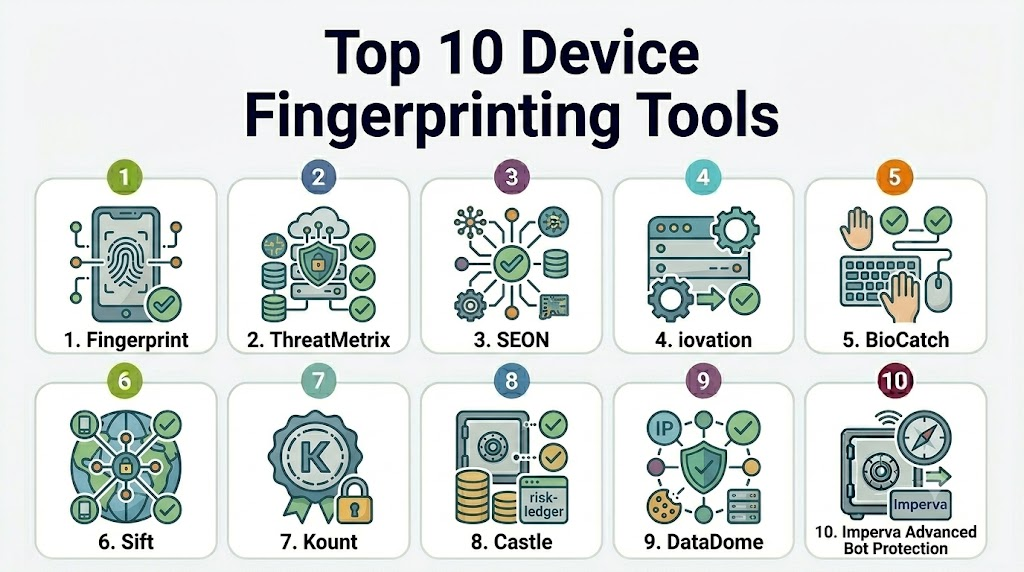
Top 10 Device Fingerprinting Tools
1- Fingerprint
Short description: Fingerprint is one of the most recognized device intelligence platforms. It helps organizations identify visitors and devices with high accuracy for fraud prevention, account security, and personalization.
Key Features
- Visitor identification technology
- Device intelligence APIs
- Bot detection
- Fraud prevention workflows
- Smart signals
- Browser and device recognition
- Real-time risk insights
Pros
- High identification accuracy
- Developer-friendly APIs
- Strong fraud-focused capabilities
Cons
- Premium pricing for large volumes
- Enterprise features may require higher tiers
Platforms / Deployment
Cloud
Security & Compliance
SSO, encryption, audit capabilities. Additional certifications vary by plan.
Integrations & Ecosystem
Fingerprint integrates with fraud platforms, analytics tools, identity systems, and custom applications.
- REST APIs
- Web SDKs
- Mobile SDKs
- Cloud integrations
Support & Community
Strong documentation and active developer adoption.
2- ThreatMetrix
Short description: ThreatMetrix is an enterprise-grade digital identity and device intelligence platform widely used in banking, fintech, and large-scale fraud prevention programs.
Key Features
- Device fingerprinting
- Digital identity network
- Fraud detection
- Risk scoring
- Identity intelligence
- Global trust network
- Behavioral analytics
Pros
- Strong enterprise reputation
- Extensive fraud intelligence network
- Excellent financial services adoption
Cons
- Enterprise-focused pricing
- Complex implementation
Platforms / Deployment
Cloud
Security & Compliance
Enterprise-grade security controls. Additional compliance details vary.
Integrations & Ecosystem
Supports integration into fraud management and identity systems.
- API access
- Banking integrations
- Authentication platforms
- Risk engines
Support & Community
Enterprise onboarding and dedicated support options.
3- SEON
Short description: SEON combines device fingerprinting, behavioral analysis, and digital footprint intelligence for fraud prevention and AML use cases.
Key Features
- Device intelligence
- Fraud scoring
- Email intelligence
- Phone intelligence
- Behavioral monitoring
- Transaction risk assessment
- Case management
Pros
- Easy deployment
- Comprehensive fraud signals
- Strong fintech adoption
Cons
- Advanced workflows may require tuning
- Pricing can increase with transaction volume
Platforms / Deployment
Cloud
Security & Compliance
Encryption, access controls, and enterprise security features.
Integrations & Ecosystem
Supports major commerce and fintech ecosystems.
- APIs
- Webhooks
- CRM integrations
- Payment platform integrations
Support & Community
Strong documentation and customer success programs.
4- iovation
Short description: iovation provides device reputation and fraud detection technology used by financial institutions, gaming operators, and e-commerce companies.
Key Features
- Device fingerprinting
- Device reputation database
- Risk scoring
- Account protection
- Fraud analytics
- Cross-session recognition
- Threat intelligence
Pros
- Large device reputation network
- Proven fraud prevention record
- Global deployments
Cons
- Enterprise-oriented
- Limited transparency on pricing
Platforms / Deployment
Cloud
Security & Compliance
Enterprise security controls.
Integrations & Ecosystem
Supports integration with authentication and fraud systems.
- APIs
- Identity platforms
- Authentication services
Support & Community
Enterprise-grade support available.
5- BioCatch
Short description: BioCatch combines behavioral biometrics and device intelligence to detect fraud, account takeovers, and social engineering attacks.
Key Features
- Device intelligence
- Behavioral biometrics
- Fraud analytics
- Session monitoring
- Real-time alerts
- User behavior profiling
- Risk assessment
Pros
- Strong fraud detection
- Behavioral intelligence layer
- Financial services expertise
Cons
- Primarily enterprise-focused
- Advanced deployment requirements
Platforms / Deployment
Cloud
Security & Compliance
Enterprise security controls and compliance-focused design.
Integrations & Ecosystem
Integrates with fraud, identity, and authentication platforms.
- APIs
- Banking platforms
- Risk management tools
Support & Community
Dedicated enterprise support.
6- Sift
Short description: Sift delivers AI-powered fraud prevention using device fingerprinting, behavioral analytics, and machine learning.
Key Features
- Device fingerprinting
- Fraud scoring
- Machine learning
- Chargeback prevention
- Account protection
- Bot detection
- Trust network insights
Pros
- Strong AI capabilities
- Easy API integration
- Comprehensive fraud platform
Cons
- Advanced features may increase costs
- Best value for larger transaction volumes
Platforms / Deployment
Cloud
Security & Compliance
Enterprise security controls.
Integrations & Ecosystem
Works across e-commerce, fintech, and marketplaces.
- APIs
- Commerce platforms
- Payment gateways
- Authentication systems
Support & Community
Strong customer support and implementation guidance.
7- Kount
Short description: Kount provides digital fraud prevention powered by device intelligence, machine learning, and identity trust signals.
Key Features
- Device identification
- Identity trust analysis
- Fraud prevention
- AI decisioning
- Risk scoring
- Account protection
- Transaction monitoring
Pros
- Strong payment fraud capabilities
- Scalable architecture
- Proven enterprise deployments
Cons
- Enterprise pricing
- May require dedicated fraud teams
Platforms / Deployment
Cloud
Security & Compliance
Enterprise-grade security controls.
Integrations & Ecosystem
Supports numerous payment and commerce ecosystems.
- APIs
- Payment processors
- Identity providers
- Fraud systems
Support & Community
Strong enterprise support structure.
8- Castle
Short description: Castle is a developer-focused fraud prevention platform that leverages device fingerprinting and behavioral signals to stop account abuse.
Key Features
- Device fingerprinting
- Bot detection
- Account takeover prevention
- Risk scoring
- Real-time monitoring
- Behavioral signals
- Developer APIs
Pros
- Developer-friendly
- Fast implementation
- Modern architecture
Cons
- Smaller ecosystem than enterprise incumbents
- Less focused on traditional banking
Platforms / Deployment
Cloud
Security & Compliance
Access controls and encryption.
Integrations & Ecosystem
Built for SaaS and internet businesses.
- APIs
- Webhooks
- Cloud integrations
- Authentication platforms
Support & Community
Strong technical documentation.
9- DataDome
Short description: DataDome is primarily a bot protection platform that uses device intelligence and fingerprinting to distinguish legitimate users from automated threats.
Key Features
- Device intelligence
- Bot detection
- Real-time mitigation
- Threat analytics
- Fraud protection
- API security
- Adaptive machine learning
Pros
- Excellent bot defense
- Fast deployment
- Strong API protection
Cons
- Less focused on traditional fraud workflows
- Best suited for bot-heavy environments
Platforms / Deployment
Cloud
Security & Compliance
Enterprise security controls.
Integrations & Ecosystem
Integrates with CDN, WAF, and security stacks.
- APIs
- CDN integrations
- Security platforms
- Web applications
Support & Community
Strong support for enterprise customers.
10- Imperva Advanced Bot Protection
Short description: Imperva combines device fingerprinting, bot detection, and threat intelligence to secure web applications and digital services.
Key Features
- Device fingerprinting
- Bot management
- Threat intelligence
- API protection
- Behavioral analysis
- Automated mitigation
- Security analytics
Pros
- Strong security ecosystem
- Enterprise scalability
- Broad protection coverage
Cons
- Complex deployment
- Premium pricing
Platforms / Deployment
Cloud
Security & Compliance
Enterprise security features including RBAC, audit logging, and encryption.
Integrations & Ecosystem
Works with broader security infrastructures.
- SIEM integrations
- Security platforms
- APIs
- Cloud services
Support & Community
Comprehensive enterprise support programs.
Comparison Table
| Tool Name | Best For | Platforms Supported | Deployment | Standout Feature | Public Rating |
|---|---|---|---|---|---|
| Fingerprint | SaaS & fraud prevention | Web, Mobile | Cloud | Visitor identification accuracy | N/A |
| ThreatMetrix | Financial services | Web, Mobile | Cloud | Global digital identity network | N/A |
| SEON | Fintech & AML | Web, Mobile | Cloud | Digital footprint intelligence | N/A |
| iovation | Fraud prevention | Web, Mobile | Cloud | Device reputation database | N/A |
| BioCatch | Behavioral fraud detection | Web, Mobile | Cloud | Behavioral biometrics integration | N/A |
| Sift | AI fraud prevention | Web, Mobile | Cloud | Machine learning risk engine | N/A |
| Kount | Payment fraud | Web, Mobile | Cloud | Identity trust network | N/A |
| Castle | SaaS security | Web | Cloud | Developer-focused APIs | N/A |
| DataDome | Bot mitigation | Web, API | Cloud | Real-time bot detection | N/A |
| Imperva | Enterprise security | Web, API | Cloud | Advanced bot protection | N/A |
Evaluation & Scoring of Device Fingerprinting Tools
| Tool | Core | Ease | Integrations | Security | Performance | Support | Value | Weighted Total |
|---|---|---|---|---|---|---|---|---|
| Fingerprint | 9.5 | 9 | 9 | 8.5 | 9 | 8.5 | 8.5 | 8.95 |
| ThreatMetrix | 10 | 7.5 | 9 | 9.5 | 9.5 | 9 | 7.5 | 8.93 |
| SEON | 9 | 9 | 8.5 | 8.5 | 8.5 | 8.5 | 9 | 8.80 |
| iovation | 8.5 | 8 | 8 | 9 | 8.5 | 8.5 | 8 | 8.38 |
| BioCatch | 9 | 7.5 | 8.5 | 9.5 | 9 | 8.5 | 7.5 | 8.53 |
| Sift | 9.5 | 8.5 | 9 | 9 | 9 | 8.5 | 8 | 8.83 |
| Kount | 9 | 8 | 8.5 | 9 | 8.5 | 8.5 | 8 | 8.50 |
| Castle | 8.5 | 9 | 8.5 | 8 | 8.5 | 8 | 9 | 8.58 |
| DataDome | 9 | 8.5 | 8 | 9 | 9 | 8.5 | 8 | 8.58 |
| Imperva | 9.5 | 7.5 | 8.5 | 9.5 | 9 | 9 | 7.5 | 8.75 |
Which Device Fingerprinting Tool Is Right for You?
Solo / Freelancer
Most freelancers do not require dedicated device fingerprinting platforms. Lightweight fraud detection services or built-in authentication protections are usually sufficient.
SMB
SEON, Castle, and Fingerprint provide strong fraud detection with relatively simple deployment and manageable operational complexity.
Mid-Market
Sift, Kount, and Fingerprint offer a balance between scalability, fraud intelligence, and implementation effort.
Enterprise
ThreatMetrix, BioCatch, Imperva, and Kount are strong options for organizations handling large transaction volumes and advanced fraud risks.
Budget vs Premium
Budget-conscious organizations should evaluate Castle and SEON. Premium enterprise buyers may benefit more from ThreatMetrix, BioCatch, and Imperva.
Feature Depth vs Ease of Use
Fingerprint and Castle emphasize developer experience. ThreatMetrix and BioCatch offer deeper enterprise functionality but require more planning.
Integrations & Scalability
Sift, Kount, and ThreatMetrix offer extensive integration ecosystems suitable for growing organizations.
Security & Compliance Needs
Organizations in regulated sectors should focus on ThreatMetrix, BioCatch, Kount, and Imperva due to their enterprise-oriented security capabilities.
Frequently Asked Questions
1- What is device fingerprinting?
Device fingerprinting identifies devices using browser, hardware, software, network, and behavioral characteristics. It helps organizations recognize returning devices and detect suspicious activity.
2- Is device fingerprinting better than cookies?
Device fingerprinting and cookies serve different purposes. Fingerprinting is often more resilient for fraud prevention, while cookies remain useful for user experience and session management.
3- How accurate are device fingerprinting solutions?
Accuracy varies by vendor, deployment environment, browser privacy settings, and available signals. Leading platforms achieve high recognition rates when properly configured.
4- Can device fingerprinting stop account takeover attacks?
It can significantly reduce account takeover risks by identifying suspicious devices, unusual login patterns, and known fraudulent behaviors.
5- Is device fingerprinting privacy compliant?
Compliance depends on implementation, jurisdiction, and data handling practices. Organizations should review privacy regulations and vendor guidance before deployment.
6- How long does implementation typically take?
Developer-focused platforms may be implemented within days, while enterprise deployments involving multiple systems can take weeks or months.
7- Do these tools work on mobile devices?
Yes. Most leading vendors support mobile applications and mobile browsers through SDKs and APIs.
8- Can device fingerprinting detect bots?
Many solutions combine fingerprinting with behavioral analytics and machine learning to identify automated traffic and sophisticated bots.
9- What are the common implementation mistakes?
Common mistakes include insufficient tuning, lack of monitoring, ignoring false positives, and failing to integrate device intelligence into broader fraud workflows.
10- What alternatives exist to device fingerprinting?
Alternatives include behavioral biometrics, identity verification platforms, multifactor authentication, risk-based authentication, and traditional fraud management systems.
Conclusion
Device fingerprinting has evolved into a critical component of modern fraud prevention and digital identity strategies. As organizations face increasingly sophisticated account takeover attacks, payment fraud schemes, and automated bot threats, device intelligence provides valuable context that traditional authentication methods often miss. The leading platforms in this market differ significantly in their strengths, with some focusing on developer-friendly deployment and others delivering enterprise-grade fraud intelligence networks. There is no universal winner. Organizations should evaluate their fraud risk profile, compliance requirements, transaction volumes, integration needs, and budget before making a decision. For most buyers, the best next step is to shortlist two or three solutions, conduct a proof of concept, validate integration requirements, measure fraud detection performance, and confirm operational fit before committing to a broader rollout.

Find Trusted Cardiac Hospitals
Compare heart hospitals by city and services — all in one place.
Explore Hospitals
A factor worth considering is how these platforms handle rapidly changing device ecosystems and emerging hardware types. Maintaining detection accuracy across new browsers, operating systems, and connected devices can become a significant long-term challenge.