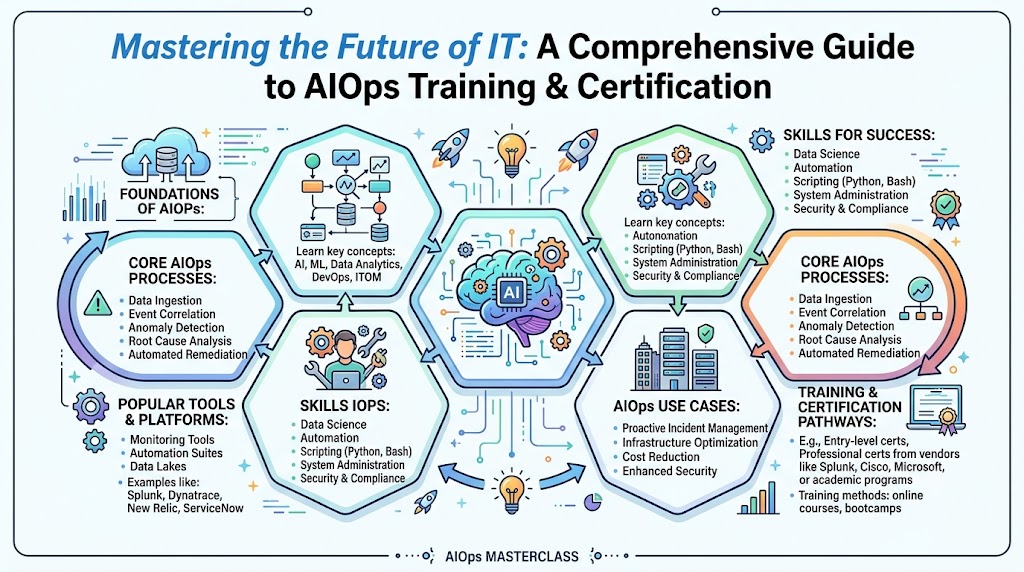
Modern IT environments have evolved into highly complex, distributed ecosystems. With the rapid adoption of cloud-native architectures, microservices, and hybrid infrastructure, traditional monitoring tools are struggling to keep pace. The sheer volume of data, logs, and alerts generated daily makes manual intervention impossible, leading to “alert fatigue” and increased downtime.The rise of AI-powered IT Operations (AIOps) provides a necessary paradigm shift, enabling teams to move from reactive troubleshooting to proactive management. By integrating machine learning into the operational lifecycle, organizations can achieve higher uptime and operational efficiency. For professionals aiming to navigate this transformation, AIOpsSchool offers the definitive pathway to mastering the tools, techniques, and strategies required to thrive in this new era.
What Is AIOps?
AIOps, or Artificial Intelligence for IT Operations, is the application of machine learning, data science, and advanced analytics to automate and improve IT operations. It bridges the gap between massive data streams and actionable insights.At its core, AIOps isn’t just about automation; it is about intelligence. By collecting data from diverse sources—including logs, metrics, and traces—AIOps platforms perform real-time analysis to identify anomalies, correlate events, and pinpoint root causes without human intervention. This shift allows IT teams to focus on strategic innovation rather than constant firefighting.
What Is AIOpsSchool?
AIOpsSchool is the world’s leading training and certification platform dedicated to the advancement of AIOps and MLOps. It serves as a comprehensive ecosystem designed to bridge the skills gap in modern IT operations.Through a blend of project-based learning, industry-aligned certifications, and hands-on lab environments, the platform provides professionals with the practical expertise needed for real-world enterprise implementation. Whether you are a beginner looking to understand the fundamentals or an architect designing scalable systems, AIOpsSchool provides the structured learning path, expert support, and global community to accelerate your career.
Why AIOps Is Important in Modern IT Operations
As businesses scale, the complexity of managing infrastructure grows exponentially. AIOps solves several critical operational challenges:
- Cloud-Native Complexity: Manually managing dynamic containers and serverless functions is untenable.
- Incident Management: AIOps reduces the “mean time to repair” (MTTR) by automatically correlating incidents and suggesting solutions.
- Operational Efficiency: Automating mundane tasks allows SRE and DevOps teams to allocate time toward building resilient services.
- Predictive Operations: By analyzing trends, AIOps anticipates issues—such as capacity shortages—before they manifest as downtime.
Who Should Learn AIOps?
The demand for AIOps expertise spans several key roles:
- DevOps Engineers: To integrate intelligent automation into CI/CD pipelines.
- SRE Engineers: To enhance service reliability through predictive maintenance and smart alerting.
- Cloud & Platform Engineers: To optimize resource allocation and manage large-scale infrastructure.
- IT Managers & Architects: To lead organizational transformation and design robust, AI-driven architectures.
- Students and Beginners: To gain a competitive edge in an industry increasingly focused on AI and automation.
AIOps Certification: Why It Matters
In a rapidly evolving job market, AIOps certifications from AIOpsSchool serve as a benchmark of professional competence. These certifications validate that a candidate understands not just the theoretical concepts, but also the practical application of AI in operational workflows. For enterprises, hiring certified professionals reduces the time to value, while for individuals, it translates to significant career growth, higher earning potential, and global credibility.
AIOps Tools and Technologies
Effective AIOps implementation requires a strategic stack.
| Tool Category | Purpose | Benefits | Typical Use Cases |
| Monitoring | Data Collection | Real-time visibility | Infrastructure health tracking |
| Observability | Deep insight into state | Full-stack transparency | Microservices debugging |
| Log Analytics | Pattern Recognition | Identifying anomalies | Security & performance auditing |
| Event Management | Noise Reduction | Fewer false positives | Alert correlation |
| Automation | Auto-Remediation | Reduced MTTR | Auto-scaling, patching |
AIOps vs DevOps vs MLOps: Key Differences
| Area | DevOps | AIOps | MLOps |
| Primary Goal | Software delivery speed | Operational efficiency | Model lifecycle management |
| Focus | Development & Ops collaboration | Monitoring, Analytics, Automation | Model building, deployment, scale |
| Impact | Faster releases | Reduced downtime/noise | Model performance/reproducibility |
How Anomaly Detection Works in AIOps
Anomaly detection is the heartbeat of AIOps. Unlike static threshold monitoring, which often leads to false alerts, AIOps uses machine learning to create “behavioral baselines.” By analyzing historical performance patterns, the system automatically recognizes what “normal” looks like. When behavior deviates—such as a sudden, unexplained spike in traffic or an unusual latency pattern—the system flags an anomaly, allowing for investigation before a full-scale outage occurs.
Root Cause Analysis (RCA) in AIOps
In traditional setups, RCA is a manual, time-consuming process involving war rooms and endless log digging. AIOps transforms this by:
- Dependency Mapping: Automatically visualizing how services, databases, and networks interact.
- Event Correlation: Grouping related alerts to identify the “needle in the haystack.”
- Automated RCA: Suggesting the most likely cause of an incident based on historical evidence.
Future of AIOps
The future is autonomous. We are moving toward “self-healing infrastructure,” where systems not only detect and diagnose issues but also execute the necessary code or configuration changes to fix them automatically. As enterprise AI adoption matures, the role of AIOps will shift from a “helper” tool to the central nervous system of IT infrastructure.
Frequently Asked Questions (FAQs)
- What is the best way to start AIOps training?
Begin with an AIOps Foundation course to grasp core principles before moving to hands-on labs. - Does AIOps replace DevOps?
No, it complements it. AIOps enhances the operational side of the DevOps lifecycle. - How long does it take to learn AIOps?
With a structured program like those at AIOpsSchool, foundational skills can be built in 30–45 days. - Are AIOps certifications worth it?
Yes, they provide industry validation that is increasingly sought after by employers. - Do I need to know programming?
Basic coding knowledge is beneficial for automation and working with APIs, but conceptual understanding is the primary requirement.
Final Recommendation
The complexity of modern IT is not decreasing; it is accelerating. Embracing AIOps is no longer a luxury—it is a requirement for any engineer or organization aiming for operational excellence. By focusing on structured training and practical certification, you position yourself at the forefront of this industry shift. We encourage you to explore the certification paths and hands-on training programs at AIOpsSchool to start your journey toward becoming an AI-driven operations expert today.

Find Trusted Cardiac Hospitals
Compare heart hospitals by city and services — all in one place.
Explore Hospitals