Introduction
Data Center Infrastructure Management (DCIM) software helps organizations monitor, manage, optimize, and plan the physical infrastructure of their data centers. It combines information about power systems, cooling equipment, rack space, environmental conditions, assets, and facility operations into a centralized management platform. As data centers continue to support AI workloads, cloud services, edge computing, and high-density computing environments, DCIM has become increasingly important. Modern organizations need greater visibility into energy consumption, capacity utilization, sustainability metrics, and infrastructure reliability.
Real-World Use Cases
- Monitoring power and cooling systems across data centers
- Managing rack capacity and asset lifecycle
- Tracking environmental conditions such as temperature and humidity
- Supporting capacity planning and expansion projects
- Improving energy efficiency and sustainability initiatives
Evaluation Criteria for Buyers
When evaluating DCIM software, consider:
- Asset discovery and inventory management
- Power and cooling monitoring capabilities
- Capacity planning and forecasting
- Data visualization and dashboards
- Integration with ITSM and monitoring tools
- Automation capabilities
- Scalability across multiple facilities
- Security and access controls
- Reporting and compliance support
- Vendor support and ecosystem maturity
Best for: Enterprise data centers, colocation providers, cloud infrastructure operators, financial institutions, healthcare organizations, government agencies, and large enterprises managing critical infrastructure.
Not ideal for: Small businesses with limited server rooms or organizations primarily operating in public cloud environments with minimal on-premises infrastructure.
Key Trends in Data Center Infrastructure Management DCIM Software
- AI-powered predictive maintenance and anomaly detection
- Increased focus on sustainability and carbon tracking
- Digital twin technology for infrastructure simulation
- Real-time capacity forecasting for AI workloads
- Hybrid cloud and edge infrastructure visibility
- Greater automation of power and cooling optimization
- Integration with IT operations and observability platforms
- Enhanced cybersecurity monitoring for facility systems
- Modular deployment options including SaaS-based DCIM
- Advanced analytics for energy cost optimization
How We Selected These Tools
The tools in this list were evaluated using the following methodology:
- Strong market adoption and enterprise presence
- Comprehensive DCIM functionality
- Reliability in large-scale deployments
- Asset management capabilities
- Power and cooling monitoring depth
- Integration ecosystem maturity
- Security and access control features
- Multi-site management capabilities
- Vendor innovation and roadmap strength
- Suitability across different organization sizes
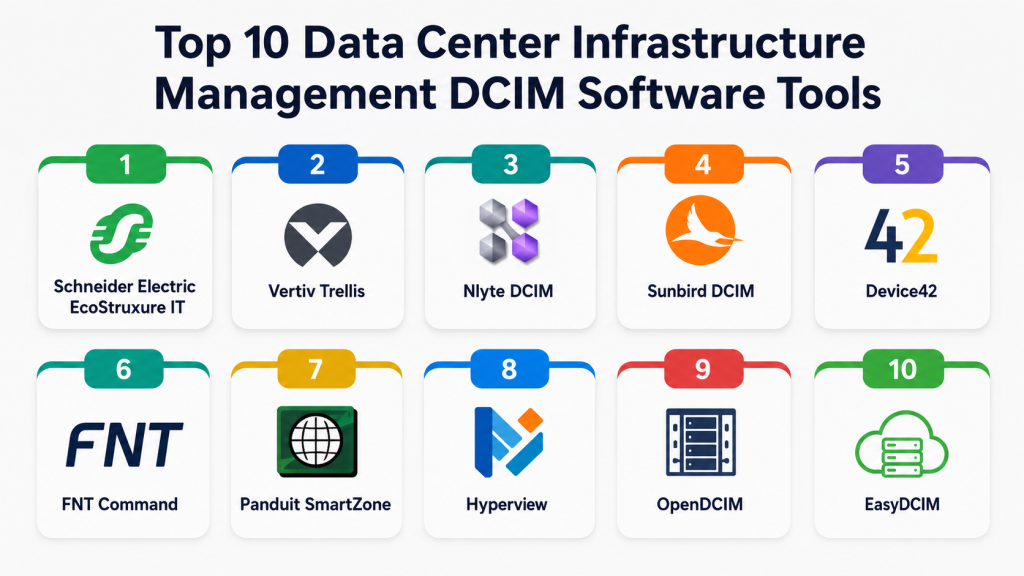
Top 10 Data Center Infrastructure Management DCIM Software Tools
1- Schneider Electric EcoStruxure IT
Short description: EcoStruxure IT is one of the most widely adopted DCIM platforms globally. It provides comprehensive monitoring, analytics, asset management, and predictive insights for modern data centers.
Key Features
- Remote infrastructure monitoring
- Asset lifecycle management
- Power chain visibility
- Environmental monitoring
- AI-assisted analytics
- Capacity planning tools
- Multi-site management
Pros
- Strong enterprise scalability
- Extensive hardware ecosystem
- Comprehensive monitoring capabilities
Cons
- Premium pricing
- Complex implementation
- Advanced features require training
Platforms / Deployment
- Web
- Cloud
- Hybrid
Security & Compliance
- RBAC
- Audit logging
- Encryption
- SSO support available
Integrations & Ecosystem
EcoStruxure integrates with facility management, monitoring, and enterprise IT systems.
- REST APIs
- Building management systems
- ITSM platforms
- Monitoring tools
- Energy management solutions
Support & Community
Strong enterprise support with extensive documentation, training, and global professional services.
2- Vertiv Trellis
Short description: Vertiv Trellis combines facility and IT infrastructure monitoring to provide unified visibility into data center operations.
Key Features
- Capacity management
- Asset tracking
- Environmental monitoring
- Change management
- Energy analytics
- Workflow automation
- Real-time dashboards
Pros
- Comprehensive facility visibility
- Strong analytics capabilities
- Enterprise-grade architecture
Cons
- Steeper learning curve
- Resource-intensive deployments
- Premium licensing
Platforms / Deployment
- Web
- Self-hosted
- Hybrid
Security & Compliance
- Role-based access controls
- Audit trails
- Encryption support
Integrations & Ecosystem
Supports enterprise monitoring and facility systems.
- APIs
- Building management platforms
- Network monitoring tools
- ITSM integrations
Support & Community
Strong vendor-backed support with implementation assistance.
3- Nlyte DCIM
Short description: Nlyte focuses on asset lifecycle management, capacity planning, and operational efficiency for enterprise data centers.
Key Features
- Asset inventory management
- Capacity planning
- Workflow automation
- Move-add-change tracking
- Power monitoring
- Reporting tools
- Compliance tracking
Pros
- Strong asset management
- Excellent planning tools
- Workflow automation strengths
Cons
- User interface can feel dated
- Advanced customization may require expertise
- Longer deployment timelines
Platforms / Deployment
- Web
- Cloud
- Hybrid
Security & Compliance
- RBAC
- Audit logging
- SSO capabilities
Integrations & Ecosystem
Works with ITSM, CMDB, and infrastructure platforms.
- Service management tools
- CMDB systems
- Monitoring platforms
- APIs
Support & Community
Enterprise-focused support with consulting services.
4- Sunbird DCIM
Short description: Sunbird DCIM is designed specifically for modern data center operations with a focus on usability, visibility, and capacity management.
Key Features
- Asset management
- Power monitoring
- Environmental analytics
- Capacity planning
- Rack visualization
- Reporting dashboards
- Change management
Pros
- User-friendly interface
- Faster deployment
- Strong visualization tools
Cons
- Smaller ecosystem than some competitors
- Enterprise customization limitations
- Premium modules increase costs
Platforms / Deployment
- Web
- Cloud
- Self-hosted
Security & Compliance
- Access controls
- Encryption
- Audit logs
Integrations & Ecosystem
Provides broad integration capabilities.
- APIs
- ITSM platforms
- Monitoring tools
- Facility systems
Support & Community
Well-regarded customer support and onboarding resources.
5- Device42
Short description: Device42 combines asset discovery, CMDB functionality, and infrastructure visibility, making it valuable for hybrid IT environments.
Key Features
- Automated discovery
- Dependency mapping
- Asset tracking
- Capacity reporting
- Rack visualization
- Power mapping
- CMDB integration
Pros
- Strong discovery capabilities
- Excellent dependency mapping
- Broad infrastructure visibility
Cons
- Not a traditional DCIM-first platform
- Advanced configuration may be required
- Some DCIM features less specialized
Platforms / Deployment
- Web
- Cloud
- Self-hosted
Security & Compliance
- SSO support
- RBAC
- Audit logs
Integrations & Ecosystem
Strong integration ecosystem.
- CMDB tools
- Monitoring platforms
- ITSM solutions
- APIs
Support & Community
Comprehensive documentation and enterprise support options.
6- FNT Command
Short description: FNT Command provides infrastructure management for data centers, telecom networks, and hybrid infrastructure environments.
Key Features
- Infrastructure modeling
- Capacity planning
- Asset management
- Workflow automation
- Reporting
- Service mapping
- Digital twin capabilities
Pros
- Highly detailed infrastructure modeling
- Strong planning capabilities
- Large-scale deployment support
Cons
- Complex implementation
- Requires specialized expertise
- Higher operational overhead
Platforms / Deployment
- Web
- Hybrid
- Self-hosted
Security & Compliance
- RBAC
- Audit logging
- Authentication controls
Integrations & Ecosystem
Strong enterprise integration support.
- APIs
- ERP systems
- ITSM platforms
- Network management tools
Support & Community
Enterprise-grade support and consulting services.
7- Panduit SmartZone
Short description: SmartZone focuses on monitoring, energy management, and infrastructure visibility for data center operators.
Key Features
- Environmental monitoring
- Asset tracking
- Energy analytics
- Power monitoring
- Capacity reporting
- Alerting system
- Dashboard visualization
Pros
- Strong environmental monitoring
- Useful energy management tools
- Straightforward deployment
Cons
- Less extensive ecosystem
- Limited advanced automation
- Smaller market presence
Platforms / Deployment
- Web
- Cloud
- Hybrid
Security & Compliance
- Access management
- Logging capabilities
- Encryption support
Integrations & Ecosystem
Supports integration with facility systems.
- APIs
- Sensors
- Monitoring tools
- Building systems
Support & Community
Vendor support available with training resources.
8- Hyperview
Short description: Hyperview is a cloud-native DCIM platform designed for modern data centers and distributed edge environments.
Key Features
- SaaS deployment
- Asset management
- Capacity planning
- Environmental monitoring
- Power analytics
- Workflow automation
- Reporting
Pros
- Cloud-native architecture
- Faster implementation
- Modern user experience
Cons
- Newer platform compared to established vendors
- Smaller customer base
- Fewer enterprise-specific customizations
Platforms / Deployment
- Web
- Cloud
Security & Compliance
- Role-based access
- Encryption
- Audit capabilities
Integrations & Ecosystem
Modern API-driven integrations.
- REST APIs
- Monitoring platforms
- Asset management tools
- Analytics systems
Support & Community
Growing support ecosystem with vendor-led assistance.
9- OpenDCIM
Short description: OpenDCIM is an open-source DCIM platform providing asset tracking, rack management, and capacity planning functionality.
Key Features
- Asset inventory
- Rack management
- Power tracking
- Capacity planning
- Reporting
- Open-source architecture
- Customizable workflows
Pros
- No licensing costs
- Highly customizable
- Active open-source community
Cons
- Requires technical expertise
- Limited enterprise support
- Fewer advanced analytics features
Platforms / Deployment
- Web
- Self-hosted
Security & Compliance
- Varies / N/A
Integrations & Ecosystem
Community-driven integrations.
- APIs
- Custom integrations
- Open-source extensions
Support & Community
Community-driven documentation and support resources.
10- EasyDCIM
Short description: EasyDCIM combines DCIM capabilities with colocation and hosting infrastructure management features.
Key Features
- Rack management
- Asset tracking
- Customer management
- Power monitoring
- Billing integration
- Capacity reporting
- Infrastructure visualization
Pros
- Useful for hosting providers
- Integrated business workflows
- Colocation-focused features
Cons
- Niche focus
- Less suited for large enterprises
- Smaller ecosystem
Platforms / Deployment
- Web
- Self-hosted
Security & Compliance
- Access controls
- Logging features
Integrations & Ecosystem
Supports hosting and infrastructure integrations.
- APIs
- Billing systems
- Hosting platforms
- Monitoring tools
Support & Community
Commercial support available with documentation resources.
Comparison Table
| Tool Name | Best For | Platform(s) Supported | Deployment | Standout Feature | Public Rating |
|---|---|---|---|---|---|
| EcoStruxure IT | Enterprise Data Centers | Web | Cloud/Hybrid | Predictive Analytics | N/A |
| Vertiv Trellis | Large Enterprises | Web | Hybrid | Unified Facility Visibility | N/A |
| Nlyte DCIM | Asset Lifecycle Management | Web | Cloud/Hybrid | Capacity Planning | N/A |
| Sunbird DCIM | Modern Operations Teams | Web | Cloud/Self-hosted | Rack Visualization | N/A |
| Device42 | Hybrid Infrastructure | Web | Cloud/Self-hosted | Automated Discovery | N/A |
| FNT Command | Telecom and Enterprise | Web | Hybrid | Digital Infrastructure Modeling | N/A |
| SmartZone | Environmental Monitoring | Web | Cloud/Hybrid | Energy Analytics | N/A |
| Hyperview | Cloud-Native DCIM | Web | Cloud | SaaS Architecture | N/A |
| OpenDCIM | Open Source Users | Web | Self-hosted | Customization | N/A |
| EasyDCIM | Hosting Providers | Web | Self-hosted | Colocation Management | N/A |
Evaluation & Scoring of Data Center Infrastructure Management DCIM Software
| Tool | Core | Ease | Integrations | Security | Performance | Support | Value | Weighted Total |
|---|---|---|---|---|---|---|---|---|
| EcoStruxure IT | 10 | 8 | 9 | 9 | 10 | 9 | 7 | 8.95 |
| Vertiv Trellis | 9 | 7 | 8 | 9 | 9 | 8 | 7 | 8.20 |
| Nlyte DCIM | 9 | 7 | 8 | 8 | 9 | 8 | 8 | 8.20 |
| Sunbird DCIM | 8 | 9 | 8 | 8 | 8 | 8 | 8 | 8.20 |
| Device42 | 8 | 8 | 9 | 8 | 8 | 8 | 8 | 8.15 |
| FNT Command | 9 | 6 | 8 | 8 | 9 | 8 | 7 | 7.95 |
| SmartZone | 7 | 8 | 7 | 7 | 8 | 7 | 8 | 7.55 |
| Hyperview | 8 | 9 | 7 | 8 | 8 | 7 | 8 | 8.00 |
| OpenDCIM | 6 | 6 | 6 | 6 | 7 | 6 | 10 | 6.80 |
| EasyDCIM | 7 | 8 | 7 | 7 | 7 | 7 | 8 | 7.40 |
Which Data Center Infrastructure Management DCIM Tool Is Right for You?
Solo / Freelancer
Most individual users do not require full DCIM platforms. OpenDCIM can be suitable for learning, lab environments, and small infrastructure projects.
SMB
Small and medium businesses should consider Sunbird DCIM, Hyperview, or Device42 for easier deployment and lower operational complexity.
Mid-Market
Nlyte, Device42, and Sunbird provide a strong balance between enterprise capabilities and implementation complexity.
Enterprise
Large enterprises should evaluate EcoStruxure IT, Vertiv Trellis, FNT Command, and Nlyte for advanced capacity planning and infrastructure management.
Budget vs Premium
OpenDCIM offers the lowest entry cost. EcoStruxure IT and Vertiv Trellis provide premium enterprise functionality for organizations with larger budgets.
Feature Depth vs Ease of Use
Sunbird and Hyperview prioritize usability. FNT Command and Vertiv Trellis emphasize feature depth and advanced infrastructure modeling.
Integrations & Scalability
Device42, EcoStruxure IT, and FNT Command offer extensive integration ecosystems suitable for large-scale environments.
Security & Compliance Needs
Organizations with strict governance requirements should prioritize enterprise vendors that support RBAC, audit logging, encryption, and centralized identity integration.
Frequently Asked Questions
1. What is DCIM software?
DCIM software helps organizations monitor, manage, and optimize data center infrastructure including power, cooling, assets, and capacity planning.
2. How does DCIM differ from IT monitoring tools?
IT monitoring focuses on servers and applications, while DCIM focuses on physical infrastructure such as racks, power systems, cooling systems, and facilities.
3. Is DCIM only for large enterprises?
No. While many platforms target enterprises, cloud-native and open-source options also support smaller organizations.
4. What is the biggest benefit of DCIM?
Improved visibility into infrastructure utilization, energy efficiency, and operational reliability.
5. Can DCIM help reduce energy costs?
Yes. Many platforms provide power monitoring, cooling analytics, and optimization recommendations that help reduce energy consumption.
6. How long does implementation usually take?
Implementation timelines vary significantly depending on facility size, integration requirements, and data quality. Projects can range from weeks to several months.
7. Does DCIM support hybrid environments?
Most modern DCIM platforms support hybrid infrastructure environments that include traditional data centers, colocation facilities, and edge sites.
8. What integrations are most important?
Common priorities include ITSM systems, CMDB platforms, monitoring tools, building management systems, and automation platforms.
9. Are cloud-based DCIM platforms becoming more popular?
Yes. SaaS and cloud-native deployments are becoming increasingly attractive because of faster deployment and simplified maintenance.
10. What mistakes should buyers avoid?
Common mistakes include focusing only on monitoring, ignoring integration requirements, underestimating data quality needs, and failing to plan for future growth.
Conclusion
Data Center Infrastructure Management software has evolved from simple monitoring tools into comprehensive operational platforms that support capacity planning, sustainability initiatives, asset lifecycle management, and infrastructure optimization. As AI workloads, edge computing, and sustainability requirements continue to grow, DCIM platforms are becoming essential for maintaining visibility and control across increasingly complex environments. There is no single best DCIM solution for every organization. Schneider Electric EcoStruxure IT, Vertiv Trellis, Nlyte, and FNT Command remain strong enterprise choices, while Sunbird, Device42, and Hyperview provide compelling alternatives for organizations seeking faster deployment and easier usability. OpenDCIM offers flexibility for budget-conscious teams, and EasyDCIM serves hosting-focused environments well. The most effective approach is to shortlist two or three candidates, run a pilot deployment, validate integrations, confirm security requirements, and assess long-term scalability before making a final decision.

Find Trusted Cardiac Hospitals
Compare heart hospitals by city and services — all in one place.
Explore Hospitals
DCIM software becomes far more useful when it bridges the gap between facilities teams and IT operations instead of treating them as separate domains. Better coordination around power usage, cooling capacity, and asset lifecycle planning can prevent costly infrastructure bottlenecks before they impact service availability.