Introduction
Asset Lifecycle Management (ALM) tools help organizations manage physical and digital assets from acquisition and deployment to maintenance, optimization, retirement, and disposal. These platforms provide visibility into asset performance, costs, utilization, compliance, and maintenance activities throughout the entire asset lifecycle. As organizations continue to digitize operations, manage distributed infrastructure, and optimize operational expenses, Asset Lifecycle Management has become a strategic necessity. Modern ALM platforms increasingly incorporate AI-driven maintenance recommendations, predictive analytics, IoT integration, and automated workflows to improve asset reliability and reduce operational costs.
Real-World Use Cases
- Managing enterprise equipment and infrastructure assets
- Tracking IT hardware and software lifecycles
- Optimizing maintenance schedules for manufacturing assets
- Managing facilities, utilities, and field equipment
- Supporting regulatory compliance and audit requirements
Evaluation Criteria for Buyers
When evaluating Asset Lifecycle Management tools, consider:
- Asset tracking and inventory capabilities
- Maintenance management functionality
- Lifecycle cost analysis
- Mobile accessibility
- Integration ecosystem
- Reporting and analytics
- Automation capabilities
- Security and compliance controls
- Scalability and deployment flexibility
- Vendor support and implementation services
Best for: Enterprise operations teams, facilities managers, asset managers, manufacturing organizations, utilities, transportation companies, healthcare providers, and IT asset management teams requiring comprehensive asset visibility.
Not ideal for: Small organizations managing only a few assets through spreadsheets or businesses seeking only basic inventory tracking without lifecycle management requirements.
Key Trends in Asset Lifecycle Management Tools
- AI-powered predictive maintenance is becoming a standard capability.
- Increased use of IoT sensors for real-time asset monitoring.
- Digital twin technology is improving asset planning and maintenance.
- Mobile-first maintenance and inspection workflows continue to expand.
- Cloud-based deployment models are replacing legacy on-premises systems.
- Sustainability and ESG reporting are becoming important asset metrics.
- Integration with ERP, procurement, and finance systems is deepening.
- Automation of maintenance scheduling and work order generation is increasing.
- Advanced analytics are helping optimize asset utilization and lifecycle costs.
- Hybrid asset management environments are driving demand for flexible architectures.
How We Selected These Tools (Methodology)
The tools in this list were evaluated using the following criteria:
- Market adoption and industry recognition
- Breadth of lifecycle management capabilities
- Maintenance and asset tracking functionality
- Enterprise scalability and reliability
- Integration ecosystem maturity
- Cloud and hybrid deployment options
- Mobile workforce support
- Reporting and analytics capabilities
- Security and governance features
- Suitability across multiple industries and organization sizes
Top 10 Asset Lifecycle Management Tools
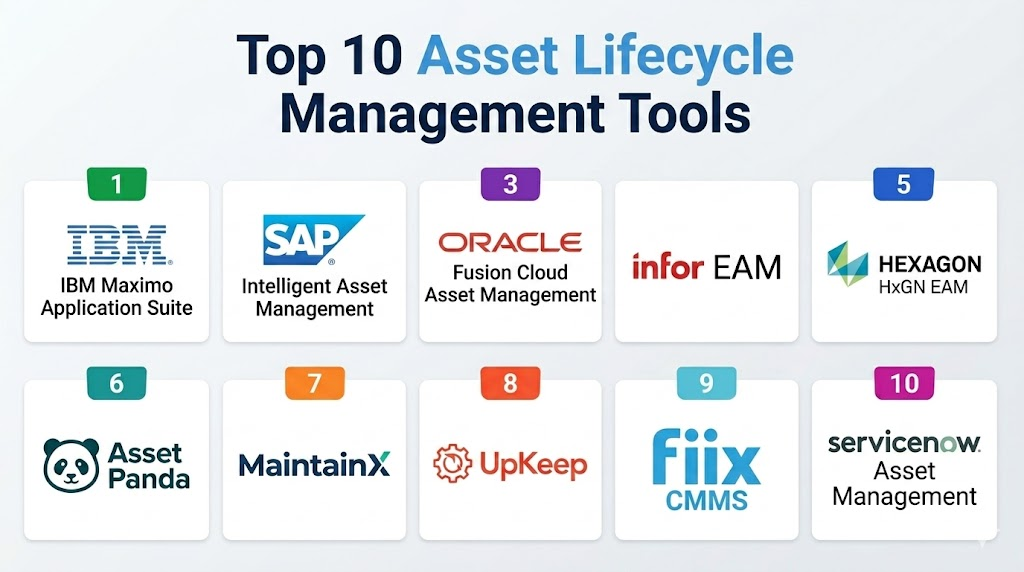
1- IBM Maximo Application Suite
Short description: IBM Maximo is one of the most comprehensive enterprise asset management and lifecycle management platforms available. It is widely used by large enterprises managing critical infrastructure and industrial assets.
Key Features
- Enterprise asset management
- Predictive maintenance
- AI-powered asset insights
- Work order management
- Inventory management
- Digital twin capabilities
- Mobile maintenance applications
Pros
- Extremely comprehensive functionality
- Strong AI and analytics capabilities
- Highly scalable enterprise platform
Cons
- Complex implementation process
- Significant training requirements
- Higher total cost of ownership
Platforms / Deployment
Web, iOS, Android
Cloud, Self-hosted, Hybrid
Security & Compliance
RBAC, audit capabilities, encryption, SSO support. Additional certifications vary by deployment.
Integrations & Ecosystem
IBM Maximo integrates with enterprise systems including ERP, IoT, analytics, and monitoring platforms.
- SAP
- Oracle
- IBM Watson
- IoT platforms
- REST APIs
Support & Community
Strong enterprise support, extensive documentation, global consulting ecosystem, and large customer community.
2- SAP Intelligent Asset Management
Short description: SAP Intelligent Asset Management extends SAP’s enterprise capabilities with asset lifecycle management, maintenance planning, and predictive maintenance functionality.
Key Features
- Asset performance management
- Predictive maintenance
- Digital asset records
- Work management
- Risk assessment
- Asset intelligence network
- Maintenance planning
Pros
- Deep SAP ecosystem integration
- Strong enterprise capabilities
- Comprehensive reporting
Cons
- Best suited for SAP environments
- Implementation complexity
- Premium pricing
Platforms / Deployment
Web
Cloud, Hybrid
Security & Compliance
Enterprise-grade identity management, audit capabilities, and security controls.
Integrations & Ecosystem
Strong integration across SAP business applications and operational systems.
- SAP S/4HANA
- SAP ERP
- SAP Analytics
- APIs
- Third-party connectors
Support & Community
Large global support organization and extensive implementation partner network.
3- Oracle Fusion Cloud Asset Management
Short description: Oracle provides a modern cloud-based platform for managing enterprise assets throughout their lifecycle while connecting maintenance and financial operations.
Key Features
- Asset tracking
- Preventive maintenance
- Asset costing
- Financial integration
- Work orders
- Predictive analytics
- Reporting dashboards
Pros
- Strong cloud architecture
- Unified business process integration
- Scalable platform
Cons
- Oracle ecosystem preference
- Learning curve
- Enterprise-oriented pricing
Platforms / Deployment
Web
Cloud
Security & Compliance
Role-based security, auditing, encryption, and enterprise identity controls.
Integrations & Ecosystem
Broad integration with Oracle business applications and external systems.
- Oracle ERP
- Oracle SCM
- APIs
- Analytics tools
- Integration services
Support & Community
Strong enterprise support and extensive documentation.
4- Infor EAM
Short description: Infor EAM is a mature enterprise asset management platform serving manufacturing, healthcare, facilities, and public sector organizations.
Key Features
- Asset lifecycle tracking
- Preventive maintenance
- Work management
- Asset performance analysis
- Inventory management
- Mobile maintenance
- Compliance reporting
Pros
- Industry-specific functionality
- Mature feature set
- Strong maintenance capabilities
Cons
- Interface may feel dated in some areas
- Configuration complexity
- Advanced features require expertise
Platforms / Deployment
Web, Mobile
Cloud, Self-hosted
Security & Compliance
Enterprise security controls and access management capabilities.
Integrations & Ecosystem
Supports integration with ERP, financial, and operational systems.
- ERP platforms
- GIS systems
- Mobile platforms
- APIs
- Reporting tools
Support & Community
Well-established support organization and industry-focused implementation resources.
5- Hexagon HxGN EAM
Short description: Hexagon delivers enterprise asset lifecycle management focused on asset-intensive industries including manufacturing, energy, transportation, and utilities.
Key Features
- Asset management
- Maintenance scheduling
- Mobile workforce tools
- Asset analytics
- Risk management
- Reliability engineering
- Compliance tracking
Pros
- Strong reliability management
- Suitable for asset-intensive industries
- Comprehensive lifecycle visibility
Cons
- Enterprise-focused complexity
- Advanced deployment planning required
- Higher implementation effort
Platforms / Deployment
Web, Mobile
Cloud, Hybrid
Security & Compliance
Enterprise access controls and audit capabilities.
Integrations & Ecosystem
Strong industrial and operational technology integrations.
- ERP systems
- GIS platforms
- IoT systems
- APIs
- Analytics platforms
Support & Community
Strong enterprise support and industry expertise.
6- ServiceNow Asset Management
Short description: ServiceNow extends beyond IT service management to provide asset lifecycle management for hardware, software, and enterprise assets.
Key Features
- Asset tracking
- Software asset management
- Hardware lifecycle management
- Workflow automation
- CMDB integration
- Reporting
- Procurement management
Pros
- Excellent workflow automation
- Strong IT asset management
- Unified platform approach
Cons
- Less focused on industrial assets
- Licensing costs can increase quickly
- Requires platform expertise
Platforms / Deployment
Web
Cloud
Security & Compliance
RBAC, audit logs, encryption, SSO integration, enterprise controls.
Integrations & Ecosystem
Extensive enterprise integration ecosystem.
- Microsoft
- SAP
- Oracle
- APIs
- Marketplace integrations
Support & Community
Large global user community and comprehensive documentation.
7- Asset Panda
Short description: Asset Panda provides flexible cloud-based asset lifecycle management suitable for SMBs and mid-market organizations.
Key Features
- Asset tracking
- Barcode support
- Mobile applications
- Maintenance tracking
- Custom workflows
- Reporting
- Audit history
Pros
- User-friendly interface
- Flexible customization
- Fast implementation
Cons
- Less suitable for complex enterprises
- Limited advanced analytics
- Fewer industrial features
Platforms / Deployment
Web, iOS, Android
Cloud
Security & Compliance
Role-based permissions and standard cloud security controls.
Integrations & Ecosystem
Integrates with common business applications and workflow systems.
- APIs
- Business software
- Mobile devices
- Barcode systems
Support & Community
Strong onboarding support and accessible documentation.
8- UpKeep
Short description: UpKeep combines maintenance management and asset lifecycle capabilities in a mobile-first platform designed for maintenance teams.
Key Features
- Asset management
- Work orders
- Preventive maintenance
- Inventory tracking
- Mobile maintenance
- Reporting
- Analytics
Pros
- Excellent mobile experience
- Fast deployment
- Easy adoption
Cons
- Limited enterprise depth
- Advanced customization constraints
- Complex use cases may require alternatives
Platforms / Deployment
Web, iOS, Android
Cloud
Security & Compliance
Role-based access and cloud security controls.
Integrations & Ecosystem
Supports operational and maintenance integrations.
- ERP systems
- IoT platforms
- APIs
- Business applications
Support & Community
Responsive support and active customer community.
9- MaintainX
Short description: MaintainX focuses on maintenance operations and asset lifecycle management through an easy-to-use platform optimized for frontline teams.
Key Features
- Asset tracking
- Preventive maintenance
- Work orders
- Digital procedures
- Team collaboration
- Analytics
- Mobile operations
Pros
- Modern interface
- Strong mobile usability
- Quick deployment
Cons
- Enterprise complexity limitations
- Some advanced features require higher tiers
- Less extensive than large EAM platforms
Platforms / Deployment
Web, iOS, Android
Cloud
Security & Compliance
Role-based permissions and cloud-based security controls.
Integrations & Ecosystem
Supports operational technology and business system integrations.
- APIs
- ERP platforms
- Sensors
- Business applications
Support & Community
Strong customer support and growing user community.
10- Fiix CMMS
Short description: Fiix offers cloud-based maintenance and asset lifecycle management designed for manufacturing and maintenance-focused organizations.
Key Features
- Asset lifecycle tracking
- Preventive maintenance
- Inventory management
- Work order automation
- Analytics
- Mobile access
- Reporting
Pros
- Easy implementation
- Strong maintenance functionality
- Good value for mid-sized organizations
Cons
- Advanced enterprise capabilities may be limited
- Customization constraints
- Industry-specific requirements may need extensions
Platforms / Deployment
Web, iOS, Android
Cloud
Security & Compliance
Role-based permissions and standard cloud security capabilities.
Integrations & Ecosystem
Integrates with maintenance, ERP, and operational systems.
- APIs
- ERP platforms
- IoT integrations
- Reporting tools
Support & Community
Good documentation, onboarding assistance, and customer support.
Comparison Table
| Tool Name | Best For | Platform(s) Supported | Deployment | Standout Feature | Public Rating |
|---|---|---|---|---|---|
| IBM Maximo | Large Enterprises | Web, Mobile | Cloud, Hybrid, Self-hosted | Predictive Maintenance & Digital Twins | N/A |
| SAP Intelligent Asset Management | SAP Customers | Web | Cloud, Hybrid | SAP Ecosystem Integration | N/A |
| Oracle Fusion Asset Management | Oracle Environments | Web | Cloud | Unified Financial Integration | N/A |
| Infor EAM | Manufacturing & Facilities | Web, Mobile | Cloud, Self-hosted | Industry-Specific Workflows | N/A |
| Hexagon HxGN EAM | Asset-Intensive Industries | Web, Mobile | Cloud, Hybrid | Reliability Engineering | N/A |
| ServiceNow Asset Management | IT Asset Management | Web | Cloud | Workflow Automation | N/A |
| Asset Panda | SMBs | Web, Mobile | Cloud | Flexible Customization | N/A |
| UpKeep | Maintenance Teams | Web, Mobile | Cloud | Mobile-First Experience | N/A |
| MaintainX | Frontline Operations | Web, Mobile | Cloud | Digital Procedures | N/A |
| Fiix CMMS | Mid-Market Manufacturing | Web, Mobile | Cloud | Fast Deployment | N/A |
Evaluation & Scoring of Asset Lifecycle Management Tools
| Tool | Core | Ease | Integrations | Security | Performance | Support | Value | Weighted Total |
|---|---|---|---|---|---|---|---|---|
| IBM Maximo | 10 | 7 | 10 | 9 | 10 | 9 | 7 | 8.95 |
| SAP IAM | 9 | 7 | 10 | 9 | 9 | 9 | 7 | 8.65 |
| Oracle Fusion | 9 | 8 | 9 | 9 | 9 | 8 | 8 | 8.60 |
| Infor EAM | 9 | 7 | 8 | 8 | 9 | 8 | 8 | 8.25 |
| Hexagon HxGN EAM | 9 | 7 | 8 | 8 | 9 | 8 | 7 | 8.10 |
| ServiceNow | 8 | 9 | 10 | 9 | 9 | 9 | 7 | 8.65 |
| Asset Panda | 7 | 9 | 7 | 7 | 8 | 8 | 9 | 7.95 |
| UpKeep | 7 | 9 | 7 | 7 | 8 | 8 | 9 | 7.95 |
| MaintainX | 7 | 9 | 7 | 7 | 8 | 8 | 9 | 7.95 |
| Fiix CMMS | 8 | 8 | 7 | 7 | 8 | 8 | 9 | 8.00 |
Which Asset Lifecycle Management Tool Is Right for You?
Solo / Freelancer
Asset Panda, UpKeep, and MaintainX offer straightforward deployment, lower complexity, and easier administration.
SMB
Fiix CMMS, Asset Panda, and UpKeep provide strong lifecycle management capabilities without requiring large implementation teams.
Mid-Market
Infor EAM, Fiix CMMS, and MaintainX offer a balance of functionality, scalability, and operational control.
Enterprise
IBM Maximo, SAP Intelligent Asset Management, Oracle Fusion Asset Management, and Hexagon HxGN EAM provide enterprise-grade lifecycle management and scalability.
Budget vs Premium
Budget-focused organizations should consider MaintainX, UpKeep, and Asset Panda. Premium enterprise environments benefit from IBM, SAP, Oracle, and Hexagon platforms.
Feature Depth vs Ease of Use
IBM Maximo and SAP offer extensive capabilities but require expertise. MaintainX and UpKeep prioritize simplicity and fast adoption.
Integrations & Scalability
ServiceNow, SAP, Oracle, and IBM offer extensive integration ecosystems suitable for complex enterprise environments.
Security & Compliance Needs
Organizations with strict governance requirements should prioritize IBM Maximo, SAP Intelligent Asset Management, Oracle Fusion Asset Management, and ServiceNow.
Frequently Asked Questions (FAQs)
1- What is Asset Lifecycle Management?
Asset Lifecycle Management is the process of managing assets from acquisition through operation, maintenance, optimization, and retirement to maximize value and reduce costs.
2- How is ALM different from inventory management?
Inventory management focuses on tracking assets, while ALM manages the entire lifecycle including maintenance, utilization, performance, and disposal.
3- Can small businesses benefit from ALM tools?
Yes. SMB-focused solutions such as Asset Panda, UpKeep, and MaintainX provide lifecycle visibility without enterprise-level complexity.
4- What industries use Asset Lifecycle Management most?
Manufacturing, utilities, transportation, healthcare, facilities management, government, and energy sectors commonly rely on ALM platforms.
5- Are cloud-based ALM tools secure?
Most modern ALM platforms provide role-based access, encryption, auditing, and identity management features, though security capabilities vary by vendor.
6- What are the biggest implementation challenges?
Data quality issues, incomplete asset inventories, process alignment challenges, and user adoption often create implementation difficulties.
7- How long does deployment typically take?
Cloud solutions may deploy within weeks, while enterprise implementations involving complex integrations can take several months.
8- Do ALM tools support predictive maintenance?
Many modern platforms now offer predictive maintenance through AI, machine learning, IoT sensors, and analytics capabilities.
9- Can ALM tools integrate with ERP systems?
Yes. Most enterprise ALM platforms integrate with ERP, finance, procurement, and operational systems through APIs and connectors.
10- What should buyers evaluate first?
Organizations should first assess asset complexity, maintenance requirements, integration needs, compliance requirements, and budget constraints before selecting a platform.
Conclusion
Asset Lifecycle Management platforms have evolved from simple tracking systems into strategic operational platforms that help organizations improve reliability, reduce downtime, optimize maintenance spending, and extend asset lifespan. Enterprise leaders such as IBM Maximo, SAP Intelligent Asset Management, Oracle Fusion Asset Management, and Hexagon HxGN EAM dominate complex environments requiring deep lifecycle visibility and advanced analytics. Meanwhile, solutions such as Asset Panda, UpKeep, MaintainX, and Fiix provide accessible options for SMBs and maintenance-focused teams. The right choice depends on asset complexity, organizational size, integration requirements, and long-term operational goals. Before making a final decision, shortlist two or three solutions, conduct a pilot implementation, validate integrations and security requirements, and ensure the platform aligns with your maintenance and asset management strategy.

Find Trusted Cardiac Hospitals
Compare heart hospitals by city and services — all in one place.
Explore Hospitals