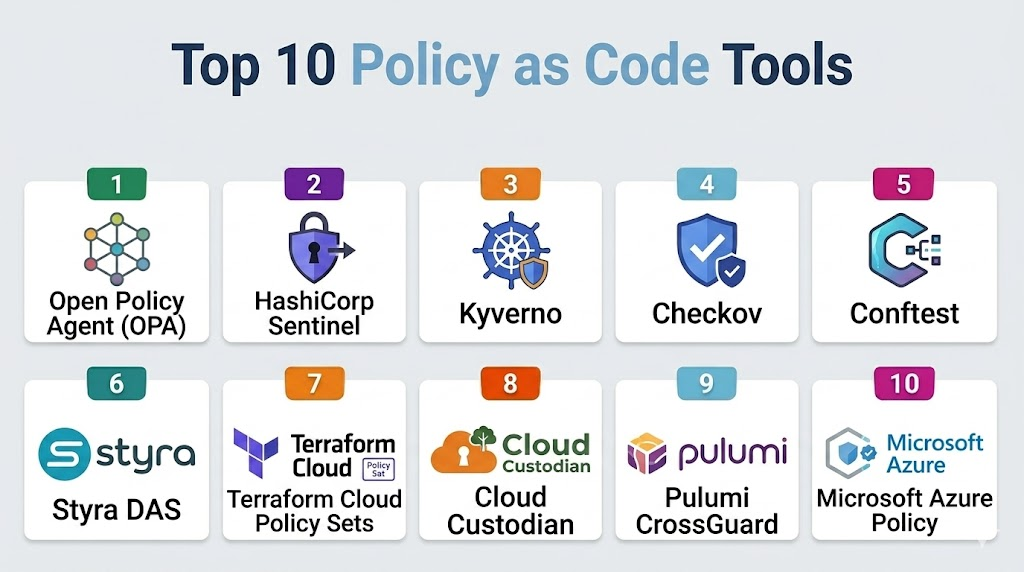
Introduction
Policy as Code tools allow organizations to define, manage, and enforce security, compliance, governance, and operational policies through machine-readable code. Instead of relying on manual reviews and audits, teams can automatically validate infrastructure, cloud resources, Kubernetes configurations, CI/CD pipelines, and application deployments against predefined policies. As cloud-native adoption, multi-cloud environments, Kubernetes deployments, and regulatory requirements continue to grow, Policy as Code has become a critical component of modern DevOps, Platform Engineering, and Security programs. Organizations increasingly need automated governance that can scale across thousands of resources without slowing innovation.
Real-World Use Cases
- Enforcing cloud security standards across AWS, Azure, and Google Cloud
- Validating Infrastructure as Code before deployment
- Kubernetes admission control and policy enforcement
- Compliance monitoring for regulated industries
- CI/CD pipeline governance and risk reduction
Evaluation Criteria for Buyers
When evaluating Policy as Code tools, buyers should consider:
- Policy language flexibility
- Cloud platform support
- Kubernetes integration
- CI/CD compatibility
- Compliance automation capabilities
- Scalability across environments
- Ease of policy management
- Developer experience
- Reporting and auditing features
- Community and vendor support
Best for: DevOps teams, security engineers, platform teams, cloud architects, compliance teams, and enterprises operating large-scale cloud environments.
Not ideal for: Small organizations with limited cloud infrastructure, teams without automated deployment workflows, or environments where governance requirements are minimal.
Key Trends in Policy as Code Tools
- AI-assisted policy creation and remediation recommendations
- Shift-left security becoming standard practice
- Policy validation integrated directly into developer workflows
- Multi-cloud governance adoption accelerating
- Platform engineering driving policy standardization
- Kubernetes-native policy enforcement becoming mainstream
- Automated compliance reporting growing in importance
- Infrastructure security integrated into CI/CD pipelines
- Unified governance across infrastructure, applications, and data
- Increased adoption of open-source policy frameworks
How We Selected These Tools
The tools in this guide were selected based on:
- Market adoption and industry recognition
- Feature completeness
- Policy language flexibility
- Kubernetes and cloud integration depth
- Security and governance capabilities
- Enterprise scalability
- Community activity and ecosystem maturity
- Developer experience
- Documentation quality
- Support for modern cloud-native architectures
Top 10 Policy as Code Tools
1- Open Policy Agent
Short Description:
Open Policy Agent is one of the most widely adopted Policy as Code frameworks. It enables teams to create unified policies for cloud infrastructure, Kubernetes, APIs, and applications using the Rego policy language.
Key Features
- Rego policy language
- Kubernetes admission control
- Multi-cloud policy enforcement
- Fine-grained authorization
- API policy validation
- CI/CD integration
- Large ecosystem support
Pros
- Highly flexible policy framework
- Large open-source community
- Broad platform compatibility
Cons
- Rego learning curve
- Complex policy design for beginners
- Requires governance planning
Platforms / Deployment
Cloud / Self-hosted / Hybrid
Security & Compliance
- RBAC integration
- Audit support
- Policy enforcement controls
- Encryption support varies by implementation
Integrations & Ecosystem
OPA integrates with a broad range of cloud-native tools and platforms.
- Kubernetes
- Envoy
- Terraform
- GitHub Actions
- Jenkins
- Docker
Support & Community
One of the largest Policy as Code communities with extensive documentation and enterprise support through ecosystem vendors.
2- HashiCorp Sentinel
Short Description:
Sentinel is HashiCorp’s policy framework designed for infrastructure governance across Terraform, Vault, Consul, and enterprise automation workflows.
Key Features
- Policy enforcement for Terraform
- Role-based governance
- Compliance automation
- Infrastructure validation
- Enterprise policy management
- Policy testing framework
- Integration with HashiCorp ecosystem
Pros
- Excellent Terraform integration
- Enterprise governance capabilities
- Strong compliance support
Cons
- Best suited for HashiCorp users
- Enterprise licensing requirements
- Smaller ecosystem than OPA
Platforms / Deployment
Cloud / Hybrid
Security & Compliance
- Access controls
- Policy auditing
- Governance enforcement
Integrations & Ecosystem
Sentinel is tightly integrated with HashiCorp products.
- Terraform
- Terraform Cloud
- Vault
- Consul
- Nomad
Support & Community
Strong enterprise support and documentation.
3- Kyverno
Short Description:
Kyverno is a Kubernetes-native Policy as Code platform that allows teams to define policies using familiar YAML rather than specialized programming languages.
Key Features
- Kubernetes-native policies
- YAML-based definitions
- Admission control
- Policy generation
- Resource mutation
- Compliance reporting
- Automated remediation
Pros
- Easier learning curve
- Kubernetes-focused simplicity
- Strong automation capabilities
Cons
- Primarily Kubernetes-focused
- Less suitable outside Kubernetes
- Advanced policies may become complex
Platforms / Deployment
Cloud / Self-hosted
Security & Compliance
- Kubernetes RBAC integration
- Audit reporting
- Policy enforcement
Integrations & Ecosystem
- Kubernetes
- Helm
- Argo CD
- Flux CD
- GitOps workflows
Support & Community
Growing CNCF community with active development.
4- Checkov
Short Description:
Checkov focuses on Infrastructure as Code security scanning and policy validation across cloud environments before deployment.
Key Features
- Infrastructure scanning
- Compliance validation
- Security misconfiguration detection
- Multi-cloud support
- CI/CD integration
- Custom policy creation
- Kubernetes scanning
Pros
- Developer-friendly
- Strong security coverage
- Broad IaC support
Cons
- Focused mainly on scanning
- Governance capabilities limited compared to OPA
- Advanced customization requires expertise
Platforms / Deployment
Cloud / Self-hosted
Security & Compliance
- Compliance frameworks
- Security scanning
- Audit reporting
Integrations & Ecosystem
- Terraform
- Kubernetes
- GitHub
- GitLab
- Jenkins
- Azure DevOps
Support & Community
Large user base with active development.
5- Conftest
Short Description:
Conftest brings Policy as Code validation to configuration files using OPA’s Rego language, making policy testing easy within CI/CD workflows.
Key Features
- Configuration testing
- Rego policy support
- CI/CD integration
- Lightweight architecture
- Multi-format validation
- Developer-focused workflows
- Automation support
Pros
- Simple deployment
- Flexible policy testing
- Strong OPA compatibility
Cons
- Limited enterprise governance features
- Smaller ecosystem
- Primarily testing-focused
Platforms / Deployment
Cloud / Self-hosted
Security & Compliance
- Policy validation
- Compliance checks
Integrations & Ecosystem
- OPA
- Kubernetes
- Terraform
- GitHub Actions
- GitLab
Support & Community
Strong open-source community.
6- Styra DAS
Short Description:
Styra DAS is an enterprise policy management platform built around Open Policy Agent, offering centralized governance and policy lifecycle management.
Key Features
- Centralized policy management
- OPA integration
- Compliance automation
- Policy testing
- Policy distribution
- Governance dashboards
- Enterprise controls
Pros
- Enterprise-grade governance
- Strong OPA management
- Compliance-focused
Cons
- Commercial platform
- Higher cost
- More complex implementation
Platforms / Deployment
Cloud / Hybrid
Security & Compliance
- SSO
- RBAC
- Audit logging
Integrations & Ecosystem
- OPA
- Kubernetes
- Cloud platforms
- CI/CD tools
Support & Community
Strong enterprise support.
7- Terraform Cloud Policy Sets
Short Description:
Terraform Cloud Policy Sets enable governance across infrastructure deployments using centralized policy enforcement.
Key Features
- Infrastructure governance
- Policy validation
- Compliance automation
- Team-based controls
- Policy testing
- Terraform integration
- Audit visibility
Pros
- Native Terraform integration
- Easy policy distribution
- Enterprise governance
Cons
- Terraform-focused
- Requires Terraform adoption
- Licensing costs
Platforms / Deployment
Cloud
Security & Compliance
- Audit logging
- Access management
- Governance controls
Integrations & Ecosystem
- Terraform Cloud
- Sentinel
- AWS
- Azure
- Google Cloud
Support & Community
Strong HashiCorp ecosystem support.
8- Cloud Custodian
Short Description:
Cloud Custodian automates cloud governance by defining policies that identify, report, and remediate cloud resource issues.
Key Features
- Cloud governance
- Automated remediation
- Compliance enforcement
- Multi-cloud support
- Resource inventory
- Cost optimization policies
- Security monitoring
Pros
- Powerful automation
- Strong cloud coverage
- Open-source flexibility
Cons
- Learning curve
- Cloud-focused use cases
- Configuration complexity
Platforms / Deployment
Cloud / Self-hosted
Security & Compliance
- Governance automation
- Compliance controls
- Audit capabilities
Integrations & Ecosystem
- AWS
- Azure
- Google Cloud
- Kubernetes
Support & Community
Active open-source community.
9- Pulumi CrossGuard
Short Description:
CrossGuard provides policy enforcement for infrastructure deployments built with Pulumi.
Key Features
- Infrastructure governance
- Policy packs
- Multi-language support
- Compliance automation
- Deployment validation
- Cloud support
- Custom policy creation
Pros
- Developer-friendly
- Multi-language capabilities
- Strong Pulumi integration
Cons
- Best for Pulumi users
- Smaller ecosystem
- Less adoption than OPA
Platforms / Deployment
Cloud / Self-hosted
Security & Compliance
- Policy enforcement
- Governance controls
Integrations & Ecosystem
- Pulumi
- AWS
- Azure
- Google Cloud
- Kubernetes
Support & Community
Growing community and documentation.
10- Microsoft Azure Policy
Short Description:
Azure Policy enables organizations to enforce governance and compliance across Azure environments using built-in and custom policy definitions.
Key Features
- Azure governance
- Compliance reporting
- Resource validation
- Automated remediation
- Security controls
- Regulatory compliance support
- Management group integration
Pros
- Deep Azure integration
- Strong compliance capabilities
- Enterprise scalability
Cons
- Azure-focused
- Limited cross-cloud functionality
- Microsoft ecosystem dependency
Platforms / Deployment
Cloud
Security & Compliance
- RBAC
- Audit logging
- Compliance controls
Integrations & Ecosystem
- Azure Security Center
- Defender for Cloud
- Azure Resource Manager
- Azure DevOps
Support & Community
Enterprise-grade Microsoft support.
Comparison Table
| Tool Name | Best For | Platforms Supported | Deployment | Standout Feature | Public Rating |
|---|---|---|---|---|---|
| Open Policy Agent | Universal Policy Engine | Multi-platform | Hybrid | Rego Flexibility | N/A |
| Sentinel | Terraform Governance | Multi-platform | Cloud/Hybrid | Terraform Integration | N/A |
| Kyverno | Kubernetes Policies | Kubernetes | Cloud/Self-hosted | YAML Policies | N/A |
| Checkov | IaC Security | Multi-platform | Cloud/Self-hosted | Security Scanning | N/A |
| Conftest | Configuration Testing | Multi-platform | Cloud/Self-hosted | Lightweight Validation | N/A |
| Styra DAS | Enterprise Governance | Multi-platform | Cloud/Hybrid | Centralized Management | N/A |
| Terraform Policy Sets | Infrastructure Governance | Multi-platform | Cloud | Terraform Controls | N/A |
| Cloud Custodian | Cloud Governance | Multi-cloud | Hybrid | Automated Remediation | N/A |
| Pulumi CrossGuard | Developer Governance | Multi-platform | Cloud/Self-hosted | Policy Packs | N/A |
| Azure Policy | Azure Governance | Azure | Cloud | Native Compliance Controls | N/A |
Evaluation & Scoring of Policy as Code Tools
| Tool | Core | Ease | Integrations | Security | Performance | Support | Value | Weighted Total |
|---|---|---|---|---|---|---|---|---|
| Open Policy Agent | 10 | 8 | 10 | 9 | 9 | 9 | 10 | 9.35 |
| Sentinel | 9 | 8 | 8 | 9 | 9 | 9 | 8 | 8.55 |
| Kyverno | 9 | 9 | 8 | 8 | 9 | 8 | 10 | 8.80 |
| Checkov | 8 | 9 | 8 | 9 | 8 | 8 | 9 | 8.45 |
| Conftest | 8 | 8 | 7 | 8 | 8 | 8 | 10 | 8.10 |
| Styra DAS | 9 | 8 | 9 | 9 | 9 | 9 | 7 | 8.65 |
| Terraform Policy Sets | 8 | 8 | 8 | 9 | 8 | 8 | 8 | 8.10 |
| Cloud Custodian | 8 | 7 | 8 | 8 | 8 | 8 | 9 | 8.00 |
| Pulumi CrossGuard | 8 | 8 | 8 | 8 | 8 | 8 | 8 | 8.00 |
| Azure Policy | 9 | 9 | 7 | 9 | 9 | 9 | 8 | 8.60 |
Which Policy as Code Tool Is Right for You?
Solo / Freelancer
Kyverno, Conftest, and Checkov offer accessible starting points with minimal complexity.
SMB
OPA, Checkov, and Cloud Custodian provide strong governance without requiring large enterprise budgets.
Mid-Market
Kyverno, Styra DAS, and Terraform Policy Sets offer scalability and governance maturity.
Enterprise
OPA, Styra DAS, Sentinel, and Azure Policy provide advanced compliance, governance, and policy lifecycle management.
Budget vs Premium
Budget-friendly options include OPA, Kyverno, Conftest, and Cloud Custodian. Premium enterprise options include Styra DAS and Sentinel.
Feature Depth vs Ease of Use
OPA offers unmatched flexibility, while Kyverno emphasizes simplicity through Kubernetes-native YAML policies.
Integrations & Scalability
OPA, Sentinel, Styra DAS, and Azure Policy provide strong integration ecosystems and enterprise scalability.
Security & Compliance Needs
Regulated organizations should evaluate Sentinel, Azure Policy, Styra DAS, and OPA for governance and audit capabilities.
Frequently Asked Questions
1- What is Policy as Code?
Policy as Code uses machine-readable definitions to automate governance, security, and compliance enforcement across infrastructure and applications.
2- Why is Policy as Code important?
It reduces manual reviews, improves consistency, and enables scalable governance across modern cloud environments.
3- Is Open Policy Agent the industry standard?
OPA is widely considered one of the most adopted open-source Policy as Code frameworks available today.
4- Can Policy as Code improve compliance?
Yes. Automated policy enforcement helps organizations maintain compliance and generate audit evidence more efficiently.
5- Does Policy as Code work with Kubernetes?
Yes. Tools such as OPA and Kyverno are heavily used for Kubernetes governance and admission control.
6- What is the difference between OPA and Kyverno?
OPA uses the Rego language, while Kyverno uses Kubernetes-native YAML policies, making Kyverno easier for many Kubernetes teams.
7- Can Policy as Code prevent cloud misconfigurations?
Yes. Many tools validate infrastructure before deployment and block non-compliant configurations.
8- Is Policy as Code only for large enterprises?
No. Small and mid-sized organizations can benefit from automated governance and security validation.
9- How does Policy as Code integrate with CI/CD?
Policies can be evaluated during build and deployment stages to prevent risky changes from reaching production.
10- What are common implementation mistakes?
Common issues include overly complex policies, insufficient testing, poor documentation, and lack of stakeholder alignment.
Conclusion
Policy as Code has evolved from a niche governance practice into a foundational capability for cloud-native organizations. As infrastructure becomes increasingly automated and distributed, manual compliance and security reviews are no longer sufficient. Tools such as Open Policy Agent, Kyverno, Sentinel, Styra DAS, and Azure Policy help organizations establish consistent governance while maintaining deployment speed and developer productivity. The best solution depends on your environment, cloud strategy, compliance obligations, and operational maturity. Start by identifying your governance requirements, shortlist two or three tools that align with your infrastructure stack, run a proof of concept, and validate integrations, security controls, and policy management workflows before scaling adoption across the organization.

Find Trusted Cardiac Hospitals
Compare heart hospitals by city and services — all in one place.
Explore Hospitals
Policy as Code initiatives are often most successful when teams treat policies as shared development assets rather than isolated compliance requirements. Version control, peer reviews, and testing practices can make governance much easier to scale across large engineering organizations.