Introduction
GitOps is an operational framework that uses Git repositories as the single source of truth for infrastructure and application deployments. Instead of manually applying changes to Kubernetes clusters or cloud environments, teams define their desired state in Git, and automated agents continuously reconcile environments to match that state. GitOps has become increasingly important as organizations adopt cloud-native architectures, Kubernetes, multi-cloud deployments, and platform engineering practices. It improves deployment consistency, strengthens security controls, simplifies auditing, and reduces operational errors.
Real-World Use Cases
- Kubernetes application deployment automation
- Multi-cluster management
- Infrastructure configuration management
- Continuous delivery pipelines
- Compliance and audit tracking
- Disaster recovery and environment restoration
- Platform engineering self-service workflows
Evaluation Criteria for Buyers
When evaluating GitOps tools, consider:
- Kubernetes support depth
- Multi-cluster management capabilities
- Deployment automation features
- Security and access controls
- Scalability for large environments
- Integration ecosystem
- Ease of onboarding
- Observability and monitoring
- Policy enforcement capabilities
- Community and vendor support
Best for: DevOps teams, platform engineering teams, cloud-native organizations, enterprises operating Kubernetes at scale, and companies seeking deployment consistency.
Not ideal for: Organizations with minimal automation needs, small teams without Kubernetes adoption, or environments relying heavily on traditional infrastructure management approaches.
Key Trends in GitOps Tools
- AI-assisted deployment validation and troubleshooting
- GitOps expansion beyond Kubernetes into infrastructure and security policies
- Increased adoption of platform engineering workflows
- Policy-as-Code integration becoming standard
- Multi-cloud GitOps management growth
- Enhanced compliance reporting and audit automation
- Progressive delivery and canary deployment integration
- Improved developer self-service capabilities
- Supply chain security controls embedded into deployment pipelines
- Greater support for hybrid cloud environments
How We Selected These Tools
The tools in this guide were evaluated based on:
- Industry adoption and market presence
- GitOps feature completeness
- Kubernetes ecosystem integration
- Enterprise deployment capabilities
- Security and governance features
- Multi-cluster scalability
- Community engagement and documentation quality
- Reliability and operational maturity
- Vendor support offerings
- Flexibility across deployment models
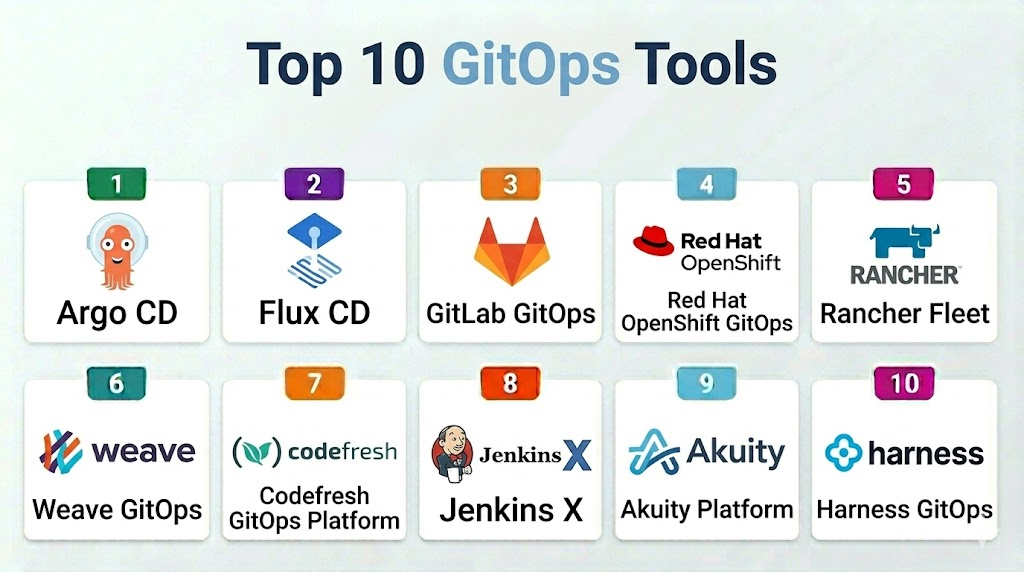
Top 10 GitOps Tools
1- Argo CD
Short Description:
Argo CD is one of the most widely adopted GitOps platforms for Kubernetes. It continuously monitors Git repositories and automatically synchronizes cluster states with desired configurations.
Key Features
- Declarative GitOps deployments
- Multi-cluster management
- Visual deployment dashboard
- Automated synchronization
- RBAC controls
- Rollback capabilities
- Progressive delivery support
Pros
- Strong Kubernetes-native design
- Large open-source community
- Excellent scalability
Cons
- Kubernetes-focused
- Learning curve for beginners
- UI customization limitations
Platforms / Deployment
Cloud / Self-hosted
Security & Compliance
- RBAC
- SSO integration
- Audit logging
- Encryption support
Integrations & Ecosystem
Argo CD integrates deeply with Kubernetes ecosystems and CI/CD tools.
- Kubernetes
- Helm
- Kustomize
- Jenkins
- GitHub
- GitLab
Support & Community
Large CNCF-backed community with extensive documentation and enterprise support options.
2- Flux CD
Short Description:
Flux CD is a CNCF project designed specifically for GitOps automation. It focuses on Kubernetes deployment management through continuous reconciliation.
Key Features
- Automated synchronization
- Multi-tenancy support
- Helm integration
- Image automation
- Git-based workflows
- Policy enforcement
- Kubernetes-native architecture
Pros
- Lightweight design
- Strong Kubernetes integration
- Active open-source community
Cons
- Less visual management than Argo CD
- Steeper learning curve
- Limited built-in dashboards
Platforms / Deployment
Cloud / Self-hosted
Security & Compliance
- RBAC
- Git signing verification
- Audit support
Integrations & Ecosystem
- Kubernetes
- Helm
- GitHub
- GitLab
- OCI registries
Support & Community
Excellent open-source documentation and strong CNCF community support.
3- GitLab GitOps
Short Description:
GitLab combines CI/CD, source control, security, and GitOps capabilities into a single platform, making it attractive for organizations seeking consolidation.
Key Features
- Integrated CI/CD
- GitOps workflows
- Security scanning
- Deployment environments
- Kubernetes management
- Merge request approvals
- Audit tracking
Pros
- Unified DevOps platform
- Strong governance capabilities
- Integrated security tools
Cons
- Feature complexity
- Higher resource requirements
- Premium features may require paid tiers
Platforms / Deployment
Cloud / Self-hosted
Security & Compliance
- SAML
- RBAC
- Audit logs
- Encryption support
Integrations & Ecosystem
- Kubernetes
- Terraform
- GitHub
- AWS
- Azure
- Google Cloud
Support & Community
Comprehensive enterprise support and extensive documentation.
4- Red Hat OpenShift GitOps
Short Description:
OpenShift GitOps provides enterprise-grade GitOps capabilities based on Argo CD, tightly integrated with OpenShift environments.
Key Features
- Argo CD foundation
- OpenShift integration
- Multi-cluster deployments
- Compliance controls
- Security policies
- Automated synchronization
- Enterprise support
Pros
- Enterprise-ready
- Strong governance
- Excellent OpenShift integration
Cons
- Best suited for OpenShift users
- Licensing costs
- Additional platform complexity
Platforms / Deployment
Cloud / Self-hosted / Hybrid
Security & Compliance
- RBAC
- SSO
- Audit logging
- Enterprise security controls
Integrations & Ecosystem
- OpenShift
- Kubernetes
- Helm
- Ansible
- Red Hat ecosystem
Support & Community
Backed by enterprise Red Hat support.
5- Harness GitOps
Short Description:
Harness GitOps extends deployment automation with advanced delivery management, governance, and observability capabilities.
Key Features
- GitOps deployment management
- Continuous delivery
- Deployment verification
- Multi-cluster support
- Governance controls
- Rollback automation
- Observability integration
Pros
- Strong enterprise features
- Advanced deployment visibility
- Automated verification
Cons
- Premium pricing
- More complex implementation
- Enterprise-oriented
Platforms / Deployment
Cloud / Hybrid
Security & Compliance
- RBAC
- SSO
- Audit trails
Integrations & Ecosystem
- Kubernetes
- Argo CD
- AWS
- Azure
- GitHub
- GitLab
Support & Community
Enterprise-focused support model.
6- Codefresh GitOps
Short Description:
Codefresh builds its platform around Argo CD and provides a complete GitOps management experience for Kubernetes environments.
Key Features
- GitOps dashboards
- Argo CD integration
- Deployment visibility
- Multi-cluster management
- Rollback support
- Workflow automation
- Team collaboration
Pros
- User-friendly interface
- Strong visibility
- Enterprise scalability
Cons
- Commercial platform
- Kubernetes-centric
- Additional licensing costs
Platforms / Deployment
Cloud / Hybrid
Security & Compliance
- RBAC
- SSO
- Audit capabilities
Integrations & Ecosystem
- Argo CD
- Kubernetes
- GitHub
- GitLab
- Jenkins
Support & Community
Strong commercial support with growing community adoption.
7- Rancher Fleet
Short Description:
Fleet is Rancher’s GitOps engine designed for managing large numbers of Kubernetes clusters at scale.
Key Features
- Massive cluster scalability
- Git-driven deployments
- Multi-cluster operations
- Lightweight agents
- Cluster grouping
- Automated synchronization
- Policy controls
Pros
- Excellent for large environments
- Lightweight architecture
- Strong cluster management
Cons
- Less mature than Argo CD
- Kubernetes-focused
- Smaller ecosystem
Platforms / Deployment
Cloud / Self-hosted
Security & Compliance
- RBAC
- Audit logging
- Access controls
Integrations & Ecosystem
- Rancher
- Kubernetes
- Helm
- Git repositories
Support & Community
Strong Rancher ecosystem support.
8- Weave GitOps
Short Description:
Weave GitOps simplifies Kubernetes operations by providing a visual GitOps experience built on Flux CD.
Key Features
- Flux integration
- Visual dashboards
- Cluster management
- Policy controls
- Team collaboration
- Automated reconciliation
- Application monitoring
Pros
- Simplified user experience
- Strong Flux integration
- Good visibility
Cons
- Flux dependency
- Smaller adoption footprint
- Enterprise features vary
Platforms / Deployment
Cloud / Self-hosted
Security & Compliance
- RBAC
- Audit support
- Authentication controls
Integrations & Ecosystem
- Flux
- Kubernetes
- Helm
- Git providers
Support & Community
Good documentation and active community.
9- Jenkins X
Short Description:
Jenkins X combines CI/CD automation and GitOps principles for Kubernetes-native software delivery.
Key Features
- GitOps workflows
- Automated environments
- Preview environments
- CI/CD pipelines
- Kubernetes integration
- Release automation
- Environment promotion
Pros
- Strong automation
- Developer-friendly workflows
- Kubernetes-native
Cons
- Operational complexity
- Learning curve
- Smaller adoption compared to Argo
Platforms / Deployment
Cloud / Self-hosted
Security & Compliance
- RBAC
- Secure pipelines
- Access controls
Integrations & Ecosystem
- Kubernetes
- GitHub
- GitLab
- Helm
Support & Community
Active community support and extensive documentation.
10- Spinnaker
Short Description:
Spinnaker is a multi-cloud deployment platform that supports GitOps practices alongside advanced deployment strategies.
Key Features
- Multi-cloud deployments
- Progressive delivery
- Canary releases
- Deployment automation
- Rollback management
- Pipeline orchestration
- Advanced release controls
Pros
- Multi-cloud capabilities
- Advanced deployment strategies
- Enterprise scalability
Cons
- Significant complexity
- Higher operational overhead
- Steeper learning curve
Platforms / Deployment
Cloud / Self-hosted
Security & Compliance
- RBAC
- Authentication integrations
- Audit support
Integrations & Ecosystem
- Kubernetes
- AWS
- Azure
- Google Cloud
- Jenkins
Support & Community
Strong enterprise adoption with mature ecosystem resources.
Comparison Table
| Tool Name | Best For | Platform Supported | Deployment | Standout Feature | Public Rating |
|---|---|---|---|---|---|
| Argo CD | Kubernetes GitOps | Kubernetes | Cloud/Self-hosted | Continuous Reconciliation | N/A |
| Flux CD | Kubernetes Automation | Kubernetes | Cloud/Self-hosted | Lightweight GitOps Engine | N/A |
| GitLab GitOps | Unified DevOps | Multi-platform | Cloud/Self-hosted | Integrated DevSecOps | N/A |
| OpenShift GitOps | Enterprise OpenShift | Kubernetes | Hybrid | OpenShift Integration | N/A |
| Harness GitOps | Enterprise Delivery | Multi-platform | Cloud/Hybrid | Deployment Verification | N/A |
| Codefresh | GitOps Visibility | Kubernetes | Cloud/Hybrid | Argo-Centric Platform | N/A |
| Rancher Fleet | Large Cluster Management | Kubernetes | Cloud/Self-hosted | Massive Scale Operations | N/A |
| Weave GitOps | Flux Management | Kubernetes | Cloud/Self-hosted | Visual GitOps Experience | N/A |
| Jenkins X | Developer Automation | Kubernetes | Cloud/Self-hosted | Preview Environments | N/A |
| Spinnaker | Multi-Cloud Delivery | Multi-platform | Cloud/Self-hosted | Progressive Delivery | N/A |
Evaluation & Scoring of GitOps Tools
| Tool | Core | Ease | Integrations | Security | Performance | Support | Value | Weighted Total |
|---|---|---|---|---|---|---|---|---|
| Argo CD | 10 | 8 | 9 | 9 | 9 | 9 | 10 | 9.20 |
| Flux CD | 9 | 7 | 8 | 9 | 9 | 8 | 10 | 8.65 |
| GitLab GitOps | 9 | 8 | 9 | 9 | 8 | 9 | 8 | 8.65 |
| OpenShift GitOps | 9 | 8 | 8 | 9 | 9 | 9 | 7 | 8.50 |
| Harness GitOps | 9 | 8 | 9 | 9 | 9 | 9 | 7 | 8.70 |
| Codefresh | 8 | 9 | 8 | 8 | 8 | 8 | 8 | 8.15 |
| Rancher Fleet | 8 | 7 | 7 | 8 | 9 | 8 | 9 | 8.00 |
| Weave GitOps | 8 | 8 | 7 | 8 | 8 | 8 | 8 | 7.95 |
| Jenkins X | 8 | 7 | 8 | 8 | 8 | 8 | 8 | 7.95 |
| Spinnaker | 9 | 6 | 9 | 8 | 9 | 8 | 7 | 8.10 |
Which GitOps Tool Is Right for You?
Solo / Freelancer
- Flux CD for lightweight Kubernetes environments
- Argo CD for learning GitOps best practices
- Jenkins X for developer-focused workflows
SMB
- Argo CD for broad adoption and flexibility
- GitLab GitOps for integrated DevOps workflows
- Codefresh for easier operational visibility
Mid-Market
- Harness GitOps
- OpenShift GitOps
- Rancher Fleet
These platforms balance governance, scalability, and operational efficiency.
Enterprise
- OpenShift GitOps
- Harness GitOps
- Argo CD
- Spinnaker
These tools provide governance, security controls, and large-scale deployment capabilities.
Budget vs Premium
Budget-Friendly: Argo CD, Flux CD, Rancher Fleet
Premium Enterprise Solutions: Harness GitOps, OpenShift GitOps, Codefresh
Feature Depth vs Ease of Use
Deep Features: Spinnaker, Harness GitOps
Ease of Use: Codefresh, Argo CD
Integrations & Scalability
Organizations with extensive cloud infrastructure should consider Argo CD, GitLab GitOps, Harness GitOps, and Spinnaker.
Security & Compliance Needs
Highly regulated organizations should evaluate OpenShift GitOps, GitLab GitOps, and Harness GitOps due to stronger governance capabilities.
Frequently Asked Questions
1- What is GitOps?
GitOps is a deployment methodology that uses Git repositories as the source of truth for infrastructure and application configurations.
2- Is GitOps only for Kubernetes?
Most GitOps platforms focus on Kubernetes, but many now support infrastructure, security policies, and cloud resources as well.
3- What is the difference between GitOps and CI/CD?
CI/CD automates building and delivery. GitOps extends this by using Git to define and continuously enforce desired system states.
4- Is Argo CD better than Flux CD?
Both are excellent. Argo CD offers richer visualization, while Flux CD focuses on simplicity and lightweight operations.
5- Does GitOps improve security?
Yes. Git-based approvals, audit trails, RBAC, and policy enforcement improve deployment governance and traceability.
6- How difficult is GitOps adoption?
Organizations familiar with Kubernetes typically adopt GitOps relatively quickly. Cultural changes often require more effort than technical implementation.
7- Can GitOps support multi-cloud deployments?
Yes. Many leading GitOps platforms support AWS, Azure, Google Cloud, and hybrid infrastructure deployments.
8- What are common GitOps implementation mistakes?
Common mistakes include poor repository structures, insufficient access controls, lack of monitoring, and overly complex workflows.
9- How does GitOps help compliance?
Git repositories provide version history, approval tracking, and auditable deployment records that simplify compliance reporting.
10- Can GitOps replace traditional deployment tools?
In Kubernetes-centric environments, GitOps often becomes the primary deployment model, although traditional CI/CD tools remain important.
Conclusion
GitOps has become a foundational practice for modern Kubernetes and cloud-native operations. By using Git as the authoritative source of truth, organizations can improve deployment consistency, reduce operational risk, strengthen security controls, and simplify compliance processes. While Argo CD and Flux CD continue to dominate open-source GitOps adoption, enterprise buyers increasingly evaluate solutions such as Harness GitOps, OpenShift GitOps, GitLab GitOps, and Codefresh for governance, visibility, and large-scale operational requirements. The right choice depends on team maturity, Kubernetes adoption, compliance needs, and integration requirements. Rather than searching for a universal winner, shortlist two or three tools that align with your environment, run a proof of concept, validate integrations and security controls, and then scale your GitOps strategy with confidence.

Find Trusted Cardiac Hospitals
Compare heart hospitals by city and services — all in one place.
Explore Hospitals
GitOps adoption tends to work best when organizations establish clear repository structures and change approval processes from the beginning. Without disciplined configuration management, the benefits of automated deployments can quickly be offset by configuration drift and operational confusion.