Introduction
Modern IT environments have moved beyond the capacity of human operators to monitor manually. With the explosion of cloud-native systems, ephemeral Kubernetes clusters, and complex microservices, organizations are drowning in a sea of telemetry data. Picture this: a mid-sized e-commerce enterprise experiences a minor latency spike. Within minutes, their monitoring dashboard fires thousands of alerts. SRE teams spend hours “alert storming”—manually correlating logs and metrics to find the culprit—while revenue bleeds away.This is the reality of traditional operations in a distributed world. The solution lies in Artificial Intelligence for IT Operations (AIOps). To navigate this transition, professionals must look toward specialized platforms like AIOpsSchool to bridge the gap between legacy monitoring and autonomous intelligence. AIOps is no longer a luxury; it is the fundamental bridge to achieving reliability in an era of hyper-scale infrastructure.
Featured Snippet
What Is AIOps?
AIOps (Artificial Intelligence for IT Operations) is the application of machine learning, data analytics, and automation to IT operations. It transforms massive volumes of noisy operational data into actionable insights, enabling teams to detect anomalies, correlate events, identify root causes, and automate incident resolution in complex, cloud-native environments.
Understanding AIOps
What Is Artificial Intelligence for IT Operations?
At its core, AIOps uses advanced algorithms to process the “Big Data” generated by IT infrastructure. It collects metrics, logs, traces, and events to create a unified view, allowing machines to find patterns that humans would otherwise miss.
Why Traditional IT Operations Are No Longer Enough
Traditional monitoring relies on static thresholds (e.g., “alert me if CPU > 80%”). In dynamic microservices, this leads to brittle alerts, high false-positive rates, and “alert fatigue,” where critical issues are ignored amidst the noise.
How AI and Machine Learning Improve Operations
AI models establish “baselines” for normal behavior. When deviations occur, the system identifies the context. Instead of just notifying that a server is down, AIOps tells the engineer why it is down by correlating dependencies across the stack.
Evolution from Monitoring to Intelligent Operations
| Traditional Operations | AIOps-Driven Operations |
| Reactive (Manual response) | Proactive (Predictive resolution) |
| Static threshold-based alerts | Dynamic, context-aware insights |
| Siloed data views | Unified observability platform |
| High manual correlation | Automated root cause analysis |
Why AIOps Skills Are Becoming Essential
Growth of Cloud-Native Infrastructure
Cloud-native systems are inherently ephemeral. IP addresses change, containers spin up and down, and service meshes create thousands of transient connections. AIOps provides the observability required to track this fluidity.
Demand for Reliability Engineering
As organizations adopt SRE (Site Reliability Engineering) principles, the need for “Error Budgets” and automated incident management grows. AIOps is the engine that powers these SRE workflows.
Future of Autonomous Operations
We are moving toward “self-healing” infrastructure. Professionals who understand the intersection of AI and systems administration will define the next decade of IT infrastructure management.
AIOps Certification Explained
What Is an AIOps Certification?
An AIOps certification is a professional credential that validates a candidate’s ability to architect, implement, and maintain intelligent monitoring and automation solutions. It proves you can move beyond mere monitoring to true operational intelligence.
Who Should Pursue AIOps Certification?
- DevOps Engineers: To automate pipeline monitoring.
- SRE Engineers: To reduce MTTR (Mean Time to Repair).
- Cloud Engineers: To manage complex distributed environments.
- Monitoring Specialists: To evolve their toolchain.
- IT Managers: To lead digital transformation initiatives.
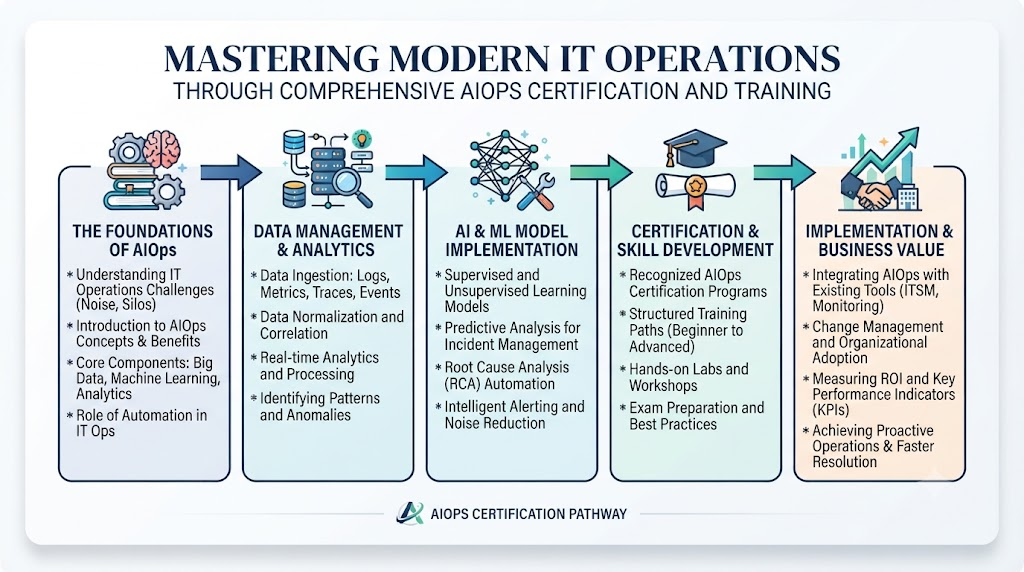
AIOps Training and Courses
Learners study a blend of data science concepts and system architecture.
- Machine Learning for IT: Understanding anomaly detection algorithms.
- Event Correlation: Grouping related alerts to find a single incident.
- Root Cause Analysis: Automating the “why” behind service outages.
- Observability & OpenTelemetry: Standardizing how data is collected and processed across the enterprise.
AIOps Engineer Certification Path
| Level | Skills | Outcome |
| Beginner | Monitoring basics, Linux, CLI | Foundational AIOps awareness |
| Intermediate | ML concepts, Python, Kubernetes | Ability to deploy AIOps tools |
| Advanced | Algorithmic analysis, Consulting | Architectural leadership in AIOps |
AIOps Engineer Career Roadmap
- Foundations: Linux, Networking, and Cloud fundamentals.
- Modern Observability: Mastering logs, metrics, and traces (OpenTelemetry).
- Automation: Learning IaC (Infrastructure as Code) and Python scripting.
- AIOps Specialization: Pursuing formal training to master event correlation and predictive analytics.
AI Observability Training
What Is AI Observability?
While monitoring tells you if a system is working, AI Observability tells you why it is acting a certain way by providing deep visibility into the internal state of distributed systems using AI-derived context.
Monitoring vs. Observability
| Feature | Monitoring | Observability |
| Focus | System health | System behavior |
| Data | Metrics/Logs | Traces/Events/Logs/Metrics |
| Outcome | Alerting | Debugging/Understanding |
AIOps for SRE and DevOps Engineers
Reducing Alert Fatigue
AIOps uses noise reduction algorithms to suppress duplicate alerts and group related events, ensuring that engineers only see actionable incidents.
Improving Incident Response
By correlating logs and events in real-time, AIOps provides engineers with a “trail of evidence” leading directly to the root cause, cutting investigation time from hours to minutes.
Enterprise AIOps Consulting and Implementation
The Implementation Lifecycle
- Assessment: Audit existing monitoring data quality.
- Design: Map out the AI-driven observability architecture.
- Integration: Connect data sources (Cloud, APM, Logs).
- Optimization: Tune models to reduce noise and increase precision.
Real-World Enterprise Use Cases
- Banking: Detecting fraudulent pattern anomalies in infrastructure to prevent service downtime during peak trading.
- SaaS: Predicting capacity requirements using machine learning to auto-scale services before latency spikes occur.
Common Challenges and Solutions
- Data Quality: Garbage in, garbage out. Solution: Invest in data cleansing before deploying ML models.
- Organizational Resistance: Fear of AI replacing roles. Solution: Focus on “AI-augmented” roles rather than replacement.
Why Learn with AIOpsSchool
AIOpsSchool provides a structured curriculum that blends theoretical AI concepts with the practical realities of enterprise IT. Our approach ensures that learners aren’t just memorizing definitions but gaining hands-on experience that can be applied to real-world infrastructure immediately.
FAQ SECTION
- What is AIOps Certification? A credential verifying expertise in applying AI to IT operational tasks.
- Who should learn AIOps? Any IT professional involved in system stability, observability, or cloud management.
- How does AIOps help DevOps teams? It bridges the gap between development and operations by automating incident triage.
- Is AIOps a good career choice? Yes, as organizations seek to automate complexity, AIOps experts are in high demand.
- What is the future of AIOps? A move toward fully autonomous, self-healing IT environments.
FINAL SUMMARY
AIOps is the inevitable evolution of IT operations. As infrastructure grows in complexity, manual management becomes impossible. By pursuing certification and specialized training, professionals can transition from reactive alert-responders to proactive architects of resilient, intelligent systems. Organizations that adopt AIOps early will gain a massive competitive advantage in service reliability and operational cost-efficiency.

Find Trusted Cardiac Hospitals
Compare heart hospitals by city and services — all in one place.
Explore Hospitals