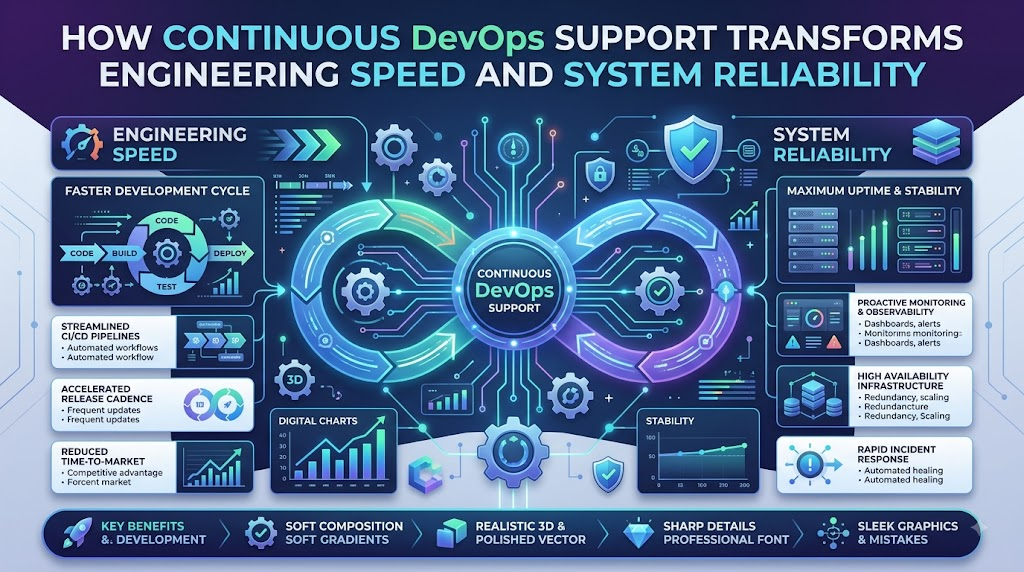
Modern software engineering teams face relentless pressure to ship features quickly while keeping production systems stable, secure, and cost-effective. As applications scale from monoliths to microservices, the underlying cloud infrastructure becomes increasingly intricate. Engineering teams often find themselves managing complex deployment pipelines, configuring DevOps support, responding to off-hours alerts, and fixing configuration drift—all while trying to build product features.Ongoing operational assistance offers a path forward. By providing dedicated focus to cloud operations, proactive monitoring, automated deployments, and incident response, continuous support models help organizations maintain reliable environments without burning out their core engineering teams.
What Are DevOps Support Services?
DevOps support services provide continuous assistance, operational maintenance, and proactive management for an organization’s software delivery pipelines and cloud infrastructure. Unlike a one-time project engagement—such as migrating an application to the cloud or setting up a basic CI/CD pipeline—ongoing support focuses on long-term health, stability, and evolution of technical environments.
+-----------------------------------------------------------------------+
|                       DevOps Operational Scope                        |
+---------------------------+-------------------------------------------+
| Core Focus Area           | Continuous Operational Tasks              |
+---------------------------+-------------------------------------------+
| Infrastructure as Code    | Terraform/CloudFormation maintenance      |
| CI/CD Pipeline Support    | Build automation, release troubleshooting |
| Cloud Operations          | AWS, Azure, GCP resource management       |
| Container Management      | Kubernetes administration & upgrades      |
| Observability & Alerting  | Log analysis, metric collection, alerts   |
| Incident Management       | Root cause analysis & triage              |
+---------------------------+-------------------------------------------+
Key operational areas covered by ongoing support include:
- Infrastructure Management: Utilizing Infrastructure as Code (IaC) tools like Terraform or AWS CloudFormation to maintain consistent, version-controlled cloud resources.
- Pipeline Maintenance: Ensuring CI/CD workflows run smoothly, dependencies remain updated, and deployment failures are triaged rapidly.
- Monitoring and Observability: Configuring metrics, log aggregation, and trace collection to detect performance degradation before end users are impacted.
- Troubleshooting and Incident Response: Investigating unexpected system behaviors, mitigating production outages, and conducting post-incident reviews to prevent recurrences.
- Performance Optimization: Identifying resource bottlenecks, optimizing database queries, and tuning system configurations for maximum throughput.
A useful distinction exists between foundational implementation and ongoing operational support. Implementation establishes the initial architectures, scripts, and environments. Support, on the other hand, absorbs the daily operational noise, responds to changing runtime conditions, and handles the continuous maintenance needed to keep those systems secure and operational over time.
Why Organizations Need Ongoing DevOps Support
Software environments are rarely static. Every new code deployment, security patch, cloud provider API change, and traffic spike introduces potential instability. Without dedicated oversight, small operational issues accumulate into severe technical debt.
Organizations frequently seek external support due to specific operational realities:
- Shifted Focus: When senior developers spend 30% to 50% of their workweek debugging build scripts or updating Kubernetes manifests, product roadmaps suffer.
- Specialized Skill Gaps: Modern cloud ecosystems require deep expertise across networking, security, containerization, and automation. Expecting every software engineer to master all these domains is often unrealistic.
- Configuration Drift: Inconsistent manual changes made during emergencies can cause production environments to diverge from staging environments, leading to unpredictable release failures.
- Scale and Complexity: Rapid business growth brings increased user loads, requiring real-time capacity scaling, cost governance, and architecture refinements.
Rather than completely replacing internal teams, ongoing support functions as a strategic force multiplier. Internal engineers remain focused on core application features and business logic, while support specialists handle background infrastructure operations, automation, and system stability.
24/7 DevOps Support Services
Critical web applications, SaaS platforms, and digital services operate globally, serving users across every time zone. System failures do not wait for business hours, and an unhandled outage during off-hours can lead to lost revenue and reputational damage.
Continuous 24/7 DevOps support services provide round-the-clock monitoring and rapid incident mitigation. This continuous operational model relies on several core elements:
- Proactive Monitoring and Alerting: Automated monitoring tooling actively tracks system health indicators (CPU utilization, memory consumption, latency, error rates). Alerts trigger immediately when thresholds are breached.
- Structured Escalation Paths: Incident response systems route alerts to on-call engineers based on clear severity matrices, ensuring urgent issues receive immediate technical attention.
- Real-Time Triage and Mitigation: Dedicated engineers step in to restore services quickly, utilizing predefined runbooks, rollback procedures, or infrastructure scaling to bring systems back online.
- Availability Monitoring: External synthetics continuously check endpoint health, guaranteeing that multi-region workloads remain accessible to global end users.
Round-the-clock operational coverage eliminates single points of failure within internal teams, preventing engineer burnout caused by continuous on-call shifts.
Managed DevOps Services
As cloud architectures expand, managing day-to-day operations can strain internal resources. Managed DevOps services offer a structured approach where an external team of specialists takes end-to-end responsibility for maintaining, running, and refining operational workflows.
+----------------------------------------------------------------------+
|                     Engagement Model Comparison                      |
+--------------------------+-------------------------------------------+
| Traditional Consulting   | Short-term, project-based delivery        |
| Internal Operations      | Full internal ownership and maintenance   |
| Managed DevOps Services  | Continuous operational management         |
+--------------------------+-------------------------------------------+
While project-based consulting addresses isolated technical hurdles, managed services focus on continuous ecosystem administration. This model typically encompasses:
- Automated Release Management: Managing deployment strategies (such as canary or blue-green deployments) to minimize risk during production updates.
- Cloud Infrastructure Governance: Maintaining access controls, cost management policies, resource tagging, and backup schedules across multiple cloud environments.
- Observability Operations: Refining metrics dashboards, managing log storage retention policies, and tuning alerting rules to eliminate alert fatigue.
- Security & Patch Management: Applying operational system security updates, rotating credentials, and maintaining secret management platforms.
Organizations often select managed models when scaling rapidly or when building an internal 24/7 operational capability is economically or operationally practical. Conversely, organizations with highly proprietary platforms or strict in-house security boundaries may choose to keep core operational workflows within internal engineering units.
Kubernetes Support Services
Container orchestration using Kubernetes has become the standard for running scalable, distributed applications. However, operating Kubernetes in production introduces substantial operational complexity.
Common operational demands within Kubernetes environments include:
- Cluster Upgrades and Maintenance: Applying Kubernetes version upgrades, node OS updates, and control plane patches without causing application downtime.
- Resource Optimization: Configuring pod resource requests, limits, and Horizontal Pod Autoscalers (HPA) to balance application performance against infrastructure costs.
- Ingress and Service Mesh Operations: Managing load balancers, SSL/TLS certificates, ingress controllers, and service meshes (such as Istio or Linkerd) for secure inter-service communication.
- Cluster Security and RBAC: Implementing strict Role-Based Access Control (RBAC), pod security standards, and network policies to isolate sensitive workloads.
Whether managing managed cloud offerings like AWS EKS, Azure AKS, and Google GKE, or self-hosted control planes, dedicated Kubernetes support ensures that containerized environments remain secure, cost-efficient, and resilient under varying user traffic loads.
AWS DevOps Support Services
Amazon Web Services (AWS) offers an expansive catalog of cloud infrastructure components. Architecting, automating, and maintaining these tools requires deep, specialized knowledge of AWS practices and ecosystem design principles.
Key operational areas within AWS DevOps support include:
- Container and Compute Platforms: Configuring and tuning Amazon EC2, Amazon Elastic Kubernetes Service (EKS), Amazon Elastic Container Service (ECS), and serverless execution environments like AWS Lambda.
- Infrastructure Automation: Developing and maintaining reusable code scripts using AWS CloudFormation or HashiCorp Terraform to manage cloud assets predictably.
- CI/CD Integration: Building delivery pipelines using AWS CodePipeline and AWS CodeBuild, or connecting third-party tools like GitHub Actions directly to AWS runtime environments.
- Observability and Cost Management: Utilizing Amazon CloudWatch, AWS X-Ray, and AWS Cost Explorer to track workload performance metrics, trace requests, and eliminate redundant operational spending.
Because cloud architecture decisions involve trade-offs between cost, latency, and fault tolerance, operational practices must be adjusted based on workload requirements rather than relying on standard templates.
Azure DevOps Support Services
Microsoft Azure powers critical enterprise applications worldwide. Operating efficiently on Azure requires mastery over native services, integration points, and delivery tooling.
Azure DevOps support services address several recurring operational needs:
- Azure Pipelines Management: Designing, optimizing, and maintaining build and release pipelines across hybrid cloud and multi-tier application architectures.
- Azure Kubernetes Service (AKS) Administration: Managing cluster deployment, nodepool scaling, virtual network configuration, and enterprise identity integration.
- Infrastructure Provisioning: Utilizing Bicep, ARM templates, or Terraform to automate Azure resource groups, virtual networks, compute instances, and database management systems.
- Governance and Security Integration: Implementing Azure Policies, Key Vault integrations for secrets management, and continuous monitoring via Azure Monitor and Log Analytics.
Systematic operational support ensures Azure environments remain compliant with internal governance standards while supporting rapid software updates.
DevSecOps Support Services
Historically, security testing occurred at the end of the software development lifecycle, right before a major release. This legacy approach created bottlenecks, delayed deployments, and made vulnerability remediations expensive. DevSecOps shifts security responsibilities earlier into the development pipeline.
+----------------------------------------------------------------------+
|                       DevSecOps Pipeline Lifecycle                   |
+----------------------------------------------------------------------+
|  [ Code ] ---> [ Build ] ---> [ Containerize ] ---> [ Deploy ]       |
|     |             |                 |                 |              |
|   SAST        Dependency        Container          Runtime           |
|  Scanning      Scanning         Security           Security          |
+----------------------------------------------------------------------+
A comprehensive DevSecOps support program embeds automated security controls across all stages of software delivery:
- Static and Dynamic Analysis (SAST/DAST): Integrating code and runtime security scanners directly into CI/CD pipelines to catch vulnerabilities early.
- Dependency and Container Scanning: Automatically checking open-source packages and container images for known vulnerabilities (CVEs) before deployment.
- Secrets Management: Centralizing the distribution of API keys, database credentials, and certificates using tools like HashiCorp Vault, avoiding hardcoded secrets in source repositories.
- Policy as Code: Enforcing infrastructure security policies automatically during code reviews to block non-compliant resource deployments.
Integrating security into daily operations helps engineering organizations minimize vulnerability exposure without sacrificing release speed.
SRE Support Services
Site Reliability Engineering (SRE) applies software engineering approaches to solve operational and infrastructure problems. SRE practices bridge the gap between development teams who want to push features quickly and operational teams who prioritize system stability.
Core SRE disciplines include:
- SLI/SLO Frameworks: Defining Service Level Indicators (SLIs) like request latency or success rate, and establishing actionable Service Level Objectives (SLOs) that align engineering priorities with business requirements.
- Error Budget Management: Tracking consumed error budgets to determine whether a team can safely deploy new software features or needs to focus on system stability tasks.
- Observability Engineering: Building comprehensive telemetry systems using metrics, logs, and distributed traces (via Prometheus, Grafana, Jaeger, or OpenTelemetry) to accelerate root-cause analysis.
- Blameless Post-Mortems: Analyzing production incidents to understand contributing system factors, leading to concrete, actionable improvements that prevent repeat failures.
SRE support helps engineering organizations build fault-tolerant architectures while maintaining a measured balance between rapid innovation and operational reliability.
MLOps Support Services
As artificial intelligence and machine learning models transition from research environments into live production applications, traditional software operations approaches become insufficient. Machine learning systems face unique operational challenges, including model drift, data pipeline failures, and heavy hardware resource demands.
MLOps support services extend traditional DevOps practices to accommodate data science workflows:
- Pipeline Automation: Building repeatable pipelines for data extraction, preprocessing, model training, and artifact registration using tools like Kubeflow or MLflow.
- Model Deployment & Serving: Deploying trained models as scalable microservices via REST or gRPC APIs, running on specialized CPU/GPU clusters.
- Continuous Model Monitoring: Tracking incoming inference data for feature drift, concept drift, and performance degradation to signal when retraining is required.
- Resource Optimization: Managing compute clusters efficiently to control the costs of distributed model training and inference.
Structured MLOps support connects data science output with reliable production infrastructure, ensuring ML models deliver consistent value.
DevOps Support Technology Areas
The modern operational ecosystem spans multiple specialized tool categories. The following table provides an overview of typical technologies used across various support areas:
| Area | Common Technologies / Practices | Primary Purpose |
| CI/CD | Jenkins, GitHub Actions, GitLab CI/CD, Azure Pipelines | Automated delivery pipelines |
| Cloud | AWS, Microsoft Azure, Google Cloud Platform | Infrastructure operations |
| Containers | Docker, Kubernetes, Helm, Containerd | Application packaging and management |
| Infrastructure as Code | Terraform, AWS CloudFormation, Pulumi, Bicep | Repeatable infrastructure automation |
| Monitoring & Logs | Prometheus, Grafana, Datadog, ELK Stack | Operational visibility and telemetry |
| Security | HashiCorp Vault, Trivy, SonarQube, Snyk | Automated security and vulnerability checks |
| SRE | OpenTelemetry, Cortex, PagerDuty, Chaos Mesh | System reliability and incident management |
| MLOps | Kubeflow, MLflow, Feast, Triton Inference Server | Production ML model operations |
Benefits of Continuous DevOps Support
Investing in sustained operational support provides practical structural advantages for technology-driven organizations:
- Accelerated Issue Resolution: Dedicated monitoring and triage protocols dramatically shorten Mean Time to Detect (MTTD) and Mean Time to Restore (MTTR) during outages.
- Consistent Infrastructure: Automated IaC workflows eliminate manual setup errors and guarantee operational parity across development, staging, and production environments.
- Stronger Security Posture: Automated security scans, regular dependency updates, and continuous compliance checks help protect production systems against emerging threats.
- Enhanced Engineering Productivity: Relieving product developers from routine infrastructure tasks allows internal talent to focus on features that drive business growth.
- Optimized Operational Costs: Continuous infrastructure auditing identifies over-provisioned compute resources, unused storage, and inefficient service allocations.
Common DevOps Support Challenges
Implementing or scaling an operational support framework presents distinct organizational challenges. Addressing these hurdles early is critical to long-term success:
- Poor Documentation: Outdated system diagrams and missing runbooks complicate incident triage and delay onboarding.
- Unclear Ownership Boundaries: Ambiguity regarding whether internal developers or support specialists handle specific pipeline failures leads to dropped tasks.
- Weak Escalation Protocols: Ill-defined alert routing causes non-critical issues to wake up key personnel off-hours, while urgent production issues stall.
- Limited Observability: Insufficient logging or unaggregated metrics leave engineers debugging complex distributed systems blindly.
- Excessive Manual Work: Relying on manual scripts instead of automated pipelines introduces human error and slows release velocity.
- Inconsistent Configurations: Divergent environmental variables make debugging issues across staging and production difficult.
- Communication Silos: Friction between developers, security specialists, and operational support teams hampers collaboration.
- Lack of Knowledge Transfer: Failing to document resolution steps leaves organizations reliant on specific individuals for critical fixes.
- Overdependence on External Teams: Delegating infrastructure management without maintaining internal architectural oversight risks strategic misalignment.
- Inflexible Security Controls: Rigid security restrictions that lack automation can slow developer workflows, tempting teams to bypass controls.
How to Choose a DevOps Support Provider
Selecting an operational partner requires careful evaluation of technical capabilities, communication protocols, and operational alignment.
+----------------------------------------------------------------------+
|                     Provider Evaluation Criteria                     |
+----------------------------------------------------------------------+
|  [ Technical Breadth ]  -> Cloud, Kubernetes, Security, SRE, MLOps   |
|  [ Response Process ]   -> SLA clarity, escalation, runbooks         |
|  [ Culture & Ops ]      -> Communication tools, transparency         |
|  [ Security & Compliance]-> Access controls, secrets management      |
+----------------------------------------------------------------------+
Engineering leaders should assess potential support providers against a structured checklist:
- Technical Expertise: Do they demonstrate deep, hands-on experience across cloud platforms, container platforms, IaC tools, and modern CI/CD architectures?
- Security Practices: How do they handle secrets management, privilege escalation, and access control within customer cloud environments?
- Incident Response SLA Structure: What are their documented response times across different incident severity tiers?
- Observability Standards: How do they instrument metrics, set up alerts, and build actionable dashboards?
- Communication and Integration: Will they integrate into your existing communication tools (e.g., Slack, Microsoft Teams, Jira) to act as a natural extension of your team?
- Knowledge Transfer Protocol: Do they maintain up-to-date runbooks and share operational documentation back with your internal engineering group?
Operational Focus Areas vs. Business Needs
Matching operational disciplines to specific business challenges helps organizations structure their technical roadmaps effectively:
| Support Area | Typical Business Need |
| DevOps Support | Ongoing infrastructure maintenance, delivery pipeline support, and automation. |
| 24/7 DevOps Support | Round-the-clock monitoring, emergency triage, and off-hours incident response. |
| Managed DevOps | Reducing internal operational workload through fully managed cloud workflows. |
| Kubernetes Support | Managing container orchestrators, upgrades, autoscaling, and microservice networking. |
| AWS DevOps Support | Architecture management, EKS/ECS scaling, and infrastructure automation on AWS. |
| Azure DevOps Support | Managing Azure Pipelines, AKS clusters, and enterprise Azure configurations. |
| DevSecOps Support | Integrating automated security scanning, compliance checks, and secrets management into CI/CD pipelines. |
| SRE Support | Enhancing reliability via SLI/SLO tracking, error budgets, and root-cause analysis. |
| MLOps Support | Deploying, monitoring, and scaling machine learning pipelines and models in production. |
Frequently Asked Questions
1. What are DevOps Support Services?
DevOps support services encompass ongoing operational assistance for cloud infrastructure, CI/CD pipelines, container orchestration platforms, and monitoring systems. They ensure software delivery systems remain stable, secure, and performant over time.
2. Why do companies need ongoing DevOps support?
Modern cloud infrastructure requires continuous maintenance, including security patching, infrastructure updates, pipeline fixes, and performance tuning. Ongoing support prevents technical debt, reduces downtime, and frees internal software engineers to focus on building features.
3. What do 24/7 DevOps Support Services include?
Round-the-clock support involves real-time monitoring of application health metrics, automated alert routing, emergency incident mitigation, production triage, and off-hours response to system outages.
4. What is the difference between managed DevOps and standard DevOps support?
Standard support often focuses on providing assistance, troubleshooting specific issues, and advising internal teams. Managed DevOps takes complete operational ownership of running, updating, and maintaining specific infrastructure elements and deployment workflows on an ongoing basis.
5. When is Kubernetes support useful?
Kubernetes support is valuable when teams run containerized workloads in production and require specialized expertise for complex cluster administration, zero-downtime upgrades, security policy enforcement, resource optimization, and autoscaling.
6. What does AWS DevOps support involve?
AWS support covers the administration and automation of Amazon Web Services infrastructure, including EC2, EKS, ECS, Lambda, Terraform automation, CloudWatch observability, and AWS pipeline configurations.
7. How does DevSecOps support improve security?
DevSecOps embeds automated security checks—such as static code analysis, dependency vulnerability scanning, container inspection, and secrets management—directly into early delivery pipelines, catching vulnerabilities before code reaches production.
8. What is the role of SRE and MLOps support?
SRE support applies engineering disciplines to maximize system reliability through SLO tracking, observability, and incident analysis. MLOps support manages the operational lifecycle of machine learning models, ensuring reliable pipeline automation, model serving, and performance monitoring.
Conclusion
Building and maintaining modern cloud infrastructure requires a balance between delivery speed, security, and operational reliability. As software systems evolve, managing CI/CD pipelines, containerized environments, multi-cloud architectures, and specialized workflows like MLOps demands consistent effort and specialized expertise.Navigating these demands successfully requires selecting an operational model suited to your team’s size and complexity. Whether establishing internal practices or collaborating with specialized DevOps Support Services, success depends on establishing clear operational boundaries, robust documentation, automated delivery pipelines, and comprehensive observability.

Find Trusted Cardiac Hospitals
Compare heart hospitals by city and services — all in one place.
Explore Hospitals