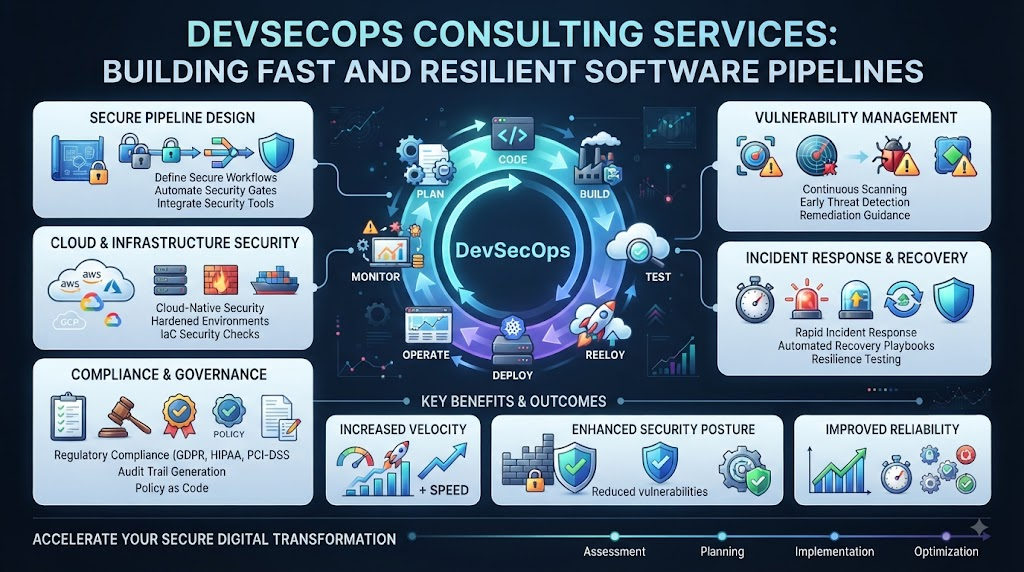
Modern software engineering moves at an incredible speed. Cloud platforms, microservices, and automated continuous delivery pipelines allow engineering teams to ship code multiple times a day. However, security often struggles to keep up with this rapid pace. Traditional security models—where a separate audit team tests an application right before production release—create massive delivery bottlenecks, friction between teams, and unaddressed vulnerabilities.DevSecOps bridges this divide by making security an automated, continuous, and shared responsibility across the entire software delivery lifecycle. Navigating this shift requires clear architecture, pragmatic tool integration, and practical cultural alignment. Engaging specialized DevSecOps Consulting Services provides engineering organizations with the targeted expertise, structural roadmaps, and technical guardrails needed to build fast, secure, and resilient delivery pipelines.In this comprehensive guide, we examine core DevSecOps principles, explore essential technical capabilities across cloud and container security, review common implementation pitfalls, and outline how expert advisory services accelerate engineering maturity.
What Is DevSecOps?
DevSecOps represents the natural evolution of modern software delivery. It integrates security practices and compliance controls directly into agile development and DevOps workflows. Rather than treating security as an isolated, perimeter-focused gatekeeper, DevSecOps establishes automated safety mechanisms throughout every stage of the engineering lifecycle.
       [ Plan & Code ]  -->  [ Build & Test ]  -->  [ Release & Deploy ]  -->  [ Operate & Monitor ]
              |                      |                       |                         |
       ( Threat Models &      ( SAST, SCA &           ( IaC Scanning &          ( Runtime Defense &
       Secrets Policy )       Container Checks )      Policy as Code )          Observability )
Definition of DevSecOps
DevSecOps is a cultural, engineering, and operational model that embeds security testing, risk assessment, and compliance automation into every phase of the software development lifecycle (SDLC), from initial design to active production runtime.
DevOps vs. DevSecOps
Traditional DevOps emphasizes release velocity, collaboration, and automated infrastructure provisioning. While DevOps optimizes for deployment speed, it can inadvertently amplify technical debt if code is released without structured security validation. DevSecOps augments this framework by integrating security gates into the same automated delivery mechanisms, ensuring speed does not come at the cost of stability or data protection.
Why Security Must Shift Left
Fixing a security defect discovered in production is significantly more expensive and disruptive than addressing it during local development. Shifting left means introducing automated testing, static code analysis, and architectural threat reviews at the earliest moments of code authoring, allowing developers to remediate risks immediately.
Security Throughout the SDLC
Security within DevSecOps is continuous. It begins during initial planning via threat modeling, extends through pull-request builds with automated scanning, verifies deployment templates with policy engines, and continues into production through runtime observability and telemetry.
Role of Automation
Manual reviews cannot scale with automated pipelines. DevSecOps relies on automated workflows that trigger security scans, validate infrastructure declarations, enforce regulatory baselines, and surface actionable feedback directly in developer dashboards.
What Are DevSecOps Consulting Services?
Adopting DevSecOps requires more than purchasing automated scanners; it demands tailored architectural design and operational alignment. DevSecOps Consulting Services provide the technical leadership, operational blueprints, and domain knowledge necessary to assess, structure, and operationalize security across complex delivery systems.
DevSecOps Strategy
Consultants evaluate existing workflows, tooling, and organizational culture to define an incremental adoption strategy that aligns with delivery goals and governance requirements.
Security Integration
Advisors help engineering teams integrate automated verification checkpoints into daily development flows without introducing excessive build latency or disruptive alert fatigue.
CI/CD Security
Securing the continuous integration and delivery pipeline itself is vital. Consulting services guide the hardening of pipeline runners, credential isolation, and branch protection policies.
Cloud Security
Modern applications rely on complex cloud primitives. Strategic consulting aligns cloud configuration, identity architectures, and workload isolation with established frameworks like NIST SP 800-204.
Application Security
Advisory teams assist in setting realistic vulnerability thresholds for custom code, establishing scanning standards, and conducting contextual threat modeling.
Infrastructure Security
Consultants guide the implementation of Infrastructure as Code (IaC) linting and policy enforcement, ensuring cloud resources meet baseline security criteria before provisioning.
Container Security
Advisors help design secure base image distribution workflows, minimal runtime configurations, and registry scanning strategies.
Continuous Security Monitoring
Consulting services establish unified monitoring frameworks that correlate pipeline build metrics, configuration drift alerts, and runtime security events.
DevSecOps Implementation Services
Designing a high-level strategy is the first step; technical execution transforms that strategy into working software pipelines. Through structured DevSecOps Implementation Services, technical specialists configure, integrate, and tune the automated platforms needed across development environments.
Implementation engagements typically operationalize:
- Static Application Security Testing (SAST): Scanning source code for logic bugs, injection vulnerabilities, and common weaknesses.
- Dynamic Application Security Testing (DAST): Probing running staging applications to detect functional security defects and configuration gaps.
- Software Composition Analysis (SCA): Cataloging third-party libraries to identify vulnerable dependencies and license compliance issues.
- Secrets Scanning: Preventing API keys, tokens, and certificates from being committed into source control.
- Container Scanning: Inspecting image layers, operating system packages, and runtime binaries for known Common Vulnerabilities and Exposures (CVEs).
- IaC Security: Validating Terraform, OpenTofu, CloudFormation, or Bicep templates against security best practices.
- Policy as Code: Enforcing organizational compliance rules via frameworks such as Open Policy Agent (OPA).
- Vulnerability Management Platforms: Aggregating security alerts into centralized dashboards with automated deduplication and prioritization.
- Security Gates: Defining pull-request blocking rules based on flaw severity thresholds.
- Automated Compliance Checks: Generating audit-ready evidence directly from deployment pipelines.
Practical CI/CD Pipeline Integration Scenario
Consider a standard deployment pipeline. A developer commits code and opens a pull request. Automated hooks immediately run unit tests alongside a lightweight SAST scanner and secrets detector.
[ Developer Commit ]
        │
        ▼
[ Pre-Merge Pipeline ] ──► ( SAST Scan + Secrets Check + SCA Audit )
        │
        ├─► [ Security Threshold Passed ] ──► Merge to Main Branch
        │
        └─► [ Critical Finding Detected ] ──► Block PR & Output Contextual Fix
Concurrently, an SCA tool inventories dependencies. If an engineer accidentally commits a plain-text private key or introduces an exploitable remote code execution dependency, the pipeline fails automatically. The system provides immediate, contextual remediation feedback in the pull-request comment, stopping vulnerable artifacts before they are merged.
DevSecOps Managed Services
Maintaining modern security infrastructure requires continuous operational care. Many organizations leverage DevSecOps Managed Services to maintain, optimize, and run their security toolchains alongside internal engineering teams.
       ┌────────────────────────────────────────────────────────┐
       │             DevSecOps Managed Operations               │
       ├──────────────────────────┬─────────────────────────────┤
       │ Pipeline Monitoring      │ Rule & Policy Tuning        │
       │ Alert Triage & Filtering │ Remediation Guidance        │
       │ Tool Maintenance         │ Incident Escalation Support │
       └──────────────────────────┴─────────────────────────────┘
Managed operations deliver continuous value across multiple functional areas:
- Security Pipeline Monitoring: Ensuring CI/CD scanners run reliably without failing legitimate builds due to tool timeouts.
- Vulnerability Triage and Prioritization: Filtering false positives so development teams spend time fixing genuine risks.
- Security Policy Updates: Regularly tuning rulesets to guard against emerging zero-day vulnerabilities and updated compliance standards.
- Remediation Support: Assisting developers with practical architectural guidance to resolve complex application vulnerabilities.
- Continuous Security Improvement: Tracking vulnerability resolution timelines and optimizing pipeline speed.
- Security Monitoring: Analyzing automated telemetry across development, staging, and production environments.
- Incident Support: Providing expert analysis when security alerts require root-cause investigations.
- Compliance Support: Maintaining automated logging and reporting to satisfy regular audit requirements.
Organizations benefit from managed support when internal teams must stay focused on core product engineering, or when specialized security staff is unavailable for round-the-clock toolchain operations.
DevSecOps Training
Automation is only as effective as the engineers who build and maintain it. Comprehensive DevSecOps Training builds security awareness across the entire technical organization, ensuring security is integrated by design rather than retrofitted.
Effective training programs cover core competencies:
- Secure SDLC Methodologies: Understanding how design decisions, coding habits, and code reviews impact system resilience.
- CI/CD Pipeline Security: Learning how to build hardened runners, isolate environment credentials, and configure automated security checks.
- Cloud Security Principles: Mastering the cloud shared responsibility model, least-privilege access, and secure network architecture.
- Container and Kubernetes Security: Understanding namespace isolation, non-root execution, and Pod Security Standards.
- Security Testing Tools: Learning how to interpret SAST, DAST, and SCA reports without experiencing alert fatigue.
- Practical Vulnerability Remediation: Exploring how to patch common software weaknesses systematically.
Corporate DevSecOps Training
For enterprise organizations, transforming delivery practices requires upskilling cross-functional teams simultaneously. Tailored corporate programs bridge communication silos between development, security, and operations.
Cross-Disciplinary Team Coverage
- Development Teams: Learn safe coding practices, dependency hygiene, and vulnerability triage.
- DevOps & Platform Teams: Master secure pipeline architecture, secrets lifecycle management, and automated guardrails.
- Security Teams: Learn how modern pipelines work, how to write security tests as code, and how to support high-velocity releases.
- Cloud & SRE Teams: Focus on infrastructure hardening, automated compliance verification, and runtime observability.
Enterprise training focuses on real-world scenarios, hands-on labs, customized tooling exercises, and practical team-level workflows to ensure security becomes an everyday operational habit.
DevSecOps Assessment Services
Before introducing new tools or changing workflows, organizations must understand their current capabilities. Structured DevSecOps Assessment Services evaluate existing processes, highlight critical exposure areas, and provide a clear roadmap for security maturity.
  [ Maturity Assessment ] ──► [ Pipeline Analysis ] ──► [ Cloud & Cluster Review ]
                                                                │
                                                                ▼
  [ Transformation Roadmap ] ◄── [ Gap Prioritization ] ◄───────┘
A comprehensive assessment examines:
- Current-State Delivery Practices: Evaluating developer workflows, deployment frequency, and existing testing procedures.
- CI/CD Pipeline Configurations: Identifying unencrypted secrets, overly permissive build runners, and missing verification gates.
- Code and Dependency Governance: Reviewing how external packages and internal source code are scanned and tracked.
- Cloud and Container Posture: Inspecting infrastructure definitions, access controls, and container orchestration policies.
- Identity and Access Management (IAM): Verifying least-privilege configurations across developer tooling and cloud environments.
- Compliance and Governance Alignment: Mapping current automation to regulatory frameworks like SOC 2, ISO 27001, or HIPAA.
The assessment delivers an actionable, risk-ranked transformation roadmap that guides leadership on where to invest engineering resources for maximum security impact.
Cloud Security Consulting Services
Cloud environments provide agility, but improper configurations can expose critical data within seconds. Specialized Cloud Security Consulting Services align cloud infrastructure across AWS, Microsoft Azure, and Google Cloud with modern DevSecOps practices.
Key focus areas include:
- Identity and Access Management (IAM): Enforcing strict role-based access, automated credential rotation, and multi-factor authentication.
- Cloud Security Posture Management (CSPM): Continuously monitoring cloud resources for dangerous misconfigurations, open storage buckets, and overly permissive firewall rules.
- Infrastructure as Code (IaC) Security: Embedding automated checks into pipelines to ensure Terraform and OpenTofu definitions adhere to security baselines prior to deployment.
- Network Segmentation and Workload Security: Implementing isolated virtual networks, private endpoints, and micro-segmentation.
- Centralized Logging and Observability: Aggregating cloud control-plane logs and audit trails to support continuous threat detection.
Kubernetes Security Consulting Services
Container orchestration platforms introduce distinct operational and security challenges. Dedicated Kubernetes Security Consulting Services help organizations harden clusters across the entire workload lifecycle, drawing upon recommendations from the CNCF Security TAG.
Critical Kubernetes security domains include:
- Role-Based Access Control (RBAC): Restricting cluster API access to minimize administrative blast radius.
- Network Policies: Defining granular ingress and egress rules to prevent unrestricted pod-to-pod communication.
- Admission Controllers and Policy Engines: Utilizing admission webhooks (like Kyverno or OPA Gatekeeper) to validate or mutate pod specifications dynamically.
- Secrets Management: Integrating external secret stores with Kubernetes without exposing plain-text values in manifests.
- Container Hardening: Enforcing Pod Security Standards, disallowing privileged execution, and making root filesystems read-only.
- Runtime Protection: Monitoring cluster system calls to detect unauthorized behavior in running pods.
Scenario: Preventing Insecure Pod Deployments
A developer inadvertently creates a deployment manifest configured to run a container as the root user with host network access. When the developer attempts to apply this manifest, a Kubernetes admission controller intercepts the request, evaluates it against active policy rules, and blocks the deployment immediately.
The engineer receives an explicit error message explaining that containers must run as a non-root user, preventing a risky configuration from ever reaching the cluster.
Software Supply Chain Security Services
Modern software applications are rarely built entirely from scratch; they assemble numerous third-party libraries, open-source modules, container base images, and external build plugins. Consequently, adversaries increasingly target software supply chains. Specialized supply chain security advisory helps organizations verify the origin, integrity, and safety of all software dependencies, using standards such as SLSA Framework.
  [ Third-Party Source ] ──► ( Cryptographic Verification ) ──► [ Secure Build ]
                                                                       │
  [ Verified Artifact ]  ◄── ( SBOM Attestation & Signing ) ◄──────────┘
Core supply chain protection measures include:
- Software Bill of Materials (SBOM): Generating and tracking accurate inventories of all software components, direct dependencies, and transitive packages.
- Software Composition Analysis (SCA): Monitoring dependencies continuously for known CVEs and obsolete libraries.
- Cryptographic Signing and Provenance: Signing build artifacts, container images, and release packages to verify provenance.
- Build Pipeline Hardening: Isolating build environments, using ephemeral build agents, and preventing tampering during artifact compilation.
- Artifact Repository Security: Implementing private proxy registries that scan, quarantine, and cache verified external packages.
Penetration Testing Services
Automated tools excel at discovering known vulnerabilities and syntax-level weaknesses. However, they cannot replicate the creative problem-solving of a skilled human adversary. Professional penetration testing complements automated DevSecOps pipelines by validating whether security controls work effectively against targeted attacks.
Penetration testing evaluations cover:
- Web Applications & APIs: Testing business logic flaws, authorization bypasses, and complex injection vectors.
- Cloud Infrastructure: Assessing IAM permission boundaries, metadata service exposure, and resource isolation.
- Containers and Kubernetes: Attempting container breakouts, lateral network movement, and cluster privilege escalation.
- CI/CD Pipelines: Validating runner security, repository permissions, and code review bypass controls.
Rather than replacing automated scanners, penetration testing validates that automated guardrails are correctly configured and identifying risks as intended.
DevSecOps Security Toolchain
A well-structured DevSecOps ecosystem integrates specialized security tooling across every phase of the delivery lifecycle.
| Security Domain | Core Focus | Common Tooling Categories / Approaches |
| Code Security | Source code flaw detection | SAST, Linting, Pre-commit Hooks |
| Application Testing | Behavioral runtime testing | DAST, IAST, API Contract Testing |
| Dependency Security | Open-source library scanning | SCA, License Compliance Tools |
| Secret Detection | Preventing credential leaks | Secrets Scanners, Git Pre-receive Hooks |
| Infrastructure as Code | Cloud manifest hardening | IaC Scanners, Static Policy Evaluators |
| Container Security | Base image vulnerability checks | Image Scanners, Minimal Distroless Images |
| Cluster Security | Orchestration hardening | Admission Controllers, Pod Security Standards |
| Supply Chain | Provenance and inventory tracking | SBOM Generators, Artifact Signing Engines |
| Runtime Protection | Production threat monitoring | eBPF Instrumentation, Runtime Telemetry, SIEM |
Practical Benefits of DevSecOps Consulting
Partnering with experienced DevSecOps consultants provides substantial, measurable improvements to an engineering organization’s operational efficiency and risk profile:
- Earlier Vulnerability Detection: Finding and resolving flaws during development reduces expensive late-stage rework.
- Reduced Operational Risk: Automated guardrails prevent high-risk configurations from reaching production systems.
- Faster Remediation Times: Contextual feedback delivered directly to developers speeds up bug fixes.
- Hardened CI/CD Pipelines: Build systems and runner environments are protected against tampering and unauthorized access.
- Enhanced Cloud & Cluster Security: Infrastructure definitions and Kubernetes workloads adhere to verified security baselines.
- Streamlined Compliance Reporting: Continuous evidence generation simplifies audit preparation for SOC 2, ISO 27001, and other regulatory frameworks.
- Reduced Alert Fatigue: Expert tool tuning removes false positives, allowing engineers to focus on genuine risks.
- Improved Engineering Collaboration: Shared visibility and automated processes replace adversarial handoffs between development and security teams.
The DevSecOps Implementation Process
Building a resilient DevSecOps practice follows a structured, iterative implementation process:
  [ 1. Assess ] ──► [ 2. Identify Gaps ] ──► [ 3. Define Standards ] ──► [ 4. Build Roadmap ]
                                                                                │
  [ 8. Iterate ] ◄── [ 7. Secure K8s ]  ◄── [ 6. Secure Cloud ]    ◄── [ 5. CI/CD Gates ]
- Assess the Current Environment: Review development workflows, pipeline tools, deployment architectures, and active security measures.
- Identify Security Gaps: Pinpoint unmonitored attack surfaces, manual bottlenecks, missing automated tests, and configuration drift.
- Define Security Requirements: Establish clear policies for vulnerability severity levels, allowed base images, and pull-request gating rules.
- Build the DevSecOps Roadmap: Create a phased execution plan prioritized by risk reduction and engineering impact.
- Integrate Security into CI/CD: Embed SAST, SCA, secrets scanning, and IaC verification into build workflows.
- Secure Cloud and Infrastructure: Harden cloud accounts, implement strict IAM boundaries, and enforce policy as code.
- Secure Containers and Kubernetes: Configure automated image scanning, admission controls, and runtime security monitoring.
- Implement Monitoring and Continuous Improvement: Correlate telemetry, track remediation velocity, and refine rulesets continuously.
Common DevSecOps Mistakes (And How to Avoid Them)
Organizations often encounter preventable challenges when adopting DevSecOps. Being aware of these pitfalls ensures a smoother adoption journey.
       ┌──────────────────────────────┬──────────────────────────────┐
       │ Common Pitfall               │ Recommended Solution         │
       ├──────────────────────────────┼──────────────────────────────┤
       │ Tool Sprawl & Clutter        │ Standardize on Core Scanners │
       │ Ignoring Developer Friction  │ Deliver Contextual Findings  │
       │ Deploying All Gates at Once  │ Introduce Blocking Gradually │
       │ Overlooking Secrets Hygiene  │ Automate Secret Vaulting     │
       │ Treating DevSecOps as Tools  │ Invest in Continuous Culture │
       └──────────────────────────────┴──────────────────────────────┘
- Deploying Excessive Scanners at Once: Turning on multiple scanners with strict blocking rules overwhelms developers. Solution: Introduce scanners incrementally, starting with high-severity alerts.
- Ignoring Developer Experience: Security tools that require complex external logins create friction. Solution: Surface actionable findings directly within IDEs and pull-request comments.
- Failing to Prioritize Vulnerabilities: Treating all security findings as critical leads to alert fatigue. Solution: Prioritize vulnerabilities based on exploitability and reachability.
- Neglecting Secrets Management: Hardcoding tokens in source code remains a leading cause of compromise. Solution: Implement pre-commit hooks, centralized secret stores, and automated scanning.
- Treating DevSecOps Solely as Tool Acquisition: Buying security software without training teams or refining workflows produces poor results. Solution: Balance tool implementation with training and cultural alignment.
DevSecOps Best Practices
To maintain a secure, high-velocity delivery ecosystem, engineering organizations should adopt these core best practices:
- Shift Security Left: Introduce automated code reviews and threat modeling early in the software lifecycle.
- Automate Repetitive Testing: Run static, dependency, and infrastructure security checks on every pull request.
- Prioritize Risks Contextually: Focus remediation efforts on reachable, highly exploitable vulnerabilities first.
- Secure Delivery Infrastructure: Protect CI/CD runners, restrict pipeline permissions, and safeguard administrative access.
- Enforce Centralized Secrets Hygiene: Use dedicated secret vaults and rotate API tokens automatically.
- Maintain Real-Time SBOMs: Keep an accurate, real-time inventory of all open-source libraries and container base images.
- Harden Container Environments: Use minimal base images, avoid running containers as root, and enforce Kubernetes admission controls.
- Audit Cloud Posture Continuously: Detect and remediate infrastructure configuration drift automatically using policy as code.
- Upskill Teams Continuously: Provide practical, hands-on training to developers, platform engineers, and security specialists.
How to Choose DevSecOps Consulting Services
Selecting the right advisory partner is essential for establishing an effective security practice. When evaluating consulting providers, consider these criteria:
- Demonstrated Technical Depth: Look for practical experience across modern CI/CD ecosystems, cloud architectures, and container orchestration platforms.
- Pragmatic, Developer-Centric Focus: Ensure the consulting team values developer velocity and designs practical workflows rather than rigid, manual roadblocks.
- Comprehensive Service Offerings: Partner with advisors who understand the full spectrum of security, from strategic assessments and pipeline implementation to Kubernetes hardening and team training.
- Clear, Actionable Reporting: Choose consultants who provide prioritized, risk-ranked remediation guidance rather than raw, uncurated scanner exports.
- Collaborative Knowledge Transfer: Select a team committed to upskilling internal engineers so your organization maintains security autonomy over time.
DevSecOpsNow.com Service Fit
DevSecOpsNow.com provides end-to-end consulting, engineering, and training services tailored to organizations at every stage of their security journey:
- DevSecOps Consulting Services: Strategic advisory to define roadmaps, establish security frameworks, and align delivery practices with compliance standards.
- DevSecOps Implementation Services: Hands-on engineering to embed SAST, DAST, SCA, secrets scanning, and policy-as-code engines into CI/CD workflows.
- DevSecOps Managed Services: Ongoing operational support, alert triage, policy optimization, and toolchain maintenance.
- DevSecOps Training & Corporate Training: Practical, lab-based educational programs designed to upskill development, DevOps, and security teams.
- DevSecOps Assessment Services: In-depth evaluations of pipelines, cloud workloads, and operational practices to identify security gaps.
- Cloud & Kubernetes Security Consulting: Advanced hardening, admission control architecture, and policy enforcement across multi-cloud and cluster environments.
- Software Supply Chain Security & Penetration Testing: Comprehensive defense validation, SBOM implementation, and adversarial testing across applications and infrastructure.
Frequently Asked Questions
1.What are DevSecOps Consulting Services?
DevSecOps Consulting Services provide organizations with expert strategic guidance, architectural design, and operational roadmaps to integrate security testing and governance directly into continuous integration, continuous delivery, cloud infrastructure, and software delivery workflows.
2.How does DevSecOps differ from traditional application security?
Traditional application security often relies on late-stage, manual security reviews conducted right before production release. DevSecOps embeds automated security checks throughout every stage of the development lifecycle, allowing teams to identify and resolve vulnerabilities earlier.
3.What is the first step in DevSecOps implementation?
A successful implementation begins with a thorough maturity assessment of your existing development pipelines, cloud configurations, toolchains, and team workflows. This assessment identifies security gaps and establishes a prioritized adoption roadmap.
4.How do DevSecOps Managed Services support internal engineering teams?
Managed services handle the ongoing operational overhead of running security toolchains. They filter false positives, update security policies, monitor pipeline integrity, and provide expert remediation guidance, freeing developers to focus on building features.
5.Why is corporate DevSecOps training important for engineering organizations?
Tools alone cannot secure a software delivery pipeline. Corporate training ensures that developers, platform engineers, and security analysts share a common understanding of secure coding practices, automated testing guardrails, and rapid remediation techniques.
6.What does a DevSecOps assessment evaluate?
An assessment reviews source code security, CI/CD pipeline hardening, secret management practices, cloud infrastructure configurations, container settings, Kubernetes admission policies, and overall compliance alignment.
7.How does DevSecOps integrate with cloud security?
DevSecOps incorporates cloud security by validating Infrastructure as Code templates prior to provisioning, enforcing least-privilege identity access, monitoring for configuration drift, and automating cloud security posture checks within deployment pipelines.
8.What are the primary security considerations for Kubernetes clusters?
Key Kubernetes security priorities include enforcing granular Role-Based Access Control, implementing network segmentation policies, utilizing admission controllers to block insecure pod configurations, securing container images, and monitoring runtime system events.
9.Why has software supply chain security become essential?
Modern software relies heavily on external open-source packages and build tools. Supply chain security ensures these dependencies are inventoried via SBOMs, continuously scanned for known vulnerabilities, and cryptographically verified to prevent tampering.
10.Does automated DevSecOps replace penetration testing?
No. Automated scanning tools excel at identifying known syntax and configuration issues, while penetration testing uses human expertise to discover complex business logic flaws, authorization weaknesses, and sophisticated multi-stage attack vectors.
Conclusion
Building secure software at cloud speed requires an intentional balance of culture, process, and automated technology. Modern engineering teams cannot afford to choose between deployment velocity and comprehensive security protection. By shifting security left, automating testing gates, protecting software supply chains, and hardening cloud and Kubernetes workloads, organizations can confidently ship resilient code faster.Partnering with experienced advisors through professional DevSecOps Consulting Services accelerates this operational shift. Expert consulting helps organizations avoid common implementation mistakes, reduce alert fatigue, and build scalable security workflows tailored to their unique technical requirements. With continuous security automation, clear governance, and well-trained engineering teams, organizations transform security from a release bottleneck into an operational accelerator.

Find Trusted Cardiac Hospitals
Compare heart hospitals by city and services — all in one place.
Explore Hospitals