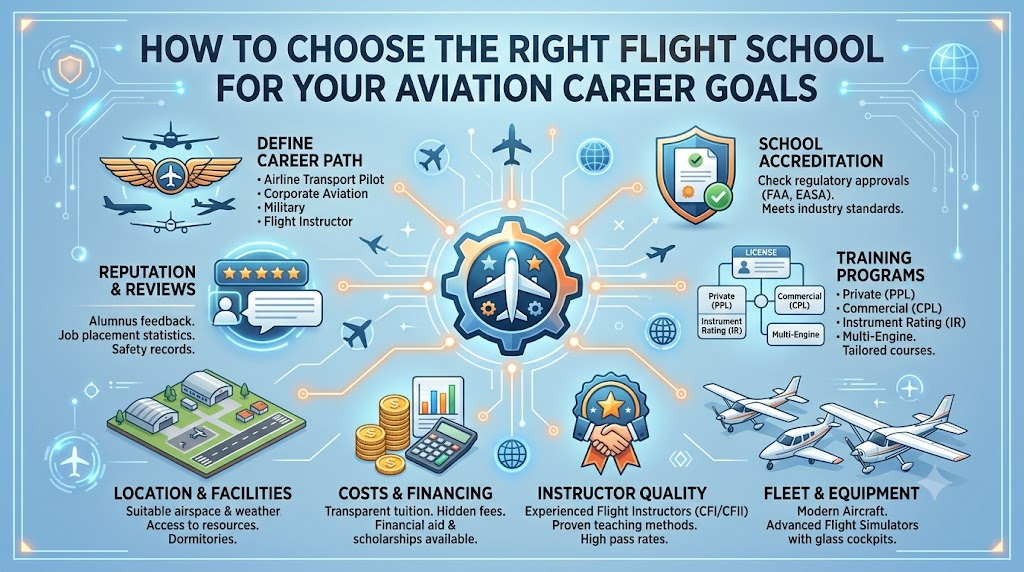
Embarking on a career as a professional pilot is one of the most exciting and rewarding journeys in aviation. However, before setting foot in a cockpit or taking command of an aircraft, every aspiring aviator faces a critical first decision: selecting the right flight training institution. Choosing where to undertake flight training is a significant educational and financial investment that lays the foundation for safety, aeronautical skill, and professional habits throughout a pilot’s career.Because learning to fly requires both rigorous academic study and hands-on practical instruction, evaluating training organizations demands thorough preparation. Prospective students must look beyond marketing brochures and examine key operational factors, including regulatory certifications, instructor qualifications, fleet conditions, safety cultures, and transparent pricing structures. Because individual career goals, personal budgets, and geographical preferences differ, there is no single flight school that fits every student perfectly. Researching various programs thoughtfully before enrolling ensures that students invest their time and resources into a pathway aligned with their long-term aviation ambitions.BestPilotsSchool serves as an educational research resource to help prospective students compare training pathways, flight academies, and commercial flight programs across the globe.
Understanding Pilot Training
Pilot education is a dual-track learning process that seamlessly integrates theoretical knowledge with practical application. Students must master aeronautical concepts on the ground while simultaneously building practical stick-and-rudder skills in the air.
- Ground Training: Covers academic subjects such as aerodynamics, meteorology, air law, navigation, aircraft systems, human factors, and radio communications. Ground school prepares students for official written knowledge examinations administered by aviation authorities.
- Practical Flight Training: Involves maneuvers, takeoff and landing procedures, emergency operations, cross-country navigation, night flying, and instrument navigation under direct supervision and solo conditions.
- Assessments and Examinations: Throughout training, students complete progress checks, written exams, and practical flight tests (often called checkrides) conducted by designated examiners to demonstrate competency.
Pilot training pathways vary considerably depending on the country, the local aviation authority, and whether a student pursues a modular or integrated training track. Understanding this relationship helps students appreciate why structured ground instruction and disciplined flight practice are equally vital.
What Makes a Good Pilot School?
Identifying high-quality pilot training institutions involves assessing how effectively a school balances safety, educational quality, and student support. When evaluating various options, aspiring aviators should consider specific operational indicators:
- Regulatory Certification: Official authorization and oversight from national aviation authorities ensure that the school adheres to established educational and safety standards.
- Instructor Experience and Culture: Qualified, passionate flight instructors who prioritize student learning over accumulating flight hours create a supportive, safety-oriented environment.
- Fleet Diversity and Maintenance: A well-maintained fleet with high availability ensures students experience minimal training delays due to mechanical issues.
- Comprehensive Facilities and Technology: Modern ground school classrooms, dedicated briefing areas, and advanced flight simulators enhance learning efficiency.
- Transparent Fee Structures: Clear line-item estimates covering aircraft hourly rates, instructor fees, fuel surcharges, exam fees, and supplies prevent unexpected costs.
- Operational Weather and Location: Local airspace, airport traffic density, and seasonal weather conditions directly influence training progress and flight scheduling.
Ultimately, identifying the best pilot schools requires evaluating how well a school’s culture, location, operational capabilities, and pricing structure match a student’s personal learning preferences and professional objectives.
How to Compare the Best Flight Schools
Comparing training facilities responsibly requires a systematic approach rather than relying solely on promotional literature or casual recommendations. Aspiring pilots benefit from building a structured framework to assess multiple flight institutions side by side.
When evaluating the best flight schools, review their regulatory credentials, aircraft availability, student-to-instructor ratios, and ground training resources. Look into the school’s scheduling flexibility and how weather disruptions are handled. Assessing student support services—such as progress tracking, administrative guidance, and career counseling—provides valuable insight into the overall learning environment. Comparing accommodation options, local living costs, and total estimated training fees allows students to make realistic financial arrangements. Evaluating these elements systematically enables prospective students to select an environment that supports consistent progress.
Understanding Commercial Pilot Training
Commercial pilot training prepares aviators to operate aircraft for compensation or hire. Beyond basic handling skills, commercial instruction focuses on precision flying, advanced aircraft systems, complex maneuver execution, and professional decision-making.
Students master commercial cross-country navigation, high-altitude operations, complex system management, emergency procedures, and multi-engine operations where applicable. Commercial syllabi emphasize night operations, strict adherence to aviation regulations, precise flight planning, and advanced meteorology. Flight-hour requirements and curriculum structures vary depending on the governing aviation authority and program format (integrated versus modular). Because commercial training establishes the benchmark for professional aviation standards, choosing a thorough, well-regulated training environment is vital for career development.
What to Look for in the Best Commercial Pilot Training Schools
Institutions offering professional commercial pathways should maintain elevated operational and educational standards. When evaluating prospective academies for commercial flight preparation, focus on several structural indicators:
- Structured Professional Syllabi: Comprehensive, clear training syllabi designed to take students systematically from initial training through commercial licensing.
- Advanced Fleet and Simulators: Access to multi-engine aircraft, modern glass-cockpit avionics, and certified flight simulation training devices.
- Experienced Commercial Instructors: Flight instructors with real-world charter, corporate, or airline background who share practical industry insights.
- Robust Progress Tracking: Structured stage checks and regular performance reviews to monitor student development and keep training on schedule.
- Career Readiness and Professional Orientation: Exposure to standard operating procedures, crew resource management concepts, and professional aviation standards.
Selecting among the best commercial pilot training schools requires verifying that an institution provides transparent cost tracking, reliable aircraft availability, and high instructional standards without relying on unrealistic career guarantees.
Choosing a Pilot Training Academy
Selecting a dedicated pilot training academy involves verifying regulatory credentials, facility resources, and operational disciplines. Formal academies often present structured, full-time learning environments designed to transition students efficiently through multiple licenses and ratings.
Prospective students should confirm that the academy holds appropriate approvals from the local aviation authority and maintains disciplined aircraft maintenance schedules. Evaluate whether the academy provides dedicated ground instructors, modern learning materials, and adequate flight scheduling capacity to avoid training bottlenecks. Reviewing student housing, campus resources, and administrative support helps determine if the environment is conducive to full-time study. Checking these details directly with school representatives and aviation authorities ensures that students make informed choices based on verified facts.
How to Find the Best Flying Schools
Finding suitable flying schools involves combining online research, direct inquiries, and on-site visits where feasible. While online reviews and community forums offer initial context, they should serve only as starting points for deeper evaluation.
- Research regional and national aviation authority databases to verify school approval status and history.
- Inspect aircraft maintenance logs, hangar conditions, and fleet availability during personal visits or virtual consultations.
- Evaluate airport airspace complexity, local weather patterns, and runway availability, as busy airspace or frequent adverse weather can affect timeline and budget.
- Assess instructor availability and turnover rates to ensure continuity in training.
By gathering information from multiple independent channels, students can identify the best flying schools for their specific location, budget, and schedule requirements.
Understanding Commercial Pilot License Training
Commercial pilot license training represents a major milestone in a pilot’s professional journey. It bridges the gap between private recreational flying and professional aviation operations.
The curriculum covers theoretical ground school subjects alongside practical flight operations, including performance calculations, weight and balance, complex navigation, and radio communications. Candidates undergo written knowledge examinations, practical flight tests, and flight-hour accumulation under specific conditions (such as solo cross-country and instrument hours) prescribed by national aviation authorities. Because licensing requirements, medical standards, and hour minimums differ across jurisdictions, candidates should review regulations published directly by their local aviation governing body.
Choosing an Airline Pilot Training Academy
For individuals aiming specifically at career paths with commercial air carriers, selecting an airline pilot training academy requires careful evaluation of specialized training components:
- Crew Resource Management (CRM): Training that emphasizes team communication, workload management, situational awareness, and decision-making in multi-crew environments.
- Advanced Simulator Integration: Utilization of modern flight simulation devices to replicate complex system failures, adverse weather, and multi-engine procedures.
- Standard Operating Procedures (SOPs): Training environments that incorporate professional airline-style checklists, briefings, and operational discipline.
- Advanced Ratings: Integration of instrument ratings, multi-engine ratings, and jet orientation courses into cohesive training tracks.
Airline hiring criteria vary based on market conditions, regional regulations, flight experience, and specific carrier requirements. Aspiring airline pilots should focus on obtaining high-quality foundational training rather than choosing programs based on unverified employment claims.
How to Evaluate the Best Aviation Academy for Pilot Training
Evaluating top-tier aviation academies involves analyzing performance, safety discipline, facilities, and educational support across multiple operational areas.
| Evaluation Category | Key Indicators | Operational Value |
| Regulatory & Safety | Official authority approval, safety management systems, transparent maintenance records | Ensures compliance, high safety standards, and valid licensing pathways |
| Instructional Quality | Certified flight and ground instructors, structured syllabi, low student-to-instructor ratio | Delivers consistent, high-standard aeronautical education |
| Fleet & Technology | Modern avionics, multi-engine aircraft, certified flight simulators | Prepares students for current industry technology and complex aircraft |
| Training Efficiency | Reliable aircraft availability, efficient scheduling, weather-adapted planning | Minimizes training delays, extra costs, and idle time |
| Financial Transparency | Itemized fee estimates, clear refund policies, transparent payment schedules | Prevents unexpected expenses and protects student investments |
Comparing these structural metrics allows prospective students to determine the best aviation academy for pilot training relative to their budget, location, and career objective.
Comparing the Best Pilot Schools in the World
For students considering training overseas, researching international flight schools introduces additional regulatory and practical considerations. Global training destinations often attract students due to favorable weather conditions, modern aircraft fleets, or competitive training costs.
However, training abroad requires careful planning. Aspiring pilots must research license conversion processes between the host country’s aviation authority and their home country’s regulatory body. Differences in airspace complexity, communication procedures, visa requirements, living expenses, and language proficiency expectations must also be considered. While exploring the best pilot schools in the world offers valuable opportunities, international candidates must confirm that their foreign qualifications convert smoothly into their intended job market.
Important Factors to Consider Before Enrolling in Flight School
Making a financial and time commitment to flight training requires evaluating practical, real-world factors that influence student success.
- Total Cost Structure: Obtain itemized cost estimates that include flight hours, instructor time, ground school, fuel surcharges, examination fees, supplies, and landing fees.
- Training Delays: Account for potential weather disruptions, seasonal maintenance cycles, and instructor availability when budgeting time and money.
- Medical Certification: Secure required aviation medical certificates from an authorized medical examiner prior to paying tuition or enrolling.
- Payment Terms and Refund Policies: Review tuition schedules, escrow protections, and withdrawal policies in writing before transferring funds.
Asking for clear, written financial and operational policies protects students and ensures realistic expectations regarding timeline and total expense.
Why Flight School Safety Matters
Safety is the cornerstone of all aviation operations. A flight school’s commitment to safety reflects its operational discipline, maintenance standards, and organizational culture.
Evaluating safety practices involves reviewing how maintenance is conducted on training aircraft, how pre-flight inspections are monitored, and how weather limits are enforced. Quality schools foster a positive safety culture where safety concerns can be reported without penalty. Emergency procedures, spin awareness, collision avoidance, and risk management should be integrated into every phase of flight and ground instruction. Verifying a school’s safety discipline through authority records and on-site observation gives students confidence in their learning environment.
Questions to Ask Before Choosing a Pilot School
When visiting or interviewing potential flight training institutions, prospective students should ask targeted questions to assess operational quality:
- Which aviation authority regulates and approves your flight training programs?
- What specific pilot licenses, ratings, and certificates can students earn here?
- What aircraft models make up the active training fleet, and how are they maintained?
- What is the current student-to-instructor ratio, and will I be assigned a primary instructor?
- What is the average total cost paid by recent students to complete this specific program?
- What additional fees—such as fuel surcharges, checkride fees, or landing fees—are not included in the basic quote?
- How are flight schedules managed during poor weather or unexpected maintenance?
- What ground school materials, classroom instruction, and tutoring resources are provided?
- What medical certification is required before beginning practical flight lessons?
- What terms apply to refund policies, account balances, and payment schedules?
Requesting clear answers to these questions helps students avoid unexpected costs and scheduling issues later in their training.
How to Prepare for Pilot Training
Proper preparation before formal instruction begins helps students progress more smoothly through ground school and flight lessons.
- Research Licensing Pathways: Learn about the specific licensing steps, exams, and hour minimums required by your target aviation authority.
- Complete Aviation Medical Exams: Obtain the appropriate medical certificate early to confirm eligibility before committing financial resources.
- Study Foundational Concepts: Review basic physics, mathematics, aerodynamics, and meteorology concepts to build background knowledge.
- Practice Aviation English: Strengthen radio communication skills and technical English vocabulary where applicable.
- Plan Finances Realistically: Establish a clear budget covering tuition, living expenses, contingency funds, and potential training delays.
Arriving at flight school organized, mentally prepared, and financially organized allows students to focus entirely on learning and mastering flight skills.
Common Mistakes to Avoid When Choosing a Flight School
Navigating flight school choices requires caution to avoid common pitfalls that lead to frustration, increased costs, or delayed progress.
- Selecting a school based strictly on advertised lowest price without verifying hidden fees or fleet conditions.
- Assuming that advertised minimum training hours represent the actual time needed to finish a license or rating.
- Failing to verify current regulatory approvals and certifications with local aviation authorities.
- Overlooking aircraft availability, instructor ratios, and local weather patterns that affect completion timelines.
- Believing claims of guaranteed employment, airline placement, or guaranteed exam passes.
- Committing funds without reviewing refund policies, payment terms, and account protection rules.
- Ignoring license conversion requirements when planning to train abroad and return home to work.
Avoiding these common errors helps prospective aviators protect their investment and stay focused on achieving their training milestones.
How BestPilotsSchool Can Help Aspiring Pilots Research Their Options
Navigating flight schools, licensing rules, and training pathways can feel overwhelming for prospective students. BestPilotsSchool provides an educational platform where aspiring aviators can explore, research, and compare pilot schools, flight academies, and commercial flight training options worldwide.
By organizing information based on location, facilities, licensing pathways, and training structures, BestPilotsSchool helps students evaluate flight training options objectively. The platform enables users to compare training environments against their personal career goals, budget constraints, and geographical preferences, serving as a starting point for independent research and informed decision-making.
The Future of Pilot Training
Flight education continues to evolve through technological advancements and modern instructional methods. Computer-based training platforms, virtual reality tools, and modern flight simulators allow students to practice complex procedures, systems management, and emergency drills safely on the ground.
Data-driven flight tracking, digital progress monitoring, and advanced glass-cockpit avionics prepare students for modern commercial aircraft environments. However, while digital tools and advanced simulation enhance learning efficiency, practical flight instruction in real aircraft remains the fundamental core of pilot certification. Blending modern technology with disciplined practical flying ensures that the next generation of aviators is well-prepared for professional flying careers.
Frequently Asked Questions About Pilot Schools and Flight Training
1.How Do I Choose the Best Pilot School?
Choosing a pilot school involves evaluating regulatory approvals, instructor qualifications, aircraft fleet condition, safety practices, ground school resources, total transparent costs, location weather, and your specific career goals.
2.What Should I Look for in the Best Flight Schools?
Key factors include certified ground and flight instructors, well-maintained training aircraft, modern simulation tools, transparent pricing structures, structured progress tracking, and a strong safety culture.
3.How Long Does Commercial Pilot Training Take?
Training duration varies based on whether a student selects a full-time integrated course or a part-time modular pathway. Weather conditions, student aptitude, aircraft availability, and local regulatory hours also affect timeline.
4.What Is Included in Commercial Pilot Training?
Commercial pilot training combines ground instruction in regulations, meteorology, navigation, and systems with practical flight maneuvers, cross-country operations, night flying, multi-engine training, and emergency procedures.
5.How Much Does Commercial Pilot License Training Cost?
Costs vary widely depending on the country, aviation authority, aircraft model, hourly flight rates, instructor fees, living expenses, and total hours required to achieve proficiency.
6.How Do I Choose an Airline Pilot Training Academy?
Look for academies offering structured commercial syllabi, multi-engine and instrument ratings, simulator integration, crew resource management concepts, professional standards, and verified authority approvals.
7.Are the Best Pilot Schools in the World Always the Best Choice for Every Student?
Not necessarily. The ideal school depends on individual factors such as local license conversion rules, budget, personal schedule, preferred training location, language requirements, and specific career goals.
8.Do I Need a Medical Certificate Before Starting Pilot Training?
Yes, obtaining the appropriate aviation medical certificate from an authorized medical examiner prior to beginning practical training ensures you meet all physical and health requirements.
9.Can I Become a Commercial Pilot Without Previous Flying Experience?
Many flight academies offer zero-to-commercial training programs designed for beginners, provided candidates meet age, educational, medical, and regulatory eligibility criteria.
10.Can BestPilotsSchool Help Me Research Pilot Training Options?
BestPilotsSchool helps aspiring aviators research and compare flight schools, pilot academies, and commercial training programs based on location, facilities, licensing pathways, and career objectives.
Conclusion
Selecting the right flight school is one of the most important decisions an aspiring pilot will make. Navigating this pathway successfully requires research, clear goals, and an understanding of flight education fundamentals. By carefully evaluating regulatory credentials, instructor experience, fleet availability, safety cultures, and transparent pricing structures, prospective students can choose a training environment that supports their personal development and aeronautical safety.Because aviation regulations, medical standards, and licensing rules vary globally, students should verify operational details directly with flight schools and national aviation authorities. No training institution can guarantee career outcomes or employment, but high-quality instruction builds a solid foundation for professional flying. Educational comparison platforms such as BestPilotsSchool offer helpful tools to research training programs, compare global options, and take confident steps toward a professional pilot career.

Find Trusted Cardiac Hospitals
Compare heart hospitals by city and services — all in one place.
Explore Hospitals