Introduction
Cloud environments make it easy to add servers, containers, databases, and other resources, but that flexibility can create a difficult question: how much capacity is actually needed? Too little capacity can affect application performance, while too much can leave organizations paying for resources they rarely use. Traditional monitoring can show what is happening now, but capacity planning often requires understanding patterns across large amounts of operational data.
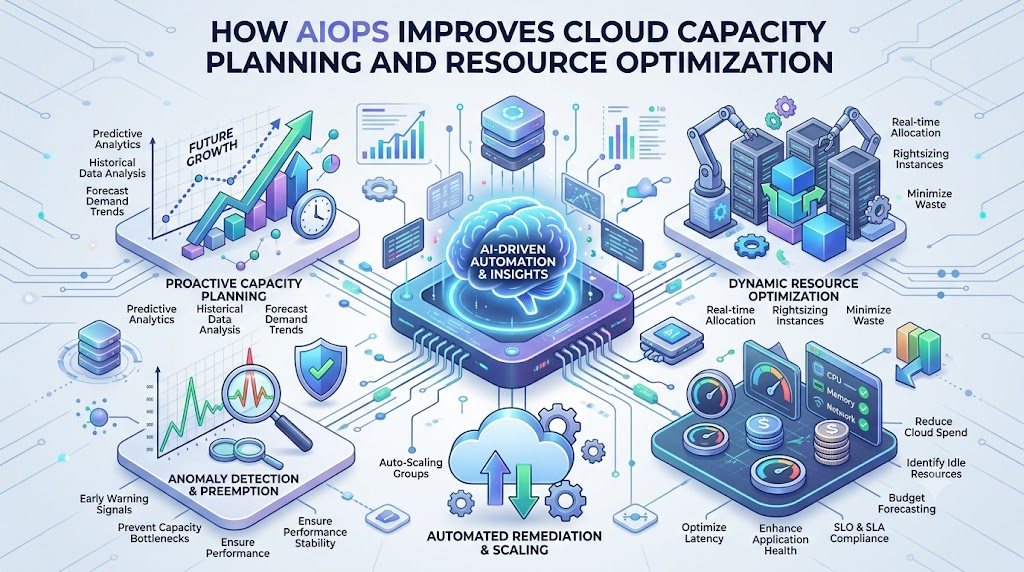
TheAIOps explores how Artificial Intelligence for IT Operations can turn operational data into useful insights. AIOps can combine metrics, logs, events, topology, and historical patterns to support more informed capacity decisions. This guide explains how AIOps can be applied to cloud capacity planning, where it fits into resource optimization, and what organizations should consider before introducing automation.
What Is AIOps-Based Cloud Capacity Planning?
Cloud capacity planning is the process of estimating how much computing, storage, networking, and application capacity will be required over time. The goal is to maintain appropriate performance without continuously overprovisioning infrastructure.
An AIOps approach adds machine learning, analytics, observability, and automation to this process. Instead of looking only at fixed thresholds, an AIOps Platform can analyze historical and current operational patterns to identify changes in resource demand.
For example, a retail application may experience predictable increases in traffic during weekends or promotional campaigns. An AIOps system can analyze previous behavior and provide signals that help operations teams prepare infrastructure before demand increases.
This does not mean AIOps can perfectly predict every future workload. Forecast quality depends heavily on the quality, completeness, and relevance of the operational data being analyzed.
Why Traditional Capacity Planning Can Become Difficult
Modern environments generate data from many sources, including virtual machines, containers, Kubernetes clusters, databases, APIs, networks, and cloud services.
A simple CPU threshold may identify when a server is busy, but it does not necessarily explain why utilization increased or whether the increase will continue.
Cloud-native applications introduce additional complexity. A single user transaction may pass through multiple microservices, databases, queues, and external services. Capacity decisions therefore need context rather than isolated metrics.
AIOps can bring these signals together and support a broader operational view.
How AIOps Supports Cloud Resource Optimization
Intelligent Monitoring
AIOps Tools can collect and analyze telemetry from infrastructure and applications. Metrics such as CPU utilization, memory consumption, disk usage, network traffic, request rates, and latency provide the foundation for capacity analysis.
The value comes from connecting these measurements with operational context. A sudden increase in CPU usage, for instance, may be normal during a scheduled workload but concerning when it occurs alongside increasing latency and error rates.
Anomaly Detection
Anomaly detection identifies behavior that differs from an established operational pattern.
Instead of relying only on a rule such as “CPU above 80% equals an alert,” machine learning models may consider historical behavior, time periods, workload patterns, and related signals.
This can help teams investigate unusual resource consumption earlier, although false positives and false negatives remain possible.
Predictive Analytics
Predictive analytics uses historical information and statistical or machine learning techniques to estimate future patterns.
For capacity planning, this may involve analyzing:
- Increasing application traffic
- Memory growth
- Storage consumption
- Database workload
- Seasonal demand
- Container resource usage
- Infrastructure utilization
The resulting forecasts can support decisions about scaling, budgeting, and infrastructure preparation.
Event Correlation
Capacity issues rarely appear as a single isolated event. A resource bottleneck may produce several related symptoms across an application stack.
Event correlation can connect these signals so that operations teams have more context when investigating an issue. TheAIOps.com already covers event correlation as a method for connecting distributed operational events into more meaningful incidents.
Practical AIOps Capacity Planning Use Cases
| Capacity Planning Area | AIOps Capability | Practical IT Operations Use Case |
|---|---|---|
| Cloud infrastructure | Predictive analytics | Forecast increasing compute and memory demand |
| Kubernetes | Anomaly detection | Identify unusual pod or node resource consumption |
| Databases | Intelligent monitoring | Detect growing storage or query workload patterns |
| Applications | Observability | Connect traffic growth with latency and infrastructure demand |
| Networks | Event correlation | Relate bandwidth utilization to application performance |
Kubernetes Resource Planning
Kubernetes environments can change rapidly because workloads may scale horizontally, containers can move between nodes, and deployments can occur frequently.
An AIOps workflow can analyze pod, node, application, and service telemetry together. If a service repeatedly approaches resource limits during predictable traffic periods, the information can support adjustments to resource requests, limits, autoscaling policies, or cluster capacity.
Kubernetes observability depends on understanding telemetry such as logs, metrics, traces, and events across the environment.
Application and Database Capacity
Application performance and infrastructure capacity are closely connected.
Suppose an API begins receiving more requests. CPU utilization may rise, database connections may increase, query latency may grow, and downstream services may experience additional load.
An AIOps system can correlate these signals and help engineers understand whether the problem is primarily related to application demand, infrastructure constraints, database performance, or another dependency.
A Practical AIOps Implementation Approach
Successful AIOps Implementation should begin with a specific operational problem rather than attempting to automate everything simultaneously.
1. Define the Capacity Problem
Determine whether the main issue is overprovisioning, unexpected resource growth, application performance, infrastructure saturation, or planning for predictable demand.
2. Collect Relevant Operational Data
Identify available metrics, logs, traces, events, configuration information, cloud usage data, and application telemetry.
Data quality matters. Incomplete or inconsistent telemetry can produce unreliable analysis.
3. Establish Baselines
Before introducing predictive models, understand normal resource behavior. Baselines provide useful context for anomaly detection and forecasting.
4. Introduce Analytics and Correlation
Use suitable AIOps capabilities to identify unusual patterns and relationships between infrastructure and application behavior.
5. Automate Carefully
Automation can support actions such as scaling approved resources or triggering predefined workflows. Production automation should use access controls, testing, monitoring, approval policies, and rollback procedures.
6. Measure the Results
Track meaningful operational indicators such as resource utilization, incident frequency, capacity-related alerts, performance trends, and manual effort.
Security and Governance Considerations
Resource optimization should not come at the expense of operational control.
An AIOps environment may receive access to infrastructure metrics, configuration information, cloud accounts, and automation systems. Least-privilege permissions should therefore be used wherever possible.
Automated remediation also requires safeguards. High-impact actions should be tested in controlled environments, logged for auditability, and monitored after execution. Human approval may remain appropriate for changes that could affect critical production services.
Skills Needed for AIOps-Based Capacity Planning
Professionals working in this area benefit from a combination of infrastructure and data skills.
AIOps Training can cover observability, monitoring, cloud infrastructure, automation, machine learning concepts, incident management, and operational data analysis.
An AIOps Course may also introduce AIOps architecture, event correlation, anomaly detection, predictive analytics, and practical implementation workflows.
AIOps Certification can demonstrate knowledge of particular AIOps concepts or technologies, depending on the certification program. Professionals should examine the actual curriculum and assessment requirements rather than assuming every certification covers the same material.
An AIOps Engineer may work across monitoring, automation, cloud infrastructure, data pipelines, incident workflows, and operational analytics. Responsibilities vary between organizations.
For organizations that need help designing or integrating these capabilities, AIOps Consulting and AIOps Services may address areas such as architecture, tool selection, observability integration, automation, and implementation planning.
Common Mistakes to Avoid
One common mistake is treating resource utilization as the only measure of capacity. CPU or memory consumption alone may not explain application performance.
Another mistake is automating scaling decisions before validating the underlying data and models. Incorrect signals can lead to unnecessary scaling or insufficient capacity.
Organizations should also avoid selecting AIOps Tools solely because they offer many features. Integration support, scalability, APIs, security, governance, observability coverage, and compatibility with existing operational workflows are equally important.
Finally, AIOps should complement engineering judgment rather than remove it. Human review remains valuable when situations are unusual, high-risk, or poorly represented in historical data.
The Future of Intelligent Capacity Management
Cloud operations are becoming increasingly dynamic as organizations adopt containers, microservices, serverless architectures, multi-cloud environments, and continuous delivery.
This creates a growing need for operational systems that can interpret large volumes of telemetry and provide useful context. AIOps can contribute through intelligent monitoring, anomaly detection, predictive analytics, event correlation, and controlled automation.
The direction is not simply toward more automation. Effective systems will also need better observability, reliable data, clear governance, and mechanisms that allow engineers to understand why an operational recommendation was generated.
Frequently Asked Questions
1. What is AIOps in cloud capacity planning?
AIOps in cloud capacity planning uses AI, machine learning, operational analytics, and observability data to help teams understand resource demand, identify unusual usage, and plan future infrastructure requirements.
2. Can AIOps predict cloud resource demand?
AIOps can analyze historical patterns and other operational signals to produce forecasts. Forecast accuracy depends on data quality, workload stability, model design, and changing business conditions.
3. How does AIOps reduce cloud resource waste?
It can identify persistent underutilization, unusual consumption, and changing workload patterns. These insights may help teams adjust resource allocations and scaling policies.
4. Can AIOps work with Kubernetes?
Yes. AIOps workflows can use Kubernetes-related metrics, events, logs, traces, and infrastructure information to support monitoring, anomaly detection, capacity analysis, and operational automation.
5. What data is needed for AIOps capacity planning?
Useful data may include infrastructure metrics, application telemetry, logs, traces, cloud usage information, deployment events, database performance data, and historical workload patterns.
6. Is an AIOps Platform necessary for capacity planning?
Not every organization needs the same platform. The appropriate approach depends on infrastructure complexity, existing monitoring systems, operational goals, data sources, and automation requirements.
7. What are common AIOps capacity planning challenges?
Common challenges include poor telemetry quality, disconnected monitoring systems, inaccurate baselines, integration complexity, false alerts, insufficient governance, and overly aggressive automation.
8. How does predictive analytics differ from traditional monitoring?
Traditional monitoring generally focuses on current or threshold-based conditions. Predictive analytics uses historical and contextual data to identify trends and estimate possible future behavior.
9. Should cloud scaling be fully automated with AIOps?
Not necessarily. Low-risk, well-tested actions may be automated, while high-impact production changes may require approval, safeguards, logging, and rollback mechanisms.
10. What skills should an AIOps Engineer develop?
An AIOps Engineer may benefit from knowledge of cloud infrastructure, observability, monitoring, automation, scripting, data analysis, incident management, machine learning fundamentals, DevOps, and SRE practices.
Conclusion
AIOps can make cloud capacity planning more data-driven by connecting infrastructure telemetry, application behavior, observability, analytics, and automation. Instead of relying only on static thresholds or manual reviews, teams can use anomaly detection, predictive analytics, and event correlation to understand resource patterns and investigate emerging capacity concerns. The strongest implementations still depend on reliable data, careful governance, security controls, and human oversight. When introduced around clearly defined operational problems, AIOps can become a practical component of modern cloud operations and resource management.

Find Trusted Cardiac Hospitals
Compare heart hospitals by city and services — all in one place.
Explore Hospitals