Introduction
Diagramming Tools have become the visual language of modern work—turning complex ideas into clear, actionable insights. Whether you’re mapping a business workflow, designing system architecture, or brainstorming your next big idea, these tools help teams think faster, communicate better, and execute smarter.
Gone are the days of static flowcharts. Today’s diagramming platforms are AI-powered, collaborative, and deeply integrated into daily workflows. They’re no longer just tools—they’re decision-making engines that bridge the gap between strategy and execution.
From product teams and developers to marketers and operations leaders, diagramming tools are now a core productivity layer across industries.
Common use cases include:
- Visualizing workflows and business processes
- Designing system architecture and technical diagrams
- Brainstorming ideas and mind mapping
- Planning projects and team collaboration
- Creating documentation and knowledge bases
What buyers should evaluate:
- Ease of use and speed of creation
- AI-powered diagram generation
- Collaboration and real-time editing
- Template variety and diagram types
- Integration with existing tools (Slack, Jira, etc.)
- Performance with complex diagrams
- Export and sharing flexibility
- Security and access control features
- Cross-platform compatibility
- Pricing and scalability
Best for: Product teams, developers, architects, consultants, marketers, and organizations that rely on visual thinking and collaboration.
Not ideal for: Users who only need simple text notes or basic documentation without visual mapping.
Key Trends in Diagramming Tools
- AI-generated diagrams from simple text prompts
- Infinite canvas workspaces for flexible collaboration
- Real-time multi-user editing becoming standard
- Diagram-as-code adoption (e.g., text-based diagramming)
- Deep integration with DevOps and productivity tools
- Automation of workflows and process mapping
- Cloud-first tools replacing traditional desktop software
- Embedded live data and dynamic diagrams
- Cross-functional usage across business and tech teams
- Faster onboarding with templates and smart suggestions
How We Selected These Tools (Methodology)
- Strong adoption across industries and teams
- Comprehensive diagramming capabilities (flowcharts, UML, etc.)
- Performance with large and complex diagrams
- Collaboration and real-time editing features
- Integration with modern business ecosystems
- Security and enterprise readiness
- Balance between simplicity and advanced functionality
- Innovation in AI and automation
- Active community and strong documentation
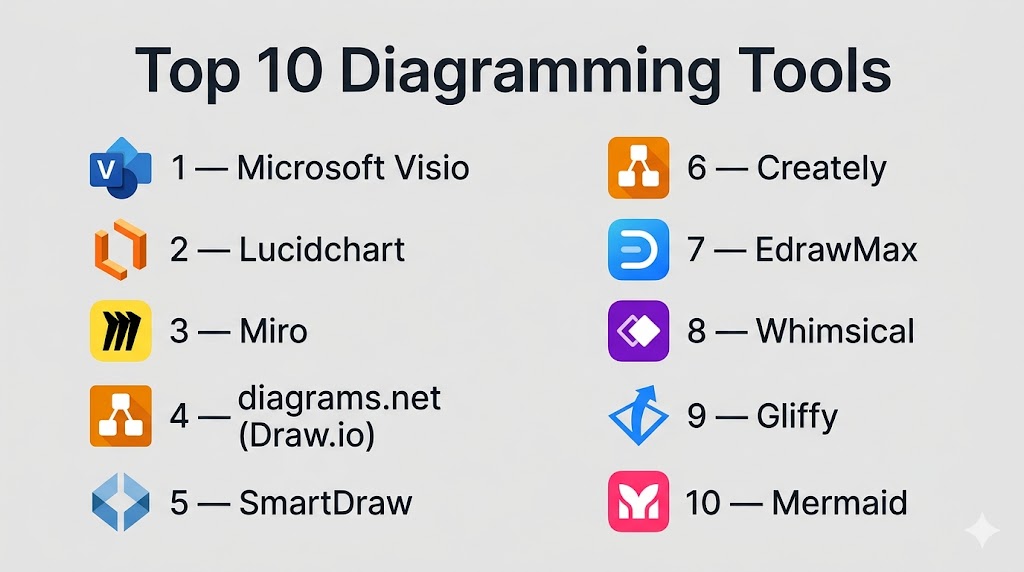
Top 10 Diagramming Tools
#1 — Microsoft Visio
Short description: The enterprise powerhouse for structured diagramming, widely used for business processes and technical systems.
Key Features
- Extensive diagram templates (UML, flowcharts, network)
- Data-linked diagrams
- Advanced shape libraries
- Process automation tools
- Microsoft 365 integration
- Collaboration features
- Professional-grade exports
Pros
- Enterprise-ready capabilities
- Deep ecosystem integration
Cons
- Expensive
- Not beginner-friendly
Platforms / Deployment
Windows / Web
Security & Compliance
Enterprise-grade controls (details not publicly stated)
Integrations & Ecosystem
Visio integrates seamlessly into enterprise workflows.
- Microsoft Teams
- Excel
- SharePoint
- OneDrive
Support & Community
Extensive enterprise support and documentation.
#2 — Lucidchart
Short description: A cloud-first diagramming tool built for speed, simplicity, and collaboration.
Key Features
- Real-time collaboration
- Drag-and-drop interface
- AI-assisted diagram creation
- Templates for multiple use cases
- Version history
- Data linking
- Cross-platform support
Pros
- Easy to adopt
- Strong collaboration features
Cons
- Limited free tier
- Costs increase with team size
Platforms / Deployment
Web / Windows / macOS
Security & Compliance
Enterprise controls available (details not publicly stated)
Integrations & Ecosystem
Lucidchart connects deeply with modern workflows.
- Google Workspace
- Microsoft 365
- Slack
- Atlassian tools
Support & Community
Large user base with strong support.
#3 — Miro
Short description: A visual collaboration platform that combines whiteboarding with powerful diagramming.
Key Features
- Infinite canvas
- Real-time team collaboration
- Diagram templates
- AI-powered suggestions
- Sticky notes and brainstorming tools
- Presentation mode
- Workflow integrations
Pros
- Extremely flexible
- Ideal for distributed teams
Cons
- Can feel cluttered
- Internet dependency
Platforms / Deployment
Web / Windows / macOS / iOS / Android
Security & Compliance
Not publicly stated
Integrations & Ecosystem
- Jira
- Slack
- Notion
- Google Drive
Support & Community
Highly active and widely adopted.
#4 — diagrams.net (Draw.io)
Short description: A powerful, free diagramming tool offering flexibility and privacy-friendly deployment.
Key Features
- Flowcharts and UML diagrams
- Offline and online modes
- Custom templates
- XML-based diagrams
- Drag-and-drop editor
- Cloud storage integration
Pros
- Completely free
- Flexible deployment options
Cons
- Basic interface
- Limited collaboration features
Platforms / Deployment
Web / Windows / macOS / Linux
Security & Compliance
Not publicly stated
Integrations & Ecosystem
- Google Drive
- OneDrive
- Git-based workflows
Support & Community
Strong open-source community.
#5 — SmartDraw
Short description: A fast, automation-driven diagramming tool focused on productivity.
Key Features
- Intelligent formatting
- Auto-alignment
- Templates for various diagrams
- Data integration
- Export options
- Collaboration tools
Pros
- Fast diagram creation
- Easy automation
Cons
- Limited customization depth
- Paid solution
Platforms / Deployment
Web
Security & Compliance
Not publicly stated
Integrations & Ecosystem
- Microsoft Office
- Google Workspace
- Cloud storage
Support & Community
Professional support available.
#6 — Creately
Short description: An AI-powered diagramming and collaboration platform designed for modern teams.
Key Features
- AI-generated diagrams
- Infinite canvas
- Real-time collaboration
- Database linking
- Templates
- Visual workspace
Pros
- Strong collaboration
- AI-enhanced workflows
Cons
- Performance limitations on large diagrams
- Limited advanced controls
Platforms / Deployment
Web / Windows / macOS
Security & Compliance
Not publicly stated
Integrations & Ecosystem
- Slack
- Google Workspace
- Confluence
Support & Community
Growing adoption and support.
#7 — EdrawMax
Short description: A versatile diagramming tool supporting a wide range of diagram types.
Key Features
- 200+ diagram types
- Templates and symbols
- AI tools
- Cross-platform support
- Presentation export
- Vector-based design
Pros
- Extremely versatile
- Feature-rich
Cons
- Complex interface
- Paid plans
Platforms / Deployment
Windows / macOS / Linux / Web
Security & Compliance
Not publicly stated
Integrations & Ecosystem
- Office tools
- Export systems
Support & Community
Good documentation.
#8 — Whimsical
Short description: A fast, clean diagramming tool designed for simplicity and speed.
Key Features
- Flowcharts
- Mind maps
- Wireframes
- Collaboration tools
- Templates
- Clean interface
Pros
- Very easy to use
- Fast performance
Cons
- Limited advanced features
- Cloud-only
Platforms / Deployment
Web
Security & Compliance
Not publicly stated
Integrations & Ecosystem
- Collaboration tools
- Cloud workflows
Support & Community
Moderate support.
#9 — Gliffy
Short description: A diagramming tool tightly integrated with Atlassian products.
Key Features
- Flowcharts and diagrams
- Drag-and-drop interface
- Confluence integration
- Templates
- Collaboration features
Pros
- Strong Atlassian integration
- Easy to use
Cons
- Limited outside ecosystem
- Subscription required
Platforms / Deployment
Web
Security & Compliance
Not publicly stated
Integrations & Ecosystem
- Jira
- Confluence
Support & Community
Moderate community support.
#10 — Mermaid
Short description: A developer-focused diagramming tool that creates diagrams from text.
Key Features
- Text-based diagram generation
- Markdown-style syntax
- Version control integration
- Automation-friendly
- Lightweight
Pros
- Perfect for developers
- Easy to version control
Cons
- Requires technical knowledge
- Limited visual editing
Platforms / Deployment
Web / Developer environments
Security & Compliance
Not publicly stated
Integrations & Ecosystem
- GitHub
- Documentation tools
- IDEs
Support & Community
Strong developer community.
Comparison Table (Top 10)
| Tool Name | Best For | Platform(s) Supported | Deployment | Standout Feature | Public Rating |
|---|---|---|---|---|---|
| Visio | Enterprise | Windows, Web | Hybrid | Microsoft ecosystem | N/A |
| Lucidchart | Teams | Web, Desktop | Cloud | Collaboration | N/A |
| Miro | Collaboration | Multi-platform | Cloud | Infinite canvas | N/A |
| Draw.io | Free users | Cross-platform | Hybrid | Free & flexible | N/A |
| SmartDraw | Automation | Web | Cloud | Auto diagrams | N/A |
| Creately | AI workflows | Multi-platform | Cloud | AI diagrams | N/A |
| EdrawMax | Versatility | Cross-platform | Hybrid | 200+ diagrams | N/A |
| Whimsical | Simplicity | Web | Cloud | Clean UI | N/A |
| Gliffy | Atlassian users | Web | Cloud | Jira integration | N/A |
| Mermaid | Developers | Cross-platform | Code-based | Text diagrams | N/A |
Evaluation & Scoring of Diagramming Tools
| Tool Name | Core | Ease | Integrations | Security | Performance | Support | Value | Weighted Total |
|---|---|---|---|---|---|---|---|---|
| Visio | 10 | 7 | 9 | 8 | 9 | 9 | 6 | 8.5 |
| Lucidchart | 9 | 9 | 9 | 8 | 8 | 8 | 8 | 8.6 |
| Miro | 8 | 9 | 9 | 7 | 8 | 8 | 8 | 8.3 |
| Draw.io | 8 | 8 | 7 | 7 | 7 | 7 | 10 | 8.0 |
| SmartDraw | 8 | 8 | 7 | 7 | 8 | 7 | 7 | 7.7 |
| Creately | 8 | 9 | 8 | 7 | 7 | 7 | 8 | 7.9 |
| EdrawMax | 9 | 7 | 7 | 7 | 8 | 7 | 7 | 7.8 |
| Whimsical | 7 | 10 | 6 | 7 | 8 | 7 | 8 | 7.9 |
| Gliffy | 7 | 8 | 8 | 7 | 7 | 7 | 7 | 7.6 |
| Mermaid | 8 | 6 | 7 | 7 | 8 | 7 | 9 | 7.7 |
How to interpret scores:
These scores highlight relative strengths—not absolute winners. A higher score means stronger overall performance across key criteria, but the right tool depends on your workflow. Always match tool capabilities with your team’s needs and use cases.
Which Diagramming Tool Is Right for You?
Solo / Freelancer
Draw.io and Whimsical are perfect for quick, cost-effective diagramming.
SMB
Lucidchart and Creately offer strong collaboration and usability.
Mid-Market
Miro and SmartDraw balance flexibility and structured workflows.
Enterprise
Visio and Lucidchart provide scalability and deep integrations.
Budget vs Premium
Draw.io leads in free value, while Visio offers enterprise-grade capabilities.
Feature Depth vs Ease of Use
Visio offers depth, Whimsical offers simplicity and speed.
Integrations & Scalability
Lucidchart and Miro dominate integration ecosystems.
Security & Compliance Needs
Enterprises should validate vendor security controls before adoption.
Frequently Asked Questions (FAQs)
1. What are diagramming tools used for?
They help visualize processes, systems, and ideas in a structured format.
2. Are free tools like Draw.io enough?
Yes, they are powerful for most use cases, especially for individuals.
3. What is the best tool for collaboration?
Lucidchart and Miro are top choices for team collaboration.
4. What is diagram-as-code?
It’s a method where diagrams are created using text-based syntax.
5. Do these tools support integrations?
Yes, most tools integrate with productivity and DevOps platforms.
6. Are AI features useful?
Yes, they speed up diagram creation and improve accuracy.
7. Can I create large diagrams?
Yes, but performance depends on the tool and system.
8. Are these tools cloud-based?
Most modern tools are cloud-first.
9. Is security important?
Yes, especially for enterprise environments.
10. How do I choose the right tool?
Focus on collaboration, complexity, and integration needs.
Conclusion
Diagramming Tools have evolved into essential engines of clarity, collaboration, and execution. They help teams break down complexity, align faster, and communicate ideas with precision. Whether you’re mapping a workflow, designing a system, or brainstorming the next big idea, the right tool can transform how your team thinks and works. From enterprise-grade platforms like Visio to flexible, collaborative tools like Miro and Lucidchart, the ecosystem offers powerful options for every need. The smartest approach is to shortlist a few tools, test them in real workflows, and choose the one that accelerates your team’s thinking—not just your diagrams.

Find Trusted Cardiac Hospitals
Compare heart hospitals by city and services — all in one place.
Explore Hospitals
This explains how diagramming tools help turn complex ideas into simple visuals that are easy to understand.