Introduction
Digital Experience Platforms (DXP) are integrated software solutions designed to deliver consistent, personalized, and seamless digital experiences across multiple channels—web, mobile, apps, email, and more. Unlike traditional CMS platforms, DXPs combine content management, customer data, personalization, analytics, and marketing automation into a unified ecosystem.
As organizations compete on customer experience rather than just products or services, DXPs have become strategic platforms for managing the entire digital journey. They empower businesses to understand user behavior, deliver targeted content, and optimize engagement across every touchpoint.
Common Use Cases
- Delivering personalized website experiences
- Managing omnichannel marketing campaigns
- Integrating customer data for targeted content
- Powering eCommerce and digital portals
- Enhancing customer journeys across platforms
What Buyers Should Evaluate
- Personalization and targeting capabilities
- Content management and delivery flexibility
- Integration with CRM, CDP, and analytics tools
- Scalability for high-traffic environments
- API-first and headless architecture support
- Security and compliance features
- Workflow automation and governance
- Total cost and implementation complexity
- Multi-channel content orchestration
Best for: Enterprises, digital-first businesses, marketing teams, and organizations focused on customer experience optimization.
Not ideal for: Small businesses with simple websites or those not requiring advanced personalization and integration capabilities.
Key Trends in Digital Experience Platforms (DXP)
- AI-driven personalization and customer journey mapping
- Composable DXP architectures replacing monolithic systems
- Headless and API-first content delivery
- Integration with Customer Data Platforms (CDP)
- Real-time analytics and behavioral insights
- Omnichannel content orchestration
- Low-code/no-code tools for marketers
- Cloud-native deployment for scalability
- Increased focus on privacy and data compliance
- Microservices-based digital ecosystems
How We Selected These Tools (Methodology)
- Evaluated enterprise adoption and market leadership
- Compared personalization and experience delivery capabilities
- Assessed scalability and performance under high traffic
- Reviewed integration ecosystems and APIs
- Considered security and compliance readiness
- Included both enterprise and composable platforms
- Analyzed usability for marketers and developers
- Reviewed support, onboarding, and documentation
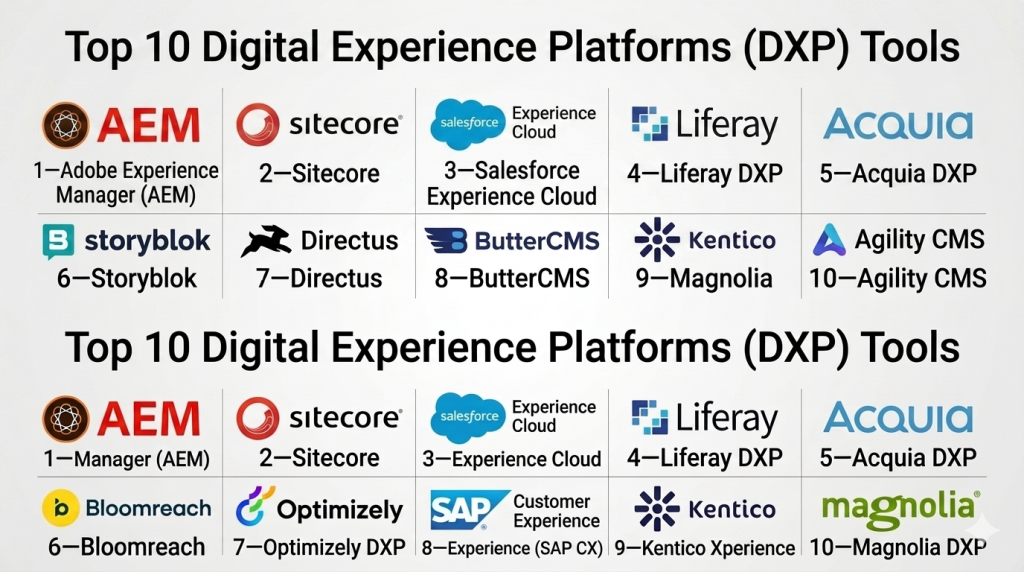
Top 10 Digital Experience Platforms (DXP) Tools
#1 — Adobe Experience Manager (AEM)
Short description: Enterprise-grade DXP combining content management, personalization, and digital asset management.
Key Features
- Advanced content management
- Personalization engine
- Digital asset management
- Multi-channel delivery
- Workflow automation
- Analytics integration
Pros
- Highly scalable
- Strong enterprise ecosystem
Cons
- Expensive
- Complex implementation
Platforms / Deployment
Cloud / Hybrid
Security & Compliance
Not publicly stated
Integrations & Ecosystem
Extensive integrations with marketing and analytics tools
- APIs
- Enterprise systems
- Marketing platforms
Support & Community
Enterprise-level support
#2 — Sitecore
Short description: Leading DXP focused on personalization, content, and customer experience management.
Key Features
- Personalization engine
- Content management
- Customer data integration
- Marketing automation
- Analytics tools
Pros
- Strong personalization
- Enterprise-ready
Cons
- Complex setup
- High cost
Platforms / Deployment
Cloud / Hybrid
Security & Compliance
Not publicly stated
Integrations & Ecosystem
- CRM systems
- Marketing tools
- APIs
Support & Community
Strong enterprise support
#3 — Salesforce Experience Cloud
Short description: DXP integrated with CRM for building customer portals and digital experiences.
Key Features
- Customer portals
- CRM integration
- Workflow automation
- Personalization
- Analytics
Pros
- Deep CRM integration
- Scalable
Cons
- Expensive
- Requires Salesforce ecosystem
Platforms / Deployment
Cloud
Security & Compliance
Not publicly stated
Integrations & Ecosystem
- CRM
- APIs
- Automation tools
Support & Community
Enterprise support
#4 — Liferay DXP
Short description: Open-source-based DXP for building enterprise portals and digital experiences.
Key Features
- Content management
- Portal development
- Personalization
- Workflow automation
- API support
Pros
- Flexible
- Open-source foundation
Cons
- Requires technical expertise
- UI can feel outdated
Platforms / Deployment
Cloud / Self-hosted / Hybrid
Security & Compliance
Not publicly stated
Integrations & Ecosystem
- APIs
- Enterprise systems
Support & Community
Strong community
#5 — Acquia DXP
Short description: Drupal-based DXP offering flexibility and enterprise-grade digital experience tools.
Key Features
- Content management
- Personalization
- Hosting and cloud services
- Marketing tools
- Analytics
Pros
- Flexible architecture
- Strong Drupal ecosystem
Cons
- Requires expertise
- Implementation complexity
Platforms / Deployment
Cloud
Security & Compliance
Not publicly stated
Integrations & Ecosystem
- Drupal modules
- APIs
Support & Community
Strong support
#6 — Bloomreach
Short description: AI-driven DXP focused on eCommerce and personalization.
Key Features
- AI-powered personalization
- Search and discovery
- Content management
- Customer insights
- Analytics
Pros
- Strong AI capabilities
- eCommerce-focused
Cons
- Niche focus
- Pricing varies
Platforms / Deployment
Cloud
Security & Compliance
Not publicly stated
Integrations & Ecosystem
- eCommerce platforms
- APIs
Support & Community
Good support
#7 — Optimizely DXP
Short description: Experimentation-driven DXP combining content, personalization, and A/B testing.
Key Features
- Content management
- A/B testing
- Personalization
- Analytics
- Workflow tools
Pros
- Strong experimentation tools
- Good for optimization
Cons
- Expensive
- Learning curve
Platforms / Deployment
Cloud
Security & Compliance
Not publicly stated
Integrations & Ecosystem
- Analytics tools
- APIs
Support & Community
Enterprise support
#8 — SAP Customer Experience (SAP CX)
Short description: Enterprise DXP integrated with SAP ecosystem for commerce and customer engagement.
Key Features
- Customer data management
- Commerce integration
- Personalization
- Analytics
- Workflow automation
Pros
- Strong enterprise integration
- Scalable
Cons
- Complex
- High cost
Platforms / Deployment
Cloud
Security & Compliance
Not publicly stated
Integrations & Ecosystem
- SAP ecosystem
- APIs
Support & Community
Enterprise support
#9 — Kentico Xperience
Short description: Hybrid DXP combining CMS, marketing automation, and personalization.
Key Features
- Content management
- Marketing automation
- Personalization
- Analytics
- Workflow tools
Pros
- All-in-one platform
- Flexible
Cons
- Limited ecosystem
- Mid-market focus
Platforms / Deployment
Cloud / Hybrid
Security & Compliance
Not publicly stated
Integrations & Ecosystem
- APIs
- Marketing tools
Support & Community
Good support
#10 — Magnolia DXP
Short description: Composable DXP designed for flexibility and modern digital experiences.
Key Features
- Headless CMS
- Personalization
- Workflow automation
- API-first design
- Multi-channel delivery
Pros
- Flexible architecture
- Developer-friendly
Cons
- Requires setup
- Smaller ecosystem
Platforms / Deployment
Cloud / Hybrid
Security & Compliance
Not publicly stated
Integrations & Ecosystem
- APIs
- Enterprise tools
Support & Community
Enterprise support
Comparison Table (Top 10)
| Tool Name | Best For | Platform(s) Supported | Deployment | Standout Feature | Public Rating |
|---|---|---|---|---|---|
| AEM | Enterprise | Multi | Hybrid | Full DXP suite | N/A |
| Sitecore | Enterprise | Multi | Hybrid | Personalization | N/A |
| Salesforce | CRM users | Cloud | Cloud | CRM integration | N/A |
| Liferay | Portals | Multi | Hybrid | Open-source | N/A |
| Acquia | Drupal users | Web | Cloud | Drupal-based | N/A |
| Bloomreach | eCommerce | Web | Cloud | AI personalization | N/A |
| Optimizely | Optimization | Web | Cloud | A/B testing | N/A |
| SAP CX | Enterprise | Multi | Cloud | SAP ecosystem | N/A |
| Kentico | Mid-market | Web | Hybrid | All-in-one | N/A |
| Magnolia | Composable | Web | Hybrid | Headless DXP | N/A |
Evaluation & Scoring of Digital Experience Platforms (DXP)
| Tool | Core | Ease | Integrations | Security | Performance | Support | Value | Total |
|---|---|---|---|---|---|---|---|---|
| AEM | 10 | 6 | 10 | 9 | 9 | 9 | 6 | 8.4 |
| Sitecore | 10 | 6 | 9 | 9 | 9 | 9 | 6 | 8.3 |
| Salesforce | 9 | 7 | 10 | 9 | 8 | 9 | 6 | 8.2 |
| Liferay | 8 | 7 | 8 | 8 | 8 | 8 | 8 | 8.0 |
| Acquia | 9 | 7 | 9 | 8 | 8 | 8 | 7 | 8.1 |
| Bloomreach | 9 | 8 | 8 | 8 | 8 | 8 | 7 | 8.1 |
| Optimizely | 9 | 7 | 8 | 8 | 8 | 8 | 7 | 8.0 |
| SAP CX | 9 | 6 | 10 | 9 | 9 | 9 | 6 | 8.2 |
| Kentico | 8 | 8 | 7 | 7 | 7 | 7 | 8 | 7.6 |
| Magnolia | 8 | 7 | 8 | 8 | 8 | 7 | 7 | 7.8 |
Interpretation:
Scores are comparative. Enterprise DXPs excel in scalability and integrations, while mid-market tools provide better usability and cost efficiency.
Which Digital Experience Platform (DXP) Tool Is Right for You?
Solo / Freelancer
Not recommended; DXPs are overkill
SMB
Kentico or Bloomreach for simplicity
Mid-Market
Acquia or Optimizely for balance
Enterprise
AEM, Sitecore, or Salesforce
Budget vs Premium
Budget: Liferay
Premium: AEM
Feature Depth vs Ease of Use
Advanced: AEM, Sitecore
Easy: Kentico
Integrations & Scalability
Best: Salesforce, SAP
Security & Compliance Needs
Best: AEM, SAP
Frequently Asked Questions (FAQs)
1. What is a DXP?
A platform for managing digital experiences across channels.
2. How is DXP different from CMS?
DXP includes personalization, analytics, and integrations.
3. Who uses DXP?
Enterprises and digital-first organizations.
4. Is DXP expensive?
Yes, most enterprise platforms are costly.
5. Can DXP scale?
Yes, they are built for large-scale operations.
6. Does DXP support personalization?
Yes, it is a core feature.
7. Can DXP integrate with CRM?
Yes, most support CRM integration.
8. Is coding required?
Often yes, depending on platform complexity.
9. How long to implement?
Weeks to months.
10. Alternatives?
CMS or headless CMS platforms.
Conclusion
Digital Experience Platforms (DXP) have emerged as the backbone of modern digital strategy, enabling organizations to deliver consistent, personalized, and data-driven experiences across every customer touchpoint. Unlike traditional content systems, DXPs unify content management, customer data, analytics, and marketing capabilities into a single powerful ecosystem, making them essential for businesses focused on customer engagement and digital growth.

Find Trusted Cardiac Hospitals
Compare heart hospitals by city and services — all in one place.
Explore Hospitals
This explains how DXP tools combine content, data, and personalization to create better digital experiences.