Introduction
Digital Wikis are collaborative knowledge management platforms that allow teams to create, organize, and share information in a structured and searchable way. Unlike static documents, wikis evolve continuously—making them ideal for internal documentation, team collaboration, and knowledge sharing.
In today’s fast-paced digital environment, organizations rely heavily on centralized knowledge systems to reduce information silos, improve productivity, and maintain operational clarity. With remote work, distributed teams, and complex workflows becoming the norm, digital wikis have become a critical component of modern work infrastructure.
Common Use Cases
- Internal documentation (SOPs, policies, onboarding guides)
- Product and technical documentation
- Team collaboration and knowledge sharing
- Customer-facing help centers
- Project documentation and knowledge bases
What Buyers Should Evaluate
- Ease of use and editor experience
- Search and content discovery capabilities
- Permission controls and access management
- Integration with existing tools
- Scalability and performance
- Version control and audit logs
- Security and compliance features
- Customization and extensibility
Best for: Teams, startups, enterprises, developers, customer support teams, and knowledge-driven organizations.
Not ideal for: Individuals needing simple note-taking apps or teams requiring heavy document automation workflows.
Key Trends in Digital Wikis
- AI-powered content creation and summarization
- Real-time collaboration with version tracking
- Integration with DevOps and productivity ecosystems
- Headless and API-first wiki architectures
- Enhanced search using semantic and AI-based indexing
- Stronger security models with granular permissions
- Hybrid deployment options (cloud + self-hosted)
- Automation workflows for content updates and approvals
- Markdown-first editing for developers
- Embedded analytics for knowledge usage tracking
How We Selected These Tools (Methodology)
- Strong market adoption and brand recognition
- Feature completeness across documentation and collaboration
- Performance and reliability signals
- Security posture and enterprise readiness
- Integration capabilities with popular tools
- Usability for both technical and non-technical users
- Flexibility in deployment (cloud/self-hosted)
- Community and support ecosystem
- Scalability across team sizes
- Innovation in AI and automation features
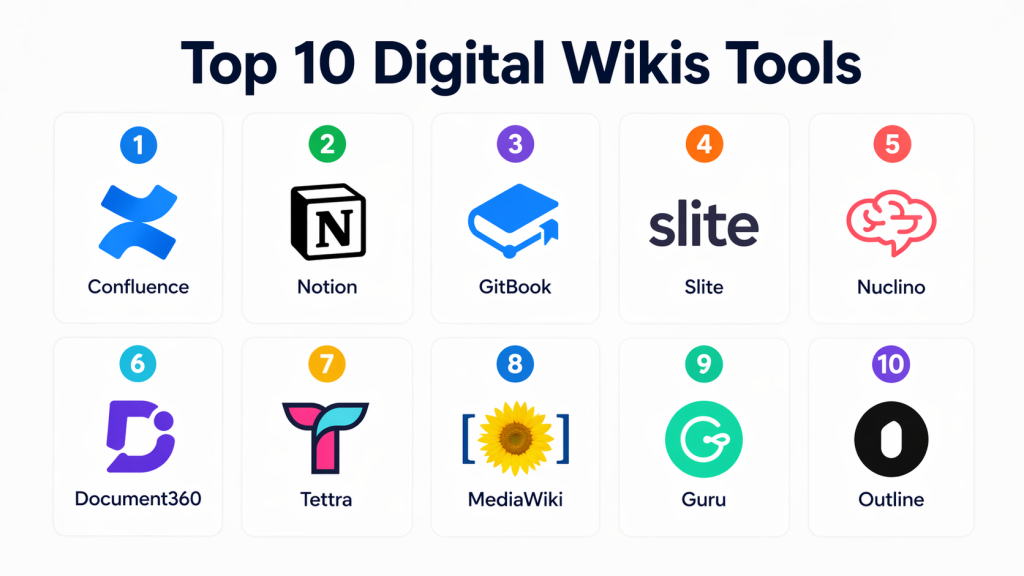
Top 10 Digital Wikis Tools
#1 — Confluence
Short description: A widely used enterprise wiki platform designed for team collaboration and documentation.
Key Features
- Rich text editor and templates
- Deep integration with project tools
- Version history and tracking
- Advanced permission management
- Knowledge base publishing
- Content organization with spaces
Pros
- Strong collaboration features
- Enterprise-grade scalability
Cons
- Can become complex at scale
- Performance issues in large instances
Platforms / Deployment
Web / Cloud / Self-hosted
Security & Compliance
SSO, MFA, RBAC; compliance details not publicly stated
Integrations & Ecosystem
Integrates with project management, communication, and developer tools
- Jira
- Slack
- Git tools
- APIs
Support & Community
Extensive documentation and large community
#2 — Notion
Short description: A flexible all-in-one workspace combining wiki, notes, and databases.
Key Features
- Drag-and-drop editor
- Databases and structured content
- Real-time collaboration
- Templates and customization
- AI content assistance
Pros
- Extremely flexible
- Easy to use
Cons
- Limited advanced permissions
- Can become unstructured
Platforms / Deployment
Web / Windows / macOS / iOS / Android
Security & Compliance
Basic security features; detailed compliance not publicly stated
Integrations & Ecosystem
- Slack
- APIs
- Productivity tools
Support & Community
Strong community and growing support
#3 — GitBook
Short description: A modern documentation platform focused on developers and technical teams.
Key Features
- Markdown-based editing
- Git integration
- API documentation support
- Version control
- Public/private docs
Pros
- Developer-friendly
- Clean UI
Cons
- Limited non-technical features
- Pricing can scale quickly
Platforms / Deployment
Web / Cloud
Security & Compliance
Not publicly stated
Integrations & Ecosystem
- GitHub
- APIs
- Dev tools
Support & Community
Good documentation support
#4 — Slite
Short description: A collaborative documentation tool designed for remote teams.
Key Features
- Clean editor
- Team collaboration
- Document organization
- Templates
- Offline support
Pros
- Simple and intuitive
- Great for small teams
Cons
- Limited enterprise features
- Basic integrations
Platforms / Deployment
Web / Windows / macOS
Security & Compliance
Not publicly stated
Integrations & Ecosystem
- Slack
- APIs
Support & Community
Moderate support resources
#5 — Nuclino
Short description: A lightweight wiki for fast and simple knowledge sharing.
Key Features
- Real-time collaboration
- Graph view visualization
- Markdown support
- Fast performance
- Minimalist UI
Pros
- Very fast
- Easy to adopt
Cons
- Limited advanced features
- Not ideal for large enterprises
Platforms / Deployment
Web / Windows / macOS
Security & Compliance
Basic controls; details not publicly stated
Integrations & Ecosystem
- Slack
- APIs
Support & Community
Basic support and growing community
#6 — Document360
Short description: A knowledge base platform for internal and customer-facing documentation.
Key Features
- Knowledge base builder
- Version control
- SEO optimization
- Category management
- Analytics
Pros
- Strong documentation features
- Customer-facing capabilities
Cons
- Learning curve
- Pricing varies
Platforms / Deployment
Web / Cloud
Security & Compliance
Not publicly stated
Integrations & Ecosystem
- CRM tools
- APIs
Support & Community
Good onboarding and support
#7 — Tettra
Short description: A simple internal wiki designed for teams using messaging platforms.
Key Features
- Q&A knowledge sharing
- Content verification workflows
- Slack integration
- Simple editor
Pros
- Easy onboarding
- Strong Slack integration
Cons
- Limited scalability
- Basic feature set
Platforms / Deployment
Web / Cloud
Security & Compliance
Not publicly stated
Integrations & Ecosystem
- Slack
- Google Workspace
Support & Community
Decent support for SMBs
#8 — MediaWiki
Short description: An open-source wiki platform used for large-scale knowledge bases.
Key Features
- Open-source flexibility
- Extensive customization
- Version control
- Large community support
Pros
- Highly customizable
- Free to use
Cons
- Complex setup
- Requires technical expertise
Platforms / Deployment
Web / Self-hosted
Security & Compliance
Depends on deployment
Integrations & Ecosystem
- Plugins
- APIs
Support & Community
Strong open-source community
#9 — Guru
Short description: A knowledge management platform focused on delivering verified information.
Key Features
- Knowledge verification workflows
- Browser extensions
- AI-powered suggestions
- Real-time syncing
Pros
- Reliable content accuracy
- Strong integrations
Cons
- Pricing can be high
- Limited customization
Platforms / Deployment
Web / Cloud
Security & Compliance
Not publicly stated
Integrations & Ecosystem
- Slack
- CRM tools
- APIs
Support & Community
Good enterprise support
#10 — Outline
Short description: A modern open-source wiki tool for teams.
Key Features
- Markdown editor
- Clean UI
- Permission management
- Real-time collaboration
Pros
- Open-source flexibility
- Simple design
Cons
- Limited enterprise features
- Requires hosting setup
Platforms / Deployment
Web / Self-hosted
Security & Compliance
Not publicly stated
Integrations & Ecosystem
- Slack
- APIs
Support & Community
Active open-source community
Comparison Table (Top 10)
| Tool Name | Best For | Platform(s) | Deployment | Standout Feature | Public Rating |
|---|---|---|---|---|---|
| Confluence | Enterprise teams | Web | Cloud/Self-hosted | Deep integrations | N/A |
| Notion | Flexible teams | Web/Mobile/Desktop | Cloud | All-in-one workspace | N/A |
| GitBook | Developers | Web | Cloud | Git integration | N/A |
| Slite | Remote teams | Web/Desktop | Cloud | Simple collaboration | N/A |
| Nuclino | Small teams | Web/Desktop | Cloud | Fast performance | N/A |
| Document360 | Knowledge bases | Web | Cloud | Customer-facing docs | N/A |
| Tettra | SMB teams | Web | Cloud | Slack integration | N/A |
| MediaWiki | Large open projects | Web | Self-hosted | Open-source power | N/A |
| Guru | Knowledge delivery | Web | Cloud | Verified content workflows | N/A |
| Outline | Open-source teams | Web | Self-hosted | Clean markdown UI | N/A |
Evaluation & Scoring of Digital Wikis
| Tool | Core | Ease | Integrations | Security | Performance | Support | Value | Total |
|---|---|---|---|---|---|---|---|---|
| Confluence | 9 | 7 | 9 | 8 | 8 | 9 | 7 | 8.3 |
| Notion | 8 | 9 | 7 | 6 | 8 | 8 | 8 | 7.9 |
| GitBook | 8 | 8 | 8 | 7 | 8 | 7 | 7 | 7.8 |
| Slite | 7 | 9 | 6 | 6 | 8 | 7 | 8 | 7.6 |
| Nuclino | 7 | 9 | 6 | 6 | 9 | 7 | 8 | 7.7 |
| Document360 | 8 | 7 | 7 | 7 | 8 | 8 | 7 | 7.7 |
| Tettra | 7 | 8 | 7 | 6 | 7 | 7 | 8 | 7.4 |
| MediaWiki | 8 | 5 | 7 | 7 | 7 | 8 | 9 | 7.3 |
| Guru | 8 | 8 | 8 | 7 | 8 | 8 | 7 | 7.9 |
| Outline | 7 | 8 | 6 | 6 | 8 | 7 | 8 | 7.3 |
Interpretation:
- Scores reflect relative comparison, not absolute quality
- Higher scores indicate stronger overall capability
- Enterprise tools score higher in integrations and security
- Simpler tools score higher in ease of use and value
Which Digital Wikis Tool Is Right for You?
Solo / Freelancer
- Notion or Nuclino for simplicity and flexibility
SMB
- Slite or Tettra for easy onboarding and collaboration
Mid-Market
- Document360 or Guru for structured documentation
Enterprise
- Confluence for scalability and integrations
Budget vs Premium
- Budget: MediaWiki, Outline
- Premium: Confluence, Guru
Feature Depth vs Ease of Use
- Depth: Confluence, Document360
- Ease: Notion, Slite
Integrations & Scalability
- High: Confluence, Guru
- Moderate: Notion, GitBook
Security & Compliance Needs
- Enterprise-grade: Confluence
- Basic: Smaller tools
Frequently Asked Questions (FAQs)
1. What is a digital wiki?
A collaborative platform used to create and manage knowledge in a structured format.
2. Are digital wikis secure?
Most provide basic security; enterprise tools offer advanced controls.
3. Can wikis replace documentation tools?
Yes, for many use cases, especially internal documentation.
4. Are there free options?
Yes, open-source tools like MediaWiki are free.
5. Do wikis support integrations?
Most modern tools integrate with productivity and DevOps tools.
6. How scalable are wikis?
Enterprise tools scale well; simpler tools may have limits.
7. Can wikis be public-facing?
Yes, some tools support public knowledge bases.
8. Is coding required?
Not for most tools; open-source options may require setup.
9. What are common mistakes?
Poor structure and lack of governance.
10. How to choose the right tool?
Evaluate features, scalability, and team needs.
Conclusion
Digital wikis have evolved into powerful knowledge management platforms that go far beyond simple documentation. Whether you’re a startup building internal processes, a mid-sized company managing cross-functional knowledge, or an enterprise scaling global operations, choosing the right wiki tool can significantly impact productivity and collaboration.The key is not to chase the “most popular” tool, but the one that aligns with your workflows, team size, and integration needs. Some tools excel in flexibility, while others dominate in enterprise-grade governance and security.

Find Trusted Cardiac Hospitals
Compare heart hospitals by city and services — all in one place.
Explore Hospitals
This explains how digital wikis help teams store and share knowledge in a simple and organized way.