Introduction
Drug Discovery Platforms are specialized software solutions designed to accelerate the identification, design, and optimization of new therapeutic compounds. These platforms integrate computational modeling, AI-driven predictions, and data management tools to streamline the drug discovery process. In with the rise of precision medicine and high-throughput screening, efficient platforms are essential for reducing time-to-market and improving success rates in R&D pipelines.
Real-world use cases include:
- Computational modeling of molecular interactions and protein targets
- High-throughput virtual screening of compound libraries
- Predictive ADMET (absorption, distribution, metabolism, excretion, toxicity) analysis
- Collaborative project management across research teams
- Integration with laboratory automation systems for experimental validation
When evaluating Drug Discovery Platforms, buyers should consider:
- AI and machine learning capabilities for predictive modeling
- Integration with chemical, biological, and omics datasets
- Computational chemistry and molecular docking tools
- Cloud or local deployment flexibility
- User interface and workflow automation
- Collaboration features for multi-team projects
- Data security and regulatory compliance
- Scalability for large compound libraries
- Visualization and reporting capabilities
- Cost structure and licensing flexibility
Best for: Pharmaceutical companies, biotech startups, academic research labs, and CROs engaged in drug discovery and early-stage R&D.
Not ideal for: Small labs or organizations with limited compound libraries or without computational resources; simpler molecular modeling tools or spreadsheets may suffice.
Key Trends in Drug Discovery Platforms
- AI-driven Drug Design: Platforms increasingly use machine learning for predicting molecular properties and optimizing compounds.
- Integration of Multi-Omics Data: Genomics, proteomics, and metabolomics data are now integrated for target validation.
- Cloud-based Computational Power: Cloud platforms allow large-scale simulations and virtual screening without high local infrastructure costs.
- Collaborative R&D Features: Teams can work together in real-time across global sites.
- High-throughput Virtual Screening: Automation enables testing of millions of compounds quickly.
- Predictive ADMET Modeling: Early toxicity and metabolism prediction reduces late-stage failures.
- Visualization & Interactive Dashboards: 3D modeling, molecular interactions, and dynamic data visualization are standard.
- Interoperability: Platforms increasingly support standard formats (SMILES, SDF) and API connectivity.
- Flexible Licensing Models: Subscription and usage-based pricing are becoming common.
- Security and Compliance: Emphasis on IP protection, encryption, and audit trails for sensitive research data.
How We Selected These Tools (Methodology)
- Market adoption and mindshare among pharmaceutical and biotech organizations
- Breadth and depth of drug discovery capabilities, including modeling, screening, and analysis
- Reliability and computational performance for large-scale simulations
- Security and compliance posture for sensitive research data
- Integration potential with laboratory, chemical, and biological databases
- Fit for various organization sizes from startups to global enterprises
- Usability and workflow automation for research teams
- Innovation in AI and computational chemistry
- Vendor support and training resources
- Cost-effectiveness and scalability for growing R&D needs
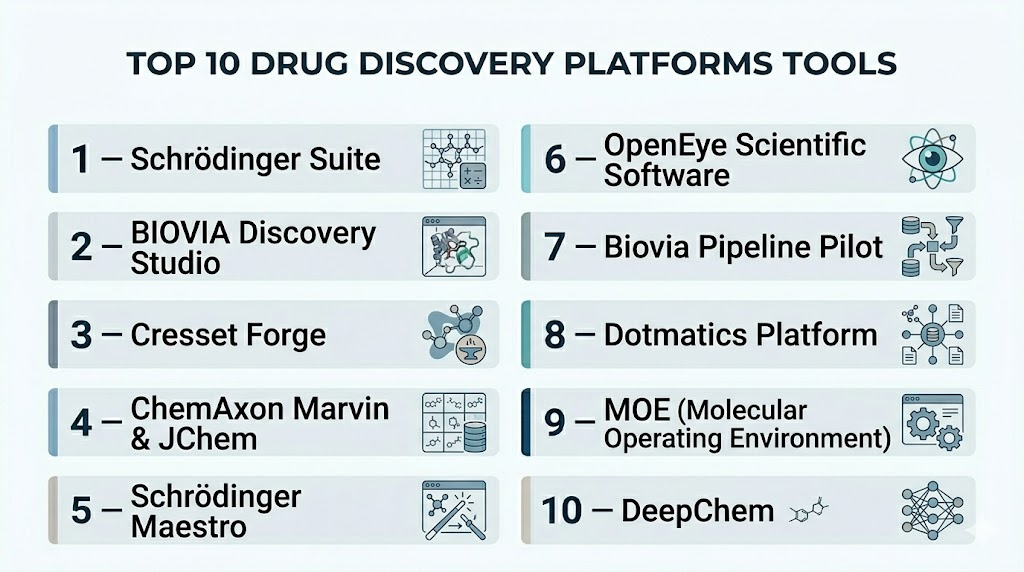
Top 10 Drug Discovery Platforms Tools
#1 — Schrödinger Suite
Short description : Schrödinger Suite provides end-to-end drug discovery solutions, including molecular modeling, computational chemistry, and virtual screening. Ideal for pharmaceutical companies and research institutions seeking precision and performance in computational drug design.
Key Features
- Molecular docking and dynamics simulations
- Predictive ADMET modeling
- Quantum mechanics-based calculations
- Library preparation and virtual screening
- 3D visualization and interactive molecular modeling
- Workflow automation and scripting
- Integration with chemical and biological databases
Pros
- High accuracy and performance
- Comprehensive computational chemistry capabilities
Cons
- High cost for small teams
- Requires specialized expertise
Platforms / Deployment
- Windows / Linux / Cloud / Hybrid
Security & Compliance
- Encryption, user access control, audit logs
- Not publicly stated: SOC 2, ISO 27001
Integrations & Ecosystem
Supports extensive database connections and APIs.
- Chemical and biological databases
- Laboratory information systems
- Data visualization tools
Support & Community
Strong vendor support, documentation, and professional training.
#2 — BIOVIA Discovery Studio
Short description : BIOVIA Discovery Studio offers a comprehensive platform for molecular modeling, simulations, and virtual screening. It is widely used by pharmaceutical companies and academic research labs for computational drug discovery.
Key Features
- Molecular modeling and docking
- ADMET prediction and toxicity analysis
- Structure-based and ligand-based design
- Workflow automation
- Predictive analytics
- Visualization and reporting tools
Pros
- Integrated multi-functional platform
- Robust visualization and modeling tools
Cons
- Can be resource-intensive
- Learning curve for beginners
Platforms / Deployment
- Windows / Linux / Cloud
Security & Compliance
- Encryption, RBAC, audit logs
- Not publicly stated: HIPAA, ISO 27001
Integrations & Ecosystem
- Integration with chemical and omics datasets
- APIs for custom computational workflows
- Laboratory automation systems
Support & Community
Vendor-provided support, training modules, and active user community.
#3 — Cresset Forge
Short description : Cresset Forge focuses on structure-based and ligand-based design for drug discovery. It is suitable for small to mid-size pharmaceutical companies and academic groups requiring rapid compound optimization.
Key Features
- Molecular field-based modeling
- Bioisostere replacement and compound optimization
- Virtual screening and ranking
- ADMET property prediction
- Visualization and interactive analysis
Pros
- Intuitive interface for chemists
- Efficient compound optimization workflows
Cons
- Limited enterprise-scale capabilities
- Smaller integration ecosystem
Platforms / Deployment
- Windows / macOS / Cloud
Security & Compliance
- Encryption and user access control
- Not publicly stated: SOC 2, ISO 27001
Integrations & Ecosystem
- Integrates with chemical libraries and databases
- Supports API-based custom workflows
- Compatible with modeling and visualization tools
Support & Community
Standard support and training; vendor-led community.
#4 — ChemAxon Marvin & JChem
Short description : ChemAxon provides molecular modeling and cheminformatics tools that support drug discovery workflows. Ideal for academic labs, biotech startups, and chemical informatics teams.
Key Features
- Molecular visualization and editing
- Structure-based search and database querying
- Property prediction and ADMET modeling
- Workflow automation
- Integration with compound libraries
Pros
- Flexible and extensible
- Strong cheminformatics capabilities
Cons
- Less focus on high-throughput virtual screening
- Requires integration with other platforms for full workflows
Platforms / Deployment
- Windows / Linux / macOS / Cloud
Security & Compliance
- Encryption, access control
- Not publicly stated: HIPAA, ISO 27001
Integrations & Ecosystem
- Database integration (local or cloud)
- API support for custom workflows
- Visualization and analytics tools
Support & Community
Vendor support, online documentation, and active academic user base.
#5 — Schrödinger Maestro
Short description : Maestro is Schrödinger’s molecular modeling interface, enabling visualization, docking, and computational analysis. Suitable for teams requiring interactive design and predictive simulations.
Key Features
- 3D visualization and molecular editing
- Docking and molecular dynamics
- Workflow automation for simulations
- Integration with compound libraries
- ADMET prediction tools
Pros
- Interactive and visually rich interface
- Supports complex molecular simulations
Cons
- Part of Schrödinger Suite, additional modules may be needed
- High computational requirements
Platforms / Deployment
- Windows / Linux / Cloud
Security & Compliance
- Encryption and user permissions
- Not publicly stated: ISO 27001, HIPAA
Integrations & Ecosystem
- Compound libraries and chemical databases
- APIs for computational workflows
Support & Community
Professional support and comprehensive training resources.
#6 — OpenEye Scientific Software
Short description: OpenEye provides tools for molecular modeling, cheminformatics, and virtual screening, catering to pharmaceutical and biotech companies seeking flexible computational solutions.
Key Features
- Molecular docking and scoring
- Conformer generation and optimization
- Cheminformatics analytics
- Integration with compound libraries
- Workflow automation and scripting
Pros
- Fast and efficient computations
- Strong cheminformatics capabilities
Cons
- Smaller enterprise footprint
- Requires external tools for full-scale R&D integration
Platforms / Deployment
- Windows / Linux / Cloud
Security & Compliance
- Encryption and access controls
- Not publicly stated: SOC 2, HIPAA
Integrations & Ecosystem
- Compound libraries and databases
- APIs for scripting and automation
- Visualization and reporting tools
Support & Community
Vendor support, documentation, and training materials.
#7 — Biovia Pipeline Pilot
Short description : Pipeline Pilot enables automated workflows for drug discovery and computational chemistry. It suits organizations needing flexible workflow management and data integration capabilities.
Key Features
- Workflow automation
- Data integration from multiple sources
- Molecular modeling and analysis
- Visualization dashboards
- Scripting and custom pipeline creation
Pros
- Highly flexible workflow design
- Integration with various datasets
Cons
- Requires training to design pipelines
- Less focus on interactive modeling
Platforms / Deployment
- Windows / Linux / Cloud
Security & Compliance
- Encryption, RBAC, audit logs
- Not publicly stated: ISO 27001
Integrations & Ecosystem
- EHR, lab, chemical, and omics datasets
- Custom APIs and scripts
- Reporting tools
Support & Community
Vendor support, professional training, and online resources.
#8 — Dotmatics Platform
Short description : Dotmatics provides a cloud-based informatics platform supporting molecular design, data analysis, and collaborative research. Ideal for mid-size to enterprise organizations needing integrated discovery workflows.
Key Features
- Molecular modeling and visualization
- Data management and analytics
- Collaboration and project management tools
- Predictive modeling for ADMET
- Integration with lab instruments
Pros
- Cloud-native and collaborative
- Scalable for multiple teams
Cons
- Advanced modeling requires training
- Enterprise pricing
Platforms / Deployment
- Web / Cloud
Security & Compliance
- Encryption, RBAC, audit trails
- GDPR and HIPAA compliance
Integrations & Ecosystem
- Laboratory instruments and data sources
- APIs for computational workflows
- Visualization tools
Support & Community
Vendor support, onboarding assistance, and documentation.
#9 — MOE (Molecular Operating Environment)
Short description : MOE is a comprehensive platform for molecular modeling, simulations, and cheminformatics. It is widely used in academic and industrial drug discovery programs.
Key Features
- Molecular docking and dynamics
- Structure-based drug design
- Cheminformatics analytics
- Visualization and reporting
- Predictive ADMET modeling
Pros
- Comprehensive functionality
- Widely recognized in research
Cons
- Requires local computational resources
- Learning curve for new users
Platforms / Deployment
- Windows / Linux / macOS
Security & Compliance
- Encryption, access control
- Not publicly stated: ISO 27001
Integrations & Ecosystem
- Compound libraries and chemical databases
- APIs and scripting
- Data visualization tools
Support & Community
Vendor support and academic community engagement.
#10 — DeepChem
Short description : DeepChem is an open-source library for machine learning in drug discovery, suitable for organizations leveraging AI for predictive modeling and compound screening.
Key Features
- Machine learning models for molecular prediction
- Integration with chemical and biological datasets
- Predictive ADMET modeling
- Virtual screening and optimization
- Supports Python-based workflows
Pros
- Open-source and flexible
- Strong AI and ML capabilities
Cons
- Requires programming expertise
- Less out-of-the-box workflow support
Platforms / Deployment
- Linux / macOS / Cloud
Security & Compliance
- Varies / N/A
Integrations & Ecosystem
- Compatible with Python libraries, RDKit, and TensorFlow
- Connects to chemical databases
- Supports custom pipelines
Support & Community
Active open-source community and documentation; no formal vendor support.
Comparison Table (Top 10)
| Tool Name | Best For | Platform(s) Supported | Deployment | Standout Feature | Public Rating |
|---|---|---|---|---|---|
| Schrödinger Suite | Enterprise pharma & research | Windows / Linux | Cloud / Hybrid | Molecular modeling & docking | N/A |
| BIOVIA Discovery Studio | Pharma & academic labs | Windows / Linux | Cloud | Integrated modeling & simulation | N/A |
| Cresset Forge | Mid-size pharma & biotech | Windows / macOS | Cloud | Ligand optimization & bioisostere design | N/A |
| ChemAxon Marvin & JChem | Academic & biotech labs | Windows / Linux / macOS | Cloud | Cheminformatics & visualization | N/A |
| Schrödinger Maestro | Research teams | Windows / Linux | Cloud | Interactive molecular modeling | N/A |
| OpenEye Scientific Software | Pharma & biotech | Windows / Linux | Cloud | Cheminformatics & docking | N/A |
| BIOVIA Pipeline Pilot | Pharma & CROs | Windows / Linux | Cloud | Workflow automation & integration | N/A |
| Dotmatics Platform | Mid-size & enterprise | Web | Cloud | Cloud-native collaboration & data analytics | N/A |
| MOE | Academic & industrial labs | Windows / Linux / macOS | Varies | Comprehensive modeling & simulations | N/A |
| DeepChem | AI-driven research | Linux / macOS | Cloud | Open-source ML drug discovery | N/A |
Evaluation & Scoring of Drug Discovery Platforms
| Tool Name | Core (25%) | Ease (15%) | Integrations (15%) | Security (10%) | Performance (10%) | Support (10%) | Value (15%) | Weighted Total (0–10) |
|---|---|---|---|---|---|---|---|---|
| Schrödinger Suite | 9 | 7 | 8 | 8 | 9 | 8 | 7 | 8.4 |
| BIOVIA Discovery Studio | 8 | 7 | 8 | 8 | 8 | 7 | 7 | 7.9 |
| Cresset Forge | 7 | 8 | 6 | 7 | 7 | 7 | 8 | 7.4 |
| ChemAxon Marvin & JChem | 7 | 8 | 6 | 7 | 7 | 7 | 8 | 7.4 |
| Schrödinger Maestro | 8 | 8 | 7 | 8 | 8 | 8 | 7 | 7.9 |
| OpenEye Scientific Software | 8 | 7 | 7 | 7 | 8 | 7 | 7 | 7.6 |
| BIOVIA Pipeline Pilot | 8 | 7 | 8 | 7 | 8 | 7 | 7 | 7.7 |
| Dotmatics Platform | 8 | 8 | 8 | 8 | 8 | 8 | 7 | 8.0 |
| MOE | 8 | 7 | 7 | 7 | 8 | 7 | 7 | 7.5 |
| DeepChem | 7 | 6 | 7 | 6 | 7 | 6 | 8 | 6.9 |
Interpretation: Higher weighted totals indicate stronger overall capability across core features, ease of use, integrations, security, performance, support, and value. Scores are comparative and help identify which platforms best match organizational needs.
Which Drug Discovery Platform Is Right for You?
Solo / Freelancer
Open-source tools like DeepChem or small-scale Cresset Forge deployments are ideal for individuals focusing on predictive modeling and compound screening.
SMB
Mid-size companies may benefit from Dotmatics Platform or Cresset Forge for collaborative cloud-based workflows and efficient molecular design.
Mid-Market
BIOVIA Discovery Studio or Schrödinger Maestro provide scalable capabilities for larger R&D teams with more complex modeling and analytics needs.
Enterprise
Schrödinger Suite, BIOVIA Discovery Studio, or Pipeline Pilot suit enterprise organizations needing high-throughput simulations, global collaboration, and robust workflow automation.
Budget vs Premium
Budget-conscious teams can leverage DeepChem or Cresset Forge, while premium enterprise tools like Schrödinger Suite and BIOVIA Discovery Studio deliver advanced features and enterprise support.
Feature Depth vs Ease of Use
High-end platforms provide advanced modeling, simulation, and analytics but may require training. Cloud-native platforms strike a balance between depth and usability.
Integrations & Scalability
Large enterprises or CROs should prioritize platforms with robust API integrations, cloud scalability, and multi-dataset support for efficient R&D pipelines.
Security & Compliance Needs
For sensitive compound and research data, choose platforms offering encryption, RBAC, audit trails, and compliance with IP protection standards.
Frequently Asked Questions (FAQs)
1. What are common pricing models?
Subscription-based SaaS, per-user licensing, and enterprise agreements are typical. Costs vary with deployment scale and feature requirements.
2. How long does implementation take?
Small-scale cloud tools may deploy in weeks, while enterprise platforms may require several months including training and data integration.
3. Can these platforms integrate with lab instruments?
Yes, most platforms support integration with laboratory automation, chemical databases, and data acquisition systems.
4. Are the platforms compliant with data protection regulations?
Many platforms provide GDPR, HIPAA, and IP protection measures. Verify specific compliance features for your region and project.
5. How secure is the research data?
Encryption, RBAC, audit trails, and controlled access are standard. Enterprise tools provide additional compliance and monitoring.
6. Can small teams benefit from these platforms?
Yes, open-source or cloud-based solutions like DeepChem and Cresset Forge are suitable for small teams or startups.
7. What are common implementation mistakes?
Neglecting training, poor data migration planning, and choosing tools without considering scalability or integrations.
8. How do platforms handle large compound libraries?
High-performance cloud deployment and workflow automation enable rapid virtual screening of millions of compounds.
9. Can I switch tools easily?
Data migration is possible but may require effort, particularly for complex workflows or proprietary data formats.
10. Are AI features standard?
AI-driven predictions are increasingly common but may be limited in entry-level or open-source platforms.
Conclusion
Drug Discovery Platforms are transforming R&D by integrating AI, predictive modeling, and cloud-based workflows. Selecting the right platform depends on organization size, research complexity, and integration requirements. Smaller teams can leverage cost-effective or open-source solutions, while enterprises benefit from comprehensive suites offering automation, predictive analytics, and global collaboration. Evaluate platforms against usability, feature depth, security, and scalability, shortlist 2–3 candidates, and run pilots to validate performance and integration readiness. Making informed choices ensures faster discovery cycles, improved compound selection, and better regulatory compliance.

Find Trusted Cardiac Hospitals
Compare heart hospitals by city and services — all in one place.
Explore Hospitals
A model may rank compounds highly, but that does not always mean they will work in experiments. Teams should track prediction accuracy against experimental results and use those results to improve future models. This feedback loop can help reduce wasted lab work and make AI-based drug discovery more reliable.