Introduction
Key Management Systems (KMS) are platforms designed to create, store, manage, and protect encryption keys across applications, cloud services, and IT infrastructure. They ensure data confidentiality, integrity, and compliance by providing centralized key lifecycle management, access control, and auditing. With the increasing adoption of cloud, multi-cloud, and hybrid environments, KMS tools have become essential for securing sensitive information and cryptographic assets.
Real-world use cases include encrypting cloud storage and databases, managing API encryption keys, securing application-level data, supporting zero-trust frameworks, and ensuring compliance with regulatory standards such as GDPR, HIPAA, and SOC 2. Buyers evaluating KMS solutions should consider key lifecycle automation, deployment flexibility, scalability, compliance certifications, integration capabilities, performance, user interface, security features, and support resources.
Best for: Enterprises, mid-market organizations, and SMBs managing sensitive data, cryptographic assets, or regulatory compliance requirements. Security teams, IT administrators, and developers benefit most.
Not ideal for: Organizations with minimal encryption needs, small-scale operations with limited keys, or environments that rely solely on built-in OS or cloud-native key management features.
Key Trends in Key Management Systems (KMS)
- AI-driven automation for key lifecycle management and anomaly detection
- Cloud-native KMS solutions with multi-cloud support
- Integration with zero-trust security models and identity platforms
- Centralized dashboards for key inventory and auditing
- API-first design for DevOps and application integration
- Support for hardware security modules (HSM) and managed services
- Automated compliance reporting for GDPR, HIPAA, and SOC 2
- Hybrid deployment options for on-prem and cloud
- IoT device key management and secure authentication
- Subscription-based and flexible pricing models
How We Selected These Tools
- Market adoption and enterprise mindshare
- Feature completeness including key lifecycle management, automation, and monitoring
- Performance and reliability signals
- Security posture and certifications
- Integrations with cloud, applications, and identity platforms
- Customer fit across small, mid-market, and enterprise organizations
- Support quality and community engagement
- Pricing transparency and total cost of ownership
- Ease of deployment, scalability, and usability
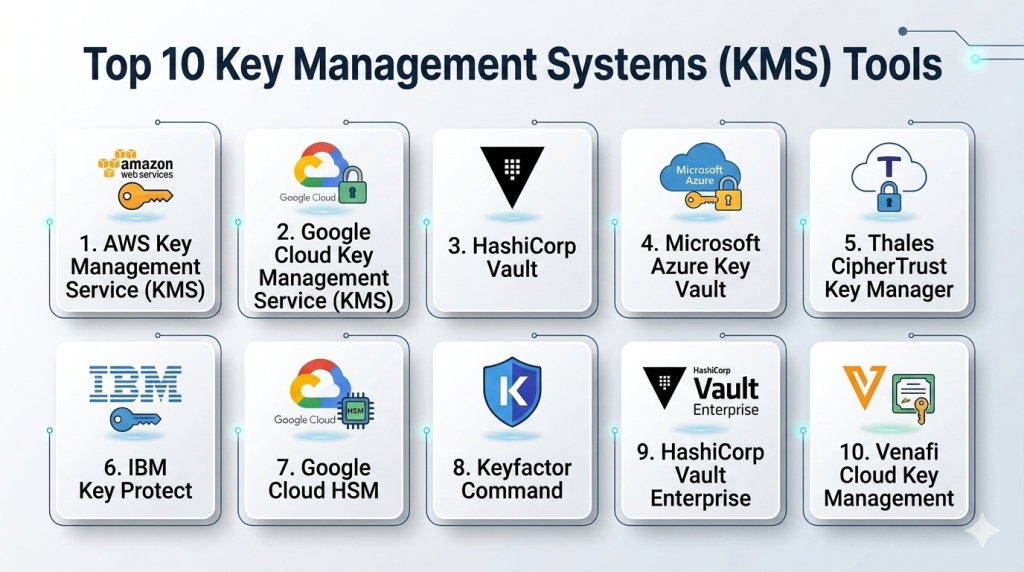
Top 10 Key Management Systems (KMS) Tools
#1 — AWS Key Management Service (KMS)
Short description: AWS KMS enables cloud-native key management for applications and services hosted in AWS. Ideal for developers and cloud-first organizations, it automates encryption key creation, storage, and lifecycle management.
Key Features
- Managed encryption key creation and rotation
- API-driven key integration with applications
- Multi-region key management
- IAM-based access control
- Integration with AWS services like S3, RDS, and Lambda
- Detailed logging via CloudTrail
Pros
- Native AWS integration simplifies cloud encryption
- Automatic key rotation reduces operational overhead
Cons
- Limited to AWS ecosystem
- Advanced reporting requires additional setup
Platforms / Deployment
- Web / AWS Cloud
- Cloud
Security & Compliance
- AES-256 encryption, IAM policies
- SOC 2, ISO 27001, HIPAA, GDPR
Integrations & Ecosystem
Works seamlessly with AWS services and DevOps workflows
- AWS S3, RDS, Lambda, EC2
- SDKs for custom applications
- Logging and monitoring via CloudTrail
Support & Community
AWS support tiers, extensive documentation, and active developer community
#2 — Google Cloud Key Management Service
Short description: Google Cloud KMS manages cryptographic keys for cloud-native applications, enabling secure storage, rotation, and access controls. Best for organizations leveraging Google Cloud infrastructure.
Key Features
- Centralized key management for Google Cloud resources
- Automatic key rotation
- IAM-based granular access control
- Cloud HSM integration
- API and SDK support
Pros
- Cloud-native and scalable
- Simplifies certificate and key management for developers
Cons
- Limited outside Google Cloud environment
- Advanced auditing requires configuration
Platforms / Deployment
- Web / Google Cloud
- Cloud
Security & Compliance
- AES-256, RSA encryption, IAM policies
- SOC 2, ISO 27001, GDPR
Integrations & Ecosystem
Integrates with GCP services and DevOps tools
- Google Cloud Storage, BigQuery, Compute Engine
- APIs for automation and workflow integration
Support & Community
Google Cloud support tiers, extensive documentation, and forums
#3 — HashiCorp Vault
Short description: Vault is an open-source and enterprise-ready KMS that provides secrets management, encryption as a service, and identity-based access controls for hybrid and cloud environments.
Key Features
- Centralized secrets management
- Dynamic key generation and encryption-as-a-service
- API-driven automation and DevOps integration
- Identity-based access control and audit logging
- Hybrid deployment support
Pros
- Flexible for hybrid and multi-cloud environments
- Open-source version available for developers
Cons
- Requires technical expertise to configure
- Enterprise features can be costly
Platforms / Deployment
- Windows / Linux / macOS
- Cloud / Self-hosted / Hybrid
Security & Compliance
- AES and RSA encryption, audit logs, RBAC
- SOC 2, ISO 27001, GDPR
Integrations & Ecosystem
Integrates with cloud providers, DevOps pipelines, and IAM systems
- AWS, Azure, GCP
- Kubernetes, CI/CD pipelines
- REST APIs for automation
Support & Community
Enterprise support, detailed documentation, active open-source community
#4 — Microsoft Azure Key Vault
Short description: Azure Key Vault allows secure storage and management of keys, secrets, and certificates for Azure-hosted applications. Ideal for Microsoft-centric organizations.
Key Features
- Centralized key and secret management
- Hardware security module (HSM) support
- Certificate lifecycle management
- RBAC and policy enforcement
- Integration with Azure services and DevOps pipelines
Pros
- Seamless Azure integration
- Supports HSM-backed keys for higher security
Cons
- Limited functionality outside Azure environment
- Learning curve for non-Microsoft environments
Platforms / Deployment
- Web / Windows / Linux
- Cloud
Security & Compliance
- AES-256, RSA encryption, RBAC, audit logging
- ISO 27001, SOC 2, GDPR, HIPAA
Integrations & Ecosystem
- Azure App Services, Azure SQL, AKS
- Azure DevOps pipelines
- APIs for custom application integration
Support & Community
Microsoft support tiers, documentation, and active forums
#5 — Thales CipherTrust Cloud Key Manager
Short description: CipherTrust KMS manages encryption keys across cloud and on-premises environments. Best for enterprises needing multi-cloud key control and compliance support.
Key Features
- Centralized cloud key management
- Multi-cloud support (AWS, Azure, GCP)
- Policy-driven key rotation and revocation
- Audit and compliance reporting
- Integration with HSMs
Pros
- Enterprise-grade security and compliance
- Scalable across multiple cloud platforms
Cons
- Implementation complexity for hybrid environments
- Licensing can be costly
Platforms / Deployment
- Windows / Linux / macOS
- Cloud / Self-hosted / Hybrid
Security & Compliance
- AES-256, RSA encryption, RBAC
- SOC 2, ISO 27001, HIPAA, GDPR
Integrations & Ecosystem
- Cloud providers, IAM platforms, DLP and SIEM tools
- REST APIs for automation and monitoring
Support & Community
Enterprise support, knowledge base, and professional services
#6 — IBM Key Protect
Short description: IBM Key Protect provides a cloud-based KMS for IBM Cloud applications, enabling encryption key management, lifecycle automation, and HSM-backed security.
Key Features
- Centralized key management for IBM Cloud
- Automated key rotation and lifecycle
- Integration with IBM Cloud services and HSM
- Access control and audit logging
- API support for developers
Pros
- Simplifies key management for IBM Cloud workloads
- Supports HSM for higher security
Cons
- Limited outside IBM Cloud
- Advanced analytics requires configuration
Platforms / Deployment
- Web / IBM Cloud
- Cloud
Security & Compliance
- AES and RSA encryption, RBAC, audit logging
- SOC 2, ISO 27001, GDPR
Integrations & Ecosystem
- IBM Cloud services
- CI/CD pipelines, HSM integration
- REST APIs for custom apps
Support & Community
IBM support tiers, documentation, and developer forums
#7 — Google Cloud HSM
Short description: Google Cloud HSM provides managed hardware-based key management for Google Cloud workloads. Suitable for organizations needing FIPS 140-2 certified keys.
Key Features
- Hardware-backed encryption keys
- Centralized key management
- FIPS 140-2 compliant HSM
- Key rotation and lifecycle management
- API access for automation
Pros
- FIPS-certified security
- Scalable for enterprise cloud deployments
Cons
- Limited to Google Cloud
- Cost higher than software-only KMS
Platforms / Deployment
- Web / Google Cloud
- Cloud
Security & Compliance
- AES and RSA encryption, RBAC
- SOC 2, ISO 27001, GDPR, HIPAA
Integrations & Ecosystem
- Google Cloud Storage, BigQuery, Compute Engine
- APIs for DevOps integration
Support & Community
Google Cloud support tiers, documentation, and forums
#8 — Keyfactor Command
Short description: Keyfactor Command provides enterprise-grade key management across cloud and on-premises infrastructure, enabling automation, auditing, and compliance.
Key Features
- Centralized certificate and key lifecycle management
- Automated discovery and renewal of keys
- Multi-cloud and hybrid support
- Policy-driven access and auditing
- REST API and DevOps integration
Pros
- Strong enterprise automation
- Comprehensive visibility into keys
Cons
- Premium licensing
- Requires technical expertise for hybrid deployment
Platforms / Deployment
- Windows / Linux / macOS
- Cloud / Self-hosted / Hybrid
Security & Compliance
- AES/RSA encryption, RBAC, audit logs
- SOC 2, ISO 27001, GDPR
Integrations & Ecosystem
- IAM platforms, cloud providers, DevOps tools
- Active Directory, AWS, Azure
Support & Community
Enterprise support, knowledge base, online forums
#9 — HashiCorp Vault Enterprise
Short description: Enterprise Vault offers KMS and secrets management with policy-based automation, encryption as a service, and hybrid deployment support.
Key Features
- Secrets and key lifecycle management
- API-driven automation for DevOps
- Identity-based access control
- Audit logging and monitoring
- Cloud and on-prem hybrid support
Pros
- Flexible for hybrid and multi-cloud environments
- Open-source version for developers
Cons
- Technical expertise required
- Enterprise pricing
Platforms / Deployment
- Windows / Linux / macOS
- Cloud / Self-hosted / Hybrid
Security & Compliance
- AES and RSA encryption, RBAC, audit logs
- SOC 2, ISO 27001, GDPR
Integrations & Ecosystem
- Cloud providers, DevOps pipelines, IAM systems
- APIs and SDKs
Support & Community
Enterprise support, documentation, and open-source community
#10 — Venafi Cloud Key Management
Short description: Venafi KMS provides centralized key management, automated rotation, and auditing for multi-cloud and hybrid environments. Ideal for enterprises focused on key security and compliance.
Key Features
- Centralized key management
- Multi-cloud and hybrid support
- Automated key rotation
- Policy-driven access control
- Audit and reporting
Pros
- Enterprise-grade automation and compliance
- Visibility into all cryptographic keys
Cons
- Costly for SMBs
- Complex hybrid deployments
Platforms / Deployment
- Windows / Linux / macOS
- Cloud / Self-hosted / Hybrid
Security & Compliance
- AES/RSA encryption, RBAC, MFA, audit logs
- SOC 2, ISO 27001, GDPR, HIPAA
Integrations & Ecosystem
- Cloud platforms, IAM systems, DevOps tools
- REST API for automation
Support & Community
Enterprise support, professional services, documentation
Comparison Table
| Tool Name | Best For | Platforms | Deployment | Standout Feature | Public Rating |
|---|---|---|---|---|---|
| AWS KMS | AWS users | Web / AWS | Cloud | Automatic key lifecycle | N/A |
| Google Cloud KMS | Google Cloud users | Web / GCP | Cloud | Centralized cloud key management | N/A |
| HashiCorp Vault | Developers & enterprises | Windows, Linux, macOS | Cloud / Self-hosted / Hybrid | Secrets and key management | N/A |
| Azure Key Vault | Azure users | Windows / Linux | Cloud | HSM-backed key storage | N/A |
| Thales CipherTrust | Enterprises | Windows, Linux, macOS | Cloud / Self-hosted / Hybrid | Multi-cloud key control | N/A |
| IBM Key Protect | IBM Cloud users | Web / IBM Cloud | Cloud | Cloud key lifecycle management | N/A |
| Google Cloud HSM | Enterprises | Web / GCP | Cloud | FIPS 140-2 certified keys | N/A |
| Keyfactor Command | Enterprise IT | Windows, Linux, macOS | Cloud / Self-hosted / Hybrid | Hybrid key management automation | N/A |
| HashiCorp Vault Enterprise | Large enterprises | Windows, Linux, macOS | Cloud / Self-hosted / Hybrid | Policy-based automation | N/A |
| Venafi Cloud KMS | Enterprises | Windows, Linux, macOS | Cloud / Self-hosted / Hybrid | Automated key rotation | N/A |
Evaluation & Scoring
| Tool Name | Core (25%) | Ease (15%) | Integrations (15%) | Security (10%) | Performance (10%) | Support (10%) | Value (15%) | Weighted Total |
|---|---|---|---|---|---|---|---|---|
| AWS KMS | 8 | 9 | 8 | 9 | 9 | 7 | 8 | 8.4 |
| Google Cloud KMS | 8 | 9 | 8 | 9 | 9 | 7 | 8 | 8.4 |
| HashiCorp Vault | 9 | 7 | 8 | 9 | 8 | 7 | 7 | 8.0 |
| Azure Key Vault | 8 | 8 | 8 | 9 | 8 | 7 | 7 | 8.0 |
| Thales CipherTrust | 9 | 7 | 8 | 9 | 8 | 7 | 6 | 8.0 |
| IBM Key Protect | 8 | 8 | 7 | 8 | 8 | 7 | 7 | 7.8 |
| Google Cloud HSM | 8 | 8 | 7 | 9 | 8 | 7 | 7 | 7.9 |
| Keyfactor Command | 9 | 7 | 8 | 9 | 8 | 7 | 6 | 7.9 |
| Vault Enterprise | 9 | 6 | 8 | 9 | 8 | 7 | 6 | 7.8 |
| Venafi Cloud KMS | 9 | 7 | 8 | 9 | 8 | 7 | 6 | 7.9 |
Which KMS Tool Is Right for You
Solo / Freelancer
Open-source tools like HashiCorp Vault (open-source version) are suitable for developers or small teams needing low-cost, flexible key management.
SMB
Azure Key Vault or Google Cloud KMS provide simplified cloud-native key management without heavy operational overhead.
Mid-Market
AWS KMS, IBM Key Protect, or Thales CipherTrust support multi-cloud environments with automation and compliance reporting.
Enterprise
Venafi Cloud KMS, HashiCorp Vault Enterprise, or Thales CipherTrust deliver full enterprise-grade automation, auditing, and hybrid cloud support.
Budget vs Premium
Open-source or cloud-native services like Vault OSS or Azure Key Vault offer cost efficiency. Enterprise platforms provide advanced features at premium pricing.
Feature Depth vs Ease of Use
Enterprise solutions like Venafi and Vault Enterprise provide comprehensive features but require technical expertise. Cloud-native KMS tools emphasize usability and developer-friendly APIs.
Integrations & Scalability
Cloud-native KMS platforms scale seamlessly across multi-cloud and hybrid deployments. Enterprise platforms integrate with IAM, DevOps pipelines, and HSMs for broader ecosystems.
Security & Compliance Needs
Organizations with strict compliance mandates should prioritize enterprise-grade tools with HSM support, auditing, and automated rotation, such as Thales CipherTrust, Vault Enterprise, and Venafi.
Frequently Asked Questions
1. What are KMS tools used for?
KMS tools manage cryptographic keys, enforce policies, and automate key lifecycle for encryption, identity, and application security.
2. How complex is deployment?
Cloud-native tools deploy quickly. Enterprise-grade or hybrid KMS solutions require configuration and planning for automation and auditing.
3. Can KMS integrate with cloud services?
Yes, most tools integrate with AWS, Azure, GCP, and hybrid environments via APIs, automation, and IAM systems.
4. Are KMS tools suitable for DevOps?
Yes, API-first KMS platforms allow developers to embed key management into pipelines and automate encryption workflows.
5. How do KMS tools support compliance?
KMS platforms provide auditing, reporting, key rotation, and lifecycle management to meet GDPR, HIPAA, and SOC 2 requirements.
6. Can KMS automate key rotation?
Yes. Automation reduces human error, enforces policies, and prevents expired keys from disrupting applications.
7. Are KMS tools scalable?
Cloud-native and enterprise KMS platforms scale across hybrid, multi-cloud, and IoT deployments efficiently.
8. What are common mistakes?
Mistakes include poor key management, missing auditing, inconsistent rotation, or insufficient access controls.
9. Are open-source KMS tools reliable?
Open-source KMS like HashiCorp Vault are reliable but require technical expertise for secure configuration and management.
10. Can I switch KMS tools?
Migration may be complex due to key dependencies. Careful planning, phased adoption, and auditing are recommended.
Conclusion
Key Management Systems (KMS) are critical for securing cryptographic keys, enabling encryption, and ensuring compliance across cloud, hybrid, and on-prem environments. Enterprises benefit from Thales CipherTrust, Venafi, and Vault Enterprise for comprehensive automation, auditing, and hybrid support, while SMBs and cloud-native organizations can leverage AWS KMS, Azure Key Vault, or Google Cloud KMS for scalable, easy-to-use management. Open-source solutions like HashiCorp Vault provide flexible options for developers and small teams. Organizations should evaluate

Find Trusted Cardiac Hospitals
Compare heart hospitals by city and services — all in one place.
Explore Hospitals
Key rotation or a temporary KMS outage can affect applications that depend on encrypted data. Teams should test key rotation, access recovery, backup procedures, and what happens when the KMS is unavailable. Having a clear recovery plan can prevent a small key-management issue from becoming a major production outage.