Introduction
Database Monitoring Tools are platforms designed to observe, analyze, and optimize database performance in real time. They help IT teams maintain uptime, troubleshoot slow queries, detect anomalies, and enforce security policies across databases. By providing insights into resource usage, query performance, and system health, these tools are essential for managing both on-premise and cloud database environments.
With increasing data volumes, hybrid cloud adoption, and growing regulatory requirements, database monitoring is crucial to prevent downtime, improve efficiency, and maintain compliance. Modern tools include AI-powered anomaly detection, automated alerts, and integration with DevOps and IT management platforms.
Real-world use cases include:
- Monitoring SQL and NoSQL database performance
- Identifying slow queries and bottlenecks
- Managing multi-cloud and hybrid environments
- Ensuring compliance through audit logging and reporting
- Proactively preventing outages and failures
Evaluation criteria for Database Monitoring Tools:
- Real-time performance monitoring
- Query and workload analysis
- Alerting and anomaly detection
- Multi-database and multi-platform support
- Cloud, on-prem, or hybrid deployment
- Compliance and audit reporting
- AI and automation capabilities
- Ease of use and dashboards
- Integration with ITSM, DevOps, and analytics tools
- Pricing and licensing flexibility
Best for: Database administrators, IT operations teams, enterprises, and SaaS providers
Not ideal for: Small businesses with minimal database activity or low regulatory obligations
Key Trends in Database Monitoring Tools
- AI-driven anomaly detection and predictive analytics
- Cloud-native monitoring for multi-cloud environments
- Automated performance tuning and alerting
- Integration with DevOps, CI/CD pipelines, and ITSM tools
- Support for hybrid and multi-database deployments
- Role-based access and secure monitoring
- Compliance-ready dashboards and audit reporting
- Visualization of database performance metrics
- Subscription and usage-based pricing models
- Self-healing automation for routine issues
How We Selected These Tools (Methodology)
- Evaluated market adoption and customer trust
- Assessed monitoring, alerting, and reporting capabilities
- Verified AI and automation features for proactive maintenance
- Reviewed integration potential with cloud platforms and ITSM tools
- Analyzed multi-database and hybrid environment support
- Examined performance metrics and reliability signals
- Checked security features, access controls, and auditing
- Evaluated scalability for SMB, mid-market, and enterprise deployments
- Reviewed documentation, onboarding, and support quality
- Considered pricing models and total value
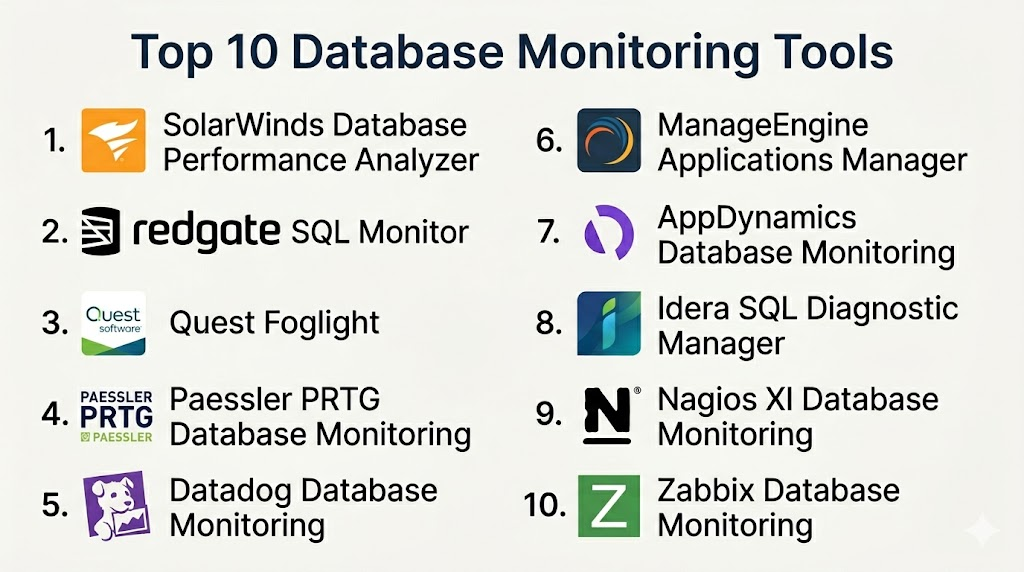
Top 10 Database Monitoring Tools
#1 — SolarWinds Database Performance Analyzer
Short description:
SolarWinds DPA monitors SQL Server, Oracle, MySQL, and PostgreSQL, providing query performance insights, wait-time analysis, and automated alerts. Ideal for enterprises managing multi-database environments.
Key Features
- Multi-database performance monitoring
- Query tuning and optimization
- Real-time alerting and notifications
- Wait-time and bottleneck analysis
- Historical trend reporting
- Cloud and hybrid monitoring
Pros
- Comprehensive performance insights
- Multi-database support
Cons
- Enterprise pricing
- Learning curve for advanced features
Platforms / Deployment
- Windows / Linux / Web
- Cloud / On-prem / Hybrid
Security & Compliance
- Role-based access control
- Audit logging
Integrations & Ecosystem
- DevOps pipelines, ITSM tools
- Cloud provider integration
- API support
Support & Community
Documentation, forums, enterprise support
#2 — Redgate SQL Monitor
Short description:
Redgate SQL Monitor provides real-time SQL Server monitoring with alerts, historical reporting, and query performance analysis, suitable for DBAs and IT teams.
Key Features
- SQL Server performance monitoring
- Query performance and diagnostics
- Customizable alerts
- Historical trend analysis
- Integration with SQL Server Agent
- Dashboard and reporting
Pros
- Easy-to-use dashboards
- Targeted SQL Server optimization
Cons
- SQL Server only
- Limited cross-platform support
Platforms / Deployment
- Windows / Web
- On-prem / Cloud
Security & Compliance
- Role-based access
- Audit logs
Integrations & Ecosystem
- SQL Server Agent, DevOps pipelines
- API access for automation
Support & Community
Documentation, enterprise support
#3 — Quest Foglight
Short description:
Quest Foglight provides database monitoring for SQL Server, Oracle, and MySQL, offering performance diagnostics, anomaly detection, and predictive analytics.
Key Features
- Multi-database monitoring
- Performance diagnostics
- Wait-time and bottleneck detection
- Predictive analytics
- Historical reporting
- Alerts and notifications
Pros
- Cross-database support
- AI-driven analytics
Cons
- Complex deployment
- Higher cost
Platforms / Deployment
- Windows / Linux / Web
- Cloud / On-prem / Hybrid
Security & Compliance
- Role-based access
- Audit logging
Integrations & Ecosystem
- ITSM and DevOps tools
- Cloud services
- APIs for automation
Support & Community
Documentation and enterprise support
#4 — Paessler PRTG Database Monitoring
Short description:
PRTG monitors SQL, Oracle, MySQL, and PostgreSQL, providing real-time metrics, alerts, and dashboards, suitable for SMB and mid-market IT teams.
Key Features
- Multi-database monitoring
- Customizable alerts
- Historical performance metrics
- Dashboard visualization
- Cloud and on-prem support
- API for automation
Pros
- Affordable and flexible
- Easy setup and dashboards
Cons
- Limited advanced analytics
- Enterprise features require add-ons
Platforms / Deployment
- Windows / Web
- Cloud / On-prem
Security & Compliance
- Role-based access
- SSL encryption
Integrations & Ecosystem
- Cloud services, DevOps tools
- API access
- Alerting integration
Support & Community
Documentation and community forums
#5 — Datadog Database Monitoring
Short description:
Datadog provides database monitoring for SQL, NoSQL, and cloud-native databases, integrating with infrastructure monitoring and providing AI-based anomaly detection.
Key Features
- Multi-database and multi-cloud monitoring
- AI anomaly detection
- Query performance analysis
- Real-time dashboards
- Alerting and notifications
- Cloud-native monitoring
Pros
- Multi-cloud support
- AI-assisted monitoring
Cons
- Subscription-based pricing
- Learning curve for advanced features
Platforms / Deployment
- Web / Linux / Windows
- Cloud
Security & Compliance
- Encrypted connections
- Audit logs
Integrations & Ecosystem
- Cloud services, DevOps pipelines
- APIs and integrations with observability tools
Support & Community
Documentation and enterprise support
#6 — ManageEngine Applications Manager
Short description:
Applications Manager provides database and application monitoring with performance analytics, alerts, and hybrid deployment support.
Key Features
- Multi-database monitoring
- Query and server performance analysis
- Alerts and notifications
- Backup and replication monitoring
- Historical trend reporting
- Hybrid monitoring
Pros
- Multi-platform support
- Performance analytics
Cons
- Enterprise pricing
- Limited advanced query optimization
Platforms / Deployment
- Windows / Linux / Web
- Cloud / On-prem / Hybrid
Security & Compliance
- Role-based access
- Audit logging
Integrations & Ecosystem
- ITSM and DevOps tools
- API and automation support
Support & Community
Enterprise support and documentation
#7 — AppDynamics Database Monitoring
Short description:
AppDynamics monitors databases as part of its APM suite, providing query-level analytics, performance monitoring, and anomaly detection.
Key Features
- Query-level performance monitoring
- End-to-end transaction visibility
- Anomaly detection
- Real-time dashboards
- Historical performance analytics
- Multi-database support
Pros
- Integrated with application monitoring
- Proactive alerts
Cons
- Requires AppDynamics platform subscription
- Enterprise pricing
Platforms / Deployment
- Web / Windows / Linux
- Cloud / On-prem / Hybrid
Security & Compliance
- Role-based access
- Audit logs
Integrations & Ecosystem
- Cloud, applications, DevOps tools
- API for automation
Support & Community
Enterprise support and documentation
#8 — Idera SQL Diagnostic Manager
Short description:
SQL Diagnostic Manager monitors SQL Server environments, providing performance insights, alerts, and historical analysis.
Key Features
- SQL Server monitoring
- Query performance and wait-time analysis
- Alerts and notifications
- Historical trend reporting
- Dashboard visualization
- Backup monitoring
Pros
- Focused on SQL Server
- Detailed performance insights
Cons
- SQL Server only
- Not multi-database
Platforms / Deployment
- Windows
- Cloud / On-prem
Security & Compliance
- Role-based access
- Audit logs
Integrations & Ecosystem
- DevOps tools, backup solutions
- APIs for automation
Support & Community
Documentation and enterprise support
#9 — Nagios XI Database Monitoring
Short description:
Nagios XI provides open-source monitoring for multiple databases, offering alerts, performance graphs, and custom plugin support.
Key Features
- Multi-database support
- Real-time monitoring and alerts
- Performance metrics and graphs
- Custom plugin integration
- Cloud and on-prem support
- Historical trend reporting
Pros
- Open-source and flexible
- Customizable monitoring
Cons
- Requires manual configuration
- Limited advanced analytics
Platforms / Deployment
- Windows / Linux / Web
- Cloud / On-prem
Security & Compliance
- SSL encryption
- User access control
Integrations & Ecosystem
- ITSM, DevOps tools
- APIs and custom plugins
Support & Community
Documentation, community support, enterprise support for paid edition
#10 — Zabbix Database Monitoring
Short description:
Zabbix is an open-source monitoring solution for databases and infrastructure, providing real-time metrics, alerting, and visualization.
Key Features
- Multi-database support
- Real-time monitoring
- Custom alerting and notifications
- Dashboards and visualizations
- Historical trend analysis
- API for automation
Pros
- Open-source and highly customizable
- Multi-platform monitoring
Cons
- Manual setup
- Advanced features require configuration
Platforms / Deployment
- Windows / Linux / macOS / Web
- Cloud / On-prem / Hybrid
Security & Compliance
- SSL encryption
- Role-based access
Integrations & Ecosystem
- Cloud, ITSM, DevOps tools
- APIs for automation
Support & Community
Documentation, forums, and enterprise support
Comparison Table (Top 10)
| Tool Name | Best For | Platform(s) Supported | Deployment | Standout Feature | Public Rating |
|---|---|---|---|---|---|
| SolarWinds DPA | Multi-database | Windows/Linux/Web | Cloud/On-prem/Hybrid | Query performance analysis | N/A |
| Redgate SQL Monitor | SQL Server | Windows/Web | On-prem/Cloud | Real-time monitoring | N/A |
| Quest Foglight | Multi-database | Windows/Linux | Cloud/On-prem/Hybrid | AI-driven analytics | N/A |
| Paessler PRTG | SMB/Mid-market | Windows/Web | Cloud/On-prem | Customizable alerts | N/A |
| Datadog | Multi-cloud | Web/Windows/Linux | Cloud | AI anomaly detection | N/A |
| ManageEngine AM | Multi-database | Windows/Linux/Web | Cloud/On-prem/Hybrid | Performance analytics | N/A |
| AppDynamics | Application + DB | Web/Windows/Linux | Cloud/On-prem/Hybrid | End-to-end monitoring | N/A |
| Idera SQL DM | SQL Server | Windows | Cloud/On-prem | Detailed SQL performance | N/A |
| Nagios XI | Open-source | Windows/Linux/Web | Cloud/On-prem | Custom plugin monitoring | N/A |
| Zabbix | Open-source | Windows/Linux/macOS/Web | Cloud/On-prem/Hybrid | Real-time monitoring | N/A |
Evaluation & Scoring of Database Monitoring Tools
| Tool Name | Core (25%) | Ease (15%) | Integrations (15%) | Security (10%) | Performance (10%) | Support (10%) | Value (15%) | Weighted Total |
|---|---|---|---|---|---|---|---|---|
| SolarWinds DPA | 10 | 8 | 9 | 9 | 9 | 8 | 7 | 8.7 |
| Redgate SQL Monitor | 9 | 9 | 8 | 9 | 8 | 8 | 7 | 8.3 |
| Quest Foglight | 9 | 8 | 8 | 9 | 8 | 8 | 7 | 8.2 |
| Paessler PRTG | 8 | 9 | 8 | 8 | 8 | 8 | 8 | 8.2 |
| Datadog | 9 | 8 | 9 | 9 | 8 | 8 | 7 | 8.3 |
| ManageEngine AM | 8 | 8 | 8 | 8 | 8 | 8 | 7 | 8.0 |
| AppDynamics | 9 | 8 | 8 | 9 | 8 | 8 | 7 | 8.2 |
| Idera SQL DM | 8 | 8 | 8 | 8 | 8 | 8 | 7 | 8.0 |
| Nagios XI | 7 | 8 | 7 | 7 | 7 | 7 | 7 | 7.2 |
| Zabbix | 7 | 8 | 8 | 7 | 7 | 7 | 7 | 7.3 |
Which Database Monitoring Tools Tool Is Right for You?
Solo / Freelancer
PRTG, DBeaver, or Zabbix for lightweight monitoring and simplicity
SMB
Datadog, PRTG, or Redgate SQL Monitor for multi-database and cloud integration
Mid-Market
SolarWinds DPA or AppDynamics for multi-database and performance insights
Enterprise
Quest Foglight, ManageEngine AM, Idera SQL DM for large-scale hybrid deployments
Budget vs Premium
Budget: Zabbix, PRTG; Premium: SolarWinds DPA, AppDynamics, Quest Foglight
Feature Depth vs Ease of Use
Depth: SolarWinds DPA, Quest Foglight; Ease: PRTG, Redgate SQL Monitor
Integrations & Scalability
SolarWinds DPA, AppDynamics, Datadog for multi-cloud and enterprise scaling
Security & Compliance Needs
Role-based access, audit logs, SSL encryption, and compliance reporting
Frequently Asked Questions (FAQs)
1. Which databases are supported?
Tools support SQL Server, Oracle, MySQL, PostgreSQL, and NoSQL databases depending on platform.
2. Can these monitor cloud databases?
Yes, most tools support AWS, Azure, Google Cloud, and hybrid setups.
3. Are alerts customizable?
Yes, alerts can be customized based on thresholds, anomalies, and performance metrics.
4. Do these tools provide analytics?
Yes, dashboards show query performance, resource usage, and historical trends.
5. Are there free options?
Nagios XI and Zabbix offer open-source versions; others are paid enterprise tools.
6. Can these integrate with DevOps pipelines?
Yes, API and plugin support enable integration with CI/CD and monitoring workflows.
7. How scalable are these tools?
They scale from SMBs to large enterprise environments with thousands of databases.
8. Do they support multi-cloud monitoring?
Yes, Datadog, SolarWinds DPA, and AppDynamics provide cloud-native monitoring.
9. Is security included?
Role-based access, SSL/TLS encryption, and audit logging are standard features.
10. Can they help with compliance?
Yes, enterprise tools provide audit reports, logs, and compliance dashboards for GDPR, HIPAA, and SOC 2.
Conclusion
Database Monitoring Tools are essential for maintaining database health, optimizing performance, and preventing outages. Platforms like SolarWinds DPA, AppDynamics, and Quest Foglight provide enterprise-grade insights and multi-database monitoring. SMBs and freelancers can rely on PRTG, Redgate SQL Monitor, or Zabbix for lightweight yet effective monitoring. Selecting the right tool requires evaluating database type, deployment model, integration needs, scalability, and compliance requirements. Organizations should pilot solutions, monitor dashboards, and configure alerts to proactively maintain database performance and security.

Find Trusted Cardiac Hospitals
Compare heart hospitals by city and services — all in one place.
Explore Hospitals
One practical point I would add is the impact of monitoring on the database itself. Monitoring tools also use CPU, memory, storage, and network resources, especially when collecting detailed query data. Teams should check monitoring overhead and data-retention costs before enabling everything in production. The best setup is not the one that collects the most data, but the one that gives useful information without affecting database performance.