Introduction
Building Energy Management Systems BEMS help organizations monitor, control, optimize, and report energy usage across buildings, campuses, factories, offices, hospitals, hotels, malls, and public facilities. These platforms connect with HVAC, lighting, meters, sensors, building automation systems, occupancy data, and utility systems to reduce waste and improve operational efficiency. BEMS matters because energy costs, sustainability targets, carbon reporting, comfort expectations, and building performance requirements are becoming more important for every facility team. A strong BEMS can help identify energy waste, automate control strategies, reduce peak demand, improve equipment performance, and support compliance or ESG reporting.
Real World Use Cases:
- Monitoring electricity, HVAC, lighting, gas, and water usage
- Optimizing HVAC schedules and equipment runtime
- Tracking energy consumption by building, floor, zone, or asset
- Detecting abnormal consumption and equipment inefficiency
- Supporting sustainability, carbon, and ESG reporting
- Reducing utility costs across multi-site portfolios
Evaluation Criteria for Buyers:
- Energy monitoring and metering depth
- HVAC and building automation integration
- Real-time dashboards and historical analytics
- Fault detection and diagnostics capabilities
- Demand response and peak load management
- Carbon and sustainability reporting
- Multi-site portfolio visibility
- Automation and control flexibility
- Security, permissions, and audit controls
- Integration with BMS, IoT, ERP, CMMS, and reporting systems
Best for: Facility managers, energy managers, sustainability teams, building owners, real estate operators, universities, hospitals, hotels, manufacturing sites, public sector facilities, and enterprise campuses that need better energy visibility, automation, and cost control.
Not ideal for: Very small offices with low energy complexity may not need a full BEMS. A utility dashboard, smart thermostat, basic submetering tool, or manual energy report may be enough until the building footprint, energy cost, or compliance requirement grows.
Key Trends in Building Energy Management Systems BEMS for 2026 and Beyond
- AI-driven energy optimization is growing: BEMS platforms increasingly use analytics and AI-style recommendations to identify waste, optimize schedules, and detect abnormal energy patterns.
- Carbon and sustainability reporting are becoming central: Buyers want tools that connect energy use with emissions reporting, ESG goals, carbon accounting, and sustainability dashboards.
- Open building integrations matter more: BEMS platforms need to connect with HVAC systems, lighting controls, submeters, sensors, IoT platforms, building automation systems, and enterprise analytics tools.
- Fault detection and diagnostics are expanding: Energy platforms are moving beyond dashboards to detect malfunctioning equipment, simultaneous heating and cooling, sensor issues, and poor control sequences.
- Occupancy-aware energy management is rising: Buildings increasingly use occupancy data to adjust HVAC, lighting, ventilation, and room-level controls based on actual space usage.
- Cloud-based portfolio management is growing: Multi-site organizations want centralized dashboards for all facilities, not isolated building-by-building systems.
- Demand response and peak load control are more important: BEMS tools help reduce peak demand charges, manage load shedding, and support grid flexibility programs.
- Energy and maintenance workflows are converging: Energy anomalies can trigger work orders, inspections, or maintenance checks when connected with CMMS or facility management systems.
- Cybersecurity is a bigger buying factor: Because BEMS connects to building systems, buyers need secure access, role controls, network segmentation, audit logs, and vendor security review.
- User experience is improving: Modern platforms focus on clear dashboards, alerts, benchmarking, guided recommendations, and executive-level reporting instead of complex engineering-only screens.
How We Selected These Tools
The tools below were selected using practical building energy management and facility operations evaluation logic:
- Market recognition among facility teams, energy managers, building owners, real estate operators, and enterprise campuses
- Ability to monitor, analyze, and optimize energy across buildings and portfolios
- Strength of integration with HVAC, BMS, meters, lighting, sensors, and building automation systems
- Support for fault detection, diagnostics, alerts, and energy efficiency recommendations
- Fit across commercial buildings, hospitals, universities, manufacturing sites, hotels, retail, and public sector facilities
- Reporting depth for utility usage, carbon, sustainability, benchmarking, and cost visibility
- Ability to support multi-site and portfolio-level energy management
- Security and administration controls for connected building environments
- Usability for facility managers, energy managers, executives, and operations teams
- Practical value for reducing energy waste, improving comfort, and supporting sustainability goals
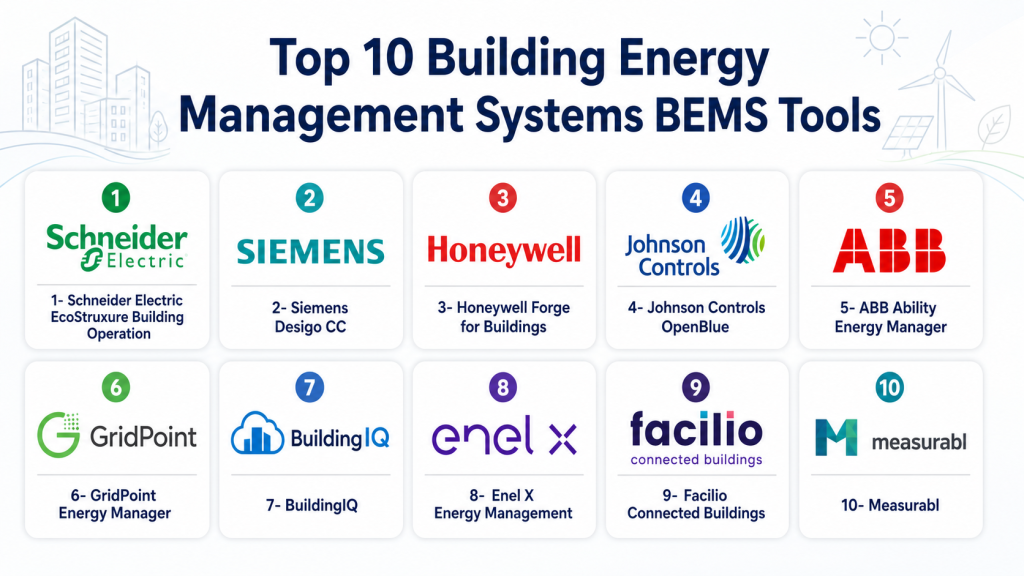
Top 10 Building Energy Management Systems BEMS Tools
1- Schneider Electric EcoStruxure Building Operation
Short description: Schneider Electric EcoStruxure Building Operation is a building management and energy optimization platform for commercial buildings, campuses, healthcare, education, and industrial facilities. It helps teams connect building systems, monitor energy use, optimize operations, and improve building performance.
Key Features
- Building automation and energy management
- HVAC, lighting, meter, and sensor integration
- Real-time monitoring and control dashboards
- Fault detection and operational alerts
- Multi-building and campus visibility
- Energy performance reporting
- Integration with Schneider Electric building ecosystem
Pros
- Strong fit for large buildings and enterprise campuses
- Broad building automation and energy management capabilities
- Useful for organizations standardizing connected building operations
Cons
- May be too advanced for small buildings
- Implementation often requires specialist configuration
- Best value depends on building system integration quality
Platforms / Deployment
Web / Mobile access varies
Cloud / Hybrid / Varies
Security & Compliance
Varies / N/A. Buyers should validate SSO, RBAC, encryption, audit logs, network security, building system access controls, and enterprise compliance requirements directly.
Integrations & Ecosystem
EcoStruxure Building Operation works well when energy management needs to connect with automation, controls, sensors, meters, and facility workflows.
- HVAC and BMS systems
- Smart meters and submeters
- Lighting controls
- Occupancy and environmental sensors
- Facility management workflows
- Enterprise reporting and analytics
Support & Community
Schneider Electric provides implementation partners, documentation, training, support resources, and building automation expertise. Support scope may vary by region, project size, and deployment model.
2- Siemens Desigo CC
Short description: Siemens Desigo CC is a building management platform that supports energy monitoring, automation, safety, comfort, and facility performance across buildings and campuses. It is useful for large facilities that need integrated control and operational visibility.
Key Features
- Integrated building management and energy monitoring
- HVAC, lighting, fire, safety, and automation system visibility
- Real-time dashboards and alarms
- Energy reporting and trend analysis
- Multi-site and campus support
- Operational control and scheduling
- Integration with Siemens building technology ecosystem
Pros
- Strong fit for complex buildings and campuses
- Supports integrated building operations beyond energy alone
- Useful for facilities requiring centralized control and visibility
Cons
- May require expert implementation and system design
- Smaller buildings may not need its full depth
- Buyers should validate integration fit with existing building systems
Platforms / Deployment
Web / Windows / Mobile access varies
Cloud / On-premises / Hybrid / Varies
Security & Compliance
Varies / N/A. Buyers should validate user access controls, encryption, audit logs, network security, building system permissions, and enterprise requirements directly.
Integrations & Ecosystem
Desigo CC is valuable when energy management is part of a broader building automation and facility control environment.
- HVAC systems
- Building automation systems
- Lighting and safety systems
- Metering and monitoring devices
- Facility operations workflows
- Enterprise analytics systems
Support & Community
Siemens provides professional services, documentation, partner implementation, and technical support. Support depth may vary by geography, contract, and building complexity.
3- Honeywell Forge for Buildings
Short description: Honeywell Forge for Buildings supports building performance, energy optimization, operational analytics, and facility visibility. It is designed for owners and operators who need better insight into energy, comfort, maintenance, and building efficiency.
Key Features
- Building performance analytics
- Energy monitoring and optimization
- Fault detection and operational insights
- Comfort and occupant experience visibility
- Portfolio-level building dashboards
- Integration with building systems
- Maintenance and operational efficiency support
Pros
- Strong fit for enterprise buildings and multi-site portfolios
- Useful for connecting energy performance with operations
- Helps facility teams identify inefficiencies and improvement areas
Cons
- Implementation may require building data and integration planning
- Smaller organizations may not need full portfolio capabilities
- Buyers should validate modules and use-case fit
Platforms / Deployment
Web / Mobile access varies
Cloud / Hybrid / Varies
Security & Compliance
Varies / N/A. Buyers should validate SSO, access permissions, encryption, audit logs, data governance, and connected building security controls directly.
Integrations & Ecosystem
Honeywell Forge works best when connected to building systems, operational data, and facility workflows.
- Building automation systems
- HVAC and energy systems
- Sensor and equipment data
- Facility operations workflows
- Maintenance and service workflows
- Portfolio analytics dashboards
Support & Community
Honeywell provides enterprise support, building services, implementation resources, and technical expertise. Support scope may vary by contract, modules, and region.
4- Johnson Controls OpenBlue
Short description: Johnson Controls OpenBlue is a smart building platform that supports energy optimization, connected building operations, sustainability, comfort, and facility intelligence. It is suitable for building owners, enterprises, healthcare, education, and large real estate portfolios.
Key Features
- Smart building and energy management
- HVAC and building automation integration
- Energy optimization and operational insights
- Sustainability and performance dashboards
- Fault detection and equipment monitoring
- Occupancy and comfort-related analytics
- Multi-building portfolio support
Pros
- Strong fit for connected building and sustainability programs
- Useful for large facilities and real estate portfolios
- Supports both operational efficiency and energy goals
Cons
- May require complex implementation for best results
- Smaller facilities may not need the full platform scope
- Buyers should validate integration with existing building systems
Platforms / Deployment
Web / Mobile access varies
Cloud / Hybrid / Varies
Security & Compliance
Varies / N/A. Buyers should validate access controls, encryption, audit logs, user roles, network security, and building data governance directly.
Integrations & Ecosystem
OpenBlue fits organizations that want energy optimization connected with broader smart building strategy and facility operations.
- HVAC and building automation
- Equipment and sensor data
- Sustainability reporting workflows
- Occupancy and comfort analytics
- Facility management workflows
- Enterprise dashboards
Support & Community
Johnson Controls provides implementation support, building services, technical resources, and partner expertise. Support depth may vary by region and project complexity.
5- ABB Ability Energy Manager
Short description: ABB Ability Energy Manager helps organizations monitor, analyze, and optimize energy consumption across facilities, electrical systems, and industrial environments. It is useful for teams that need energy visibility, power monitoring, and efficiency reporting.
Key Features
- Energy monitoring and consumption analytics
- Electrical system visibility
- Dashboards for energy performance
- Alerts and anomaly detection support
- Multi-site energy reporting
- Utility and cost tracking
- Integration with ABB electrical and automation ecosystem
Pros
- Strong fit for electrical energy monitoring and industrial facilities
- Useful for energy managers tracking consumption and costs
- Supports multi-site energy visibility
Cons
- May require ABB ecosystem or compatible hardware planning
- Building comfort and HVAC optimization depth should be validated
- Implementation depends on metering and data quality
Platforms / Deployment
Web / Mobile access varies
Cloud / Varies / N/A
Security & Compliance
Varies / N/A. Buyers should validate user roles, encryption, data access controls, audit logs, device security, and enterprise requirements directly.
Integrations & Ecosystem
ABB Ability Energy Manager works well when energy monitoring needs to connect with electrical infrastructure and facility operations.
- Electrical meters and devices
- Energy monitoring systems
- Industrial automation workflows
- Utility reporting
- Facility dashboards
- Enterprise analytics workflows
Support & Community
ABB provides technical documentation, implementation partners, and support resources. Support scope may vary by region, hardware environment, and deployment size.
6- GridPoint Energy Manager
Short description: GridPoint Energy Manager helps businesses monitor and control energy usage across commercial facilities, especially distributed multi-site environments. It is useful for retail, restaurants, offices, and organizations that need energy optimization across many locations.
Key Features
- Energy monitoring and control
- HVAC scheduling and optimization
- Multi-site energy dashboards
- Utility cost and consumption visibility
- Alerts for abnormal usage
- Equipment performance insights
- Demand management support
Pros
- Strong fit for distributed commercial portfolios
- Useful for retail, restaurant, and multi-location operations
- Helps identify energy waste across many sites
Cons
- May be less suited for highly complex industrial energy use cases
- Hardware and controls rollout may require planning
- Buyers should validate integration with existing building systems
Platforms / Deployment
Web / Mobile access varies
Cloud
Security & Compliance
Varies / N/A. Buyers should validate permissions, encryption, access controls, device security, and enterprise data policies directly.
Integrations & Ecosystem
GridPoint fits organizations that need energy monitoring and control across multiple commercial locations.
- HVAC controls
- Energy meters
- Utility data workflows
- Multi-site reporting
- Alerts and performance dashboards
- Facility operations workflows
Support & Community
GridPoint provides energy management support, deployment guidance, and customer service resources. Support depth may vary by site count and contract.
7- BuildingIQ
Short description: BuildingIQ provides energy intelligence and optimization solutions for commercial buildings. It helps facility teams improve building performance through analytics, predictive control, energy insights, and operational recommendations.
Key Features
- Energy analytics and optimization
- Predictive control support
- Fault detection and diagnostics
- HVAC performance insights
- Building performance dashboards
- Energy savings opportunity identification
- Integration with building automation systems
Pros
- Strong fit for data-driven building energy optimization
- Useful for identifying HVAC inefficiencies and control issues
- Helps facility teams move beyond simple energy reporting
Cons
- Results depend on building data quality and controls integration
- Smaller buildings may not need advanced optimization
- Buyers should validate deployment approach and expected outcomes
Platforms / Deployment
Web / Varies / N/A
Cloud / Hybrid / Varies
Security & Compliance
Varies / N/A. Buyers should validate access control, encryption, data security, audit logs, and building automation integration security directly.
Integrations & Ecosystem
BuildingIQ works well when connected with building automation systems, metering data, and operational dashboards.
- Building automation systems
- HVAC control systems
- Metering and energy data
- Facility operations workflows
- Fault detection workflows
- Reporting dashboards
Support & Community
BuildingIQ provides technical support and energy optimization guidance. Support scope may vary by building type, contract, and system complexity.
8- Enel X Energy Management
Short description: Enel X Energy Management supports energy monitoring, demand response, flexibility, and sustainability-related energy programs. It is useful for organizations looking to manage energy consumption, optimize costs, and participate in energy flexibility initiatives.
Key Features
- Energy monitoring and performance visibility
- Demand response program support
- Energy cost and consumption analytics
- Load management and flexibility insights
- Sustainability and carbon-related reporting support
- Multi-site energy visibility
- Utility and grid program alignment
Pros
- Strong fit for demand response and energy flexibility programs
- Useful for organizations managing energy cost and grid participation
- Supports broader sustainability and energy strategy
Cons
- Building-level controls depth should be validated
- Fit may depend on region and energy market participation
- Buyers should verify available programs and integration needs
Platforms / Deployment
Web / Mobile access varies
Cloud / Varies / N/A
Security & Compliance
Varies / N/A. Buyers should validate data privacy, permissions, encryption, audit logs, access controls, and regional energy data requirements directly.
Integrations & Ecosystem
Enel X Energy Management fits organizations that need energy intelligence connected with utility programs, demand response, and sustainability workflows.
- Utility data workflows
- Demand response programs
- Energy monitoring systems
- Load management workflows
- Sustainability reporting
- Multi-site dashboards
Support & Community
Enel X provides energy program support, advisory resources, and customer service options. Support scope may vary by region, contract, and energy program.
9- Facilio Connected Buildings
Short description: Facilio Connected Buildings helps real estate owners and facility teams manage building operations, energy performance, assets, service workflows, and sustainability insights. It is useful for multi-site property operators that need connected operational visibility.
Key Features
- Connected building operations
- Energy performance monitoring
- Asset and equipment visibility
- Work order and facility service workflows
- Fault detection and operational insights
- Multi-site portfolio dashboards
- Sustainability and performance reporting support
Pros
- Strong fit for property operators and multi-site facilities
- Connects energy insights with maintenance and operations
- Useful for centralized building performance management
Cons
- May require integration planning with building systems
- Small standalone buildings may not need full platform scope
- Buyers should validate exact energy and controls capabilities
Platforms / Deployment
Web / Mobile access varies
Cloud
Security & Compliance
Varies / N/A. Buyers should validate SSO, permissions, encryption, audit logs, building data security, and enterprise requirements directly.
Integrations & Ecosystem
Facilio works well when energy data needs to connect with facility operations, maintenance, assets, and portfolio dashboards.
- Building management systems
- IoT and sensor workflows
- Maintenance and work orders
- Energy and sustainability dashboards
- Vendor and service workflows
- Portfolio reporting
Support & Community
Facilio provides implementation, onboarding, and support resources for property and facility operations teams. Support depth may vary by deployment size and integration complexity.
10- Measurabl
Short description: Measurabl is a sustainability and ESG data platform widely used by real estate organizations to manage energy, utility, carbon, and sustainability reporting. It is useful for teams focused on energy data transparency, portfolio reporting, and ESG performance.
Key Features
- Utility and energy data management
- Carbon and sustainability reporting
- ESG performance dashboards
- Real estate portfolio data visibility
- Benchmarking and reporting workflows
- Data collection and normalization support
- Stakeholder reporting and disclosure support
Pros
- Strong fit for real estate sustainability and ESG teams
- Useful for portfolio-level energy and carbon reporting
- Helps organize sustainability data for decision-making
Cons
- Not a traditional building controls platform
- HVAC optimization and automation depth should be validated
- Best suited for reporting and sustainability data workflows
Platforms / Deployment
Web
Cloud
Security & Compliance
Varies / N/A. Buyers should validate data privacy, user permissions, encryption, audit logs, ESG data governance, and enterprise security requirements directly.
Integrations & Ecosystem
Measurabl fits organizations that need energy data connected with sustainability, ESG, carbon, and real estate reporting.
- Utility data workflows
- Energy reporting systems
- Real estate portfolio data
- Carbon reporting
- ESG disclosure workflows
- Analytics dashboards
Support & Community
Measurabl provides onboarding, support, documentation, and sustainability-focused customer resources. Support scope may vary by portfolio size and reporting requirements.
Comparison Table
| Tool Name | Best For | Platform Supported | Deployment | Standout Feature | Public Rating |
|---|---|---|---|---|---|
| Schneider Electric EcoStruxure Building Operation | Enterprise buildings and campuses | Web, mobile access varies | Cloud / Hybrid / Varies | Building automation and energy optimization | N/A |
| Siemens Desigo CC | Complex building control environments | Web, Windows, mobile access varies | Cloud / On-premises / Hybrid / Varies | Integrated building management and energy visibility | N/A |
| Honeywell Forge for Buildings | Multi-site building performance teams | Web, mobile access varies | Cloud / Hybrid / Varies | Building performance and operational analytics | N/A |
| Johnson Controls OpenBlue | Smart building and sustainability programs | Web, mobile access varies | Cloud / Hybrid / Varies | Connected building intelligence and optimization | N/A |
| ABB Ability Energy Manager | Electrical and industrial energy monitoring | Web, mobile access varies | Cloud / Varies | Energy and electrical system performance visibility | N/A |
| GridPoint Energy Manager | Distributed commercial portfolios | Web, mobile access varies | Cloud | Multi-site energy monitoring and controls | N/A |
| BuildingIQ | Predictive energy optimization | Web, varies | Cloud / Hybrid / Varies | Data-driven HVAC and energy optimization | N/A |
| Enel X Energy Management | Demand response and energy flexibility | Web, mobile access varies | Cloud / Varies | Energy flexibility and demand response support | N/A |
| Facilio Connected Buildings | Property operators and connected facilities | Web, mobile access varies | Cloud | Energy insights connected with operations | N/A |
| Measurabl | Real estate ESG and energy reporting | Web | Cloud | Utility, carbon, and ESG data management | N/A |
Evaluation & Scoring of Building Energy Management Systems BEMS
| Tool Name | Core 25% | Ease 15% | Integrations 15% | Security 10% | Performance 10% | Support 10% | Value 15% | Weighted Total |
|---|---|---|---|---|---|---|---|---|
| Schneider Electric EcoStruxure Building Operation | 9.4 | 7.5 | 9.2 | 8.3 | 9.1 | 8.6 | 7.4 | 8.6 |
| Siemens Desigo CC | 9.2 | 7.3 | 9.0 | 8.3 | 9.0 | 8.5 | 7.3 | 8.5 |
| Honeywell Forge for Buildings | 8.9 | 7.8 | 8.7 | 8.1 | 8.8 | 8.4 | 7.6 | 8.4 |
| Johnson Controls OpenBlue | 9.0 | 7.7 | 8.8 | 8.1 | 8.8 | 8.4 | 7.5 | 8.4 |
| ABB Ability Energy Manager | 8.5 | 8.0 | 8.5 | 7.9 | 8.6 | 8.2 | 7.8 | 8.3 |
| GridPoint Energy Manager | 8.4 | 8.2 | 8.2 | 7.7 | 8.4 | 8.1 | 8.0 | 8.2 |
| BuildingIQ | 8.6 | 7.8 | 8.3 | 7.7 | 8.5 | 8.0 | 7.7 | 8.2 |
| Enel X Energy Management | 8.3 | 8.0 | 8.1 | 7.7 | 8.3 | 8.1 | 7.9 | 8.1 |
| Facilio Connected Buildings | 8.5 | 8.1 | 8.6 | 7.8 | 8.4 | 8.1 | 7.8 | 8.3 |
| Measurabl | 8.1 | 8.3 | 8.2 | 7.8 | 8.1 | 8.0 | 8.0 | 8.1 |
Which Building Energy Management Systems BEMS Tool Is Right for You?
Solo / Freelancer
Solo energy consultants or small building operators usually do not need a full enterprise BEMS unless they manage complex equipment or multiple buildings. A smart meter dashboard, utility analytics tool, or basic building automation interface may be enough.
If a small team needs energy reporting or sustainability visibility, Measurabl or a lightweight energy dashboard may be more practical than a full controls-heavy platform.
SMB
Small and mid-sized facilities should focus on energy monitoring, HVAC scheduling, alerts, and practical utility cost visibility. GridPoint Energy Manager, ABB Ability Energy Manager, BuildingIQ, Facilio, and Measurabl may be useful depending on whether the need is control, reporting, or optimization.
SMBs should avoid overcomplicated building automation projects unless energy cost, comfort, or compliance pressure justifies the investment.
Mid-Market
Mid-market organizations often need multi-site dashboards, fault detection, HVAC optimization, meter integration, sustainability reporting, and facility team workflows. Honeywell Forge, Johnson Controls OpenBlue, ABB Ability Energy Manager, GridPoint, Facilio, and BuildingIQ are strong candidates.
This segment should validate hardware compatibility, building controls, integration cost, and reporting requirements before rollout.
Enterprise
Enterprise campuses, healthcare systems, universities, industrial facilities, and real estate portfolios need robust integrations, governance, automation, cybersecurity, portfolio dashboards, and sustainability reporting. Schneider Electric EcoStruxure, Siemens Desigo CC, Honeywell Forge, Johnson Controls OpenBlue, ABB Ability, and Facilio are strong options.
Enterprise buyers should involve facilities, IT, energy management, sustainability, finance, compliance, and building automation teams.
Budget vs Premium
Budget-conscious teams should start with energy reporting, meter analytics, or targeted optimization tools before investing in full automation. GridPoint, Measurabl, ABB Ability Energy Manager, or BuildingIQ may be practical depending on the use case.
Premium buyers should evaluate Schneider Electric EcoStruxure, Siemens Desigo CC, Honeywell Forge, Johnson Controls OpenBlue, and Facilio when building automation, portfolio control, and integration depth matter more than lowest cost.
Feature Depth vs Ease of Use
If ease of use and reporting matter most, Measurabl, GridPoint, ABB Ability Energy Manager, and Facilio are practical starting points. If feature depth and building controls matter more, Schneider Electric EcoStruxure, Siemens Desigo CC, Honeywell Forge, and Johnson Controls OpenBlue should be reviewed closely.
The best platform should match your operational maturity, not overwhelm facility teams with unused complexity.
Integrations & Scalability
BEMS platforms should integrate with HVAC, lighting, meters, sensors, building automation, CMMS, facility management, ERP, utility data, ESG systems, and analytics platforms. Schneider Electric, Siemens, Honeywell, Johnson Controls, ABB, and Facilio are strong options for integration-focused environments.
For multi-site portfolios, buyers should test data normalization, role permissions, dashboards, alarms, and portfolio-level reporting.
Security & Compliance Needs
BEMS platforms connect to critical building systems, so security review is essential. Buyers should evaluate SSO, MFA, RBAC, encryption, audit logs, secure remote access, network architecture, device security, and vendor access policies.
Organizations in healthcare, government, manufacturing, and enterprise real estate should include IT and cybersecurity teams before connecting a BEMS to operational building systems.
Frequently Asked Questions
1. What is a Building Energy Management System BEMS?
A Building Energy Management System BEMS helps monitor, control, and optimize energy use across buildings.
It connects with HVAC, lighting, meters, sensors, and building automation systems.
Facility teams use it to reduce waste, improve comfort, and track energy performance.
It is useful for offices, hospitals, hotels, factories, campuses, and real estate portfolios.
2. Who needs BEMS software?
Facility managers, energy managers, sustainability teams, building owners, real estate operators, and large campus teams can use BEMS software.
It is most useful when energy cost, carbon goals, building comfort, or equipment efficiency matters.
Multi-site organizations benefit from centralized energy visibility.
Small offices may only need basic utility monitoring at first.
3. How much does a BEMS cost?
BEMS pricing varies based on building size, number of sites, meters, integrations, controls, hardware, modules, and implementation complexity.
Some projects include software, sensors, gateways, engineering services, and ongoing support.
Enterprise building automation projects usually require custom pricing.
Buyers should calculate total cost, not only software subscription cost.
4. What is the difference between BEMS and BMS?
A BMS generally controls and monitors building systems such as HVAC, lighting, alarms, and mechanical equipment.
A BEMS focuses more specifically on energy monitoring, optimization, cost reduction, and energy performance reporting.
Many modern platforms combine BMS and BEMS capabilities.
The right choice depends on whether the priority is control, energy analytics, or both.
5. Can BEMS reduce energy costs?
Yes, BEMS can help reduce energy costs by identifying waste, optimizing schedules, reducing peak demand, and detecting inefficient equipment behavior.
Savings depend on building type, existing controls, utility rates, and operational discipline.
The platform must be configured properly and used consistently.
Energy teams should track baseline usage before and after deployment.
6. Which BEMS is best for enterprise buildings?
Schneider Electric EcoStruxure, Siemens Desigo CC, Honeywell Forge, Johnson Controls OpenBlue, ABB Ability, and Facilio are strong enterprise candidates.
They support building automation, energy analytics, multi-site visibility, and operational controls.
Enterprise buyers should validate integration, cybersecurity, and support requirements.
A pilot in one building or campus zone is recommended before scaling.
7. Which BEMS is best for sustainability reporting?
Measurabl, Enel X Energy Management, Facilio, ABB Ability Energy Manager, and Honeywell Forge can support energy and sustainability visibility.
The best fit depends on whether the organization needs utility data, carbon reporting, ESG workflows, or building optimization.
Reporting-focused teams should check data quality and export options.
Facilities and sustainability teams should align before selecting a tool.
8. What are common mistakes when choosing BEMS software?
Common mistakes include buying software without clear energy goals, ignoring existing building systems, and underestimating integration effort.
Teams also fail when meter data is incomplete or facility staff are not trained.
Another mistake is focusing only on dashboards without control or action workflows.
A phased rollout helps prove value before expanding.
9. Can BEMS integrate with CMMS and facility management tools?
Yes, many BEMS platforms can integrate with CMMS, facility management, work order, ERP, and analytics systems.
This allows energy anomalies or equipment faults to trigger maintenance actions.
Integration depth varies by vendor, building systems, and technical architecture.
Buyers should validate data flow and ownership before implementation.
10. What are alternatives to BEMS software?
Alternatives include utility portals, smart thermostats, basic submetering tools, manual reports, building management systems, and sustainability reporting platforms.
These may work for small buildings or simple energy tracking needs.
As buildings become larger and energy goals become stricter, basic tools may not provide enough control or insight.
A dedicated BEMS is better for complex facilities and multi-site energy optimization.
Conclusion
Building Energy Management Systems BEMS help organizations reduce energy waste, improve building performance, manage comfort, support sustainability goals, and make facility operations more data-driven. The best platform depends on building size, existing automation systems, energy goals, portfolio complexity, integration needs, and whether the organization needs controls, analytics, demand response, or ESG reporting. Schneider Electric EcoStruxure, Siemens Desigo CC, Honeywell Forge, and Johnson Controls OpenBlue are strong choices for complex buildings and enterprise campuses, while ABB Ability, GridPoint, BuildingIQ, Enel X, Facilio, and Measurabl serve different needs across electrical monitoring, distributed commercial sites, predictive optimization, energy flexibility, connected operations, and sustainability reporting. The smartest next step is to shortlist two or three systems, audit your current meters and building systems, define energy goals, validate integrations and security, and run a pilot before expanding across the building portfolio.

Find Trusted Cardiac Hospitals
Compare heart hospitals by city and services — all in one place.
Explore Hospitals
Building Energy Management Systems (BEMS) are most valuable when they help organizations monitor, control, and optimize energy usage across commercial and industrial buildings through a centralized platform. By providing real-time energy monitoring, HVAC management, lighting control, automated energy optimization, occupancy-based adjustments, utility tracking, predictive analytics, demand response, sustainability reporting, and integration with building automation systems, these platforms enable organizations to reduce energy costs, improve operational efficiency, enhance occupant comfort, support sustainability goals, and achieve better control over overall building performance.