Introduction
Child Safety Monitoring Apps help parents and guardians keep children safer by tracking location, monitoring device activity, managing screen time, detecting risky online behavior, and sending alerts when something needs attention. These apps matter now because children use smartphones, tablets, gaming platforms, school devices, social apps, messaging tools, and video platforms every day, often across multiple locations and networks. A good child safety app does more than block websites; it helps parents understand where their child is, what digital risks may be emerging, and when a conversation or boundary is needed. Modern tools may include GPS tracking, geofencing, SOS alerts, app activity reports, AI-based risk detection, content filtering, and family dashboards. Buyers should evaluate device support, age suitability, privacy balance, alert quality, location accuracy, monitoring depth, setup effort, pricing, and security.
Real-world Use Cases
- Real-time child location tracking: Parents can check where their child is during school commutes, after-school activities, travel, or outdoor play.
- Geofence safety alerts: Families can create safe zones around school, home, coaching centers, relatives’ homes, or activity locations and receive alerts when children arrive or leave.
- Emergency SOS support: Some apps allow children to send emergency alerts or quick location signals when they feel unsafe.
- Online safety monitoring: Parents can receive alerts for cyberbullying, explicit content, self-harm language, risky conversations, or unsafe online behavior.
- Screen-time and app routine management: Families can limit distracting apps, pause devices, schedule bedtime rules, and manage study-time usage.
- Family coordination: Parents can use shared maps, check-ins, battery alerts, and activity updates to coordinate pickups, school runs, and daily routines.
- Teen safety supervision: Monitoring apps can help parents support older children with location awareness and risk alerts without constantly reading every message.
- Device loss and safety recovery: Location tracking can help locate a misplaced child device, smartwatch, or phone during travel or school activities.
Evaluation Criteria for Buyers
- Location accuracy: Check GPS reliability, refresh frequency, location history, safe zones, and alerts for arrival or departure.
- Device compatibility: Buyers should confirm support for iOS, Android, smartwatches, tablets, school phones, and family member devices.
- Online monitoring depth: Review whether the app monitors social media, texts, web activity, photos, search activity, or only basic device usage.
- Emergency features: Look for SOS buttons, panic alerts, battery alerts, low-signal alerts, route history, and emergency contact workflows.
- Privacy balance: The app should protect children while supporting trust, transparency, and age-appropriate independence.
- Screen-time tools: Families may need app limits, schedules, device pause, bedtime rules, and school-time settings.
- Alert quality: Strong tools should provide meaningful alerts without overwhelming parents with unnecessary notifications.
- Security and data handling: Review encryption, account access, location data storage, child data policies, consent, and retention controls.
- Ease of setup: Parents should be able to install, configure, and adjust rules without complex technical steps.
- Pricing and family coverage: Compare number of children, number of devices, smartwatch support, premium features, and annual subscription cost.
Best for
Best for: Parents, guardians, caregivers, and families who want better visibility into children’s location, device activity, online risks, and daily safety routines.
It is useful for school-age children, early smartphone users, teens, busy families, co-parenting households, and parents managing commutes or after-school movement.
It also fits families that need geofencing, emergency alerts, screen-time boundaries, online risk alerts, and safer digital independence.
Not ideal for: Parents who expect an app to replace direct supervision, trust-building, family rules, or open conversations about online and offline safety.
It may also be less useful for families that only need simple device limits already covered by Apple Screen Time, Google Family Link, or Microsoft Family Safety.
For older teens, overly strict monitoring can create conflict, so transparent boundaries and consent-based safety rules are usually better.
Key Trends in Child Safety Monitoring Apps
- AI-based risk detection is becoming more common: Apps increasingly use automated scanning to detect grooming patterns, bullying language, self-harm signals, explicit images, or risky conversations.
- Location safety is moving beyond simple GPS: Families now expect geofencing, route history, place alerts, battery alerts, arrival confirmations, and emergency check-ins.
- Digital wellbeing is replacing strict surveillance: Parents want tools that support independence and healthy routines instead of only blocking and spying.
- Social media monitoring is becoming more nuanced: The best tools focus on risk alerts and patterns rather than forcing parents to read every private conversation.
- Smartwatch tracking is growing: Younger children may use GPS watches before getting smartphones, making wearable compatibility more important.
- Privacy expectations are rising: Parents are evaluating how apps store child location data, message alerts, images, browsing records, and account activity.
- Built-in ecosystem controls are improving: Apple, Google, and Microsoft continue to offer stronger native tools, so third-party apps must provide better alerts, location, or cross-platform coverage.
- Family cybersecurity bundles are expanding: Some child safety apps now combine parental controls with identity protection, antivirus, VPN, and family privacy tools.
- Multi-parent access is more important: Co-parents, guardians, grandparents, and caregivers often need shared alerts and location visibility with controlled permissions.
- School-device limitations remain a challenge: Monitoring may be restricted on school-managed devices, so parents must understand what the app can and cannot control.
How We Selected These Tools
The tools below were selected using practical buyer-focused evaluation logic for child safety monitoring apps.
- Market adoption and recognition among parents, caregivers, digital safety reviewers, and family security users
- Feature completeness across GPS tracking, geofencing, SOS alerts, screen-time rules, app controls, and online safety alerts
- Child safety workflow depth including emergency alerts, risky content detection, location history, and family dashboards
- Device coverage across iOS, Android, Windows, macOS, ChromeOS, smartwatches, and browser-based use where relevant
- Ease of setup and daily use for parents who may not be technical
- Reliability signals such as GPS accuracy, alert relevance, dashboard clarity, and notification consistency
- Privacy and trust considerations including transparent monitoring, consent, child data handling, and age-appropriate controls
- Security posture signals such as account protection, encryption, access control, and sensitive data handling
- Customer fit across segments including younger children, teens, multi-child families, Android households, Apple households, and mixed-device homes
- Overall value based on price, device limits, family coverage, support quality, and long-term usefulness
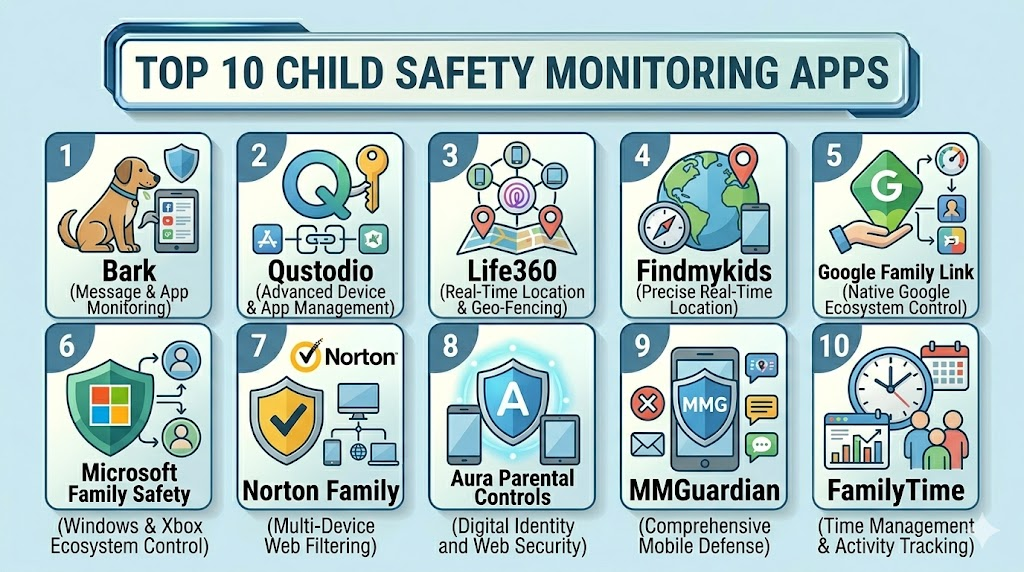
Top 10 Child Safety Monitoring Apps Tools
1- Bark
Short description: Bark is a child safety monitoring app focused on detecting risks across messages, social media, email, web activity, and device use depending on platform support. It is best for parents who want alerts about concerning behavior rather than reading every conversation manually.
Key Features
- Social media and messaging risk alerts
- Monitoring for cyberbullying, self-harm, violence, and explicit content
- Screen-time controls and web filtering
- Location alerts and check-ins
- Parent dashboard and alert summaries
- Support for many platforms with device-specific limits
- AI-assisted content and language detection
Pros
- Strong for online risk detection and safety alerts
- Good fit for tweens and teens using social platforms
- Encourages parents to focus on concerning issues instead of constant surveillance
Cons
- Monitoring depth varies by device and platform
- Setup may require account connections and permissions
- Less focused on strict app blocking than some parental control tools
Platforms / Deployment
Web / iOS / Android / ChromeOS / Amazon Fire support may vary
Cloud
Security & Compliance
Specific controls should be validated directly. MFA, encryption, child data handling, account protection, audit logs, RBAC, SOC 2, ISO 27001, GDPR, COPPA-related practices, and data retention: Not publicly stated for all items.
Integrations & Ecosystem
Bark is useful for families focused on online safety signals, social media alerts, and risky content detection. Its ecosystem centers on parent notifications and safety conversations.
- Social media monitoring
- Text and email alerts
- Web filtering
- Screen-time rules
- Location check-ins
- Risk-based parent notifications
Support & Community
Bark provides help resources, setup guidance, and online safety education. Parents should review supported platforms, connection requirements, device limits, and alert settings before choosing it.
2- Qustodio
Short description: Qustodio is a parental and child safety monitoring platform that combines screen-time limits, web filtering, app controls, location tracking, activity reports, and alerts. It is best for families that want a broad all-in-one safety dashboard across multiple devices.
Key Features
- Web filtering and content categories
- Screen-time schedules and daily limits
- App blocking and activity visibility
- Location tracking and geofencing
- Parent dashboard and detailed reports
- AI-powered alerts may vary by plan
- Cross-platform device coverage
Pros
- Strong all-around family safety feature set
- Useful for multiple children and mixed-device households
- Good balance of monitoring, filtering, and screen-time tools
Cons
- Advanced features may require paid plans
- iOS controls may be more limited than Android controls
- Parents may need time to tune filters and schedules
Platforms / Deployment
Web / Windows / macOS / iOS / Android / ChromeOS / Kindle support may vary
Cloud
Security & Compliance
Specific controls should be validated directly. MFA, encryption, account protection, audit logs, RBAC, SOC 2, ISO 27001, GDPR, COPPA-related practices, and data retention: Not publicly stated for all items.
Integrations & Ecosystem
Qustodio works well for families that need a single dashboard for browsing, screen time, location, app usage, and alerts.
- Web and content filtering
- Location and geofencing
- Child profile management
- Parent dashboard
- Device activity reports
- Screen-time and app rules
Support & Community
Qustodio provides documentation, setup help, and support resources. Buyers should review device limits, plan differences, supported platforms, and how controls work on each child device.
3- Life360
Short description: Life360 is a family location safety app focused on real-time location sharing, place alerts, driving safety features, and family coordination. It is best for families that prioritize location visibility and offline safety over deep device monitoring.
Key Features
- Real-time family location sharing
- Place alerts for home, school, and activity locations
- Location history depending on plan
- Driving safety features may vary by plan
- SOS and emergency alert features may vary
- Family circles
- Battery and device-related alerts may vary
Pros
- Strong for family location coordination
- Useful for school commutes, teen driving, and daily movement
- Simple for families who mainly need location safety
Cons
- Not a full web filtering or social monitoring tool
- Premium safety features may require paid plans
- Location tracking should be discussed transparently with teens
Platforms / Deployment
iOS / Android
Cloud
Security & Compliance
Specific controls should be validated directly. MFA, encryption, location data protection, account security, audit logs, RBAC, SOC 2, ISO 27001, GDPR, COPPA-related practices, and data retention: Not publicly stated for all items.
Integrations & Ecosystem
Life360 is useful for families that want location coordination and safety alerts rather than full device monitoring.
- Family location circles
- Place alerts
- Driving safety features depending on plan
- SOS alerts
- Location history
- Mobile notifications
Support & Community
Life360 provides app support and help resources. Families should review privacy settings, location sharing rules, plan limits, and how long location history is stored.
4- Findmykids
Short description: Findmykids is a child location and safety monitoring app focused on GPS tracking, safe zones, SOS alerts, smartwatch support, and family location visibility. It is best for parents of younger children who need location safety and emergency features.
Key Features
- Real-time GPS child tracking
- Geofencing and safe zone alerts
- SOS button support
- Location history
- Smartwatch support depending on device
- Battery alerts and device status
- Parent-child communication features may vary
Pros
- Strong fit for location-first child safety
- Useful for younger children and school commute tracking
- Smartwatch support can help families not ready for smartphones
Cons
- Not designed as a full social media monitoring platform
- Feature availability varies by device and region
- Remote audio or similar features should be reviewed carefully for privacy expectations
Platforms / Deployment
iOS / Android / GPS watch support may vary
Cloud
Security & Compliance
Specific controls should be validated directly. MFA, encryption, location data protection, child data handling, audit logs, RBAC, SOC 2, ISO 27001, GDPR, COPPA-related practices, and data retention: Not publicly stated for all items.
Integrations & Ecosystem
Findmykids fits families that need child location tracking, safe zones, and emergency location alerts.
- GPS tracking
- Geofencing
- SOS alerts
- Smartwatch support
- Battery notifications
- Parent mobile dashboard
Support & Community
Findmykids provides support resources and setup guidance. Parents should test GPS accuracy, smartwatch compatibility, privacy settings, and alert reliability before relying on it daily.
5- Google Family Link
Short description: Google Family Link is a free child safety and parental control tool for Android and Google account supervision. It is best for families using Android phones, Chromebooks, Google Play, and Google accounts.
Key Features
- Google account supervision
- Android app approval and restrictions
- Screen-time limits and bedtime schedules
- Location tracking for supported devices
- Chromebook supervision features
- Google Play controls
- Free baseline family safety controls
Pros
- Free and practical for Android families
- Easy fit for Google and Chromebook households
- Good for basic app approval, screen time, and location
Cons
- Less advanced than paid child safety monitoring apps
- Limited social media risk monitoring
- Best results depend on Google ecosystem use
Platforms / Deployment
Web / Android / iOS parent app / ChromeOS
Cloud
Security & Compliance
Specific controls should be validated directly. Google account security, MFA, encryption, account protection, GDPR, COPPA-related practices, audit logs, RBAC, and data retention details: Not publicly stated for all items.
Integrations & Ecosystem
Google Family Link works best inside the Google ecosystem, especially for Android and Chromebook management.
- Google account supervision
- Google Play approvals
- Android device controls
- Chromebook controls
- Location tools
- Screen-time rules
Support & Community
Google provides help documentation and account support resources. Parents should review age settings, account controls, and limitations compared with paid monitoring apps.
6- Microsoft Family Safety
Short description: Microsoft Family Safety helps parents manage Windows, Xbox, Microsoft accounts, screen time, web filtering, app activity, and family location features. It is best for households using Windows laptops, Xbox, and Microsoft services.
Key Features
- Windows and Xbox screen-time limits
- App and game controls
- Web and search filtering through Microsoft ecosystem
- Family activity reporting
- Location sharing features may vary
- Microsoft account-based family dashboard
- Device and account supervision
Pros
- Strong for Windows and Xbox households
- Useful free baseline family safety controls
- Good for gaming and study-time routines
Cons
- Works best inside Microsoft ecosystem
- Browser filtering may be limited outside supported settings
- Less focused on social media risk monitoring
Platforms / Deployment
Web / Windows / Xbox / Android / iOS support may vary
Cloud
Security & Compliance
Specific controls should be validated directly. Microsoft account security, MFA, encryption, account protection, GDPR, COPPA-related practices, audit logs, RBAC, and data handling: Not publicly stated for all items.
Integrations & Ecosystem
Microsoft Family Safety is useful for families managing Microsoft accounts, Windows devices, Xbox gaming, and Edge-based web controls.
- Windows supervision
- Xbox controls
- Microsoft account dashboard
- App and game limits
- Web filtering
- Location sharing features
Support & Community
Microsoft provides product documentation and account support resources. Families should test settings across devices, browsers, and gaming accounts before relying on it fully.
7- Norton Family
Short description: Norton Family is a child safety and parental control tool focused on web supervision, time limits, search monitoring, video supervision, and school-time rules. It is best for families already using Norton security products or households focused on web and device supervision.
Key Features
- Web supervision and content filtering
- Screen-time schedules and limits
- School-time mode
- Search supervision
- Video supervision features may vary
- Location tracking features may vary
- Parent portal and reports
Pros
- Good fit for families already in Norton ecosystem
- Useful web and school-time supervision features
- Strong option for Windows and Android households
Cons
- iOS feature depth may be limited
- Social media monitoring is not the strongest focus
- Some features may be tied to bundled plans
Platforms / Deployment
Web / Windows / Android / iOS support may vary
Cloud
Security & Compliance
Specific controls should be validated directly. MFA, encryption, account protection, audit logs, RBAC, SOC 2, ISO 27001, GDPR, COPPA-related practices, and data handling: Not publicly stated for all items.
Integrations & Ecosystem
Norton Family fits households that want safety controls connected to a broader cybersecurity product family.
- Norton account ecosystem
- Web supervision
- Time supervision
- School-time controls
- Search monitoring
- Parent activity reports
Support & Community
Norton provides customer support and documentation through its broader product ecosystem. Buyers should review device compatibility, plan details, and platform limitations.
8- Aura Parental Controls
Short description: Aura Parental Controls are part of a broader family digital safety suite that may include device safety, identity protection, web controls, and online security. It is best for families wanting child monitoring plus broader household cybersecurity.
Key Features
- Parental control and content filtering tools
- Screen-time and app control features may vary
- Family digital safety dashboard
- Identity protection features may vary by plan
- Device security features may vary
- Safe browsing tools
- Multi-device family coverage options
Pros
- Good fit for families wanting broader digital protection
- Useful when identity, device, and online safety matter together
- Can reduce the need for multiple separate security subscriptions
Cons
- May cost more than basic parental control apps
- Child monitoring depth should be validated before purchase
- Some bundled features may not be needed by every family
Platforms / Deployment
Web / iOS / Android / Windows / macOS support may vary
Cloud
Security & Compliance
Specific controls should be validated directly. MFA, encryption, identity protection safeguards, account protection, audit logs, RBAC, SOC 2, ISO 27001, GDPR, COPPA-related practices, and data retention: Not publicly stated for all items.
Integrations & Ecosystem
Aura is useful for households that want family safety and cybersecurity features in one subscription.
- Parental controls
- Identity protection features depending on plan
- Device protection features depending on plan
- Safe browsing
- Family dashboard
- Account alerts
Support & Community
Aura provides support across its family security suite. Buyers should compare parental control features, device limits, identity tools, plan pricing, and support access.
9- MMGuardian
Short description: MMGuardian is a parental monitoring app focused on text monitoring, app control, web filtering, screen-time limits, and safety alerts. It is best for parents who want message-related monitoring, especially on supported Android devices.
Key Features
- Text and message monitoring features may vary
- Web filtering and browsing controls
- App blocking and app usage controls
- Screen-time limits and schedules
- Location tracking features
- Safety alerts for concerning content
- Parent dashboard
Pros
- Stronger message monitoring focus than many basic tools
- Useful for parents concerned about bullying or risky conversations
- Practical controls for apps, web, and screen time
Cons
- Feature depth varies significantly between Android and iOS
- Setup and permissions may require careful configuration
- Parents should use monitoring transparently and responsibly
Platforms / Deployment
iOS / Android / Web dashboard support may vary
Cloud
Security & Compliance
Specific controls should be validated directly. MFA, encryption, account protection, child data handling, audit logs, RBAC, SOC 2, ISO 27001, GDPR, COPPA-related practices, and data retention: Not publicly stated for all items.
Integrations & Ecosystem
MMGuardian is useful for families that need monitoring of device activity, messages, web use, and screen-time patterns.
- Text monitoring depending on device
- Web filtering
- App controls
- Screen-time schedules
- Location tracking
- Parent alerts
Support & Community
MMGuardian provides help resources and setup guidance. Parents should review platform limitations, privacy expectations, and device-specific monitoring depth before using it.
10- FamilyTime
Short description: FamilyTime is a family monitoring app focused on screen-time controls, app blocking, location tracking, geofencing, and family safety alerts. It is best for parents who want device routine controls and location supervision in one app.
Key Features
- Screen-time rules and schedules
- App blocking and app limits
- Real-time location tracking
- Geofencing and safe zone alerts
- SOS and emergency alert features may vary
- Activity reports
- Family dashboard
Pros
- Strong focus on location and routine management
- Useful for screen-time rules and app control
- Good for families needing daily safety coordination
Cons
- Social media risk detection may be limited
- Feature availability varies by platform
- Parents should test location accuracy and app controls before purchase
Platforms / Deployment
Web / iOS / Android support may vary
Cloud
Security & Compliance
Specific controls should be validated directly. MFA, encryption, account security, child location data protection, audit logs, RBAC, SOC 2, ISO 27001, GDPR, COPPA-related practices, and data retention: Not publicly stated for all items.
Integrations & Ecosystem
FamilyTime fits families that want location, app control, and screen-time workflows together.
- Location tracking
- Geofencing
- Screen-time rules
- App blocking
- SOS alerts depending on plan
- Parent dashboard
Support & Community
FamilyTime provides support resources and setup help. Buyers should test device support, alert reliability, location accuracy, and plan limits before subscribing.
Comparison Table
| Tool Name | Best For | Platform(s) Supported | Deployment | Standout Feature | Public Rating |
|---|---|---|---|---|---|
| Bark | Online risk alerts and teen safety | Web / iOS / Android / ChromeOS / Fire varies | Cloud | Social and message risk alerts | N/A |
| Qustodio | All-in-one child safety dashboard | Web / Windows / macOS / iOS / Android / ChromeOS varies | Cloud | Balanced monitoring, filtering, and location | N/A |
| Life360 | Family location coordination | iOS / Android | Cloud | Real-time location and place alerts | N/A |
| Findmykids | Child GPS and smartwatch safety | iOS / Android / GPS watch varies | Cloud | GPS tracking and SOS alerts | N/A |
| Google Family Link | Android and Chromebook families | Web / Android / iOS parent app / ChromeOS | Cloud | Free Google account supervision | N/A |
| Microsoft Family Safety | Windows and Xbox households | Web / Windows / Xbox / Android / iOS varies | Cloud | Microsoft account and gaming controls | N/A |
| Norton Family | Web and school-time supervision | Web / Windows / Android / iOS varies | Cloud | School-time and web supervision | N/A |
| Aura Parental Controls | Family cybersecurity bundles | Web / iOS / Android / Windows / macOS varies | Cloud | Child safety plus identity protection | N/A |
| MMGuardian | Message monitoring and device control | iOS / Android / Web dashboard varies | Cloud | Text monitoring on supported devices | N/A |
| FamilyTime | Location and routine management | Web / iOS / Android varies | Cloud | Geofencing and screen schedules | N/A |
Evaluation & Scoring of Child Safety Monitoring Apps
| Tool Name | Core 25% | Ease 15% | Integrations 15% | Security 10% | Performance 10% | Support 10% | Value 15% | Weighted Total 0–10 |
| Bark | 9 | 8 | 8 | 8 | 8 | 8 | 7 | 8.10 |
| Qustodio | 9 | 8 | 8 | 8 | 8 | 8 | 8 | 8.25 |
| Life360 | 8 | 9 | 7 | 8 | 9 | 8 | 8 | 8.15 |
| Findmykids | 8 | 8 | 7 | 7 | 8 | 7 | 8 | 7.70 |
| Google Family Link | 7 | 9 | 8 | 8 | 8 | 7 | 10 | 8.05 |
| Microsoft Family Safety | 7 | 8 | 8 | 8 | 8 | 7 | 10 | 7.90 |
| Norton Family | 8 | 8 | 7 | 8 | 8 | 8 | 8 | 7.95 |
| Aura Parental Controls | 8 | 8 | 8 | 8 | 8 | 8 | 7 | 7.95 |
| MMGuardian | 8 | 7 | 7 | 7 | 8 | 7 | 7 | 7.40 |
| FamilyTime | 8 | 7 | 7 | 7 | 8 | 7 | 7 | 7.40 |
Which Child Safety Monitoring App Is Right for You?
Solo / Freelancer
For one-parent households or guardians managing one child’s safety, simplicity and alert reliability matter most. Google Family Link is practical for Android families, while Microsoft Family Safety works well for Windows and Xbox households. If the priority is location, Life360 or Findmykids may be better. If online risk alerts are more important, Bark is stronger.
SMB
For families with multiple children or mixed devices, broader dashboards and profile-based rules are important. Qustodio, Bark, Aura, and FamilyTime are useful tools to evaluate. Parents should create different safety rules by age rather than using the same restrictions for every child.
Mid-Market
For larger families, co-parenting households, or families with school devices, smartphones, and smartwatches, control flexibility matters. Qustodio, Life360, Findmykids, Bark, and MMGuardian are worth comparing. Buyers should review guardian access, safe zones, alert rules, and device-specific limits.
Enterprise
Child safety monitoring apps are usually consumer tools, not enterprise systems. Schools, libraries, youth programs, and childcare organizations may need education-focused filtering, MDM, DNS filtering, school safety tools, or device management platforms instead. Consumer apps may help individual families, but organizations need stronger consent, compliance, reporting, and policy control.
Budget vs Premium
Budget-focused families should start with Google Family Link, Microsoft Family Safety, or free features from location and safety apps. These can cover basic supervision, screen time, and location needs. Premium tools like Bark, Qustodio, Life360, Aura, and Findmykids may be worth it when families need stronger alerts, geofencing, online risk detection, or multiple-device coverage.
Feature Depth vs Ease of Use
If ease of use matters most, Life360, Google Family Link, and Microsoft Family Safety are simple starting points. If feature depth matters more, Qustodio, Bark, Aura, MMGuardian, and FamilyTime provide broader controls. Parents should choose the tool that matches the child’s age, device type, and actual risk level.
Integrations & Scalability
Parents should check compatibility with iOS, Android, Windows, macOS, ChromeOS, smartwatches, school devices, browsers, and messaging apps. Device ecosystem matters because Apple, Google, Microsoft, and third-party apps allow different levels of control. Families should also check whether multiple guardians can receive alerts and whether multiple child profiles are supported.
Security & Compliance Needs
Child safety apps may collect sensitive data such as location history, app use, browsing activity, message alerts, and emergency contact information. Parents should review encryption, data retention, privacy settings, account recovery, access controls, and child data policies. Safety tools should be used transparently and age-appropriately so children understand why monitoring exists.
Frequently Asked Questions
1. What are Child Safety Monitoring Apps?
Child Safety Monitoring Apps help parents track location, manage screen time, monitor device activity, and receive alerts about online or offline risks.
Some apps focus mainly on GPS and geofencing, while others focus on social media, messaging, web filtering, or device rules.
They are designed to support safer digital and physical routines for children.
They work best when combined with clear family rules and open communication.
2. How much do child safety monitoring apps cost?
Pricing depends on the app, number of children, number of devices, location features, monitoring depth, and premium plans.
Some ecosystem tools like Google Family Link and Microsoft Family Safety offer free baseline controls.
Premium apps usually charge for advanced alerts, geofencing, social monitoring, emergency features, or broader device support.
Families should compare annual cost against the features they actually need.
3. Which app is best for location tracking?
Life360 and Findmykids are strong options for location-first family safety.
They support features such as real-time location, place alerts, safe zones, and location history depending on plan.
Qustodio and FamilyTime also offer location features alongside screen-time and app controls.
Parents should test GPS accuracy on the child’s actual device before relying on it.
4. Which app is best for online risk alerts?
Bark is commonly evaluated for online risk alerts across messages, social platforms, email, and web activity depending on device support.
It is useful for detecting issues such as cyberbullying, explicit content, self-harm language, or risky conversations.
Parents should remember that platform and device restrictions can limit monitoring depth.
Risk alerts should lead to conversations, not automatic punishment.
5. Are child safety monitoring apps safe?
They can be safe when the provider uses strong privacy, encryption, account protection, and responsible data handling.
However, parents should review what data is collected, how long it is stored, and who can access it.
Location and message-related data are especially sensitive.
If privacy controls are unclear, parents should confirm details before installing the app.
6. Do these apps work on iPhone?
Many child safety apps support iPhone, but iOS restrictions can limit message monitoring, app control, and some deeper supervision features.
Apple’s built-in Screen Time may cover some basic limits and restrictions.
Third-party apps may still provide location, filtering, alerts, and dashboards depending on setup.
Parents should check iOS-specific limitations before paying for a plan.
7. What common mistakes should parents avoid?
A common mistake is installing monitoring apps secretly without explaining family safety expectations.
Parents should also avoid choosing a tool without testing it on the child’s real device and apps.
Another mistake is relying only on software instead of teaching digital safety and trust.
Monitoring should support guidance, not replace parenting conversations.
8. Can these apps help during emergencies?
Some apps include SOS alerts, panic buttons, location sharing, safe zones, or emergency contact workflows.
These features can help parents respond faster when a child feels unsafe or is in an unexpected location.
However, app alerts are not a replacement for emergency services.
Parents should teach children when to use emergency numbers and trusted adult support.
9. What integrations should buyers check first?
Buyers should check support for iOS, Android, Windows, macOS, ChromeOS, smartwatches, browsers, social apps, and school devices.
They should also test GPS, notifications, battery behavior, app permissions, and guardian access.
If the child uses multiple devices, cross-platform coverage becomes very important.
Feature availability can vary significantly by device type.
10. What alternatives exist to child safety monitoring apps?
Alternatives include built-in controls, Apple Screen Time, Google Family Link, Microsoft Family Safety, router filtering, DNS filtering, family rules, and direct supervision.
Some families also use GPS watches, shared calendars, check-in routines, or device-free zones.
Dedicated apps are better when families need alerts, geofencing, reporting, or multi-device visibility.
The best choice depends on child age, risk level, device use, and family values.
Conclusion
Child Safety Monitoring Apps help families improve digital and physical safety by combining location tracking, geofencing, SOS alerts, online risk detection, screen-time controls, activity reports, and family dashboards. The best app depends on the child’s age, device ecosystem, family communication style, privacy expectations, budget, and whether the main need is location safety, online risk alerts, or daily device routines. Bark is strong for online risk detection, Qustodio is strong for balanced monitoring, Life360 and Findmykids are useful for location safety, Google Family Link and Microsoft Family Safety are practical free ecosystem tools, Norton Family fits web supervision, Aura fits broader family cybersecurity, and MMGuardian or FamilyTime can support message, app, and location workflows. The best next step is to shortlist two or three apps, test them on real child devices, review privacy settings, explain the rules clearly, and choose the tool that supports safety without damaging trust.

Find Trusted Cardiac Hospitals
Compare heart hospitals by city and services — all in one place.
Explore Hospitals
I didn’t realize child safety apps offer so many features to help parents stay informed while supporting safer online habits.